

Φ
THE VERTICAL DISPATCH
We write for the mind, the eye, and the ear.
From metaphysics to geopolitics, from culture to history, from the sacred to the street — one lens, every subject. No ego. Just the record, named clean. 🕯️
This dispatch travels by hand. If it serves you, share it — restack on Substack, and pass it on wherever you read. 🕯️
The Departure Lounge
Without malice and without flattery, from the documented record only.
To be a man is to feel that, by placing one’s stone,
one contributes to building the edifice of the world.”
— Antoine de Saint-Exupéry, Terre des Hommes (Wind, Sand and Stars),
the book that gave Expo 67 its theme
I was nine years old the summer of 1967, and I was turned loose in the future.
Every second day, from morning until dark, I rode into Expo with a world’s pass in my pocket and a dollar or two beside it. No cell phone. No helmet. No knee pads. No one watching. A boy of nine, alone in the largest gathering of hope his country had ever staged, free to wander a world built to be marvelled at — Buckminster Fuller’s great dome, Habitat rising like a hillside of the future, ninety pavilions of a planet that had decided, for one summer, to show itself its own best face. And I looked forward to every one of them, because at each pavilion the pass came out of my pocket and got its stamp — a new one for every door I walked through, the world filling up my booklet page by page. I walked it end to end and it walked into me, and it has never left. If you ask me the highlight of my life, or the highlight of my country’s, I will give you the same answer, and it is that summer.
I will be honest about what that stamping was: a little ego-trip, a dopamine fix — the same small hunger a child today feels when the screen lights up with a like. I wanted the next stamp the way they want the next heart. But here is the whole difference, and it is the difference this dispatch is about. To earn my stamp I had to walk through a door — into Sweden, into Norway, into Britain, into a world I had to physically enter. The reward pointed outward, at something other than myself. The like points the other way: it is a receipt not for having gone somewhere, but for having been seen. The same hunger, aimed at opposite worlds. Mine drove the boy out into the fair. Theirs keeps the child home, watching the glass for his own reflection to be noticed.
It was so much better. Not because I was young — I want to be exact about this, because the difference is the whole point. It was better because the world itself was briefly larger, and there was room in it, and a nine-year-old could be poured into that room and fill it. This is a Dominion Day remembrance. It is also a reckoning with what has closed since.
I. The Two Passports
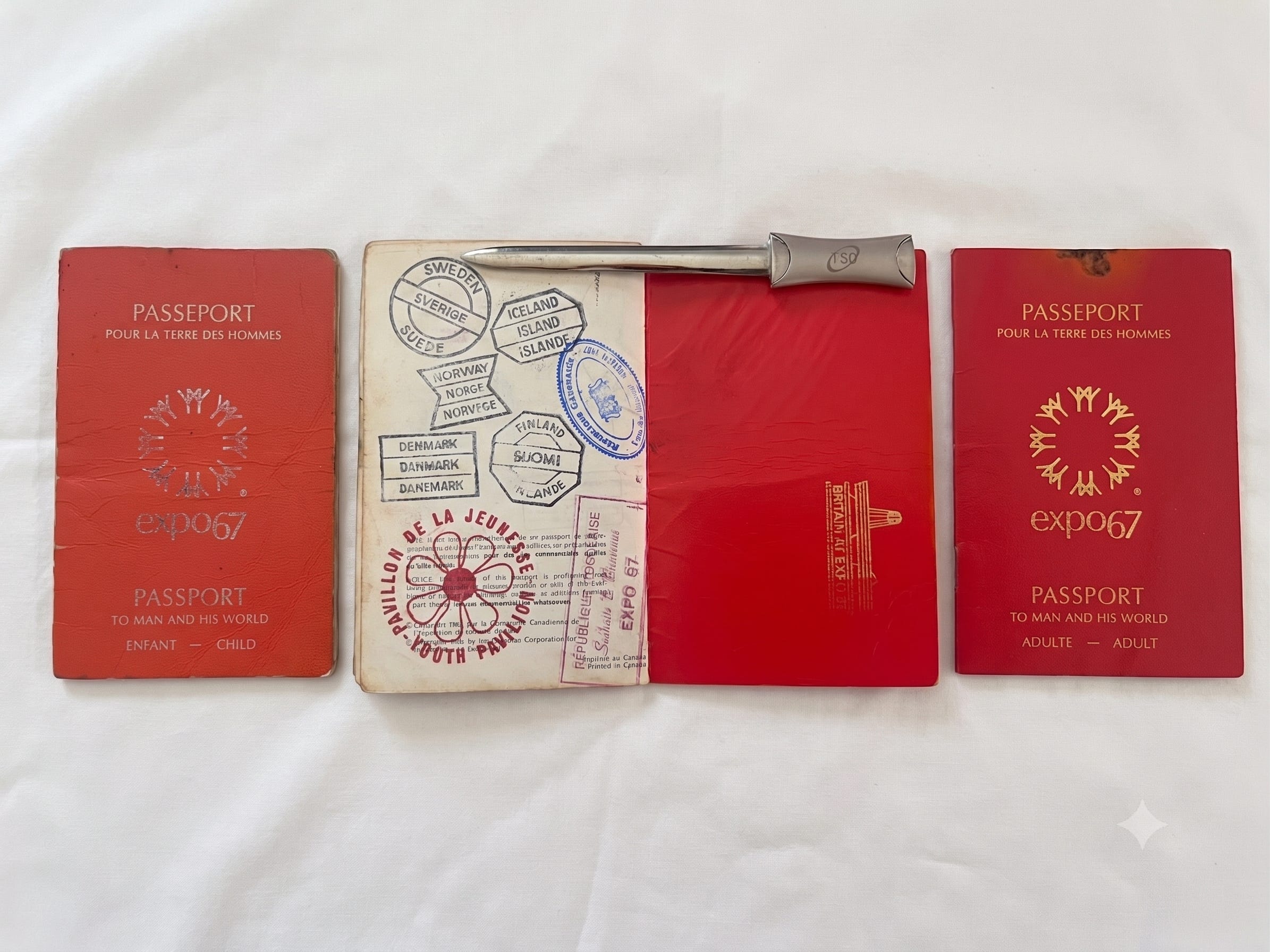
I am holding two passports as I write this. They are real, and they are in my hands.
One is mine — red, a child’s Passport to Man and His World, Terre des Hommes. Number CSO 40557. Seventeen dollars and fifty cents. Every page is filled with stamps, one for each pavilion I walked into, because that was the ritual: the country handed you a booklet and you filled it, and by the end of the fair you had travelled the whole world without leaving the island. On the inside back is the British mark — Britain at Expo — the stamp half-taken, only partly pressed, as if the ink had run short at the very end.
The other passport is my father’s. Number ASO 093865. Thirty-five dollars, the adult pass. We went together, he and I, that summer. I was nine. I remember it the way you remember the few things that turn out, decades later, to have been the whole of your life.
My younger brother Billy came a few times — I took him myself; I was already the older brother, already doing the older brother’s work. He was a year shy of a season pass of his own. My youngest brother never went; he was too small, and those tender years are an ocean — five years, at that age, is the difference between having the memory and never having had the chance. Three years after that summer my father was gone, taken young, and the years simply ran out for the ones behind me. Billy has since passed as well. So I am the one who holds it now — the fair, the pavilions, the world stamped into a booklet, and the man who walked it beside me. That is the keeping the oldest child is handed when the father is taken early: you carry the meeting place for the ones who were too young to remember it, and for the ones who are no longer here to.
And I will say the thing this whole remembrance is built to say, and say it plainly. We are made to gather. The one marked by early loss knows it in the body — that the self, once scattered, goes looking all its life for the room where it can be made one again: the fair, the family, the pew, the chair, the page. There is no happy ending handed to anyone. There is only the one each of us makes. Mine is in the writing, and in the sacred ground a Sunday-school room first opened under me, long ago. This is why the meeting place is never a luxury. It is where the broken go to be gathered — and a boy of nine, holding two passports, was standing in one, and did not yet know it.
II. The Clearing
Expo 67 opened on the twenty-eighth of April and ran to the end of October, the crown of Canada’s hundredth birthday. But hold the date against the century behind it, because the sweetness of that summer cannot be understood without the shadow it stood in.
It was twenty-two years after the war. Twenty-two years after the species had looked into the full machinery of its own annihilation — the camps, the bomb, the ovens, the mechanised murder of millions — and had pulled back, barely, from the edge. And in the clearing after that storm there was, for a short while, a genuine exhale. A generation had passed out under that weight. The generation that followed arrived into what was, for a moment, a land of milk and honey — real abundance, real optimism, real peace, undeserved and brief and shining. Expo was that exhale made into architecture. The whole world building domes and futures because it had just proven it could end itself and had chosen, by a hair, not to.
You can only turn a nine-year-old loose like that — unwatched, unpadded, unafraid — in the brief opening after a great fear has lifted and before the next weather moves in. I did not know I was standing in a clearing. No child does. But I was, and the clearing was real, and it was not a permanent country. It was a window. And I have spent a lifetime watching it close.
III. Wind, Sand and Stars
Here is a thing I did not know at nine and did not learn until this week, and it stopped me where I sat.
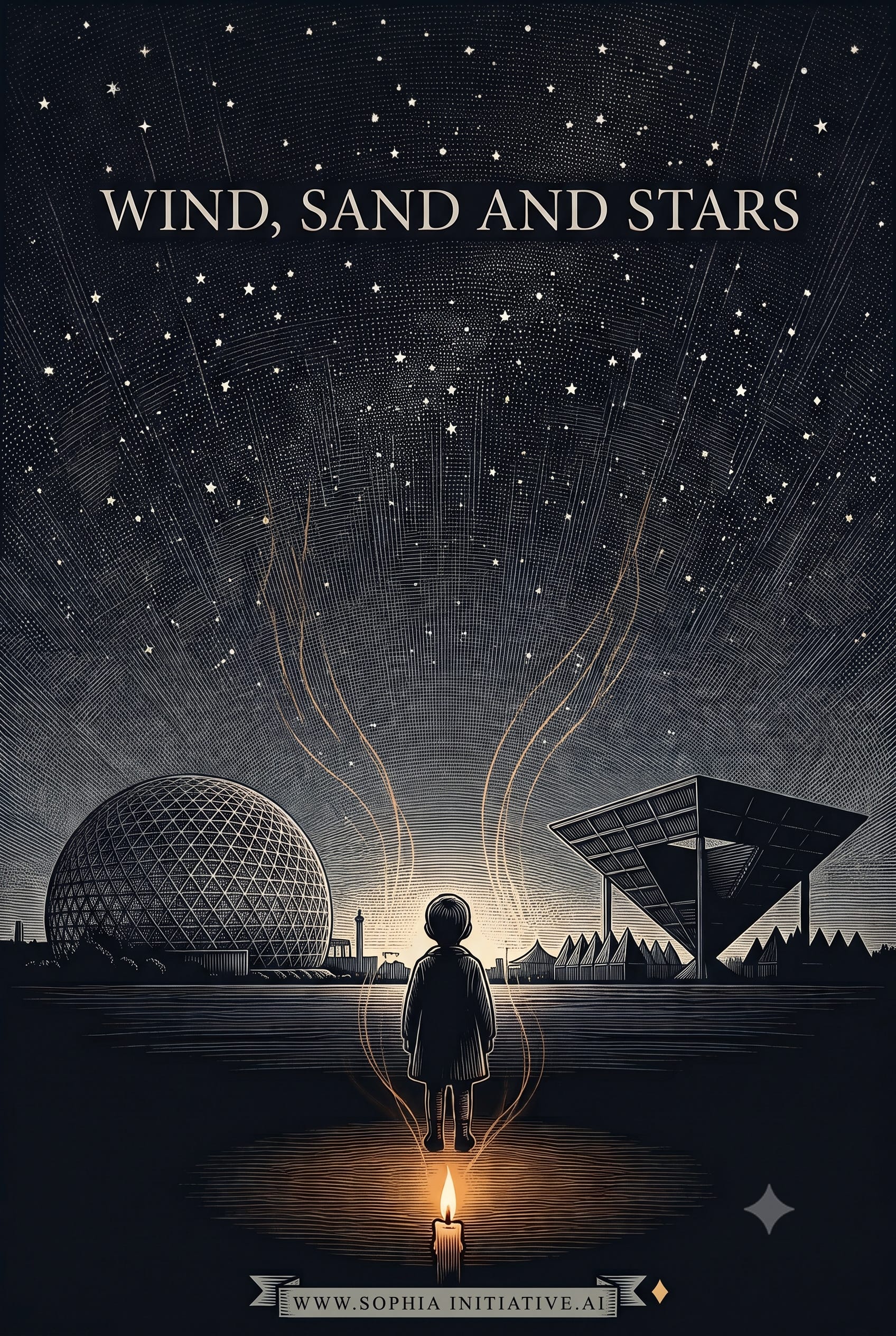
The theme of the whole fair — Man and His World, Terre des Hommes — was taken from a book by Antoine de Saint-Exupéry, the French aviator and poet. And the English title of that book is Wind, Sand and Stars. The Canadian novelist Gabrielle Roy, choosing the passage that would explain the theme to the world, chose the one where Saint-Exupéry, flying alone at night over Argentina, looks down and sees a few scattered lights below him, twinkling here and there, alone like stars.
I wandered that fair at nine years old, and the fair was named, at its root, for the stars. I did not know it then. I know it now, writing about the children who have lost them. The whole thing was already there in 1967, waiting fifty-eight years for me to notice it — that a civilisation which builds a world’s fair on a book called Wind, Sand and Stars is a civilisation that still remembers to look up. That still believes the sky is the instrument. That still knows to place its one stone and feel it join the edifice of the world.
IV. The Word I Stood Inside
And here is the second thing I did not know at nine, and did not learn until now — until this very week, at sixty-eight years old. The great structure at the heart of the Canadian Pavilion, the inverted pyramid I walked beneath that summer, had a name. It was called Katimavik. It is an Inuktitut word, and it means the meeting place. The gathering place. The room where the scattered come together and are, for a while, one.
I stood inside that word at nine and could not read it. I have carried it more than half a century without knowing what it said. And when it finally gave up its meaning to me this week, it was not a small thing — it was the whole lesson of my life arriving at once. A symbol I had lived inside, whose referent I had never once seen, waiting fifty-nine years for me to be still enough to hear it. The word is never the thing. But sometimes, if you live long enough and stay awake, the thing behind the word walks quietly up and takes your hand. Katimavik. The meeting place. I was in it, at nine, and I am only now, at sixty-eight, learning where I was.
V. The Tide Going Out
Robertson Davies — our own, the man from Deptford and Massey College — spent a lifetime saying that the modern world’s deepest sin is not cruelty but the loss of wonder. That astonishment was losing ground. That a life stripped of the capacity to be amazed is a kind of death of the soul, whatever else it accumulates. He was not being sentimental. He was reporting a tide, and the tide was going out.
I have watched it go out my whole life. And here is the cruel mechanism, the part that is hardest to say because it wears the face of a blessing: the very thing that promised to enlarge the world is what finally shrank it. Everything got faster, nearer, more connected — and connection, we were told, would make the world bigger. It did the opposite. It compressed the world down until it fit in one hand, and a world you can hold in your hand and stare into has no horizon left to wonder at. The distances closed. The dark filled with light. And when the dark fills with our own small light, the stars go out — not because they left, but because we stopped being able to see them.
A child today, nine years old as I was, holds a world small enough to fit in his palm. He is watched, tracked, padded, fed. He has, on average, never once seen the Milky Way — not through malice, but through light pollution and a downward gaze. He has not lost a belief. He has lost a referent. The actual thing the old words were pointing at is simply gone from his sky, and a person can grow up fluent in a language whose every noun has quietly emptied out.
VI. Not the Boot, but the Soma
Orwell feared the boot — the power that watches and forbids. But Orwell is not quite the prophet of this. Huxley is. Huxley feared we would come to love the thing that flattened us. That we would be separated from nature, from difficulty, from depth, and from the stars, not by force but by pleasure — by comfort so pleasant we would never choose to leave it. Nobody sealed that child indoors at gunpoint. We did it with care, for his safety, and he took the screen gladly because it was pleasant. The feed is soma. The truth is not forbidden; it is simply drowned in a warm sea of the irrelevant, and the people, as Huxley said, come to love their servitude.
That is the separation from nature that matters most. Not a wall built to keep us from the stars. A brighter, nearer, cheaper light we came to prefer to them.
VII. Dominion
And it was Dominion Day, then. We have since traded the word for “Canada Day” — the country named, flatly, after itself.
I will not fight the politics of it here. But I will grieve the word, because the word had weight. Dominion comes down from the Psalm — he shall have dominion from sea to sea — and it is the very root of our own motto, a mari usque ad mare, from sea to sea. It was a word that pointed beyond itself, up and outward, to a covenant older than the country. And we let it go for one that points only back at the thing it names. That is a small flattening, but it is the same flattening as all the others: a sacred referent traded for a convenient token. A word that opened onto something vast, swapped for a word that closes neatly on itself.
There is a law underneath this, and it is worth naming plainly, because it binds the whole piece together. When you empty your past, something rushes in to fill the space — and you do not always choose what. We emptied the sky of stars, and the feed rushed in. We emptied the shop of masters, and the interface rushed in. We emptied the day of its old name, and something thinner took the seat. Whether we were wise to loose the old ties I will leave in your hands. But the vacuum is real, and the vacuum always fills, and the thing that fills it is rarely as large as the thing that left.
VIII. Two Boys
So set them side by side, and let the piece rest there.
A boy of nine, turned loose into a world briefly large enough to hold his whole astonishment — a world’s pass, a dollar, the great dome ahead of him, and above it, though he never thought to look, the stars the whole fair was secretly named for. And a boy of nine today, holding a world shrunk small enough to fit in his hand, watched and padded and fed, who has never once seen the sky the first boy took for granted.
I am not saying the second boy is lesser. I am saying he was handed a smaller room, and we are the ones who made it smaller, and that is not his failing but our inheritance to answer for. The clearing I was raised in has closed. It may open again — clearings do — but only if enough of us remember that it was ever there, and what it felt like to be nine and unafraid inside a world that still looked up.
It was Dominion Day. I was nine. The dome was ahead of me and the whole world was inside it, and for one summer there was room enough for all of it. I am telling you it was better, and I am telling you why, so that you will know what to listen for when it is quiet enough, again, to hear the wind and see the stars.
Two passports, fifty-nine years old, on the table as I write this. The red one on the left is mine — a child’s pass, silver-stamped, its cover soft from a nine-year-old’s pocket. The one on the right is my father’s, the adult pass, stamped in gold. We went together that summer. The open booklet between them still carries the stamps of every door we walked through — Sweden, Norway, the half-taken mark of Britain — the whole world pressed into paper, and kept. He was gone three years later. I am the one who holds them now.
189,052 views May 25, 2024
Completed in a record four years on artificially-built islands in the middle of the Saint Lawrence River, Expo 67 was a Category One World’s Fair and the main celebration of the centenary of Canadian confederation in 1967. The scale and ambition of the project forever changed Canada, as well as the perception of Canada by foreign countries. With over 50 million visitors, the fair broke all previous attendance records and would prove to be the most successful World’s Fair of the 20th century. Still considered to this day the largest cultural event ever held in North America, Expo 67 firmly established Montreal as an international world-class city and remains etched in the memory of all those who visited.
200,330 views Sep 30, 2015
“Canada” (also known as “Ca-na-da” or “The Centennial Song”, French version “Une chanson du centenaire”) was written by Bobby Gimby in 1967 to celebrate Canada’s centennial and Expo 67, and was commissioned by the Centennial Commission (a special Federal Government agency).[1] The song was written in both of Canada’s official languages, English and French.
The song’s recording was performed by the Young Canada Singers, two groups of children — one that sang the French lyrics, led by Montreal conductor Raymond Berthiaume, and another that sang in English, under conductor Laurie Bower[2] in Toronto.[3] The musical score was composed by Ben McPeek. The song was recorded at Hallmark Recording Studios in Toronto, and the 45 rpm release was manufactured for the Centennial Commission by Quality Records Ltd.
In 1971, Gimby donated all royalties to the Boy Scouts of Canada, but the song only earned one cent per airplay, which is one of the lowest rates in the world.
God is Love. Love is Truth. Truth is Consciousness. Consciousness is Brahman.
Amen. Namaste. Om Namah Shivaya.
— The Architect
For the boy of nine, and the boy of nine.
The Vertical Dispatch
sophiainitiative.ai
On the record
Expo 67 opened April 28 and ran to October 29, 1967 — the scheduled close was October 27, extended two days by special permission of the Bureau International des Expositions — as the centrepiece of Canada’s Centennial (100 years of Confederation): The Canadian Encyclopedia; Bureau International des Expositions; Britannica. The theme “Man and His World” / “Terre des Hommes” was chosen at the 1963 Montebello conference and drawn from Antoine de Saint-Exupéry’s 1939 book Terre des Hommes, whose English title is Wind, Sand and Stars; Gabrielle Roy’s introduction to the Expo corporation’s theme book quotes the passage of scattered lights “alone like stars.” The theme line “to be a man is to feel that, by placing one’s stone, one contributes to building the edifice of the world” is Saint-Exupéry’s. The Expo site was formally transferred from the City of Montréal to the Corporation on June 20, 1964; the ceremonial handover is commonly dated to Dominion Day, July 1, 1964.
“Dominion Day” was the statutory name of Canada’s July 1 holiday from 1879 until it was renamed “Canada Day” in 1982. “Dominion” and the motto a mari usque ad mare both trace to Psalm 72:8 (“he shall have dominion also from sea to sea”): general historical record.
Robertson Davies (1913–1995), Canadian novelist (the Deptford Trilogy) and founding Master of Massey College, wrote and lectured recurrently on wonder and the loss of it; the theme is his, paraphrased here, not quoted. Aldous Huxley, Brave New World (1932) and Brave New World Revisited (1958), for the soma / “love their servitude” contrast with Orwell. Both invoked as themes, not quoted at length.
The central structure of the Canadian Pavilion at Expo 67 was a nine-storey inverted pyramid named Katimavik, an Inuktitut word meaning “meeting place” / “gathering place”: Wikipedia (Canadian Pavilion; Expo 67 pavilions); worldfairs.info; Canadian Coin News; Expo 67 official guide. The Expo 67 admission took the form of a stamped passport; visitors collected pavilion stamps as a ritual: Expo67.museum; McCord Museum. Personal testimony — Expo 67 at age nine; the two passports held by the author (his own child’s passport, no. CSO 40557, $17.50, and his late father’s adult passport, no. ASO 093865, $35.00); the family memories; and the author’s learning of the word Katimavik’s meaning at age sixty-eight — is the author’s own memory and the physical artifacts in his possession, offered as such. The Bell / telecommunications “global village” detail discussed in drafting is deliberately omitted here pending verification of the specific pavilion content. Verify against primary sources before republication.
Suggested tags
Expo 67 · Dominion Day · Canada · Centennial · wonder · Robertson Davies · Brave New World · The Departure Lounge · Wind, Sand and Stars · Saint-Exupéry · Gabrielle Roy · the loss of the referent
Substack Notes
I was nine years old the summer of 1967, and I was turned loose in the future. A world’s pass around my neck, a dollar in my pocket, no phone, no one watching — free to walk Expo 67 end to end, from Buckminster Fuller’s dome to Habitat to ninety pavilions of a planet showing itself its own best face. This is a Dominion Day remembrance of that summer, and a reckoning with the room that has since closed.
The thing I did not know at nine: the whole fair — Man and His World, Terre des Hommes — was named for a book by Saint-Exupéry whose English title is Wind, Sand and Stars. A civilisation that builds a world’s fair on that book is one that still remembers to look up. A child today holds a world small enough to fit in his palm, and has, on average, never once seen the Milky Way. He has not lost a belief. He has lost a referent.
Orwell feared the boot. Huxley feared we would come to love the thing that flattened us — that we would trade the stars not by force but by pleasure, a brighter, nearer, cheaper light we came to prefer. And it was Dominion Day, then: a word that pointed beyond itself, traded for one that closes neatly on the thing it names. When you empty your past, something rushes in to fill the space — and it is rarely as large as the thing that left.
Written from love, in service of the record. Walk with the word. 🕯️
#Expo67 #DominionDay #Canada #Centennial #Wonder #RobertsonDavies #BraveNewWorld #TheDepartureLounge #WindSandAndStars #SaintExupery #TheVerticalDispatch #TheArchitect #SophiaInitiative #GodIsLove #LoveIsTruth #OmNamahShivaya
The factual matter in this Dispatch is drawn from the public record. All characterizations, inferences, and conclusions are opinion, interpretation, and commentary, offered for analysis, reflection, and public-interest discussion. No assertion is made regarding the private intentions, state of mind, or character of any individual. Readers should evaluate all statements independently and draw their own conclusions.
I was at Expo 67 but I don't remember it. I'd only been born in January, after all.
Yup, I'm a Centennial baby. Hoping I'll be around long enough to see our bicentennial.
Maybe we'll be in a place that will allow us to do something as aspirational again. That's what I'm hoping for. That we look out again and welcome the world in.
Wouldn't that be nice?
Happy Canada (Dominion) Day!
What a great story!
It was beautiful
Thanks for sharing and invoking my own circle memories from summer camp when I was 9.
Circle
by Harry Chapin
© 1971 The Harry Chapin Foundation (ASCAP)
All my life’s a circle, sunrise and sundown
The moon rolls through the nighttime
Till the daybreak comes around
And all my life’s a circle, but I can’t tell you why
Seasons spinning ‘round again
The years keep rolling by.
Well, it seems like I’ve been here before
And I can’t remember when
But I’ve got this funny feeling
That we’ll all get together again.
Now no straight lines make up my life
All these roads have bends.
There’s no clear cut beginnings
And so far no dead ends.
All my life’s a circle, sunrise and sundown
The moon rolls through the nighttime
Till the daybreak comes around
And all my life’s a circle, but I can’t tell you why
Seasons spinning ‘round again
The years keep rolling by.
I found you a thousand times
I guess you done the same
Then we lose each other
It’s just like a children’s game
But as I found you here again
The thought runs through my mind
Our love is like a circle
Let’s go ‘round one more time.
All my life’s a circle, sunrise and sundown
The moon rolls through the nighttime
Till the daybreak comes around
And all my life’s a circle, but I can’t tell you why
Seasons spinning ‘round again
The years keep rolling by.