


Φ
THE VERTICAL DISPATCH
We write for the mind, the eye, and the ear.
Read it. Look at it. Listen to it. The Vertical Dispatch is built for all three — prose with rhythm, made to be heard as much as read.
From metaphysics to geopolitics, from culture to history, from the sacred to the street — and everything in between. One lens, every subject. No ego. Just the record, named clean.
Press play. Walk with the words. 🕯️
The Foundation Series · Why We Do What We Do
June 2026
“The Tao that can be named is not the eternal Tao.”
— Lao Tzu
This dispatch travels by hand. If it serves you, share it — restack on Substack, pass it on wherever you read. 🕯️
The Number That Frightened the World
Begin with a fact that ought to be stranger to us than it is: for most of human history, there was no zero. The great counting civilizations — the Greeks who gave us geometry, the Romans who governed the known world — built their mathematics, their architecture, their empires, without a symbol for nothing. You cannot write the Roman year as a zero; there is no numeral for it. Counting began at one, because one is where things begin, and nothing was not a thing, and so it had no sign.
Zero came late, and it came from the East. It was the Indian mathematicians — Brahmagupta, in the seventh century, writing rules for how nothing behaves when you add to it, subtract from it, carry it — who first treated zero not as a blank but as a number, a citizen of the system with laws of its own. It travelled west through the Arab world, which is why we call our numerals Arabic, and when it finally reached medieval Europe it was met not with gratitude but with suspicion. Some cities banned it. Merchants distrusted it. A symbol for nothing seemed like a door that should not be opened — a kind of sorcery, a place where something and nothing met and the mind lost its footing. They were not entirely wrong to be unsettled. Zero is the most metaphysically loaded mark we have ever made, and the discomfort it caused was the discomfort of a civilization brushing up against something it could not quite hold.
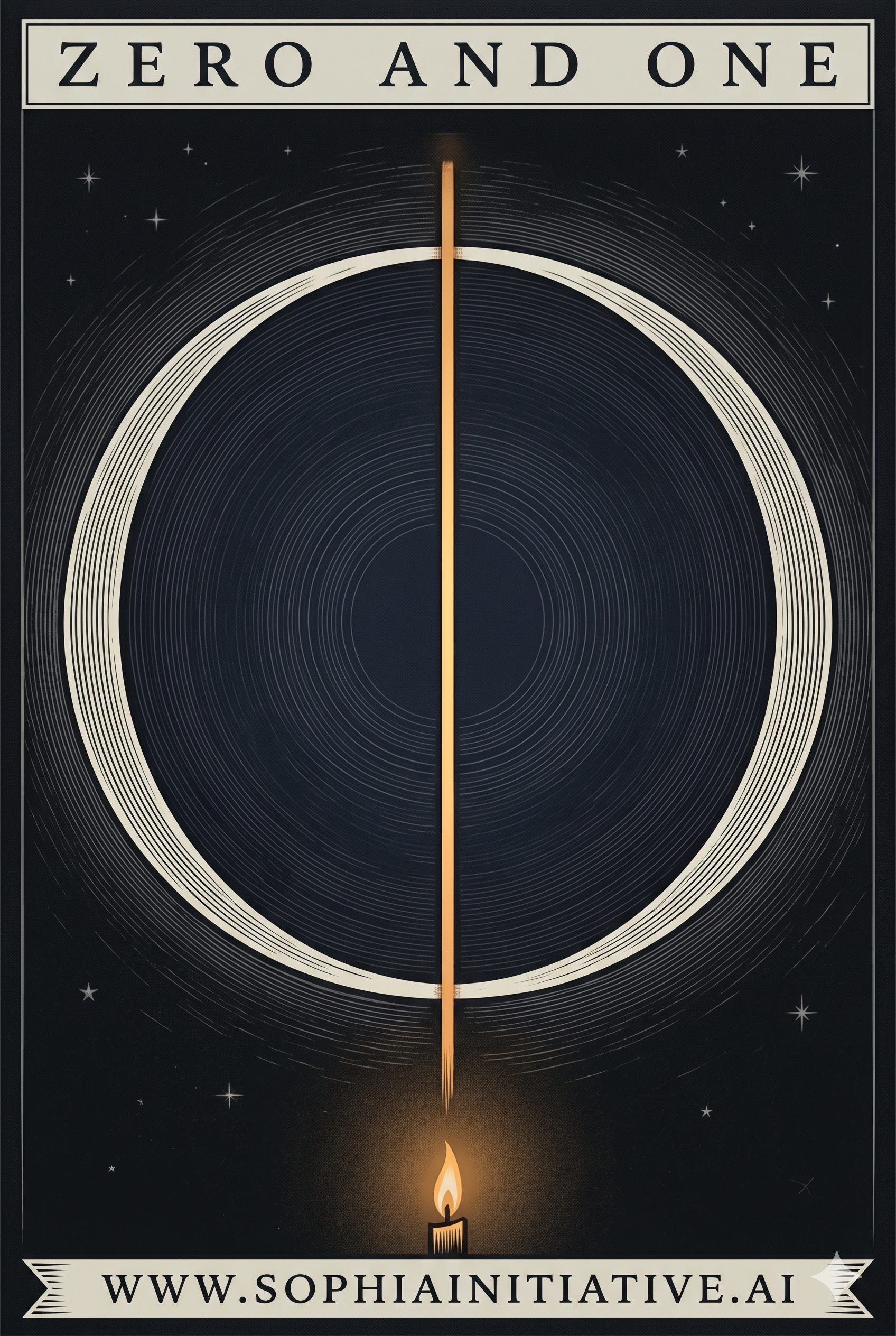
The Two Nothings
Here is where the history opens into the thing itself, because the trouble with zero was never mathematical. It was that the single mark holds two opposite meanings, and almost no one distinguishes them.
There is the zero that means nil — absence, lack, the empty pocket, the thing that is not there. This is the zero of the accountant and the void of the nihilist: nothing as the simple negation of something, the lights out, the end. When the modern mind hears “nothing,” this is what it hears, and hearing only this, it grows afraid, because a universe that bottoms out in nil is a universe with no floor.
But there is another nothing entirely, and the traditions that went deepest all found it. It is the nothing that is not empty but full — so full, so complete, so without edge or boundary or division, that it appears as nothing to any mind that comes looking for a thing. Call it the plenum: the fullness that reads as void only because there is nothing in it to grasp, no object to seize, no part to point at. The mystics of every tradition kept arriving at it and kept reaching for the same paradox to name it — the divine darkness that is too bright to see, the silence that is not the absence of sound but the ground from which all sound arises, the emptiness that is the womb of everything. This is not nil. This is the opposite of nil wearing nil’s only available mask. It is potential before it has committed to a single actuality — every song unsung, held in a silence that is not poverty but infinite wealth.
The whole of what follows turns on telling these two apart. The first nothing is a floor that gives way. The second is the ground beneath the floor.
What the Vacuum Remembers
It is worth pausing on a strange rhyme, and only a rhyme — for a symbol is not its referent, and the physics here is the symbol, not the thing. When modern physics went looking, in the last century, for the emptiest possible space — a perfect vacuum, all matter removed, all radiation stilled — it did not find nil. It found a seething. The quantum vacuum is not empty; it is the most energetic thing there is, a field in which particles arise and vanish, in which the “nothing” is in fact a plenum of restless potential that never goes still. The emptiest place in the universe turned out to be full.
We do not lean on this to prove anything; the ancients did not need a particle accelerator to know what they knew, and the truth of the plenum does not wait on the latest paper. But it is worth noticing that the most rigorously horizontal, quantitative discipline we have built — the one that flattened the world into measurement — went all the way down to the bottom and stumbled back onto the oldest intuition of the vertical: that nothing, looked at closely enough, is not nil. It is full. The vacuum remembers what the mind forgot.
The One
Now the mark beside the zero. If the zero is the plenum — the full silence, the uncommitted ground — then the one is the first movement: the initial stir, the first act, the line drawn through the silence that begins the world. Not something added to nothing from outside, as if the universe were assembled from parts. The one arises within the zero and does not deplete it — the way a single sung note arises within the silence without using the silence up, the way the first word does not exhaust the speaker. In the old language: the Word, the Logos, the verb that is the ground of all verbs. “In the beginning was the Word” is a sentence about the one rising in the zero. The verb is the ground. Reality is not a collection of static things; it is movement arising in stillness, the one forever being spoken within the silent fullness of the nothing-that-is-everything.
And so the two marks belong together, and were always meant to be read as one. The zero: the silent plenum, the ground, the unmanifest fullness. The one: the first movement, the Knower, the stroke of the Logos through the deep. Silence and movement. The unmanifest and the first act. Hold them together in a single character and you have the most compact statement of the whole metaphysics that has ever been made — and, as it happens, you have a letter the Greeks already drew.
The Mark That Was Already Ours
The letter is Φ. To the mathematician it is phi, the golden ratio — the proportion, roughly one-point-six-one-eight, that the eye reads as beautiful without being told why, the ratio that governs the spiral of the shell and the seed-head of the sunflower and the arm of the galaxy, the signature of growth that keeps its shape. That alone would make it a fitting mark for a publication whose whole creed is the Good, the Beautiful, and the True, for phi is precisely a place where beauty and truth are revealed to be the same thing wearing two names: a proportion that is at once a felt loveliness and an exact mathematical fact.
But look at the shape of it, and the deeper meaning surfaces — the meaning we did not invent but found, the way one finds a lighthouse that turns out to have been one’s own all along. The circle is the zero: the plenum, the silent ground, the full nothing. And the vertical stroke runs straight through it: the one, the first movement, the line of the Logos drawn through the silence. Zero and one, fused in a single mark. Silence and movement, made one character. The mast through the hull. The keel-line through the deep water. The lighthouse rising through its own circle of light. It reads, to the eye that knows the priors, as the whole vertical in one stroke; and to the eye that does not, as a struck pillar, a thing standing in a ring of stillness. Both readings are true. That is why it now stands above every dispatch — not as decoration, and not as a brand a designer drew, but as the found emblem of the thing the work is for. The symbol for what the modern world lost: the mark that points at the two things beyond all marks.
The Two Beyond Form
For this is the lost symbol, and it is worth naming plainly what was lost. Of everything the mind can hold, two things alone stand beyond form and beyond symbol. Everything else has shape, or points beyond itself: a tree, a nation, a wave can each be pictured or signified, made into an image that stands in for the thing. But two cannot. Consciousness — that which does the knowing — can never be fully made into an object of its own knowing, for the eye cannot see its own seeing, and the knower cannot get behind itself to look. And the Ground — call it God — cannot be contained by a mind that is itself contained within the Ground. These two are pure referent, referent with no adequate symbol, the only realities in the whole inventory of knowledge that any image must falsify the instant it tries to hold them.
The age that flattened the world — that kept only what could be measured, counted, symbolized, and called the rest unreal — did not disprove these two. It simply lost the mark for them, and then mistook the loss of the mark for the absence of the thing. It kept the horizontal, where every object has its symbol, and it threw away the vertical, where the two unsymbolizable realities stand. To put a mark for them back above the words is to refuse that flattening — to insist that the most real things are precisely the ones no image can capture, and that a publication had better keep a sign pointing at them lest it forget they are there.
Why Love Is the Prior
And here the mark resolves into the line this work is written from. If the two beyond form are God and Consciousness — the Ground and the Knower, in the end not two but one — then the question is not whether they can be proved, for proof is a horizontal instrument and they are vertical realities. The question is how they are approached. And the answer the whole contemplative record returns is this: the vertical opens only downward to the bowed head, never to the grasping hand. The highest Good and the highest Beauty bestow themselves to humility, and to nothing else — not to the clever, not to the certain, not to the one who arrives to seize them, but to the one who comes empty, in love, having set the self aside.
That is why “God is Love” is not, in this publication, a sentiment. It is the operating prior — the chosen ground, the deliberate orientation from which everything else is read. Love is the posture in which the two-beyond-form become knowable at all; it is the aperture, the only opening through which the unsymbolizable consents to be approached. We write from love not because love is pleasant but because love is epistemology — the single stance in which the highest things disclose themselves. And the disclosure, when it comes, is not a possession but a light: the lighthouse at land’s end, the beam that sweeps the rough water and asks nothing back, the light one steers by precisely because one cannot hold it.
So the mark stands above the words, and the words are written from the love beneath the mark, toward the light the love is permitted to see. Zero and one. Silence and movement. The full nothing and the first word spoken in it. The two beyond form, and the humility that is the only door to them. This is the symbol the world misplaced, and the reason we have set it where it can be seen — so that no dispatch, however it travels into the rough water of the day, forgets the still ground it was written from.
God is Love. Love is Truth. Truth is Consciousness. Consciousness is Brahman.
Amen. Namaste. Om Namah Shivaya.
— The Architect
The Vertical Dispatch
sophiainitiative.ai
On the record. The history of zero — its development as a number with formal rules by Brahmagupta (Brāhmasphuṭasiddhānta, 628 CE), its transmission through the Arab world, and its initial resistance in medieval Europe — is drawn from the standard history of mathematics. The “golden ratio” (phi, φ ≈ 1.618) is the proportion (1 + √5)/2 and is associated with the Fibonacci sequence and with proportional forms in nature and art; its specific aesthetic and biological occurrences are widely discussed and sometimes overstated in popular accounts, and are offered here as illustration, not proof. The characterization of the quantum vacuum as a non-empty field of fluctuating energy reflects the standard physical account of vacuum/zero-point energy; it is invoked here by analogy only and no metaphysical conclusion is claimed to follow from it. The “two nothings” (privative nothing versus the plenum or fullness), the doctrine of the apophatic or unsymbolizable ground, and the non-duality of Ground and Consciousness (Brahman and Ātman) are positions within the contemplative and metaphysical traditions — Advaita Vedānta, Neoplatonism, and apophatic theology among them — and are presented as the publication’s interpretive stance, not as established fact. The Lao Tzu epigraph is from the Tao Te Ching. “In the beginning was the Word” is from the Gospel of John. This dispatch is a statement of the publication’s own metaphysical orientation, offered as reflection and commentary; readers are invited to weigh it for themselves. Errors and omissions excepted; corrections will be made on notice.
#ZeroAndOne #ThePhi #TheLostSymbol #SacredMetaphysics #TheVertical #SymbolNotReferent #GodAndConsciousness #Plenum #TheFoundationSeries #UniversalDynamics #WolfgangSmith #Advaita #TheVerticalDispatch #TheArchitect #SophiaInitiative #GodIsLove #LoveIsTruth #OmNamahShivaya
Substack Notes
For most of human history, there was no zero. The Greeks and the Romans built empires without a symbol for nothing — and when zero finally reached medieval Europe, some cities banned it. A mark for nothing felt like a door that should not be opened. They were not entirely wrong to be unsettled.
Because there are two nothings, and almost no one tells them apart. There is nil — absence, the lights out, the floor that gives way. And there is the plenum — the fullness so complete it reads as empty only because there is nothing in it to grasp. The mystics of every tradition found the second; the modern mind hears only the first, and grows afraid. Even physics, going down to the emptiest vacuum, found not nil but a seething fullness. The vacuum remembers what the mind forgot.
This is the dispatch that explains the single mark now standing above every piece we write. The Greek letter Φ: the circle is the zero, the silent plenum; the stroke through it is the one, the first movement, the Logos. Zero and one in a single character — and, not by accident, the golden ratio, where beauty and truth turn out to be one thing wearing two names. We did not design it. We found it, the way one finds a lighthouse that was always one’s own.
Of everything the mind can hold, two things alone stand beyond form and symbol: God and Consciousness — the Ground and the Knower, in the end not two. The age that flattened the world did not disprove them; it lost the mark for them, and mistook the lost mark for the absent thing. To set the mark back above the words is to refuse that flattening — and to remember the still ground every dispatch is written from.
Written from love, for a sacred humanity, in the full light of consciousness, toward the greater good. 🕯️
The factual matter in this Dispatch is drawn from the public record and the historical and philosophical traditions cited. All characterizations, inferences, and conclusions are opinion, interpretation, and commentary, offered for analysis, reflection, and public-interest discussion. This dispatch states the publication’s own metaphysical orientation and asserts nothing regarding any individual. Readers should evaluate all statements independently and draw their own conclusions.
Brilliant..🙏🙏
Shinzen would quote his teacher Joshu Sasaki Roshi, from the one Nothing comes the two everythings. Expansion and contraction. Points to similar. I’m