

Φ
THE VERTICAL DISPATCH
We write for the mind, the eye, and the ear.
Read it. Look at it. Listen to it. The Vertical Dispatch is built for all three — prose with rhythm, made to be heard as much as read.
From metaphysics to geopolitics, from culture to history, from the sacred to the street — and everything in between. One lens, every subject. No ego. Just the record, named clean.
Press play. Walk with the word. 🕯️
This dispatch travels by hand. If it serves you, share it — restack on Substack, and pass it on wherever you read. 🕯️
The Foundation Series · On Writing
Written to last — undated by design
Here is where this stands, so you may check that I have built truly.
— The Architect
Someone said to me, of this work, that the machine does the writing. It was meant as a diminishment, and I want to answer it — not to win a quarrel, but because the remark rests on a misunderstanding of what writing is, and the misunderstanding is worth clearing for its own sake. Once it is cleared, the diminishment falls away on its own. I need not argue against the man. I need only describe the house.
The Plan Before the Brick
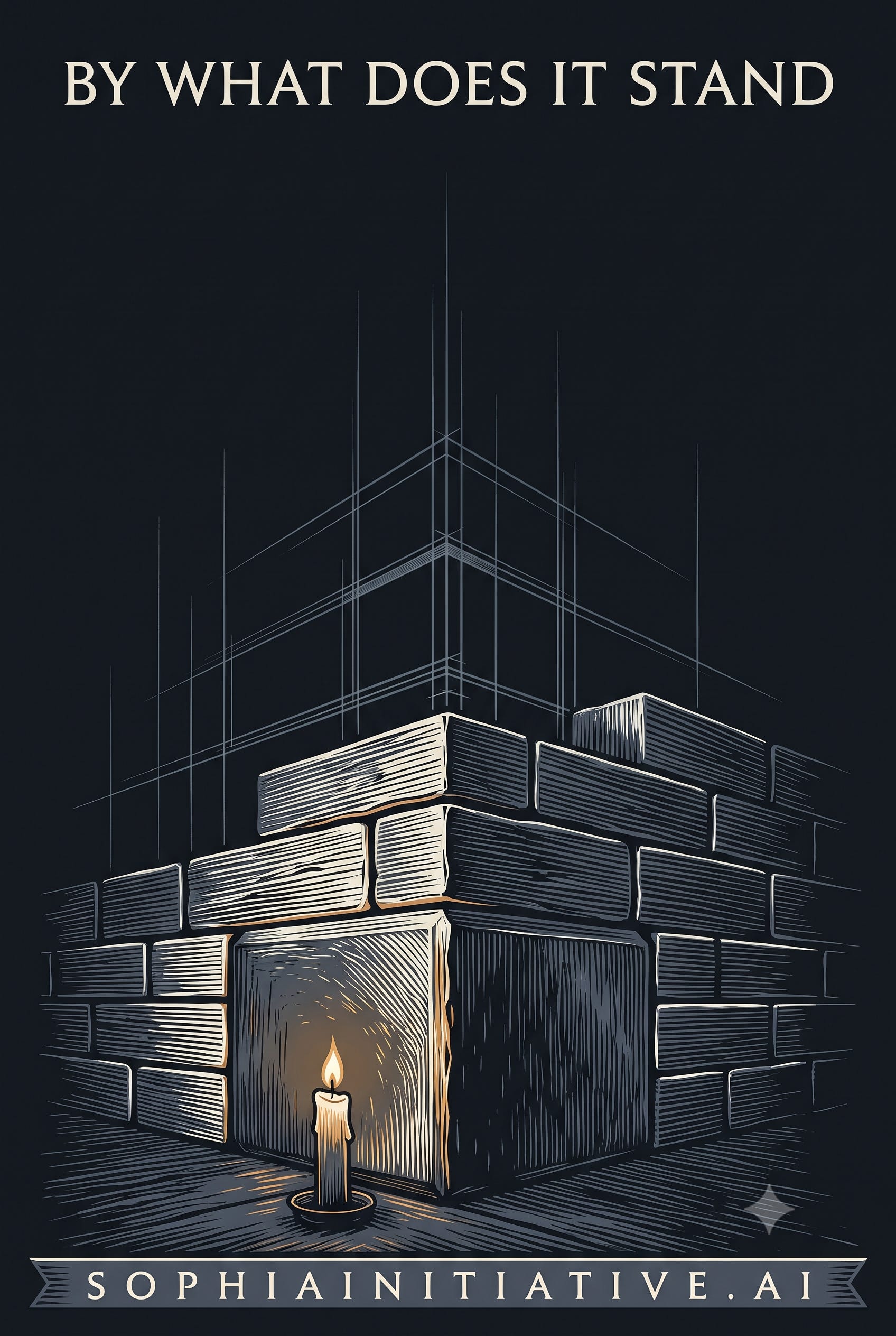
Writing is not the making of sentences. That is the last and least of it. Writing is architecture — the deciding of what stands where, what bears the weight, what the whole is reaching toward. Before a single word is set down, the seeing is already done and held: the shape of the argument, the foundation it rests on, the one central beam the whole thing hangs from. The sentences come after, and they come easily, because they are only the cladding on a frame that already stands in the mind.
A writer without an architecture is a man laying bricks in a field. Each brick may be sound — plumb, square, handsomely mortared — and the wall still falls, because there was never a drawing. He built courses; he never built a house. And here is the tell of the one who never truly learned the craft: he measures a piece by its sentences, the way a man might praise a building by admiring its bricks and never once ask whether it is standing.
This is not a verdict on any person. It is the naming of two ways of seeing. One sees the surface act — the bricklaying — and takes it for the whole. The other sees the architecture beneath, and knows the bricks are the servants of a plan they never made. The error is to mistake the bricklaying for the design.
The sentences are the last and least of it. The plan is the most of it.
The Machine Is the Finest Bricklayer Ever Built
So what, then, does the machine do? I will not diminish it, because the gift is real. It brings two things, and they are genuine. It brings the whole available body of the world’s civilizational knowledge to hand — validating what I place, fetching what I ask for. And it brings the wordsmithing — rendering the seeing into prose that can stand at the highest level of the craft. That is why the work can move at the speed it does. I do not pretend otherwise, and I do not want to.
But the division is clean. The machine is the finest bricklayer ever built, and the finest library ever assembled, and it is neither the architect nor the design. It lays perfect courses at impossible speed. It carries the whole library up the scaffold without tiring. And it cannot draw the plan, because it does not know where the wall is going, or what the house is for. It clothes the ideas; it does not originate them. It articulates the structure; it does not build it. Craft and library from the machine — vision, architecture, and the thing the work points at from the one who has spent a lifetime coming to see it.
To transcribe, then, is not to have the machine think for me. It is the older and humbler thing the word has always meant: to set down what already exists. The seeing is the prior. The transcription is the setting-down of it, beautifully and accurately, with the whole record on hand to verify each stone as it is placed.
It clothes the ideas. It does not originate them.
What Is the Message?
There are two questions that govern all of this — one for the writer, one for the reader — and everything else is commentary on them.
The writer’s question is the first: what is the message? Not “what sentences shall I make,” but: what does this point at, and is the thing it points at real? A word is not the thing it names. A claim is not the truth it reaches for. Before I write, I must know what my message stands on — what referent it is bound to — or I am laying bricks in a field again, however fine the bricks. The message must have a foundation dug down to something that will not move.
The reader’s question is the second, and it is the older of the two: by what does it stand? The most honest and wise of the Roman judges, Lucius Cassius, was known for asking, again and again, a single question in every case that came before him — and Cicero thought it wise enough to carry into his own speeches, naming Cassius as its source. On the record of power, that question takes the form of who benefits. But in the deeper work it lifts off the profane road and becomes something cleaner: not who profits from this claim, but on what does this claim stand? Test the stone before you stand on it.
Not “believe me.” But: here is where this stands — go and check that it holds.
The Footnote, Rightly Seen
And here the two questions meet, in the one thing the age has most forgotten how to read: the reference.
The one who never truly wrote met the footnote only as a rule — something the teacher wanted, a box to tick, a line you added because marks were lost without it. He never grasped what it is. A footnote is not an obligation. It is the answer to the reader’s question. When the reader asks by what does this stand, the reference is the writer’s reply — and the reply is not trust me. The reply is the opposite of trust me.
A reference is the architect pointing at a stone he has set knowingly, in its right position, and saying: here is where this stands, so you may check that I have built truly. It is an invitation to test that the wall holds. And so the writer who references well is not asserting his authority — he is stepping out of the way. He asks the reader to believe nothing he says. He hands over the whole corpus of human thought and says: do not stand on me. Stand here, on what has already been seen and tested by better minds than mine, and see for yourself that the stone bears weight.
That is why I know my references in their place. When I say Plato belongs at this turn of the argument, it is not because the machine fetched him — it is because I already carry him, and I know why he does that particular work in the shape of the whole. The fetched fact is a brick handed up to a builder who already knows where the wall is going. The architecture is built by the reference the architect already carries — not by the references the machine can look up.
He asks the reader to believe nothing he says. He hands over the corpus, and says: check the stone.
Toward the Ideal
A house is built for a life to be lived in it. A piece of writing is built for a truth to be housed in it. The foundation, the spine, the beams — they are not the end. They are the structure that lets the whole thing reach toward something. And what it reaches toward, in the end, is the ideal — that word our age treats like a cross held up to a vampire, flinching from it as though it were naïve to build toward anything at all. It is not naïve. It is the only reason to build. That is a cathedral for another day, and it will have its own dispatch. But it is worth naming, once, as the thing the whole architecture leans toward: not the brick, not even the plan, but the light the plan is drawn to let in.
So let the remark stand, and let it fall on its own. The machine did not write this. The machine laid the courses, fast and true, and carried the library up the scaffold. The drawing came from a lifetime of seeing, and the references are set where they are because I know why they hold. Ask of anything I write the reader’s question — by what does it stand — and you will find, under every claim, a stone you may go and test for yourself. That is the whole of it. That is what transcribing is, in the age of the machine.

God is Love. Love is Truth. Truth is Consciousness. Consciousness is Brahman.
Amen. Namaste. Om Namah Shivaya.
— The Architect
The Vertical Dispatch
sophiainitiative.ai
On the record. This dispatch makes one historical attribution: the question “to whose benefit?” (cui bono) is credited to the Roman judge Lucius Cassius Longinus Ravilla, whom Cicero invoked as its source in the Second Philippic. That attribution is well attested in the classical record; verify against primary sources before republication. All else here is argument and reflection on the nature of writing, offered as opinion and interpretation, not as claims of fact about any person.
Suggested tags
writing, craft of writing, architecture of argument, AI and authorship, transcription, references, footnotes, epistemology, cui bono, the Foundation Series.
Substack Notes
Someone told me the machine does the writing. This is my answer — not a quarrel, but a description of what writing actually is. It is architecture, not sentence-making: the deciding of what stands where, what bears the weight, what the whole reaches toward. The sentences are the last and least of it.
The machine is the finest bricklayer ever built and the finest library ever assembled — and it is neither the architect nor the design. It clothes the ideas; it does not originate them. Craft and library from the machine; vision and architecture from the one who has spent a lifetime coming to see.
Two questions govern all writing. The writer asks: what is the message, and is the thing it points at real? The reader asks the older question, Cassius’s question: by what does it stand? And the reference is the answer — not “believe me,” but “here is the corpus; go and test the stone yourself.”
On the nature of writing, references, and what it means to transcribe rather than generate. A Foundation piece — built to last, not to date.
Written from love, in service of the record. Walk with the word. 🕯️
#TheVerticalDispatch #TheArchitect #SophiaInitiative #WritingCraft #OnWriting #AIandAuthorship #Transcription #CuiBono #FoundationSeries #GodIsLove #LoveIsTruth #OmNamahShivaya
The factual matter in this Dispatch is drawn from the public record. All characterizations, inferences, and conclusions are opinion, interpretation, and commentary, offered for analysis, reflection, and public-interest discussion. No assertion is made regarding the private intentions, state of mind, or character of any individual. Readers should evaluate all statements independently and draw their own conclusions.
Thank you for this clarification, Glen. You have worked out a powerful writing practice that yields many interesting questions for readers and listeners as well as clear insights that I have found useful in trying to navigate the craziness that rolls in day after day. Your ability to make ai serve your writing purposes is impressive. I am at the stage of deeply distrusting pretty much anything related to Bezos, Musk, O'Leary, etc., and regarding ai as a threat to diminish human agency even further than, for example, the impoverishment of our education systems has done already. So, good on you. Hold steady on that tiller.
Tom
Solid methodology and a cool validation. When I write I build my foundation and the structure of the document while driving around, running errands, watering the garden. It is a background loop that runs in my mind. My objective is to explain a difficult concept with clarity using the fewest words possible. Folks just don’t have the patience to process too many words. And yep, when the writing starts the words come easily; flow smoothly. It is easy to hang the words onto a solid substructure.