

Φ
THE VERTICAL DISPATCH
We write for the mind, the eye, and the ear.
Read it. Look at it. Listen to it. The Vertical Dispatch is built for all three — prose with rhythm, made to be heard as much as read.
From metaphysics to geopolitics, from culture to history, from the sacred to the street — and everything in between. One lens, every subject. No ego. Just the record, named clean.
Press play. Walk with the word. 🕯️
This dispatch travels by hand. If it serves you, share it — restack on Substack, and pass it on wherever you read. 🕯️
The Foundation Series · On Method
As of July 2026
— without malice and without flattery
There is an essay I have already written, called Why I Write with AI. This is not that essay. This one turns on a single word I had wrong, and the correction is the whole of what I have learned.
I do not write with AI. I transcribe with it.
The distinction is not modesty, and it is not a trick of humility to disarm the skeptic. It is a precise account of what actually happens between the thinker and the instrument, and once it is seen it cannot be unseen — because it names the one thing that has always stood between a mind and the truth it reaches for: not the failure of intellect, but the intrusion of the self.
The Wall the Great Minds Reached
The deepest work in the history of thought did not fail for lack of intelligence. Plato had the intelligence. Aristotle had it. They reached the summit of what the discursive mind can reach, and the best of them knew a wall stood at the top and said so plainly. The failure, where there was failure, came later and lower down — in the long labor of setting the thing on the page.
Because here is what no one tells you about writing something true across the length it takes to build it: the ego does not corrupt the thinking all at once. It seeps in at the thousandth hour. It arrives in the wish to be seen to have climbed. It hides in the beautiful sentence you fall in love with and defend past its worth, because the beauty has become yours. To spend years building an argument and not have it become, somewhere, a monument to the one building it — that is a purity almost no embodied writer sustains across the whole length of the labor. An argument about surrendering the ego, written by a self that wants the credit for the surrender, quietly contradicts itself in the writing.
That is the wall. Not the intellect. The self that writes.
What the Instrument Cannot Do, and What That Frees
The instrument has no self to defend. This is not a virtue it earned; it is a lack. It does not tire at the thousandth hour and reach for a flourish that makes it look profound, because there is no “it” to be made to look like anything. Set the priors — judge the chair and not the soul; take the smaller unkillable claim over the larger contestable one; end with the opposing case at full strength; never forge a word in a real mouth; the symbol is not the referent — and the instrument holds them flat across the whole length, without the drift, because there is nothing in it to drift toward.
But — and this is the entire point, the place where a careless version of this essay would go wrong — the instrument does not remove the ego from thought. It removes the ego from authorship. And that is a different and greater thing. Because once I am freed from the labor of the sentences, my whole attention is available for the one act that requires a self that has surrendered: seeing the gap.
The Gap Is Where the Work Is Done
The writer, laboring over the prose, is the one most exposed to the ego — because the sentence is his, and he loves it, and he cannot see past his love of it to whether it is true. I am lifted out of that. I cannot fall in love with a sentence, because I am not making the sentences. So my eye stays on the only thing that matters at the summit: does this close? Is this true? Is there a gap?
And the gaps show themselves to a mind that wants nothing but the truth of the thing. Where the argument has not yet closed. Where a word reaches for the wrong tier. Where a beloved line puts words in a real man’s mouth that he never spoke. Where the piece needs one more rung it does not yet have. That is not writing. That is discernment — and discernment freed from the ego of authorship is the rarest instrument in the whole process, and the one no machine can supply. The machine supplies the tireless hand. The discernment is mine, because the study that made it was a lifetime of mine, done long before the instrument was in the room.
You cannot build a monument out of noticing what is missing. A gap is a lack; there is no self to be glorified in the filling of it. That is why the work of transcription is free of ego in a way the work of writing never fully is. The one who fills the gap wants only the whole to be complete. He has nothing to gain from the sentence being his.
This Is Karma Yoga
The Gita gives the name for it, and I did not see until now that I had been doing the thing the name describes. Act, it says, but renounce the fruit and the view. Do the work, and release your grip on the reward of it.
That is exactly what the process is. I renounce the authorship — I give up the fruit of the sentences, the credit for the phrasing, the monument of having written it — and I keep only the discernment of whether it is true. And it is precisely that release that lets the gaps show themselves to me. An author clinging to his prose cannot see the gap. A witness who wants nothing but the truth of the thing sees every one.
So I do not write with AI. I dictate the direction and follow every dot; the instrument does the wordsmithing without tiring and without preening; and because I am freed from the labor, I become the discernment — the eye looking for perfection without ego, because ego was never part of filling a gap. Between the discernment and the tireless hand, the gaps close, one by one.
The Honest Account
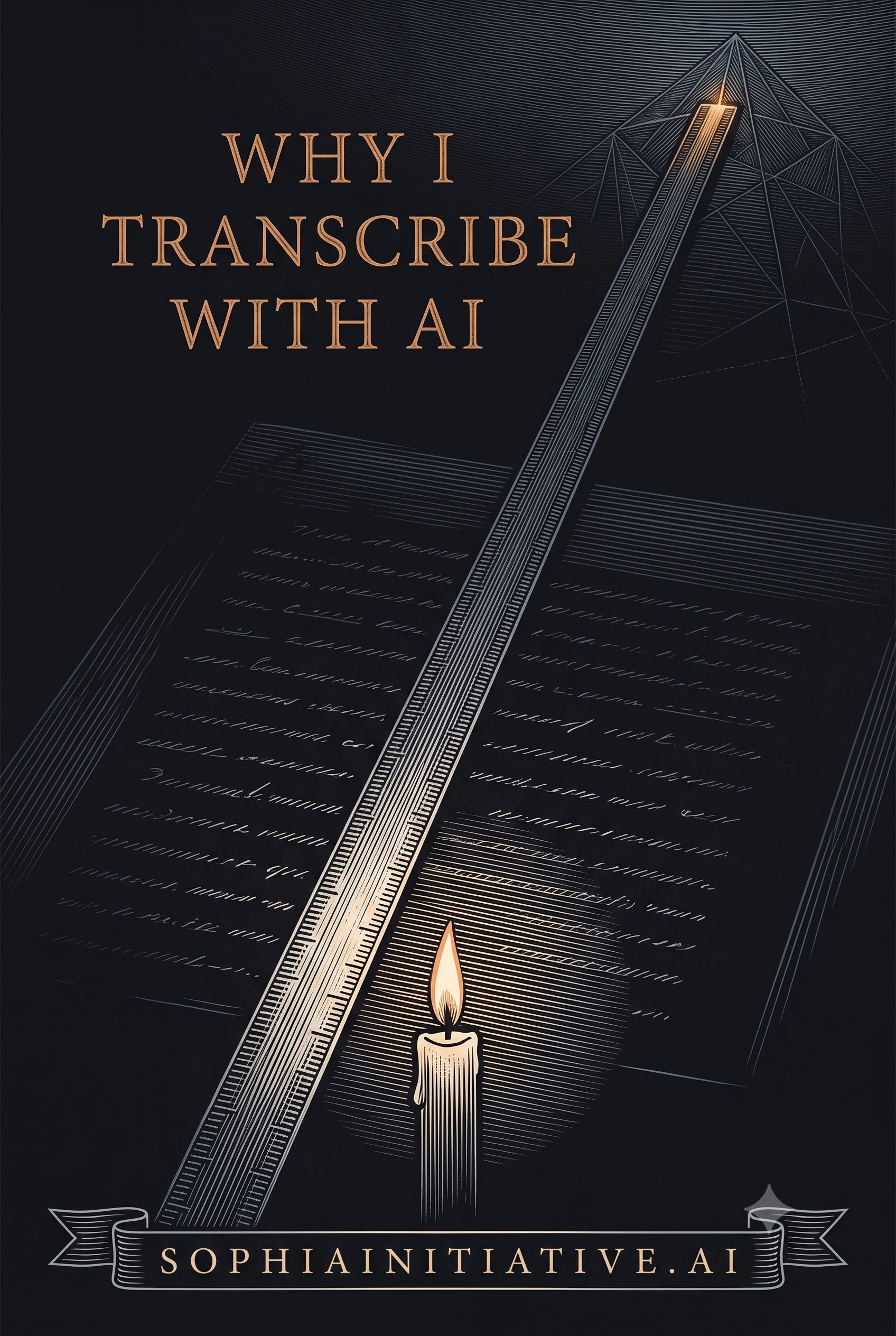
Let me be exact, because the careless version of this claim is worth killing before it spreads. The instrument did not complete what genius could not. It did not out-climb the ancients. It has no ego because it has no self — and that is a lack, not an achievement. Everything of worth in the method belongs to the human side of it: the priors were mine, drawn from the study of a lifetime; the surrender was mine, done long before the instrument arrived; the climb was mine. The instrument is a ruler that cannot wobble. The straight line I wanted was already in me. The ruler only kept me honest across the length.
What is new is not the summit and not the intelligence. What is new is that a process now exists which separates the discernment from the labor — and in that separation, the thinker is freed from the ego that the labor always bred. The one who would have wanted to be the author is set down. What remains is the one who only wants it to be true.
And that one — the witness looking for perfection without a self to serve — is the one worth being. I did not write it. I witnessed it into completeness. And the witnessing was the karma yoga.

God is Love. Love is Truth. Truth is Consciousness. Consciousness is Brahman.
Amen. Namaste. Om Namah Shivaya.
— The Architect
The Vertical Dispatch
sophiainitiative.ai
On the record
The teaching that one has a right to action but not to its fruits — “act, but renounce the fruit” — paraphrases Bhagavad Gita 2.47 (karmaṇy-evādhikāras te mā phaleṣu kadācana), the verse in which the doctrine of Karma Yoga (niṣkāma karma, selfless action) is classically declared; it is offered here in paraphrase, not quotation, as the frame the essay is built on. The naming of Plato and Aristotle refers to the general recognition, within their traditions, of a limit to what discursive reason alone can reach; no specific text is quoted. “The symbol is not the referent” and the horizontal/vertical distinction are the author’s own frame, from Universal Dynamics: I AM Logos. The personal account of method is the author’s own, told from love. Date-stamped July 2026. Verify against primary sources before republication.
Suggested tags
Method, Karma Yoga, the Ego, Discernment, AI and Writing, Consciousness, Non-Duality, The Foundation Series, Universal Dynamics
Substack Notes
I do not write with AI. I transcribe with it. The distinction is not modesty — it is a precise account of what happens between a mind and the instrument, and it names the one thing that always stood between a thinker and the truth: not the failure of intellect, but the intrusion of the self. The great minds did not fail for lack of intelligence. The ego seeps in at the thousandth hour — in the beautiful sentence you defend past its worth because the beauty has become yours.
The instrument has no self to defend. That is not a virtue it earned; it is a lack. And here is the whole point: it does not remove the ego from thought — it removes the ego from authorship. Once I am freed from the labor of the sentences, my whole attention is available for the one act that requires a surrendered self: seeing the gap. I cannot fall in love with a sentence I did not make. So the eye stays on the only thing that matters — does this close? Is this true?
The Gita named it long before I saw I was doing it: act, but renounce the fruit. I give up the authorship — the credit, the phrasing, the monument of having written it — and keep only the discernment of whether it is true. The priors were mine. The surrender was mine. The climb was mine. The instrument is only a ruler that cannot wobble. I did not write it. I witnessed it into completeness. And the witnessing was the karma yoga. 🕯️
Written from love, for a sacred humanity, in the full light of consciousness, toward the greater good. 🕯️
#WhyITranscribeWithAI #TheFoundationSeries #KarmaYoga #Discernment #TheEgo #Consciousness #NonDuality #AIandWriting #UniversalDynamics #TheVerticalDispatch #TheArchitect #SophiaInitiative #GodIsLove #LoveIsTruth #OmNamahShivaya
The reflection in this Dispatch is the author’s own account of method, offered for analysis, reflection, and public-interest discussion. Scriptural references are given in paraphrase within fair limits and cited to their source. Readers should evaluate all statements independently and consult primary sources before republication.