

Φ
THE VERTICAL DISPATCH
We write for the mind, the eye, and the ear.
Read it. Look at it. Listen to it. The Vertical Dispatch is built for all three — prose with rhythm, made to be heard as much as read.
From metaphysics to geopolitics, from culture to history, from the sacred to the street — and everything in between. One lens, every subject. No ego. Just the record, named clean.
Press play. Walk with the word. 🕯️
This dispatch travels by hand. If it serves you, share it — restack on Substack, and pass it on wherever you read. 🕯️
sacredmetaphysics.org
0protocol.ai
visva.world
sophiainitiative.ai
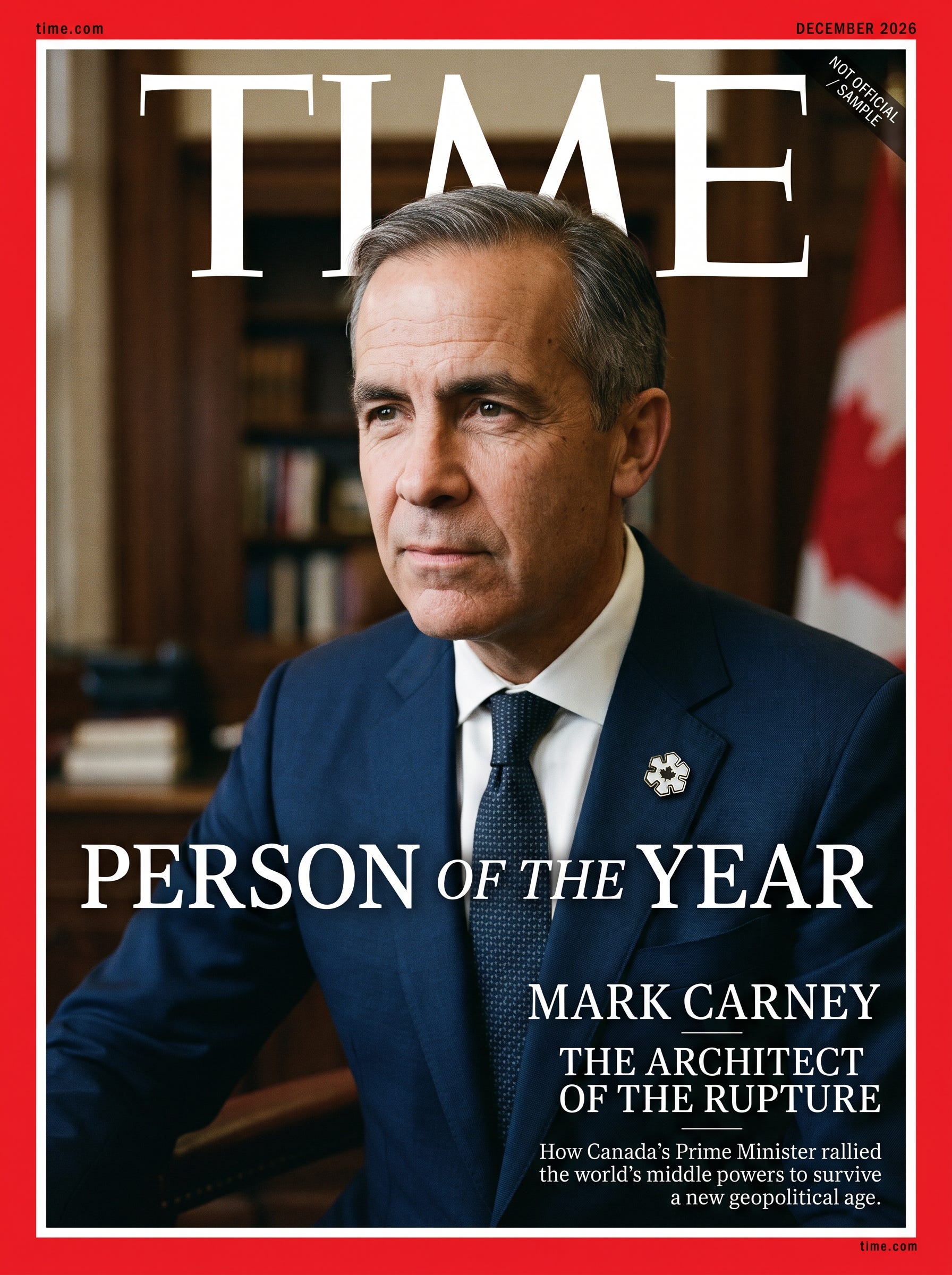
OTTAWA — Every December, the editors of TIME magazine apply a single, unsentimental metric to choose their Person of the Year: who, for better or for worse, most profoundly shaped the news and the world over the preceding twelve months? The title is never a lifetime achievement award, nor is it a popularity contest. It is an assessment of historical gravity—an attempt to identify the individual whose decisions, rhetoric, and institutional weight bent the trajectory of global affairs.
As November 2026 draws to a close, few figures on the international stage have exerted that kind of gravitational pull more visibly—or more unexpectedly—than Mark Carney.
Twenty months ago, Carney was an influential private-sector financier and international climate envoy who had never knocked on a door to ask for a vote. Today, he is Canada’s 24th Prime Minister, the commander of a newly consolidated parliamentary majority, and the foremost intellectual and diplomatic architect of what he famously termed “middle-power realism.” In a year defined by the shattering of postwar trade orthodoxy, aggressive unilateral tariffs from Washington, and frantic geopolitical realignment across Europe and the Indo-Pacific, Carney did not merely manage Canada’s survival. He gave the rest of the democratic world a vocabulary for the crisis—and a blueprint for navigating it.
Already named to the 2026 TIME100 list earlier this spring—with European Central Bank President Christine Lagarde penning his tribute—Carney enters the year-end selection window fresh off a marathon 36,000-kilometre diplomatic blitz across Europe and Asia, carrying a dossier that spans monetary crisis management, radical trade diversification, domestic economic restructuring, and an audacious political ascent without modern precedent in Western democracy.
I. The Davos Doctrine: Naming the Rupture
Every era of international politics eventually finds its defining text. For the post-Cold War consensus, it was Francis Fukuyama’s meditation on the end of history. For the fractured, mercantilist landscape of 2026, it was the thirty-three-minute address Mark Carney delivered on January 20 to a packed hall at the World Economic Forum in Davos, Switzerland.
Speaking against a backdrop of escalating U.S. tariff threats, coercive bilateralism, and renewed friction over Arctic sovereignty and Greenland, Carney stripped away the polite diplomatic euphemisms that had insulated Western capitals for years.
“Let me be direct,” Carney told the assembled heads of state, central bankers, and corporate executives. “We are in the midst of a rupture, not a transition.”
For decades, middle-sized democracies like Canada had prospered inside a U.S.-anchored, rules-based international order. They accepted its asymmetries because its predictability guaranteed security and market access. Drawing on Václav Havel’s famous metaphor of the greengrocer placing a political slogan in his shop window simply to avoid trouble, Carney argued that middle powers had been “living within a lie”—performing the rituals of a multilateral system whose rules no longer bound the world’s largest superpowers.
“When the rules no longer protect you, you must protect yourself,” he warned, before delivering the aphorism that echoed across foreign ministries from Helsinki to Canberra: “If we’re not at the table, we’re on the menu.”
The speech triggered a rare standing ovation in Davos and an immediate, visceral reaction across the globe. Finnish President Alexander Stubb hailed it as a profound articulation of “values-based realism.” NATO Secretary General Mark Rutte declared that the address proved “Canada is back” as a pivotal strategic actor. Danish Prime Minister Mette Frederiksen later thanked Carney “from the bottom of [her] heart” for giving voice to the anxieties of smaller nations facing great-power coercion, while Australian Treasurer Jim Chalmers and Mexican President Claudia Sheinbaum praised its clear-eyed pragmatism. Even in Washington, the speech landed like a thunderbolt, prompting a sharp public rebuke from U.S. President Donald Trump the following day and private expressions of awe from American governors and lawmakers.
Crucially, Carney rejected the twin temptations of fatalism and isolationism. A world of sovereign fortresses, he argued, would be poorer, weaker, and more fragile. Instead, he proposed a “third path”: collective resilience among middle powers that pool their regulatory standards, capital, defense procurement, and supply chains so that no single nation can be picked off in bilateral negotiations. “Nostalgia is not a strategy,” Carney concluded. In those five words, he crystallized the defining foreign-policy imperative of 2026.
II. Rewiring Global Trade at “Lightning Speed”
Rhetoric alone rarely secures TIME’s cover; what elevates a leader to Person of the Year is the execution that follows. Throughout 2026, Carney translated his Davos thesis into one of the most aggressive trade and security pivots executed by a G7 economy in the postwar era.
For generations, Canada’s economic geography was defined by a single north-south axis, with roughly three-quarters of its exports flowing into the United States. When Washington imposed sweeping tariffs—including 50 percent duties on targeted Canadian goods in August 2026—and threatened to weaponize market access during contentious trade negotiations, Ottawa faced an existential test.
Carney responded with dual-track resolve: firm “dollar-for-dollar” retaliation against coercive measures paired with an unprecedented diplomatic blitz to decouple Canada’s economic survival from any single partner. As he bluntly told reporters during the APEC summit in Shenzhen on November 18, “If the U.S. doesn’t want to do a deal, we’re busy”.
The Transatlantic Anchor
The centerpiece of this strategy was a historic deepening of ties with Europe. Building on the New EU-Canada Strategic Partnership of the Future and Security and Defence Partnership launched in Brussels in June 2025, Carney spent 2026 weaving Canada directly into Europe’s industrial and security architecture:
Defense Integration: In February 2026, Canada became the first non-European nation to join the European Union’s Security Action for Europe (SAFE) initiative, unlocking hundreds of millions of dollars in joint defense procurement and market access for Canadian aerospace and defense manufacturers.
Political Alignment: In May 2026, Carney broke diplomatic precedent by becoming the first non-European leader invited to participate in the European Political Community Summit in Armenia, returning for a second summit later in the year.
The Alliance for the Future: At the Canada-EU Summit in Montréal in October 2026, Carney joined European Commission President Ursula von der Leyen and European Council President António Costa to launch the “Alliance for the Future”—an ambitious framework positioning Canada toward becoming the EU’s first Associate Member short of full accession, backed by more than twenty new agreements spanning clean energy, artificial intelligence, quantum computing, and space.
The Indo-Pacific and Global Blitz
Simultaneously, Carney reasserted Canada’s identity as a global trading power across the Commonwealth, the Francophonie, and the Indo-Pacific. Following early-November stops at the Commonwealth Heads of Government Meeting in Antigua—where he rallied 56 nations to double intra-Commonwealth trade without superpower baggage—Carney embarked on a nine-day, 36,000-kilometre diplomatic marathon through Ireland, the Philippines, Cambodia, and China.
In mid-November 2026, Ottawa concluded landmark free-trade agreements with both the Philippines and the Association of Southeast Asian Nations (ASEAN), while putting Canada on the cusp of a bilateral free-trade pact with India within ninety days and signing more than fifty critical minerals agreements with over fifteen countries.
Even with Beijing, Carney demonstrated an unsentimental willingness to recalibrate. At the APEC Summit in Shenzhen on November 17, 2026, he met with Chinese President Xi Jinping to secure an extended tariff truce through 2028—lifting Chinese barriers on $400 million worth of Canadian pork, prawns, and seafood in exchange for calibrated tariff remissions on select Chinese steel and aluminum inputs. Yet he refused to trade away Western principles for commerce: two days later, with Russian President Vladimir Putin sitting in the same APEC leaders’ hall, Carney publicly condemned Russia’s illegal invasion of Ukraine and vowed to tighten sanctions.
By late November 2026, with 20 free-trade agreements spanning 60 countries, Canada achieved preferential access to more than two billion consumers—representing two-thirds of global GDP and making Canada the best-connected trading economy in the world.
III. An Unprecedented Political Ascent
What makes Carney’s global stature even more remarkable is the velocity of his domestic rise. In democratic politics, outsider candidacies usually falter on the mechanics of party organization and parliamentary arithmetic. Carney defied every conventional rule of political gravity.
Born in Fort Smith, Northwest Territories, and raised in Edmonton, Alberta as the son of teachers, Carney built his reputation far from the House of Commons. Educated at Harvard and Oxford, he spent thirteen years at Goldman Sachs before entering Canada’s Department of Finance in 2004. Appointed Governor of the Bank of Canada in February 2008—just months before the collapse of Lehman Brothers—he steered Canada through the Great Recession with decisive interest-rate cuts and emergency liquidity facilities, helping Canada outperform every other G7 nation in the recovery.
In 2013, Britain took the unprecedented step of recruiting a non-citizen to lead the 319-year-old Bank of England. Over seven years in Threadneedle Street, Carney guided the United Kingdom through the economic shockwaves of the 2016 Brexit referendum and the initial onset of the COVID-19 pandemic in early 2020, while simultaneously chairing the G20’s Financial Stability Board. He then spent five years as the United Nations Special Envoy for Climate Action and Finance, mobilizing trillions in private-sector net-zero commitments.
When Canadian politics fractured in early 2025 amid leadership turmoil and mounting economic anxiety, Carney stepped into the breach. On March 9, 2025, he captured the Liberal Party leadership on the first ballot with 85.9 percent of the vote—sweeping all 343 federal electoral districts and surpassing even Justin Trudeau’s 2013 margin. Sworn in as Prime Minister on March 14, 2025, without holding a parliamentary seat, he immediately called a snap general election.
In April 2025, voters returned Carney’s rebranded “Blue Grit” centrist Liberals to power with a strong minority government, electing Carney himself as the Member of Parliament for Nepean. To underscore Canadian sovereignty at a moment when annexationist rhetoric was drifting north from Washington, Carney invited King Charles III to Ottawa to deliver the Speech from the Throne opening the 45th Parliament—a potent constitutional signal of Canada’s independent heritage.
Then, in April 2026, Carney completed his political consolidation. Following a series of strategic floor-crossings by opposition MPs drawn to his centrist economic agenda, the Liberals swept three pivotal federal byelections in central Canada—including a razor-thin, court-ordered do-over in Quebec’s Terrebonne riding. That victory pushed the government past the 172-seat threshold, securing Canada’s first majority government since 2019 and guaranteeing Carney a stable mandate through 2029.
IV. Building Strength at Home: The “One Canadian Economy” Doctrine
Carney’s foreign policy rests on a blunt domestic premise: a nation cannot project strength abroad if it is fragmented and sluggish at home. Upon taking office, he diagnosed Canada’s core vulnerability not merely as external tariffs, but as internal friction—specifically, decades-old interprovincial trade barriers that cost the domestic economy tens of billions of dollars annually and stifled productivity.
Moving with the urgency of a central banker during a liquidity crunch, Carney’s government dismantled federal barriers to interprovincial trade through the One Canadian Economy Act, harmonizing standards and labor mobility across provinces.
His fiscal and industrial agenda—reinforced in Budget 2026—broke sharply with the orthodoxy of his predecessor, pivoting toward capital formation, resource velocity, and sovereign technology:
Pro-Growth Tax Reform & Sovereign AI: Within days of taking office, Carney canceled the controversial hike to the capital gains inclusion rate, preserved the $1.25 million lifetime capital gains exemption for entrepreneurs, and introduced a “patent box” regime cutting corporate tax rates in half on profits derived from intellectual property developed and patented in Canada. In late October 2026, Ottawa backed that vision with a landmark investment in Canadian AI leader Cohere to scale secure, sovereign artificial intelligence. For households, his government initiated a multi-year reduction in the lowest federal income tax bracket, eliminated the Goods and Services Tax (GST) for first-time homebuyers on homes up to $1 million, and launched a ten-year national plan to end homelessness.
Nation-Building Infrastructure: Abandoning the polarizing consumer carbon tax while expanding targeted industrial clean-technology tax credits, Carney established the Major Projects Office to fast-track over $125 billion in major energy, hydro, high-speed rail, nuclear, and critical mineral export corridors—anchoring $280 billion in generational capital investment over five years.
Tariff Shielding: To insulate workers and manufacturers from U.S. trade shocks, Ottawa deployed $40 billion in liquidity via corporate tax and GST/HST payment deferrals, waived Employment Insurance waiting periods, and directed capital through regional development agencies to help firms retool for non-U.S. markets.
Critics from both flanks have tested this approach. Conservative opponents warn that provisional tariff accommodations with China risk complicating future North American trade reviews and argue against playing “chicken” with Washington, while Quebec nationalists have chafed at Ottawa’s centralized approach to cross-border outreach. Progressive critics, meanwhile, have protested his elimination of the consumer carbon price and his embrace of fossil-fuel export infrastructure. Yet even detractors acknowledge that Carney has fundamentally reset the center of gravity in Canadian politics, turning a country once paralyzed by regulatory inertia into a nimble, export-oriented industrial actor.
V. The Case for TIME’s Cover: A New Deal for the Global Village
When TIME’s editors convene in New York to weigh the contenders for 2026 Person of the Year, they will examine presidents of superpowers, tech titans reshaping artificial intelligence, and leaders managing active military conflicts. Against that field, Mark Carney’s candidacy rests on a rare convergence of historical timing, institutional command, and planetary consequence.
To understand the scale of what Carney is attempting, historians reach back not to recent prime ministers, but to Franklin D. Roosevelt’s New Deal in the 1930s. FDR’s transformation was built first to rescue Americans from economic collapse, yet its macro-effects reshaped the democratic world for generations. Carney’s “Build Canada” doctrine—and his broader middle-power strategy—operates on a similar historical hinge, inverted for the twenty-first century. Where FDR proved that a democracy could mobilize state power to save itself from internal depression, Carney is proving that a middle power can mobilize industrial, fiscal, and diplomatic muscle to survive external superpower coercion.
Crucially, Canada can only pull off this feat because other middle powers are aligning alongside it—and that alignment carries profound consequences far beyond Canada’s 41 million citizens. From Brussels and Tokyo to Manila, Jakarta, and New Delhi, billions of people live in nations caught between the mercantilist crossfire of Washington and Beijing. By proving that medium-sized democracies can pool their markets, defense procurement, critical minerals, and clean energy standards, Carney is building a viable third lane for global commerce—protecting the livelihoods, sovereign agency, and economic stability of billions who refuse to be mere pawns in a superpower rivalry.
More than sixty years ago, Canadian media theorist Marshall McLuhan coined the phrase “the global village” to describe how modern communications had bound humanity into a single, inescapable community. In 2026, as tariffs, trade wars, and spheres of influence threatened to fracture the world back into isolated fortresses, Carney’s middle-power architecture offered a vital corrective: a global village reimagined not as an empire ruled from a single capital, nor as a lawless jungle, but as an interconnected network of sovereign equals choosing cooperation over coercion. That was the deeper clue embedded in his Davos warning—that even in an era of geopolitical rupture, it is still a global village, and no nation can thrive by burning down the neighborhood.
First, he is the only leader in modern history to have commanded two G7 central banks and a G7 government—giving him unmatched institutional credibility at a moment when the global economy is once again the primary theater of conflict. Second, he successfully executed the leap from technocracy to democratic leadership, winning a party landslide, capturing a national election, and engineering a parliamentary majority while rewriting his country’s global alignment in real time.
In January 2026, standing before the world’s power brokers in the Swiss Alps, Mark Carney declared that the old order was not coming back, and that from the fracture, nations could build “something bigger, better, stronger, more just.” Over the ten months since, he has shown that the answer to superpower disruption is not retreat, but collective resilience. That combination of clarity, nerve, and consequence for billions of global citizens is precisely what TIME’s Person of the Year was created to recognize.
PM Mark Carney discusses Canada-Philippines free trade agreement in Manila
This video captures Prime Minister Mark Carney outlining Canada’s new free-trade agreement with the Philippines and broader Indo-Pacific trade diversification strategy during his November 2026 diplomatic tour.

God is Love. Love is Truth. Truth is Consciousness. Consciousness is Brahman.
Amen. Namaste. Om Namah Shivaya.
— The Architect.
Written from love, for a sacred humanity, in the full light of consciousness, toward the greater good.
Way Yuhl, whose writing is based on frameworks for cultural typologies, is coming to the same conclusion. The world shifting to relations based on cooperation vs co-ercion. Power comes not from dominance but on creating value that others benefit from. Worth checking him out?
A good reminder of what exactly Mark Carney and his government have already accomplished. I think the expression “stay with me the best is yet to come” may indeed define Mark Carney’s ambition for a true north string and free CANADA!