


Φ
THE VERTICAL DISPATCH
We write for the mind, the eye, and the ear.
Read it. Look at it. Listen to it. The Vertical Dispatch is built for all three — prose with rhythm, made to be heard as much as read.
From metaphysics to geopolitics, from culture to history, from the sacred to the street — and everything in between. One lens, every subject. No ego. Just the record, named clean.
Press play. Walk with the word. 🕯️
This dispatch travels by hand. If it serves you, share it — restack on Substack, and pass it on wherever you read. 🕯️
sacredmetaphysics.org
0protocol.ai
visva.world
sophiainitiative.ai
THE VERTICAL DISPATCH • CANADIAN POLITICAL ECONOMY ESSAY
Ask a Bay Street economist how rich Canada has become, and you will receive figures that read like a triumph. By the middle of 2026, Canadian household net worth reached a record $19.1 trillion—driven by surging TSX equity valuations and residential property prices—while national net worth stood above $19.2 trillion. On a spreadsheet, the average Canadian household sits atop unprecedented wealth.
Then step onto the street. Walk past food bank lines hitting historic highs in every major city, look at commuter rail corridors decades behind Europe and Asia, or inspect the federal ledger—where Canada’s direct federal debt tops $1.3 trillion, climbing by roughly $2,000 every second, while annual debt interest charges consume $60 billion a year: more than Ottawa transfers to the provinces for healthcare ($57 billion) and more than the entire federal GST brings in ($52 billion).
Meanwhile, Canadian households carry more than $3.25 trillion in credit market debt—$1.79 for every dollar of disposable income, the heaviest household debt burden in the G7. How can a nation sitting on $19.1 trillion in paper wealth feel permanently stretched at the kitchen table, while billions materialize effortlessly for financial mergers, bank dividends, and speculative asset loops? The answer lies in how Canadian money gets created, where it flows, what the country actually makes and buys, and the deeper structural cracks that must be repaired if Canada intends to become a genuinely sovereign nation.
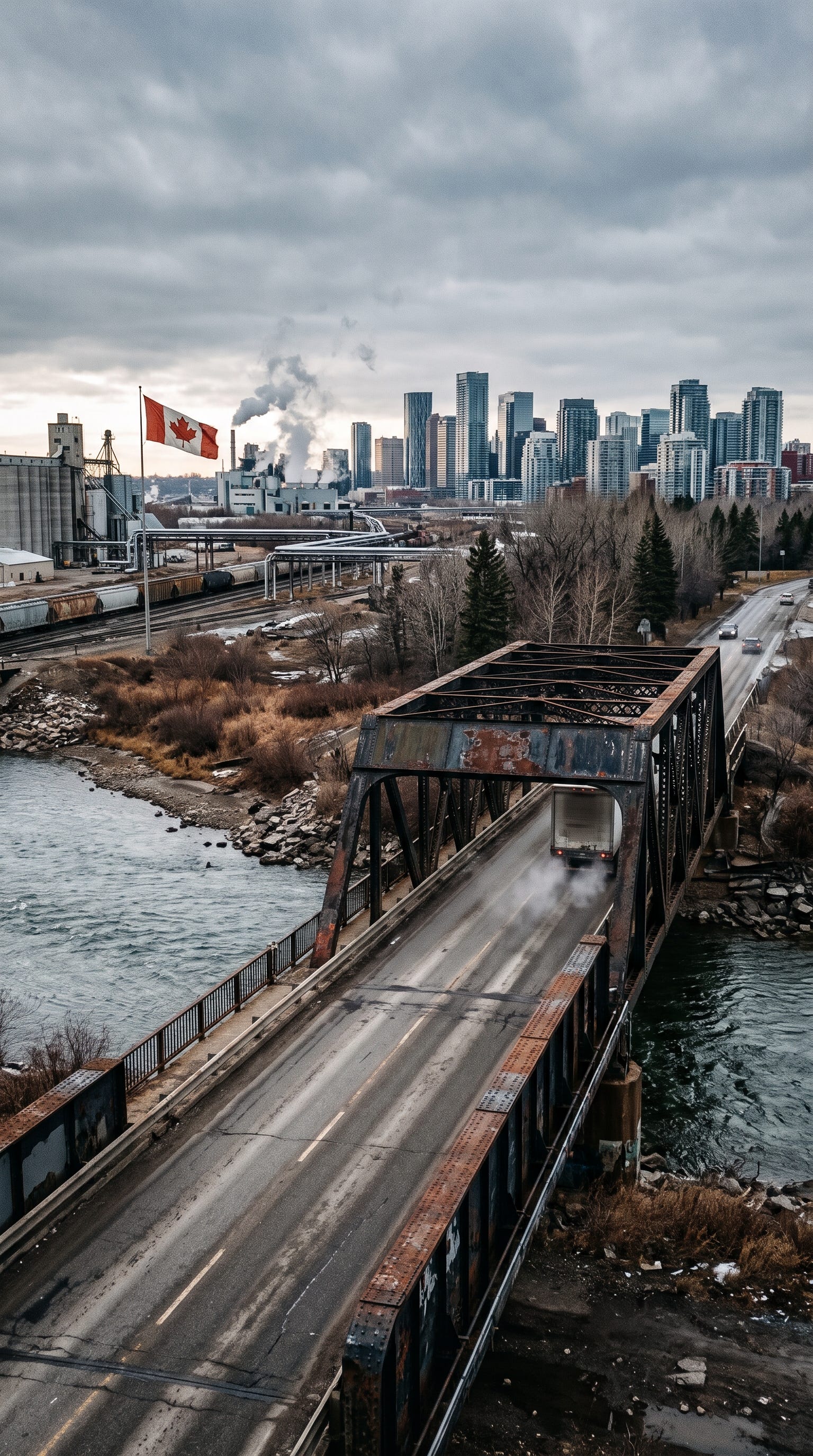
1. Money Is Born Out of Mortgages—Not Out of a Vault
Most Canadians still picture banking the way it worked in the nineteenth century: savers deposit paycheques into a chartered bank, and the bank lends out those existing savings to homebuyers and businesses. That picture has no bearing on modern reality.
Across Canada’s Big Six chartered banks, commercial lenders create money out of thin air every time they issue a loan. When a family signs an $800,000 mortgage in Toronto or Vancouver, or a corporation draws down a $200 million credit facility, the bank does not pull cash out of another customer’s savings account. It types two matching entries onto a digital ledger: a new loan asset on one side and a brand-new deposit of spendable Canadian dollars on the other. Roughly 90 percent or more of Canada’s broad money supply exists not as Bank of Canada polymer bills, but as commercial bank credit born directly out of debt.
For twenty years, Canada ran a specific version of this credit machine. Rather than channeling newly created bank credit into factories, machine tools, or domestic industrial capacity, Canada’s financial system poured trillions into residential real estate and existing financial assets. Rising house prices required larger mortgages; larger mortgages created more digital money; and more digital money bid house prices higher still.
2. Private Affluence, Household Leverage, and Public Strain
When a detached house doubles in price without adding a single square foot of living space, or when bank and energy shares rally on the Toronto Stock Exchange, national net worth jumps by hundreds of billions on paper without building a single kilometer of high-speed rail, a single refinery, or a single hospital wing.
According to Statistics Canada’s distributional wealth accounts, the top 20 percent of Canadian households hold nearly two-thirds (65.7 percent) of the nation’s entire net worth, while the bottom 40 percent hold almost none—leaving a 62.7 percentage-point wealth chasm between the top tier and working families. Higher-income households capture the compounding gains of equities and investment funds, while younger and working-class households absorb the debt service ratio—14.75 percent of disposable income directed purely to servicing debt payments—alongside rising grocery, rent, and municipal tax bills.
At the same time, decades of offloading infrastructure maintenance and relying on real-estate transaction taxes left municipalities and provinces patching aging water mains, transit bottlenecks, and congested ports while Ottawa borrows tens of billions each year simply to roll over existing obligations.
3. Out of Every 100 Canadian Workers: Who Actually Builds the Country?
Strip away the Bay Street commentary and look at the real Canadian economy through the 21.0 million people who actually go to work each day. Shrink the entire Canadian workforce down to 100 workers, and the physical foundation of the country comes into sharp focus:
Roughly 19 out of 100 workers make, grow, or extract physical things. Nearly 9 work in manufacturing factories—building vehicles, aerospace parts, steel, machinery, processed food, and wood products for an average of about $35.20 an hour (around $73,200 a year full-time)—while almost 8 work in construction and the skilled trades, building housing, roads, and industrial infrastructure for an average of $37.86 an hour (around $78,700 a year). Fewer than 2 work in oil, gas, mining, and forestry (averaging $47.32 an hour), and roughly 1 works in agriculture.
Nearly 6 out of 100 keep the country moving and the power flowing. Roughly 5 work in transportation and warehousing—hauling freight across highways, rail corridors, and ports—while fewer than 1 works in electrical, gas, and water utilities, maintaining the grid at an average of $53.37 an hour (over $111,000 a year).
More than 27 out of 100 care for, educate, and administer the public. Roughly 14 work in healthcare and social assistance—nurses, hospital staff, paramedics, and personal support workers—nearly 8 work in schools, colleges, and universities, and 6 serve directly in federal, provincial, and municipal public administration.
Roughly 38 out of 100 power the everyday commercial and office economy. Over 14 work in retail and wholesale trade, 13 work in professional, scientific, technical, and business support services (engineers, lawyers, accountants, consultants, and building maintenance), 7 work in banking, insurance, and real estate, and nearly 4 work in repair shops, personal care, and community services.
Roughly 10 out of 100 work in hospitality, food service, culture, and media. Almost 6 work in accommodation and food services—restaurant cooks, servers, baristas, and hotel staff—earning the lowest average wage in the country at $20.98 an hour (roughly $34,000 to $43,600 a year depending on hours). The remaining 4 span all of information, telecom, broadcasting, arts, entertainment, and recreation combined.
4. The Industrial Ledger: What Canada Sells vs. What Canada Must Buy
Unlike the United States, Canada does not issue the world’s reserve currency. Canada cannot print Canadian dollars to pay for foreign machinery or medicines without watching the loonie fall and import prices surge. To buy what it needs from the world, Canada must earn hard foreign currency by shipping real physical goods across oceans and borders.
Look at Canada’s top ten exports alongside its top ten imports, and a stark structural asymmetry emerges: Canada exports raw energy, metals, timber, grain, and branch-plant assemblies, while importing the advanced machinery, electronics, pharmaceuticals, and finished industrial systems required to keep a modern society running.
Canada’s Top Ten Export Pillars (Annual Goods Trade):
1. Crude Oil, Natural Gas, and Refined Petroleum Products: Canada’s single largest export engine—over $137 billion to $154 billion annually in crude bitumen, natural gas, and refined fuels, overwhelmingly shipped south through pipeline corridors.
2. Motor Vehicles and Automotive Parts: Roughly $52 billion to $58 billion in assembled light-duty vehicles, engines, and components built across Ontario’s manufacturing corridor.
3. Gold, Silver, and Precious Metals: Over $34 billion to $43 billion in mined and refined bullion and platinum-group metals, surging alongside global central-bank reserve accumulation.
4. Industrial Machinery and Mechanical Equipment: Roughly $41 billion in specialized turbines, agricultural equipment, pumps, and heavy industrial hardware.
5. Electrical and Electronic Equipment: Over $17 billion in telecommunications gear, electrical switchgear, and industrial control systems.
6. Plastics and Polymer Articles: Roughly $15 billion to $16 billion in resins, packaging, and industrial polymer components derived from domestic petrochemicals.
7. Aircraft, Engines, and Aerospace Parts: Nearly $14 billion to $21 billion in business jets, regional aircraft, landing gear, and flight simulators—one of Canada’s highest-value engineering sectors.
8. Lumber, Wood Pulp, and Paper Products: Over $12 billion in softwood lumber, structural timber, and pulp shipped globally.
9. Aluminum and Non-Ferrous Metals: Roughly $12 billion to $14 billion in primary aluminum smelted with Quebec and British Columbia hydroelectricity, alongside refined copper, nickel, and zinc.
10. Metal Ores, Potash Fertilizers, and Grains: Over $11 billion each in iron and critical mineral ores, Saskatchewan potash essential to global food harvests, and Prairie wheat and canola.
Canada’s Top Ten Import Dependencies (What the Country Must Buy Abroad):
1. Heavy Machinery, Boilers, and Industrial Tooling: Over $87 billion annually—far exceeding what Canada exports—reflecting the reality that Canadian factories, mines, and construction sites rely on foreign-built precision machines.
2. Motor Vehicles and Automotive Components: Over $87 billion in finished passenger vehicles, commercial trucks, and foreign parts—meaning Canada runs a deep structural trade deficit even inside its own auto sector.
3. Semiconductors, Computers, and Electronic Equipment: Nearly $52 billion in microchips, servers, smartphones, and consumer electronics that Canada does not fabricate at scale.
4. Refined Fuels and Regional Energy Imports: Over $34 billion in refined gasoline, diesel, and crude oil imported into Eastern Canada despite massive Western production—a direct consequence of missing east-west pipeline and refining infrastructure.
5. Precious Metals and Industrial Refining Inputs: Roughly $26 billion in doré bars, bullion, and specialty alloys routed through Canadian refineries.
6. Plastics and Synthetic Materials: Over $19 billion in finished plastic goods, medical disposables, and engineered polymers.
7. Pharmaceuticals and Biologics: Nearly $19 billion in patented medicines, vaccines, and active pharmaceutical ingredients—exposing a critical domestic vulnerability in life sciences manufacturing.
8. Medical, Optical, and Scientific Instruments: Over $16 billion in hospital imaging scanners, surgical devices, and laboratory diagnostics.
9. Fabricated Iron, Steel, and Structural Metal Products: Nearly $19 billion combined across raw steel and finished structural steel articles used in bridges, towers, and pipelines.
10. Apparel, Textiles, and Household Consumer Goods: Over $17 billion combined across clothing, footwear, and furnished household goods imported from Asian and European supply chains.
Read those two lists side by side. Canada ships out raw hydrocarbons, raw ore, unrefined lumber, and semi-finished metals, and buys back the finished machines, medicines, electronics, and steel structures made from those very inputs. For decades, successive governments treated that arrangement as permanent—assuming Washington would always guarantee open border access, cheap security, and frictionless trade.
5. The Myth of Eating the Living: The Cognitive Crack Beneath the Balance Sheet
Every empire and nation that mistakes paper wealth for real power eventually falls into the same ancient trap: eating the living. In depth psychology and political economy alike, the metapattern never varies. An organism that consumes its own muscle and bone to keep a fever burning feels warm for a season—until the structure gives way. Like a household burning its own roof beams to heat the living room, a nation that converts real productive substance into paper symbols mistakes liquidation for nourishment.
Across every cycle of institutional decline, that same four-stage pattern unfolds: first comes abstraction, turning skilled labor, physical goods, and genuine comprehension into paper metrics; next comes extraction, concentrating capital in the layer that trades those symbols; then comes illusion, celebrating record balance sheets while the foundation hollows out; and finally comes fracture, when an external shock exposes everything missing underneath.
For decades, Canada ran on that exact bargain: dig up raw resources, inflate residential real estate with bank-created mortgage debt, hand out record numbers of diplomas, and import finished machines, medicines, and security from abroad. On the surface, the numbers looked immaculate. Underneath, two deep cracks opened in the foundation.
The first crack sits in the material ledger—shipping out raw bitumen, ore, and lumber while buying back the finished industrial world at a markup. The second crack sits in the cognitive ledger, and it rarely makes the financial pages. Canada leads the entire OECD in tertiary attainment, with 64 percent of adults aged 25 to 64 holding post-secondary degrees or diplomas against a 43 percent OECD average. Yet record credential counts mask a steady erosion in foundational reading depth and analytical synthesis.
In our elementary schools, 38 percent of Grade 3 students are non-proficient readers against a 62 percent proficiency benchmark—meaning more than one in three nine-year-olds lacks fluent print decoding before they even reach middle school. That early deficit follows the country into adulthood. While Canada’s national mean adult literacy score of 271 outperforms the 259 OECD average, it still falls inside PIAAC Level 2—below the Level 3 threshold required for complex multi-source reasoning. Out of every 100 working-age Canadians, 19 read at Level 1 or below (compared to 26 across the OECD), restricted to brief, simple texts; another 30 operate at Level 2, connecting straightforward facts without deeper synthesis; 37 reach Level 3; and only 14 command Levels 4 and 5 (versus 11 across the OECD)—the sustained analytical capacity needed to integrate competing evidence, master technical systems, and govern a sovereign nation without being steered by slogans.
A country cannot build sovereign supply chains, run advanced manufacturing, or defend an Arctic continent on inflated house prices and hollow credentials. If Canada intends to fulfill its potential as a truly sovereign nation, it must repair both ledgers at once: redirecting capital from speculative real estate into physical production, and restoring the deep literacy and analytical rigor that turn a population of passive consumers into builders.
6. Where the Prime Minister Wants to Take Canada: Ending the Era of Passive Extraction
That realization finally forced a reckoning in Ottawa in 2025 and 2026. Facing aggressive U.S. tariff threats, weaponized supply chains, and an eroding rules-based order, Prime Minister Mark Carney has launched the most explicit industrial pivot since the Second World War—recasting economic policy around a single premise: the line between economic security and national security has disappeared.
Across three interlocking pillars—the Major Projects Office, Canada’s first Defence Industrial Strategy (February 2026), The Plan for a Stronger Canada (October 2026), and the November 2026 Federal Budget—the Prime Minister is attempting to rewire where Canadian capital and credit flow:
1. Fast-Tracking Nation-Building Physical Infrastructure. Through the newly empowered Major Projects Office, Ottawa has moved to bypass multi-year regulatory paralysis to accelerate physical corridors—including the Alto High-Speed Rail line along the Toronto-Québec corridor, Arctic economic and security infrastructure, port expansions, critical mineral processing, and interprovincial energy grids—backed by nearly 60 percent of new budget measures directed toward capital investment.
2. The ‘Build–Partner–Buy’ Defence Industrial Pivot. Backed by a new Defence Investment Agency, a $4 billion Defence Platform at the Business Development Bank of Canada, and $180 billion in direct procurement alongside $290 billion in defence-related infrastructure over the coming decade, Ottawa has mandated a ‘Buy Canadian’ rule targeting 70 percent domestic procurement. Rather than sending taxpayer billions abroad for off-the-shelf foreign hardware, the strategy anchors sovereign domestic production in shipbuilding, aerospace, Arctic sensors, satellites, drones, quantum communications, and specialized land vehicles—aiming to generate $125 billion in downstream domestic economic activity and boost defence exports by 50 percent.
3. Breaking Internal Trade Walls and Diversifying Global Corridors. Recognizing that sending 70-plus percent of exports to a single unpredictable buyer leaves Canada exposed to extortion, the government has moved to dismantle interprovincial trade barriers while locking in bilateral industrial, energy, and security agreements across the European Union, the United Kingdom, and the Indo-Pacific—turning Canadian critical minerals, clean power, and aerospace engineering into sovereign leverage.
4. Moving Value-Added Processing Home. Instead of exporting raw lithium, nickel, copper, and crude oil only to import finished batteries, transformers, and refined fuels, the strategy ties federal procurement, tax credits, and sovereign wealth co-investment to domestic refining, manufacturing, and intellectual property retention inside Canada.
7. The Verdict: Can the Strategy Outrun the Debt Clock?
The diagnosis in Ottawa is finally honest: a G7 nation cannot survive as a passive quarry, a real-estate casino, and a credential mill in a world of hardened economic blocs. You cannot defend Arctic sovereignty with inflated housing valuations, and you cannot manufacture turbines, destroyers, or medicines out of mortgage debt.
Yet the execution test remains severe. Ottawa is launching this industrial rebuild while carrying a $1.3 trillion federal debt, paying $60 billion a year in interest alone, and issuing roughly $298 billion to $316 billion in bonds and treasury bills annually just to refinance and fund ongoing deficits. Meanwhile, private commercial banks still make far higher, safer margins issuing residential mortgages than financing domestic factories, machine-tool startups, or mid-sized industrial suppliers—and our schools still graduate hundreds of thousands of students who struggle with sustained analytical synthesis.
If Prime Minister Carney’s industrial architecture succeeds in redirecting Canadian credit, pension capital, and public procurement away from unproductive real-estate speculation and into physical infrastructure, domestic manufacturing, and sovereign supply chains—paired with a national revival in foundational literacy and technical mastery—Canada possesses every physical and human ingredient on earth to become a true sovereign powerhouse.
If it stalls in bureaucracy while Bay Street keeps feeding the property-and-debt loop, Canada will remain trapped in the same paradox: rich on a spreadsheet, indebted at the kitchen table, and eating its own living foundation while buying back the finished world at a markup.

God is Love. Love is Truth. Truth is Consciousness. Consciousness is Brahman.
Amen. Namaste. Om Namah Shivaya.
— The Architect.
Written from love, for a sacred humanity, in the full light of consciousness, toward the greater good.