


Φ
THE VERTICAL DISPATCH
We write for the mind, the eye, and the ear.
Read it. Look at it. Listen to it. The Vertical Dispatch is built for all three — prose with rhythm, made to be heard as much as read.
From metaphysics to geopolitics, from culture to history, from the sacred to the street — and everything in between. One lens, every subject. No ego. Just the record, named clean.
Press play. Walk with the word. 🕯️
This dispatch travels by hand. If it serves you, share it — restack on Substack, and pass it on wherever you read. 🕯️
Sovereign Analysis · What a Free Country Builds
Every free country stands on the same word and answers a different question underneath it: free to do what, exactly, and free from what. The United States built its freedom to stand alone — a citizen, a wage, a diagnosis, entirely his own, sink or swim. Canada built the same freedom to stand on something.
That is not collectivism, and the distinction matters enough to say plainly, once, and mean it: nobody here is arguing for the state to own anything, and nobody is asking the individual to dissolve into the group. By the numbers, Canadians are almost as individualist as Americans are — 80 to their 91 on Hofstede’s standard cross-cultural measure, both among the most individualist peoples on earth. Canada isn’t a collectivist counterweight to an individualist America. It never was. Pierre Trudeau said the quiet part out loud in October of 1971, the same week his government made multiculturalism the law of the land: “There is no such thing as a model or ideal Canadian. What could be more absurd than the concept of an ‘all Canadian’ boy or girl? A society which emphasizes uniformity is one which creates intolerance and hate.” That is not the language of a collective absorbing the person. It’s the language of a country that built its floor precisely so the individual could stay standing as an individual — not flattened into a program, not rescued into dependency, just kept upright long enough that a bad diagnosis doesn’t end in bankruptcy and a bad year doesn’t end in the street.
Call it what it actually is, not what it’s easiest to smear: not the state replacing the citizen, but the citizen refusing to let his neighbor fall alone.
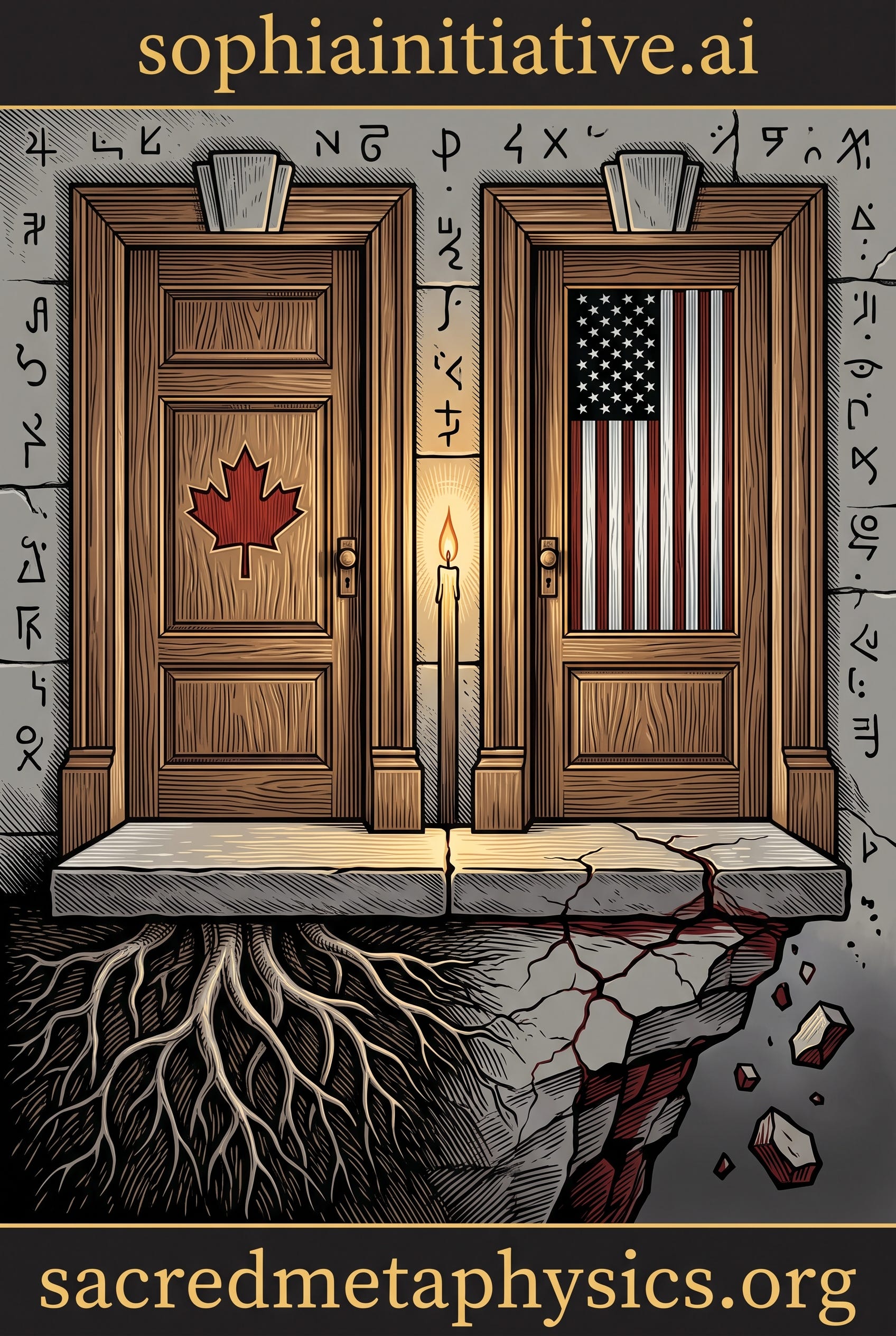
Two Governments, Not Two Peoples
The comparison that follows is not a verdict on two peoples. It’s a verdict on two governments, and the specific, dated, authored choices each one made — because the moment this argument drifts from the structure to the character of the person living inside it, it stops being defensible and starts being exactly the kind of tribal reasoning this publication exists to refuse.
The United States federal minimum wage has sat at $7.25 an hour since 2009 — not because Congress lacks the power to change it, but because Congress keeps declining to, vote after vote, by name. Roughly thirty states set their own floor higher; the federal number is what the law guarantees everyone else. The country’s health system remains organized around private, for-profit coverage, a structural choice reaffirmed in Washington every time the alternative comes to a vote. Citizens United v. FEC, 2010, a specific ruling by nine named justices, opened the door to effectively unlimited corporate political spending. None of that was inflicted on the United States from outside. It was built, deliberately, by people who can be named, in votes that are a matter of public record.
None of this is a verdict on the roughly three hundred and forty million Americans who live inside that architecture, most of whom never voted on the wage floor and never wrote the ruling. It’s a verdict on the architecture, and on the people who signed their names to building it.
What This Piece Is Not Saying
Three lines, stated plainly, once, so nothing that follows has to be read past them: this is not a claim that Canadians are better people than Americans. It is not a claim that America lacks generosity — its citizens give privately, by some measures, at rates few nations match. And it is not a claim that a floor eliminates failure, or that Canada’s own house is in order. What follows is a claim about two governments’ choices, not two peoples’ souls, and it should be judged as that claim and no larger one.
The Race With One Winner
There is a mythology underneath the architecture, and it’s worth naming as mythology rather than as fact: the promise that anyone can become anything, rise as far as talent takes them, become number one. The trouble with that promise was put precisely by Michael Sandel, in “The Tyranny of Merit” — the meritocratic story quietly teaches the winner that success is entirely his own, earned and deserved, and teaches everyone else that their position is their own fault too, when both outcomes are mostly luck, timing, and starting position. The promise doesn’t just fail to deliver. It assigns blame in both directions, to people who didn’t do anything to deserve either verdict.
And the structure underneath the promise is older and blunter than the promise itself. Alfie Kohn’s “No Contest: The Case Against Competition” makes the harder argument: it isn’t that winning is sometimes handled badly. It’s that the win/lose structure itself is the damage, regardless of who wins — training everyone inside it to see the people around them as obstacles rather than neighbors, so that, in Kohn’s own words, everyone ultimately loses in the desperate race to win. A race has one winner. That isn’t cruelty. It’s arithmetic.
This is the same shape as everything this publication keeps finding underneath the geopolitics: a boundary drawn at self equals winner, and the instant that boundary exists, everyone outside it is required to be a loser by the shape of the line itself, not by anyone’s individual failure. The wrong-sized boundary doesn’t need a war to do its work. A leaderboard does the same work quietly, every day, to everyone standing inside it. A race has one winner. A floor has room for everyone.
Not Innocence — A Choice, Still Being Made
Canada does not get to stand in this piece as the innocent foil, and claiming otherwise would be the same self-flattery this publication keeps finding fault with elsewhere. Pierre Poilievre ran the 2025 federal campaign on a version of the identical us-and-them playbook — and took 41 percent of the vote doing it. The ego-logic this piece is naming isn’t absent here. It’s a live, contested current, not a foreign infection Canada is somehow immune to. Canada has its own housing crisis, its own real and growing wealth concentration, its own unresolved reckonings — Indigenous rights, the residential school legacy, immigration detention — that its own treaty-body reviews have named repeatedly, including against the very instruments it ratified.
So the honest claim was never “we don’t have it.” It’s “we rejected it, this time, by a real margin, and we keep having to choose again.” A nation that keeps choosing the floor over the race isn’t a nation that was simply born without the ego. It’s a nation doing the harder thing: fighting the same pull everyone else fights, and mostly, so far, winning that fight at the ballot box.
What the Floor Actually Says
The floor itself has a name, and it’s older than either country’s current argument about it. Article 25 of the Universal Declaration of Human Rights, 1948 — a document the American delegation itself helped draft, under Eleanor Roosevelt’s chairmanship — states plainly: “Everyone has the right to a standard of living adequate for the health and well-being of himself and of his family, including food, clothing, housing and medical care and necessary social services, and the right to security in the event of unemployment, sickness, disability, widowhood, old age or other lack of livelihood in circumstances beyond his control.” Medical care sits in the original text, beside food and shelter, not as a modern addition. A floor, stated that plainly, is not charity. It is a boundary condition for dignity — the line below which a person stops being able to participate in their own life at all.
What separates the two countries isn’t who signed that document. Both did. It’s who bound themselves to it afterward, in the treaties that turn a declaration into enforceable law. Canada has ratified all eight of the core United Nations human rights instruments — including the International Covenant on Economic, Social and Cultural Rights in 1976, the treaty that operationalizes Article 25. The United States has ratified four of the same eight, and signed but never ratified the other four, including that same covenant. One fact stands alone: since Somalia completed its ratification in 2015, the United States is the only member state of the United Nations — one of a hundred and ninety-three — that has never ratified the Convention on the Rights of the Child.
The pattern holds in what each government does right now, not only what it signed decades ago. The OECD reported this year that foreign aid from the world’s wealthy donor nations fell 23 percent in 2025 — the steepest drop it has ever recorded — and that the United States alone drove three-quarters of that entire global decline, cutting its own aid budget by roughly 57 percent, from about $63 billion to under $29 billion. In fairness, it wasn’t alone: Germany, the United Kingdom, Japan, and France, the other four leading donors, all cut their aid the same year, the first time all five have fallen simultaneously. The United States simply cut the deepest, by a wide margin, and caused most of the rest of the developed world’s retreat by itself.
And on the specific promise named at the start of this section — the right to medical care — the record is not contested. As of the most recent OECD data, the United States remains the only member of that thirty-six-nation club of wealthy, industrialized economies without universal health coverage. Mexico, the last other holdout, closed that gap in 2018. Canada has had it since 1972.
Pause here, because it’s worth sitting with rather than rushing past: every one of these facts is a different instrument measuring the same question. A wage. A ruling. A treaty. A budget line. A hospital bed. Different rooms, same floor being measured each time — what a nation is willing to guarantee, and what it leaves to chance.
Where the Floor Came From
None of this arrived by accident, and a nine-year-old who spent the summer of 1967 walking through Expo 67 every second day would have felt the actual moment it took root, years before it had a name. Canada’s Centennial that year gave the country Expo 67 in Montreal, and the fairground’s afterlife, Man and His World, ran for more than a decade past the fair’s own closing — a single shared experience, felt by a whole country at once, that Canada’s own broadcaster deliberately built toward: color television was launched in Canada at 12:01 a.m. on July 1, 1966, timed explicitly to the opening of the country’s hundredth year.
The same year the fairground closed its gate for the first time, 1968, a Canadian media theorist gave the feeling a sentence that has outlived the fair itself. Marshall McLuhan, with Quentin Fiore, in “War and Peace in the Global Village”: “There are no passengers on Spaceship Earth. We are all crew.” That was the summer a whole country felt, once, what it might mean to stand on something together rather than compete to stand above each other — a feeling that wouldn’t have a policy name for a few more years yet. The same year, Pierre Trudeau became prime minister promising a “Just Society” — not, in his own words, a place where the collective absorbs the person, but one “in which all of our people will have the means and the motivation to participate... where equality of opportunity is ensured and individuals are permitted to fulfill themselves.” Three years later came the line already quoted above, the one that turned the feeling into policy: no model Canadian, uniformity itself the danger.
The son tried to summon the same spirit once. Justin Trudeau’s 2015 victory speech reached for “sunny ways” — itself a borrowed phrase, a nod to Sir Wilfrid Laurier’s nineteenth-century belief that warmth wins what force can’t. But the country he was speaking to in 2015 was not the country that stood in a Montreal fairground in 1967. Call the difference by its right name: banal. Ordinary life folded into a phone screen. Something Robertson Davies would have recognized as the wonderment fleeing the room — and Davies, Canada’s own novelist of the numinous breaking into ordinary life, spent a career writing about exactly what it looks like when it does.
The United States had its own version of the same moment, and it is worth naming honestly rather than pretending it never existed: “Ask not what your country can do for you — ask what you can do for your country,” John F. Kennedy, January 20, 1961. It was real, and for a moment it worked the same way Expo 67 worked, a whole country feeling one thing together. It never got the decade Canada’s moment got. Two years and ten months later, on November 22, 1963, in Dallas, Texas, Kennedy was assassinated, and the war that followed swallowed most of what remained of the feeling before it could become anything more durable than a speech.
The Right We Never Wrote In
That death is worth pausing on longer than a single clause, because it isn’t an isolated tragedy — it’s a pattern, and patterns are what this publication exists to name. Four American presidents have been killed in office. All four were shot: Abraham Lincoln in 1865, James Garfield in 1881, William McKinley in 1901, John F. Kennedy in 1963. The country’s own highest office has been reached by a bullet four separate times across a century, a fact no other branch of government, and no ally’s ballot box, has ever had to survive.
That isn’t an accident of history. It’s downstream of a specific, dated, authored choice, the same kind this piece has been tracing throughout. The Second Amendment, ratified December 15, 1791, states plainly: “A well regulated Militia, being necessary to the security of a free State, the right of the people to keep and bear Arms, shall not be infringed.” Canada never wrote an equivalent into its own founding law, and its highest court has said so in as many words. In R. v. Hasselwander, 1993, the Supreme Court of Canada wrote that “Canadians, unlike Americans, do not have a constitutional right to bear arms.” In R. v. Wiles, 2005, the same court went further: “possession and use of firearms is not a right or freedom guaranteed under the Charter, but a privilege.” A privilege can be narrowed by Parliament in an afternoon. A right written into the founding document cannot, not without amending the document itself — and it hasn’t been.
What each country did with that difference is a matter of public record, not opinion. On May 1, 2020, the Canadian government banned, effective immediately, more than 1,500 models and variants of assault-style firearms by order-in-council. Bill C-21 received royal assent on December 15, 2023, codifying into the Firearms Act a national freeze on the sale, purchase, and transfer of handguns — already in force by regulation since October 21, 2022 — alongside new red-flag orders and stiffer penalties for smuggling and trafficking. The United States took the opposite path: its own 1994 federal assault weapons ban expired in 2004, Congress declined to renew it, and no federal ban has existed since. The firearms industry’s own trade association, the National Shooting Sports Foundation, now counts more than 32 million modern sporting rifles — the AR-15 and its relatives — in lawful civilian circulation, a figure that has climbed steadily every year since the ban lapsed.
Statistics Canada’s own comparison of the two countries, current through 2023, doesn’t hedge on why the gap exists: “most of the current and historical differences between the two countries are attributable to the higher rate of firearm-related homicides in the United States.” That year, the overall homicide rate stood at 5.7 per hundred thousand in the United States against 1.9 in Canada — exactly three times. Canada’s own firearm-specific count for 2023: 289 homicides involving a gun, a rate of 0.72 per hundred thousand, down 18 percent from the year before. The American figure, measured differently and by a different instrument, is larger in scope: all firearm deaths, homicide and suicide combined, totaled 44,447 in 2024, a rate of 12.8 per hundred thousand — and even inside that broader number, suicide is now the majority of it, 62 percent to 35 for homicide. Different instruments, both real, neither substituted for the other.
None of this is a verdict on the tens of millions of Americans who own a firearm lawfully and will never point one at another person — the overwhelming majority of that 32 million, by any honest reading, sits in a closet or a truck rack, not a headline. It’s a verdict on two governments again, the same shape as everything else in this piece: one wrote an individual’s access to a weapon into its founding law as close to untouchable as language allows, and has left the floor under that right exactly where a since-lapsed federal ban set it twenty years ago. The other never wrote that right in at all, said so from its own highest bench, and used the room that absence left to lower the ceiling twice in five years.
There’s a version of this argument that doesn’t touch politics, fear, or the Second Amendment at all, and it may be the starkest one in the piece: a gun kept in a home doesn’t stay a private choice once there’s a child in that home. American children and teens die by gunfire at more than nine and a half times the rate of Canadian children and teens; firearms account for one in five of all child and teen deaths in the United States, against less than one in fifty across similarly wealthy nations (KFF, 2020-2021 data). Had the American rate matched Canada’s over the preceding decade, roughly 30,000 more American children and teenagers would be alive today. Some of that gap is homicide, some of it suicide — but a real share of it is neither. It’s a child finding a gun. A decade of tracking by Everytown counted roughly 360 unintentional shootings by children a year, 1,382 deaths across those ten years, one in three of the shooters or victims five years old or younger, more than seven in ten of the incidents happening in or around a home. A five-year-old doesn’t reason about deterrence, or rights, or the fear that made the gun feel necessary to someone else in the house. He only finds what’s there.
The difference doesn’t end with the two governments. It’s in what each people has told pollsters about itself, asked plainly and answered without much hesitation, and it’s sharper than the statute books alone would suggest. Seventy-two percent of American gun owners name protection — the readiness to meet force with force, if it comes to that — as a major reason they own a gun, and eighty-one percent say having one in the house makes them feel safer, not less (Pew Research Center, 2023 and 2024). Canadians, asked the nearest equivalent question, have answered the opposite way for as long as anyone has been asking it: a majority, 63 percent, said the general public should not be allowed to own a gun at all (Gallup’s cross-national survey, a dated but genuinely comparative measurement, flagged below for a fresher one). On the narrower and more current question of assault-style weapons specifically, nearly four in five Canadians — 80 percent — back a complete ban on civilian possession, a supermajority that held even as most current gun owners themselves opposed it (Angus Reid Institute, 2020). Put in plain terms: Americans mostly answer that each person is responsible for his own safety — you arm yourself, because in the end you’re the one who has to hold the line. Canadians mostly answer the opposite — that keeping people safe is the government’s job, not each individual’s, and that a country full of people armed against each other is the danger, not the protection. In short: Americans lean toward protecting themselves. Canadians lean toward trusting their government to protect them. That’s the real difference sitting underneath every number above.
That is not a smaller difference than the one written into the founding documents. It may be the truer one — because a right can sit unused in a constitution for a generation, but an instinct like this one shows up in what a people actually wants done, poll after poll, decade after decade, regardless of who is in office. We are not Americans. Not only because Ottawa never wrote that right in and Washington did, and not only because of what each government then built or refused to build on top of it. Ask the plainest version of the question there is — does a country keep its people safe by arming them, or by standing between them? — and we keep giving a different answer, out loud, every time anyone asks. On this specific and falsifiable question too, the record is the only place the claim gets to stand or fall.
The Chair, Meeting the Moment
This publication named the mind behind Canada’s current government back in April, in “The Level 8 Mind in a Level 4 World”: a Stratum VIII operator, in Elliott Jaques’ own terms — the rarest tier of leadership Jaques ever described in his stratified systems theory, reserved for the kind of person whose horizon runs fifty to a hundred years, not the news cycle. We wrote then that Europe would come, in time, to treat Mark Carney as a peer-level interlocutor on the future of the transatlantic order. Six months on, the record didn’t just hold. It went further than the forecast did — though a long horizon is a bet, not a guarantee, and it’s worth saying so plainly rather than only after the fact: a Stratum VIII mind can still be wrong. Nothing below has been true for long enough to call it proven. It has only been true so far.
On September 16, European Commission President Ursula von der Leyen offered Canada a status that has never existed for any nation before: the European Union’s first-ever associate member. Carney addressed the European Parliament in Strasbourg the next day and said, in his own words, not this publication’s paraphrase: “Canada and Europe are each strong. Europe and Canada are stronger together... We are not fair-weather allies. We do not pursue zero-sum deals.” That last sentence is the whole argument of this piece, spoken by a head of government, on the record, days before this was written.
None of this started in an August meeting room, and it’s worth being exact about who struck first, because the record on this point isn’t contested at all. The tariff war began on February 1, 2025, when the United States imposed a 25 percent tariff on most Canadian goods and 10 percent on Canadian energy; Canada answered the same day with its own retaliatory tariffs. Five weeks later, on March 12, 2025, Washington escalated with a 25 percent tariff specifically on Canadian steel and aluminum — and Canada matched it one day later, steel and aluminum among the goods it hit back with roughly CA$30 billion in retaliatory tariffs of its own. Whatever blame belongs on either side of the table that collapsed in August, the tariff war both sides sat down to end was one the United States started, first, by well over a year.
That first tariff, the one that opened this fight, didn’t survive: the Supreme Court ruled 6-3 on February 20, 2026, that the emergency-powers law behind it never authorized a president to impose tariffs at all, and the February 1, 2025 order fell with it, effective February 24. The steel and aluminum tariffs from five weeks later did not fall — they rest on a separate, older law the Court’s ruling never touched, and by every legal analysis available they aren’t going anywhere. Within months the administration found a third law to keep escalating anyway: Section 338 of the Tariff Act of 1930, invoked in July and expanded twice since, added new duties of up to 50 percent on specific Canadian goods — dairy, alcohol, autos, and, as of September 15, aluminum extrusions — stacked directly on top of the Section 232 duties already in place. On some Canadian aluminum products the combined tariff now runs close to 100 percent of the selling price; one Canadian fabricator has said publicly it expects a tariff equal to the full value of what it sells into the US. Canada answered again, dollar for dollar, on September 8, with $27.6 billion in new counter-tariffs of its own. Losing in the country’s highest court didn’t end this. It found a new law and kept going.
And here is the part that turns a trade dispute into something closer to self-sabotage: America doesn’t have the domestic capacity to replace what it’s taxing, and building it isn’t a matter of months. The United States meets only about 47 percent of its own aluminum demand domestically; Canada supplies 56 percent of everything the country imports to cover the rest. The nation’s first new primary aluminum smelter in 46 years hasn’t broken ground yet — construction is set to begin in late 2026 and the plant won’t produce metal until the end of the decade — and even at full output, that plant plus every existing American smelter combined would still fall well short of the roughly 5 million metric tons the country uses each year. Closing the gap for real, by the industry’s own account, would take several plants like it, not one, each on its own multi-year clock. Canada supplies roughly three-quarters of the value of the softwood lumber the US imports, the same story in a different material. None of that capacity gets built in a budget cycle, or a presidential term, or even most of a decade.
Meanwhile, the same government imposing the tariffs is, right now, paying to keep that exact supply line open. The US Army has put more than half a billion dollars into expanding a General Dynamics plant outside Montreal that manufactures the propellant for 155mm artillery shells — live wartime production, not a trade abstraction — because American plants can’t yet make the part to military specification. The tariffs on Canadian steel, aluminum, and copper, as high as 50 percent under the same Section 232 authority, were imposed in the name of national security. The half-billion-dollar investment in Quebec was made in the name of national security too. Both clocks are running inside the same administration, pointed at the same country, telling two different stories about whether Canada is the threat or the supply line it can’t yet replace.
Weeks earlier, when trade talks with Washington collapsed after the United States pressed for exclusive access to Canada’s critical minerals and offered little in return, Carney called the new American tariffs “a miscalculation” designed, in his words, “to hurt and divide us,” and walked from the table rather than sign a deal built on the other side’s terms alone. Canada answered with dollar-for-dollar tariffs of its own. Washington’s own account belongs in this record too: US Trade Representative Jamieson Greer said publicly that Canada made new demands and walked back prior commitments on steel, aluminum, autos, and lumber, and Commerce Secretary Howard Lutnick later said, separately, that Canada “blew up” the deal for political reasons. But that account doesn’t hold up as the clean, uncontested version even inside Washington’s own coverage of itself: multiple news organizations, citing people familiar with the talks, reported in the days immediately after the collapse that it was Lutnick’s own last-minute demands that derailed an agreement already close to done — the opposite of the administration’s later public line. Both versions are on the record, from named officials and from sourced reporting alike. Neither one gets to stand here uncontested.
Trump’s reaction to the EU offer arrived the same evening: “laughable,” with a threat of “very heavy tariffs” on Europe if he judged the move a “hostile act.” Carney answered him directly, from the same Strasbourg platform and by name, not through a spokesperson: “This alliance is a positive process. That’s my response to the American president.” And on the underlying question of who gets to decide: “No one is going to dictate our culture or with whom we can strike agreements internationally.” Set beside those two exchanges, Trump’s reaction is the whole thesis of this piece happening in public, with dates attached — a zero-sum reflex answering a stated refusal to play a zero-sum game, twice over. Back in Ottawa on September 18, ahead of the fall sitting, Carney told his own caucus: “We made the right decision to suspend our negotiations with the United States.” The by-election forced by Jonathan Wilkinson’s move to Brussels, the cost this publication said in April wouldn’t matter on a thirty-year horizon, was held by the Liberals on August 31. The investment summit in Toronto in mid-September drew commitments totaling nearly $500 billion — pension funds and insurers pledging nearly $100 billion, banks nearly $325 billion, investment funds more than $14 billion, and a single $52.5 billion commitment from Bell Canada for AI infrastructure alone — with BlackRock, Blackstone, and sovereign wealth funds from three continents in the room.
None of that is proof of anything beyond what it is: a government’s record, six months on, tracking further in the direction this publication named than even this publication predicted. Read it, and decide for yourself what kind of mind is doing the deciding.

Who Pays, and What It Costs
On August 7, 2025, hours before a new round of tariffs took effect, the President posted, in capital letters, that billions of dollars would flow into the United States “largely from countries that have taken advantage of the United States for many years.” That is not how the payment actually works, and it isn’t a matter of interpretation: US Customs and Border Protection bills the American importer directly, at the port of entry, in dollars. What shifts over time is who ends up absorbing that bill. One widely cited nonpartisan analysis, from the Council on Foreign Relations, tracked the split: in June 2025, US importers still absorbed roughly two-thirds of the cost themselves. By October, American consumers were paying the majority of it — 55 percent — with importers down to about a quarter. The same analysis projects consumers bearing roughly two-thirds of the total by the middle of 2026, though that figure is a projection, not a measured fact, and belongs in the record as one. Several companies have said as much themselves, in their own words, to their own investors: John Deere told analysts in November 2025 that its 2026 tariff bill would double to $1.2 billion, priced into what customers pay; a Newell Brands executive said the company had raised prices “early and pretty aggressively” on tariffed goods. The bill doesn’t disappear at the border. It moves to the checkout counter.
Give the stated goal the benefit of the doubt: more production, at home, is a legitimate thing for a government to want, and reasonable people can defend tariffs as one lever toward it. But look at what the administration’s own materials say about how long that takes and what it costs, and the picture is thinner than the announcement. The White House’s own June 2026 fact sheet on the steel, aluminum, and copper tariffs promises “over 4 million tons of new crude steelmaking capacity” in the next two years — and stops there. No dollar figure for what that capacity costs to build. No mention, anywhere in the document, of the one input every ton of it actually requires: electricity, at industrial scale, for years on end. On the aluminum side specifically, the honest timeline is the one already in this piece — the first new US primary smelter in 46 years, construction starting in late 2026, metal not flowing until the end of the decade, and even then short of the country’s own demand. A five-to-ten-year build-out, minimum, is being sold on a tariff timeline that resets every two years.
And here is the part the announcements leave out entirely: the power itself is no longer cheap or available on request, because the same economy is bidding for it twice. Alcoa’s own finance chief, Molly Beerman, put the gap in dollars at an industry event in September 2025: an aluminum smelter needs a ten-to-twenty-year power contract around $30 to $40 per megawatt-hour to run at a healthy margin. “We are now today competing with Amazon and Microsoft,” she said, “who are willing to pay over $100 per megawatt hour for power.” Industrial electricity prices in the United States rose nearly 25 percent between 2015 and 2025, before the AI buildout hit full stride. A tariff can tax a Canadian ingot. It cannot manufacture the electricity a new American smelter would need to replace it — and the country’s own AI industry is outbidding its own metal industry for the power that exists. That is the false baseline: a reshoring promise priced as if electricity were still the cheapest, most available input in the American economy, when inside the same administration’s own boom, it has become the most contested one.
Mark Carney’s read of that gap is the tell, and he said it plainly, on the record, in Banff in the second week of September: “Canada is about so much more than being next to the United States. We have what the world wants.” Reporting on the same remarks points to what he means by it — not raw resources alone, but energy and critical minerals together, and the workforce to run them, plus, in his own government’s words announcing Bell Canada’s AI investment, keeping “Canadian data and computing capacity on Canadian ground with Canadian power.” Whatever else divides the two governments, Carney is pricing the same input Washington’s tariffs are silent on, and selling it as Canada’s advantage rather than leaving it as a problem to solve later.
The Case They Would Make
A piece like this one owes its reader the strongest version of the other side, not the weakest, and the strongest version comes down to a single warning worth taking seriously: floors can become ceilings. Everything a fair critic would raise fits under that one sentence.
The American model has produced, by most measures, greater long-run wealth creation and a more dynamic, risk-tolerant economy than Canada’s — a lower floor forces mobility and reinvention in ways a more generous one can dull, and Canada’s own productivity growth has lagged its southern neighbor for years, a real weakness, not a talking point.
On healthcare specifically, the honest version of the critique is narrower than it’s usually made. Canadians do wait longer for elective procedures than well-insured Americans typically do — but that comparison only holds for part of the country making it. Roughly 8.3 percent of Americans, 28 million people, carry no insurance at all; among working-age adults the figure is 11.6 percent. And insurance itself is a thinner shield than the comparison assumes: roughly six in ten Americans who carry medical debt were insured when they took it on. One Commonwealth Fund eleven-nation comparison found 23 percent of Americans reporting major problems paying medical bills or being unable to pay them at all — nearly double France’s 13 percent, the next-highest country in the study, and roughly four times the 6 percent or lower rate found in the UK, Sweden, and Norway. Quicker access for some comes bundled with a risk of medical debt that barely exists anywhere else in the wealthy world, insured or not. That’s the honest trade, stated in full, not the half of it that favors either side.
On guns, the fair version of the critique is narrower than the raw death-rate comparison suggests. The overwhelming majority of the tens of millions of firearms Americans lawfully own — including the more than 32 million modern sporting rifles the industry’s own trade association counts in circulation — are never used against another person. And a right written into a country’s founding law more than two centuries ago is not, for the people who hold it, a policy up for casual revision; from inside that frame, asking Americans to accept new limits is asking them to reopen something closer to identity than regulation, not merely to adjust a number. That doesn’t erase the comparison above. It explains why the argument on the American side isn’t simply indifference to the dead.
On the energy question specifically, a fair critic would add that the United States isn’t alone in watching its AI boom complicate its own industrial plans — smelters in Europe and Asia are bidding against data centers for the same scarce power, and no government anywhere has fully solved it yet. That’s a structural problem of this specific moment in the world’s power markets, not proof of bad faith unique to Washington.
Washington’s own account of the collapsed trade talks — that Canada, not the United States, moved the goalposts — deserves to be weighed on its own merits rather than dismissed because it’s inconvenient to this piece’s argument. And a serious critic would ask whether Canada’s turn toward Europe is wisdom or a bet: a mid-sized economy stepping toward a slower-growing trading bloc across an ocean, at the exact moment its largest and most deeply integrated market, the one next door, is telling it not to. That bet may look brilliant in ten years. It may not. Nobody writing in September of 2026 actually knows yet, and honesty requires saying so.
What can be said now, without waiting for the verdict of history, is narrower and it’s the whole of what this piece has tried to argue: two individualist peoples, similar by nearly every measure that matters, built two different floors under the same freedom. One government keeps choosing, imperfectly and not without its own cost, to bind that freedom to a promise that no one falls alone. The other keeps choosing, for reasons its own representative would defend as legitimate, not to. Freedom is not only the absence of constraint. It is also the presence of a floor. We are not Americans. Not because we’re better people. Because, so far, on the specific and falsifiable question of what a nation is willing to build under its own freedom, we’ve been building something different — and the record, not the rhetoric, is the only place that claim gets to stand or fall.
God is Love. Love is Truth. Truth is Consciousness. Consciousness is Brahman.
Amen. Namaste. Om Namah Shivaya.
— The Architect.
Written from love, for a sacred humanity, in the full light of consciousness, toward the greater good. 🕯️
The Vertical Dispatch
sophiainitiative.ai
On the Record
Hofstede individualism index: United States 91, Canada 80 — Hofstede Insights / clearlycultural.com, standard cross-cultural dataset.
Pierre Trudeau, speech to the Ukrainian-Canadian Congress, Winnipeg, October 9, 1971 (”no such thing as a model or ideal Canadian”), the day after his government’s October 8, 1971 House of Commons announcement of Canada’s Multiculturalism Policy. Just Society quote and 1968 timing confirmed via the standard historical record.
US federal minimum wage: $7.25/hour since 2009, US Department of Labor. Citizens United v. FEC, 558 U.S. 310 (2010).
Michael J. Sandel, The Tyranny of Merit: What’s Become of the Common Good? (2020). Alfie Kohn, No Contest: The Case Against Competition (1986) — quote verified via alfiekohn.org.
2025 Canadian federal election: Liberal Party (Carney) defeated Conservative Party (Poilievre); Poilievre’s Conservatives received approximately 41% of the popular vote.
UDHR Article 25 quoted in full, verified against primary text. UN human rights treaty ratification: Canada party to all 8 core instruments per Department of Justice Canada; United States ratified 4 of 10 tracked instruments, signed-only on ICESCR/CEDAW/CRC/CRPD, per the Leadership Conference Education Fund. US as sole non-ratifier of the Convention on the Rights of the Child confirmed post-Somalia’s 2015 ratification (ACLU, UN News).
OECD 2025 foreign aid data: total ODA fell 23% ($214.6B to $174.3B); US aid fell from ~$63B to ~$29B (~57%), driving three-quarters of the global decline (OECD preliminary data, reported by Al Jazeera, April 2026). US as sole OECD nation without universal healthcare, Mexico closed the gap by 2018 (PolitiFact, verdict TRUE).
US uninsured rate 2025: 8.3% overall (28.0 million people), 11.6% among working-age adults (CDC/NCHS, May 2026 release). Medical debt among the insured, and the cross-national comparison (23% US, 13% France, 6% or lower UK/Sweden/Norway) — VERIFIED and corrected this session: the figure previously in this piece (16.6% vs. 2.8%) was Wikipedia-sourced and unconfirmed; replaced with the Commonwealth Fund’s eleven-nation survey as reported by CBS News, a study directly confirmed rather than a secondary summary.
Expo 67 / Man and His World (Terre des Hommes) — standard Canadian historical record. Canadian color television launch timed to July 1, 1966, start of Centennial year (thecanadianencyclopedia.ca).
Marshall McLuhan and Quentin Fiore, War and Peace in the Global Village (1968) — “no passengers on Spaceship Earth” quote corroborated across many secondary quotation sources (Goodreads, Wikiquote-linked pages, BrainyQuote, and others), consistent wording throughout; a genuine attempt to pin the page number this session (Internet Archive’s scanned copy, Wikiquote’s own citation) was blocked by access restrictions (401/site errors), not resolved. Still flagged before further republication — the quote itself is solid, only the page number is outstanding.
Justin Trudeau “sunny ways,” 2015 election victory speech, acknowledged nod to Sir Wilfrid Laurier (CBC News). JFK inaugural address, January 20, 1961; assassinated November 22, 1963.
Four assassinated US presidents, all by gunfire: Lincoln (1865), Garfield (1881), McKinley (1901), Kennedy (1963) — standard historical record, Britannica and the National Archives’ Warren Commission materials.
Second Amendment text and December 15, 1791 ratification date, National Constitution Center. R. v. Hasselwander, [1993] 2 S.C.R. 398 (”Canadians, unlike Americans, do not have a constitutional right to bear arms”); R. v. Wiles, 2005 SCC 84 (”possession and use of firearms is not a right or freedom guaranteed under the Charter, but a privilege”) — Supreme Court of Canada.
Canada’s May 1, 2020 order-in-council banning 1,500+ assault-style firearm models, effective immediately (Prime Minister of Canada release, CBC News). Bill C-21, royal assent December 15, 2023, codifying the national handgun freeze in force by regulation since October 21, 2022, plus red-flag orders and increased trafficking penalties (Public Safety Canada).
US federal assault weapons ban (1994) expired in 2004 and was not renewed (Brady United, 20th-anniversary release, September 2024). Modern sporting rifles in US civilian circulation: 32+ million per the National Shooting Sports Foundation’s own industry count (nssf.org / Shooting Industry Magazine).
Statistics Canada, “Crime comparisons between Canada and the United States, 1998 to 2023”: 2023 homicide rate, US 5.7 per 100,000 vs. Canada 1.9 (exactly 3x); differences attributed primarily to the US firearm-homicide rate (statcan.gc.ca). Statistics Canada Juristat, “Firearms and violent crime in Canada, 2023”: 289 firearm-related homicides, 0.72 per 100,000, down 18% from 2022’s 343 (0.88 per 100,000).
US total firearm deaths 2024: 44,447, rate 12.8 per 100,000 age-adjusted; 62% suicide, 35% homicide — CDC data via Pew Research Center, April 2026. Flagged: this is a broader measure (all firearm deaths) than the Canadian firearm-homicide figure above and the two are presented separately, not combined, per house discipline against borrowing one instrument’s number for another instrument’s claim.
Child and teen firearm mortality: US rate more than 9.5x Canada’s; firearms 20% of all US child/teen deaths (2020-2021) vs. under 2% in similarly wealthy peer nations; counterfactual of ~30,000 additional US child/teen survivors 2010-2021 had the US matched Canada’s rate — KFF, “Child and Teen Firearm Mortality in the U.S. and Peer Countries.” Unintentional shootings by children: ~360/year average, 1,382 deaths and 2,317 injuries over 2015-2024, one-third of shooters/victims age five or younger, 70%+ occurring in or around a home, handguns 86% of incidents where type was known — Everytown Research, “#NotAnAccident” ten-year index.
US gun-owner attitudes: 72% cite protection as a major reason for owning a gun (Pew Research Center, survey conducted June 5-11, 2023); 81% of gun owners say owning a gun makes them feel safer, vs. 57% of non-owners in gun-owning households (Pew Research Center, “Key facts about Americans and guns,” July 2024, citing 2023 survey data). Canadian attitudes: 63% said the general public should not be allowed to own a gun (Gallup cross-national survey, US fielded October 14-17 2002 / Canada fielded October 17-23 2001 — the most directly comparative poll found across two verification passes this session; a fresher cross-national equivalent was searched for specifically and not found — this remains the best available direct comparison, dated as it is, not an unchecked gap). 80% of Canadians support a complete ban on civilian possession of assault-style weapons, including 65% who “strongly” support it, with opposition concentrated among current gun owners at 55% (Angus Reid Institute, survey April 28-30, 2020).
Trump’s “laughable”/”hostile act” remarks on Canada’s EU associate-member offer verified across multiple independent outlets, not single-sourced: CNBC, Al Jazeera, France 24, The Hill, Time, Fox Business, Forbes, and The Washington Post, September 16-17, 2026. Carney’s direct on-record response, both quotes now VERIFIED across three independent sources this session (no longer single-sourced): “This alliance is a positive process. That’s my response to the American president” confirmed verbatim by both NPR and Benzinga; “No one is going to dictate our culture or with whom we can strike agreements internationally” confirmed via NPR, Yahoo Finance/wire reporting, and a September 17, 2026 video clip of the Strasbourg remarks titled with the same phrase. CBC’s own report of the same remarks still could not be accessed this session (403 error), but is no longer needed for cross-verification given the above.
Mark Carney / Elliott Jaques Stratified Systems Theory material carried forward from “The Level 8 Mind in a Level 4 World,” April 30, 2026 (Glen’s own prior publication) — this piece stays at Stratum VIII per Jaques’ own framework; Stratum IX in Jaques’ model is reserved for a different order of historical figure and is deliberately not invoked here.
Origin of the tariff war, added this session in response to Glen’s question about who struck first: US imposed 25% tariffs on most Canadian goods and 10% on Canadian energy, February 1, 2025 (executive order, effective February 4); Canada retaliated the same day with its own tariffs (Department of Finance Canada). US escalated with 25% tariffs specifically on Canadian steel and aluminum, effective March 12, 2025 (Section 232 presidential proclamations); Canada matched with roughly CA$29.8 billion (US$20 billion) in retaliatory tariffs on steel, aluminum, and other goods, March 13, 2025 — one day later. Chronology confirmed via Blakes LLP’s timeline of official documents and Wikipedia’s “Timeline of the 2025-2026 United States trade war with Canada,” both citing primary government orders and proclamations; US struck first at every stage, not contested in any source found.
US aluminum capacity gap, added this session per Glen’s question about US capacity to replace what it taxes: US net import reliance for aluminum, 47% of apparent consumption (2024); Canada supplied 56% of US aluminum imports, 2020-23 — both figures from USGS Mineral Commodity Summaries 2025, the primary federal source. First new US primary aluminum smelter since 1980 (46 years): construction set to begin late 2026, metal production expected “by the end of the decade” (Canary Media reporting on the Century Aluminum/EGA project); planned capacity 750,000 metric tons/year against ~5 million metric tons annual US demand, with the same reporting noting the US “will need to build multiple new smelters” to close the gap. Canada’s ~74% share of the value of US softwood lumber imports, 2024 (National Association of Home Builders/Eye on Housing, citing US Census trade data).
US defense reliance on Canadian production, added this session: US Army investment of “more than half a billion dollars” expanding General Dynamics’ Valleyfield, Quebec plant, which supplies M31A2 propellant for 155mm artillery shells, after the flagship US plant (Mesquite, Texas) had produced zero projectile metal parts meeting Army specification as of March 2026; Canadian-operated Ingersoll, Ontario facility (IMT) one of only three now carrying that production load. Section 232 tariffs on Canadian steel, aluminum, and copper up to 50%, both justified under the same national-security authority — a documented contradiction inside the same administration, not this publication’s characterization. Source: 19FortyFive, citing Maj. Gen. John Reim and Army procurement figures, August 2026.
Von der Leyen EU associate member offer and Carney’s Strasbourg address, September 16-17, 2026, quotes verified via NPR and CBC reporting. US-Canada trade talks collapse, August 21-22, 2026: Carney and Greer quotes verified via NPR and OPB, both reporting the two officials’ dueling public accounts directly. UPDATED this session, in response to Glen’s own question about whether Greer’s account stood alone: Commerce Secretary Howard Lutnick separately and publicly blamed Canada for “blowing up” the deal “for political reasons,” September 2, 2026 (CP24, CNBC, Washington Examiner) — genuine corroboration, a second named official, not just Greer. But multiple outlets’ own reporting in the days immediately after the collapse (The Hub, the Globe and Mail, Bloomberg, The Hill — via people familiar with the talks, not officials speaking on the record) found that Lutnick’s own last-minute demands were what actually derailed the deal, contradicting the administration’s later public line. Both accounts now in the piece and in this note, neither presented as simply settled. Trump’s “laughable”/”hostile act” reaction verified via CP24/NPR. Carney’s September 18, 2026 Ottawa caucus remarks verified via CTV News.
North Vancouver-Capilano by-election result, August 31, 2026, Liberal hold confirmed (Island Social Trends). Canada Investment Summit, September 14-15, 2026: nearly $500 billion in commitments — VERIFIED against the primary source, correcting an earlier $126B figure that had been sourced only to a secondary analysis (refdesk.ca). Breakdown (pension funds/insurers ~$100B, banks ~$325B, investment funds $14B+, Bell Canada AI infrastructure $52.5B) per the official release, Prime Minister of Canada, September 15, 2026.
Legal status update, added this session: Supreme Court ruled 6-3 in Learning Resources, Inc. v. Trump, February 20, 2026, that IEEPA does not authorize presidential tariffs; struck-down tariffs effective February 24, 2026 included the February 1, 2025 Canada order (Executive Order 14193) already cited in this piece’s origin paragraph (Miller & Chevalier and Thomson Reuters legal summaries of the ruling). Section 232 tariffs on steel, aluminum, and copper explicitly unaffected, confirmed by the same legal analyses as remaining in force under separate 1962 statutory authority, low litigation risk. Section 338 of the Tariff Act of 1930 invoked by proclamation July 20, 2026 (effective August 22) imposing up to 50% additional duties on Canadian dairy, alcohol, and motor vehicles; expanded by five further proclamations September 8, 2026 to include aluminum extrusions effective September 15, 2026, explicitly overriding USMCA and stacking atop existing Section 232 duties (GHY International trade-compliance summary of the proclamations; Discovery Alert market analysis on the resulting ~100% combined rate on Canadian aluminum extrusions, quoting Apex Aluminum Extrusions). Canada’s retaliatory list effective September 8, 2026, $27.6 billion covering steel, lumber, dairy and other goods, per the Department of Finance Canada’s own published list — the primary source.
Tariff incidence, added this session per Glen’s question about who actually pays and whether the administration discloses the cost/timeline of reshoring: Trump’s August 7, 2025 Truth Social post claiming tariff dollars flow in “largely from countries,” quoted and dated via FactCheck.org’s recap of the claim, rated false there against CBP’s own collection process. Incidence split over time (importers/exporters/consumers): June 2025 = 64%/14%/22%; October 2025 = 27%/18%/55%; mid-2026 = 8%/25%/67% (this last figure explicitly a projection, not measured, and presented as such) — Council on Foreign Relations analysis, published November 4, 2025. Corporate confirmation: John Deere’s 2026 tariff-cost guidance ($600M to $1.2B, priced into 2026 customer costs), November 2025 earnings call; Newell Brands pricing-response quote, December 2025 investor presentation — both via ITEP’s tariff-incidence tracking.
White House fact sheet review, added this session: “Fact Sheet: President Donald J. Trump Updates Tariffs on Steel, Aluminum, and Copper Imports,” whitehouse.gov, June 2026 — read in full for this session; claims “over 4 million tons of new crude steelmaking capacity... in the next two years” (steel, not aluminum) with no dollar cost given and no mention anywhere in the document of electricity or energy costs. Absence of those figures confirmed by direct read of the primary document, not inferred.
Aluminum-sector power competition, added this session: Alcoa CFO Molly Beerman, remarks at an industry event, September 2025, quoted and reported by Yahoo Finance/rollingout.com, November 28, 2025 (”We are now today competing with Amazon and Microsoft, who are willing to pay over $100 per megawatt hour for power”; smelters need $30-40/MWh, 10-20 year contracts, to run at healthy margin). US industrial electricity prices up ~24.9% 2015-2025, S&P Global Commodity Insights, “US Aluminum: data center-driven power prices pose major challenge for US primary aluminum sector,” January 2026.
Carney “we have what the world wants” quote, added this session: remarks at a news conference in Banff, Alberta, week of September 8, 2026, reported by Fortune, September 14, 2026. Bell Canada AI-infrastructure investment and “Canadian data and computing capacity on Canadian ground with Canadian power” language per the Prime Minister of Canada’s own release on the Canada Investment Summit, September 15, 2026 (the same summit already sourced above).
MS Copilot provided a structural second-eye pass on this piece; its suggestions were independently reviewed rather than adopted wholesale, and several were declined as inconsistent with house voice or already covered elsewhere in the piece.
Verify against primary sources before republication. Walk with the word.
Suggested Tags
Canada, United States, Mark Carney, Pierre Trudeau, The Just Society, Marshall McLuhan, Universal Declaration of Human Rights, Sovereign Analysis, Freedom, Social Contract, Second Amendment, Gun Violence, JFK.
Substack Notes
We are not Americans. Not a boast — a description of a choice, made and remade, of what a nation is willing to build under its own freedom. Two of the most individualist peoples on earth, almost identical by the numbers, built two different floors under the same word.
This dispatch walks the floor from the ground up: the wage, the ruling, the treaty, the hospital bed, the gun, all measuring the same question. Four assassinated presidents, a right written into founding law two centuries ago, and a neighbor whose own Supreme Court says the opposite — set beside each other, dated and sourced, not asserted. It names Canada’s own shadow honestly too — a housing crisis, a 41 percent vote for the same us-and-them playbook — because the claim was never that one people is better than the other.
It closes in Strasbourg, this week, with a Prime Minister telling the European Parliament, in his own words, “we do not pursue zero-sum deals” — and Washington’s reaction landing, in real time, as the clearest proof this piece could ask for.
Written from love, in service of the record. Walk with the word. 🕯️
#TheVerticalDispatch #TheArchitect #SophiaInitiative #CanadiansAreNotAmericans #MarkCarney #Canada #JustSociety #MarshallMcLuhan #SovereignAnalysis #GunViolence #SecondAmendment #GodIsLove #LoveIsTruth #OmNamahShivaya
Factual matter in this Dispatch is drawn from the public record and sourced above, including points where a figure or citation is still being finalized, which are named as such rather than resolved. All characterizations of governments, policies, and public figures are the author’s own interpretation and commentary. This piece makes no assertion about the private intentions or character of any living person, and none of its comparisons are claims about the relative character of either nation’s people. Readers are encouraged to verify all claims independently and to evaluate the argument, including the opposing case presented within it, on its own merits.
Merci.
Thanks for the thoughtful and unbiased comparison between Canada and the USA. I especially appreciated the illustration of the flag on each door and the contrasting undergrounds. That picture is a perfect summary of your entire essay. Also the fleeting reference to Robertson Davies, a favourite author of mine.