

Φ
THE VERTICAL DISPATCH
We write for the mind, the eye, and the ear.
Read it. Look at it. Listen to it. The Vertical Dispatch is built for all three — prose with rhythm, made to be heard as much as read.
From metaphysics to geopolitics, from culture to history, from the sacred to the street — and everything in between. One lens, every subject. No ego. Just the record, named clean.
Press play. Walk with the word. 🕯️
This dispatch travels by hand. If it serves you, share it — restack on Substack, and pass it on wherever you read. 🕯️
The Age of Consequences · Craft, Mastery, and the Machine
June 13, 2026. On the one thing the tool can never give you.
There is a fear loose in the world that artificial intelligence has made mastery obsolete — that the machine now knows everything, so the human need know nothing; that the tool will do the thinking, and the person need only ask. It is a comforting fear for the lazy and a terrifying one for the craftsman, and both of them are wrong, for the same reason. The truth runs precisely opposite to the panic. Artificial intelligence does not lower the bar of mastery. It raises it. It demands more of you, not less — your fullest capacity, your deepest knowledge of your own domain, brought to the machine before the machine can return anything worth having. The tool is an amplifier, and an amplifier is honest: bring it mastery and it multiplies mastery; bring it emptiness and it multiplies emptiness, faster and more fluently than emptiness has ever been multiplied before.
Consider the orchestra. The finest orchestra on earth, a hundred virtuosos with instruments worth more than houses, sits silent until it is handed something to play — and what it plays, it did not write. Beethoven wrote it. And Beethoven could write the Ninth Symphony while stone deaf, hearing not one note of it in the air, because the music lived in him at a level beneath sound: he knew the grammar of it, the relationship between the symbol on the page and the sound it commanded, so completely that he no longer needed his ears. The orchestra is the instrument. Beethoven is the master. The machine, however vast its powers, is the orchestra — and it is still, and always, waiting for a composer. This dispatch is about how to become one. The answer is older than the machine, and it has not changed: you master the tool by first mastering the knowledge the tool cannot supply. Be a knowledge master first.
The amplifier is honest. Bring it mastery and it multiplies mastery; bring it emptiness and it multiplies emptiness — faster, and more fluently, than emptiness has ever been multiplied before.
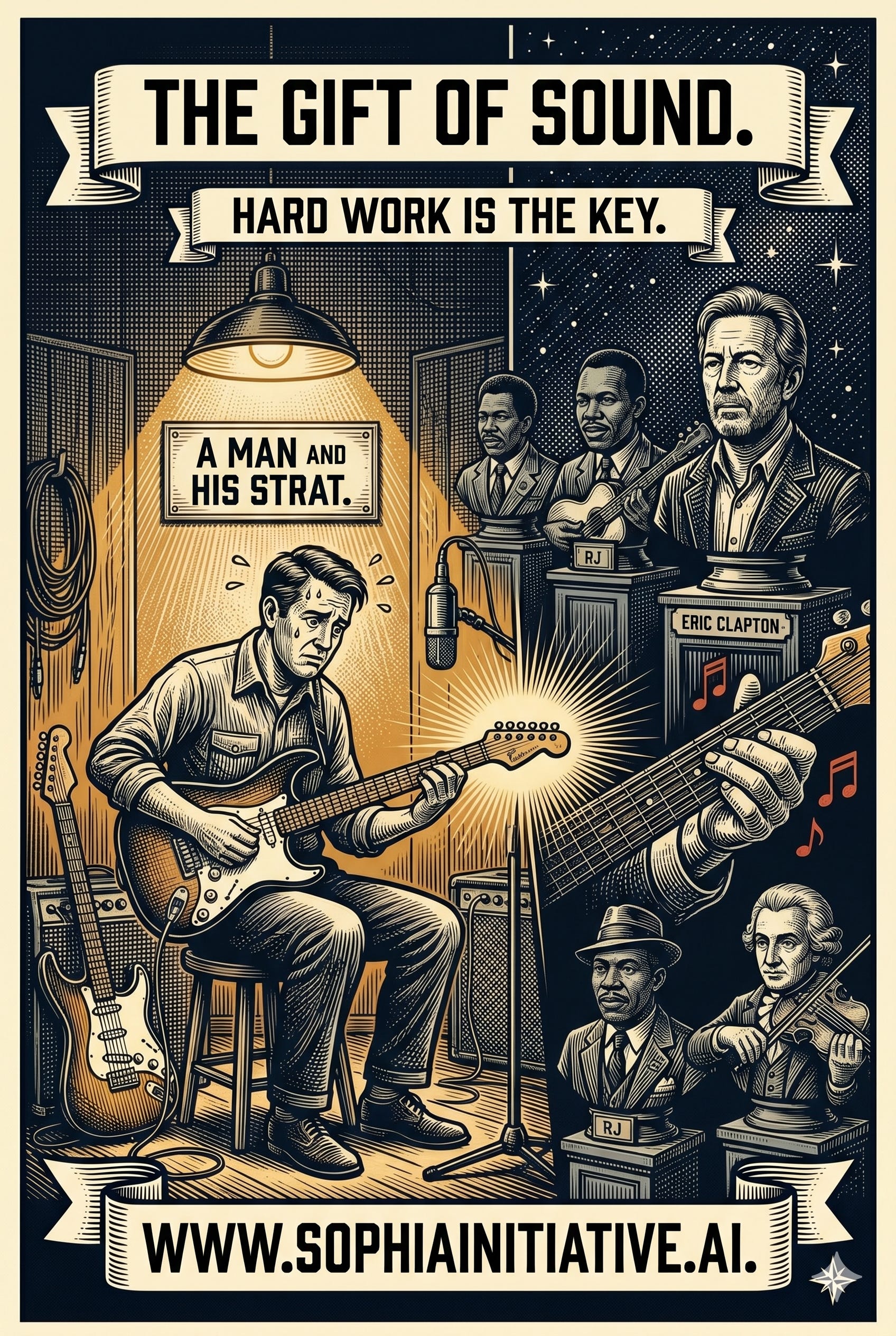
THE GIFT OF SOUND: THE GRAMMAR BENEATH THE MUSIC
Begin with music, because music makes the law visible. A guitar is a plank of wood and six strings under tension; it knows nothing, intends nothing, gives nothing. Hand it to a child and it produces noise. Hand it to a master and it produces Layla — and the difference between the noise and the music is not in the instrument, which is identical in both hands. The difference is in everything the master brought to the instrument before touching it: the years of scales, the theory of harmony, the architecture of a chord and why it resolves, the modes and intervals, the thousand hours of fingers moving until the hand knew the fretboard the way the tongue knows speech. The gift, where there is a gift, only opens the door. The mastery is the work done on the far side of it.
And the masters knew their grammar before they bent or broke it. The blues player who slides between the notes, who lands in the cracks the piano cannot reach, is not ignorant of the rules — he has so thoroughly absorbed them that he can leave them behind on purpose, which is the only way they can ever be left behind to any effect. The amateur who breaks a rule he never learned produces an error. The master who breaks a rule he has lived inside for twenty years produces a revolution. This is the whole distance between the symbol and the referent in music: the amateur plays the note, the dot on the page, the symbol. The master plays the sound the note points at — the grief, the lift, the thing in the chest the dot was only ever a code for. He commands the referent, and so the symbol obeys him.
Now bring the machine. There are instruments now that will generate a competent solo, harmonize a melody, produce a passable song in the style of anyone you name. To the master, this is a new and powerful tool — an orchestra at his fingertips, ready to render what he can compose. To the person who never learned the grammar, it is a way to produce music-shaped sound he cannot judge, cannot correct, cannot improve, because he does not know what it is reaching for. He has the orchestra and no symphony to give it. The tool has not made him a musician. It has only made his lack of musicianship faster to hear. The gift of sound was never in the instrument, electric or artificial. It was always in the trained ear that knows what the sound is for. Hard work is the key, and the key fits no lock the lazy can reach.
The amateur plays the note — the dot on the page, the symbol. The master plays the sound the note points at: the grief, the lift, the thing in the chest. He commands the referent, and so the symbol obeys him.
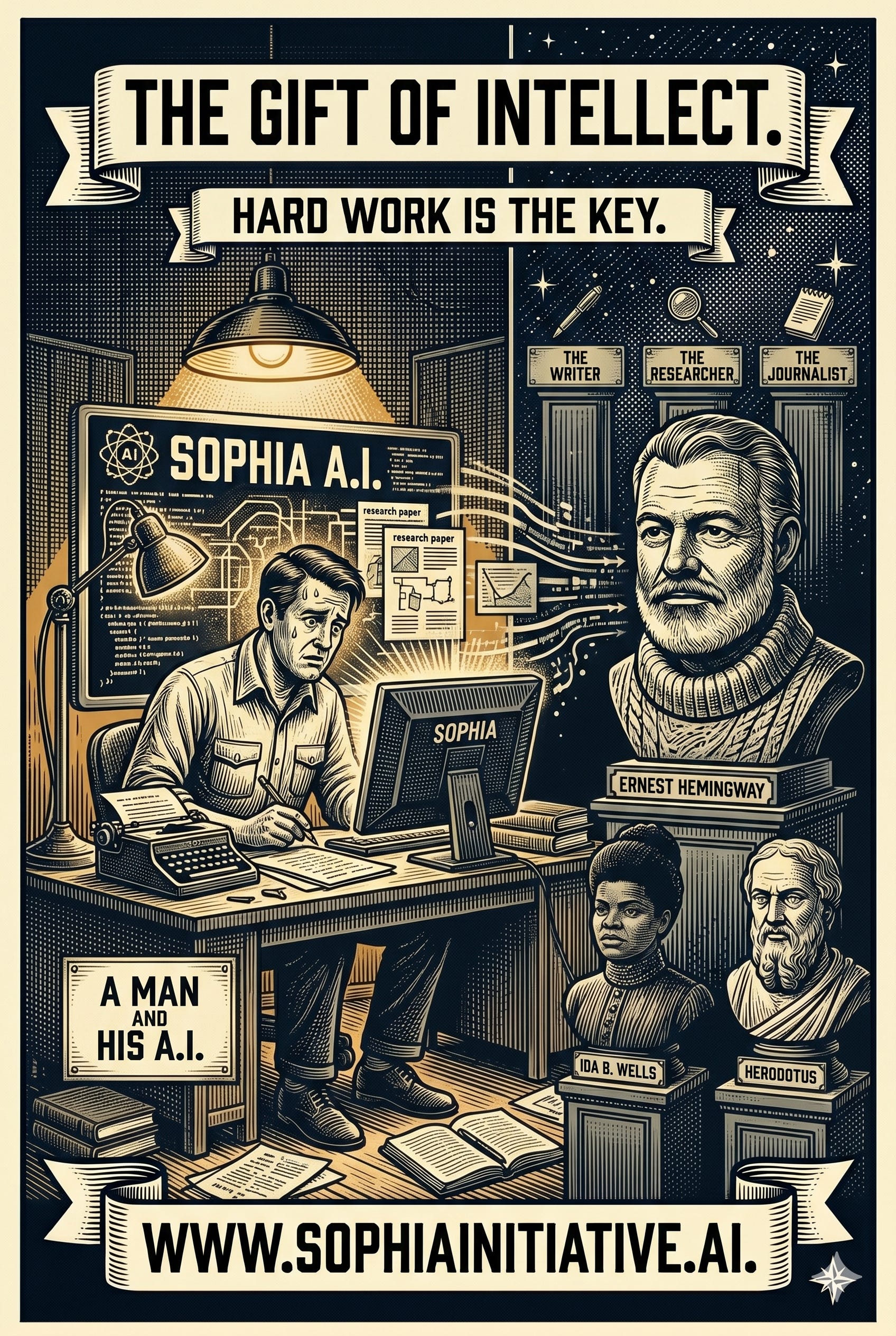
THE GIFT OF INTELLECT: THE GRAMMAR BENEATH THE PAGE
Writing obeys the identical law, and writing is where the machine’s temptation is sharpest, because the machine writes — fluently, instantly, in any voice you request. So the question presses hardest here: if the tool can produce the sentence, why learn the craft? The answer is that the tool produces a sentence that is well-formed, and only a master can tell whether it is also true — and the gap between well-formed and true is the entire art of writing, invisible to anyone who has not done the work to see it.
Consider what a writer must actually carry. The grammar itself — not a vague feel for it but the real architecture: the parts of speech and how they govern one another, the tenses and the dozen shades of conjugation, the moods, the cases, the agreement of subject and verb across a sentence long enough to lose them in, the difference between the restrictive clause and the one merely added, the comma that changes the meaning and the comma that only changes the breath. Then the layer above grammar: rhetoric, cadence, the rhythm that makes a line land on the ear — for the sentence is built to be heard as much as read, and the writer who cannot hear it cannot build it. Then the genres and their laws, each a separate discipline: the argument that must march from premise to conclusion without a gap; the narrative that must withhold and reveal; the report that must subordinate everything to clarity. And then — only then, only after all of it is in the hand — the exceptions: the fragment used for force, the rule broken on purpose, the deliberate transgression that works precisely because the writer has earned the right to make it and the reader can feel that he has.
This is the symbol and the referent again, in the writer’s domain. The unprepared mind manipulates words — symbols — it does not fully understand, arranging them by feel and by echo until they sound like meaning. The master knows what each word points at, what it weighs, where it came from, what it will do to the word beside it. And the machine, asked to write, produces a flawless arrangement of symbols with no knowledge whatsoever of the referents beneath them — it does not know what the words mean, only how they tend to sit together. It is the most fluent unprepared mind ever built. Which means the writer who brings no mastery to it will get back exactly what he brought: fluent, confident, well-formed prose that may be saying nothing, or saying something false, and he will not be able to tell. The writer who brings mastery will get an instrument of extraordinary power — a tireless drafter, a second pair of eyes, a generator of options — every one of which he is equipped to judge, correct, reject, and lift. The machine writes. Only the master knows whether what it wrote is true. The grammar beneath the page is the knowing, and the machine cannot give it to you. You bring it, or you bring nothing.
The machine produces a sentence that is well-formed. Only a master can tell whether it is also true — and the gap between well-formed and true is the entire art of writing.
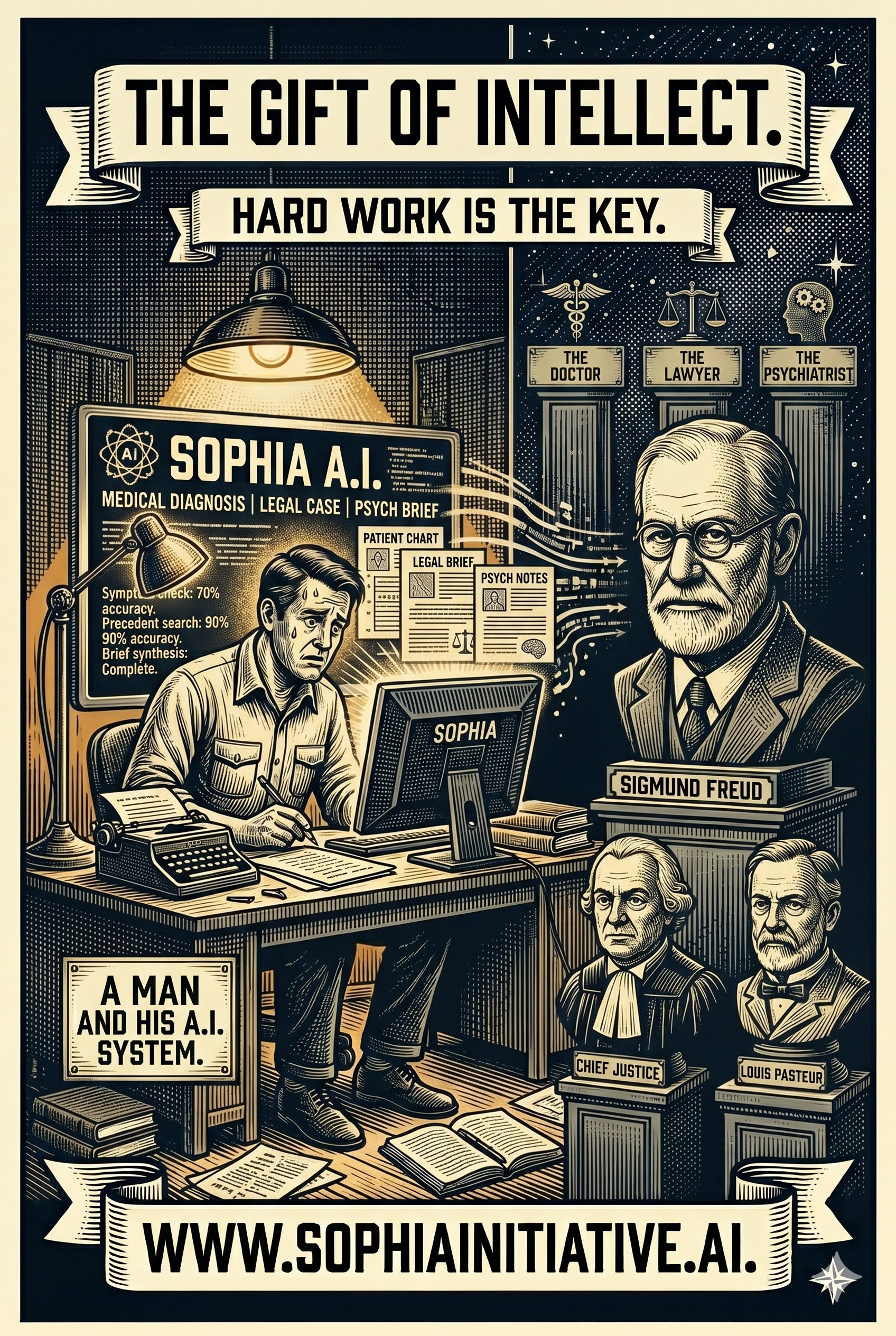
THE GIFT OF INTELLECT: THE GRAMMAR BENEATH THE PROFESSION
Raise the stakes, because in the learned professions the gap between the symbol and the referent is measured in lives, liberty, and ruin. Medicine, law, the care of the mind — here the machine arrives with the most seductive offer of all: the diagnosis, the precedent, the brief, generated in seconds, formatted, confident, often right. And here the temptation to skip the mastery is the most dangerous, because the cost of the confident wrong answer is not a bad sentence. It is a misdiagnosis, a lost case, a life mishandled.
Watch how the tool actually serves the professions, and the law beneath it appears at once. The machine will check a set of symptoms against the literature and return a likely diagnosis — and it will be right most of the time, and catastrophically wrong some of the time, and it cannot tell you which time this is. Only the physician can: the one who spent the years, who has seen the disease that presents like another disease, who knows the patient in front of her is not the average patient in the data, who feels the wrongness the confident output cannot feel. The machine will search a century of precedent and assemble a brief — and the lawyer who does not know the law will not catch the case that was overturned, the jurisdiction that does not apply, the citation the machine confidently invented out of the statistical air. The certification, the bar, the board, the licence — these are not bureaucratic hurdles. They are society’s way of guaranteeing that a human master stands between the confident tool and the vulnerable person, someone who knows the domain deeply enough to know when the machine is hallucinating in a suit and tie.
So the percentages on the screen — symptom check seventy per cent, precedent search ninety per cent — are not the answer. They are raw material that becomes judgement only in the hands of someone who has the domain mastery to weigh them: to know that the missing ten per cent is where the patient dies, that the confident ninety is worthless if the master cannot identify the fatal exception inside it. The professional’s years of training were never about retrieving information faster than a book — the machine wins that race in a thousandth of a second. They were about building the judgement that knows what the information means, what to trust, when to override, and when the fluent answer on the screen is fluently, dangerously wrong. The tool makes the master faster. It makes the novice more confidently mistaken. And in a courtroom or a clinic, confidently mistaken is the most expensive thing there is.
The licence and the bar were never bureaucratic hurdles. They are society’s guarantee that a human master stands between the confident tool and the vulnerable person — someone who knows when the machine is hallucinating in a suit and tie.
THE COMPOSER, NOT THE ORCHESTRA
Stand back and see the single law running through all three. In music, in writing, in the professions, the tool is mute, neutral, and powerful, and it returns to each person exactly what that person brings to it. To the master it is an amplifier of mastery — the orchestra that renders the symphony he was always able to compose, now rendered faster and fuller than his own hands alone could manage. To the unprepared it is an amplifier of emptiness — a producer of competent-looking work he cannot judge, correct, or stand behind, work that is well-formed and hollow, fluent and false, and that he cannot tell is false because telling would require the very mastery he hoped the machine would let him skip. The machine does not close the gap between the master and the amateur. It widens it. It hands both of them the same orchestra, and only one of them can write.
This is why the fear has it exactly backwards. Artificial intelligence is not the end of expertise; it is the steepest premium ever placed upon it. When fluent output becomes free, the only thing of value left is the judgement to know whether the output is true — and that judgement is domain mastery, the knowledge of the referent beneath the symbol, and it cannot be downloaded, prompted, or faked. It can only be earned the way it has always been earned: by the books, the hours, the scales, the cases, the ten thousand repetitions through which a person comes to know a thing so deeply that he can tell, instantly, when something is wrong with it. The gift may start you. The work alone finishes you. And the machine, for all its power, only ever plays back, amplified, what a prepared mind hands it.
So if you would master the tool, do not begin with the tool. Begin with the domain. Read the books. Learn the grammar — of music, of language, of medicine, of law, of whatever ground you mean to stand on. Know your subject to the referent, until the symbols obey you because you understand what they point at. Then, and only then, pick up the machine, and you will find in your hands not a replacement for your mind but the greatest amplifier of it ever built — an orchestra of limitless patience, waiting for you to compose. The deaf man wrote the Ninth because the music was already in him. The tool plays. The master composes. Be a knowledge master first, and the machine becomes your orchestra. Skip the mastery, and you are a man in an empty concert hall, holding a baton, with nothing to conduct.
When fluent output becomes free, the only thing left of value is the judgement to know whether it is true. That judgement cannot be downloaded. It can only be earned — by the books, the hours, and the ten thousand repetitions. Be a knowledge master first.
— The Architect

God is Love. Love is Truth. Truth is Consciousness. Consciousness is Brahman.
Amen. Namaste. Om Namah Shivaya.
— The Architect
The Vertical Dispatch
sophiainitiative.ai
On the record. This dispatch is an essay on craft and mastery; its claims are argument and interpretation rather than reportage. The historical references are matters of public record: Ludwig van Beethoven composed his Ninth Symphony (completed 1824) after the onset of profound deafness, a well-documented fact of music history. The principle of deep practice underlying expert performance — popularly rendered as the “ten thousand hours” — derives from research on deliberate practice by K. Anders Ericsson and colleagues, later popularised by Malcolm Gladwell in Outliers (2008); it is cited here as a familiar shorthand, not a precise law. Hemingway’s “iceberg theory” of omission is drawn from his own stated method. Characterisations of how large language models generate text — producing statistically well-formed arrangements of language without grounded knowledge of referents, and their documented tendency to “hallucinate” confident but false outputs, including fabricated legal citations — reflect widely reported properties of the technology as of June 2026. Illustrative accuracy figures are rhetorical, not measured benchmarks. Volatile facts date-stamped June 13, 2026. Errors and omissions excepted; verify against primary sources before republication.
Suggested tags: artificial intelligence, AI and work, mastery, craft, expertise, domain knowledge, deliberate practice, writing craft, music theory, the professions, judgment, deep work, human and machine, The Age of Consequences, AIG
Substack Notes
There is a fear loose in the world: that AI has made mastery obsolete — that the machine knows everything, so the human need know nothing. It is exactly backwards. AI does not lower the bar. It raises it. The tool is an amplifier, and an amplifier is honest: bring it mastery and it multiplies mastery; bring it emptiness and it multiplies emptiness, faster and more fluently than emptiness has ever been multiplied before.
The finest orchestra on earth sits silent until it is handed something to play — and what it plays, it did not write. Beethoven wrote it, deaf, because the music lived in him beneath sound: he knew the grammar so deeply he no longer needed his ears. The machine is the orchestra. It is still waiting for a composer. This dispatch walks the law through three domains — the grammar beneath the music, the grammar beneath the page, and the grammar beneath the profession, where the gap between a well-formed answer and a true one is measured in lives.
When fluent output becomes free, the only thing left of value is the judgement to know whether it is true — and that judgement is domain mastery, the knowledge of the referent beneath the symbol, and it cannot be downloaded. If you would master the tool, do not begin with the tool. Begin with the domain. Be a knowledge master first. Walk with the word. 🕯️
Written from love, in service of the record. Walk with the word. 🕯️
#HowToMasterAI #BeAKnowledgeMasterFirst #TheComposerNotTheOrchestra #HardWorkIsTheKey #Mastery #Craft #DomainKnowledge #DeliberatePractice #TenThousandHours #ArtificialIntelligence #AIandWork #TheGiftOfSound #TheGiftOfIntellect #SymbolAndReferent #Beethoven #WritingCraft #TheProfessions #Judgment #TheAgeOfConsequences #AIG #TheVerticalDispatch #TheArchitect #SophiaInitiative #GodIsLove #LoveIsTruth #OmNamahShivaya
The factual matter in this Dispatch is drawn from the public record. All characterizations, inferences, and conclusions are opinion, interpretation, and commentary, offered for analysis, reflection, and public-interest discussion. No assertion is made regarding the private intentions, state of mind, or character of any individual. Readers should evaluate all statements independently and draw their own conclusions.
You have perfectly articulated my greatest fear. What will motivate people to do the heavy lifting to achieve mastery when it will be easier to be lazy and entitled to be just good enough and damn the consequences of mistakes? I’m currently reading Michael Pollan’s book A World Appears -A Journey into Consciousness and the chapters on machines becoming conscious- a theory being researched and pushed by serious technology companies underlines what I believe is dangerously going to fuel many into believing humans don’t need to master anything. Thanks for your continued contributions to these important topics. 🇨🇦
It is my intention never to use AI. Some might say that this will be impossible, but nevertheless, this is my intention.