

Φ
THE VERTICAL DISPATCH
We write for the mind, the eye, and the ear.
Read it. Look at it. Listen to it. The Vertical Dispatch is built for all three — prose with rhythm, made to be heard as much as read.
From metaphysics to geopolitics, from culture to history, from the sacred to the street — and everything in between. One lens, every subject. No ego. Just the record, named clean.
Press play. Walk with the word. 🕯️
This dispatch travels by hand. If it serves you, share it — restack on Substack, and pass it on wherever you read. 🕯️
Sacred Metaphysics · The Age of Consequences
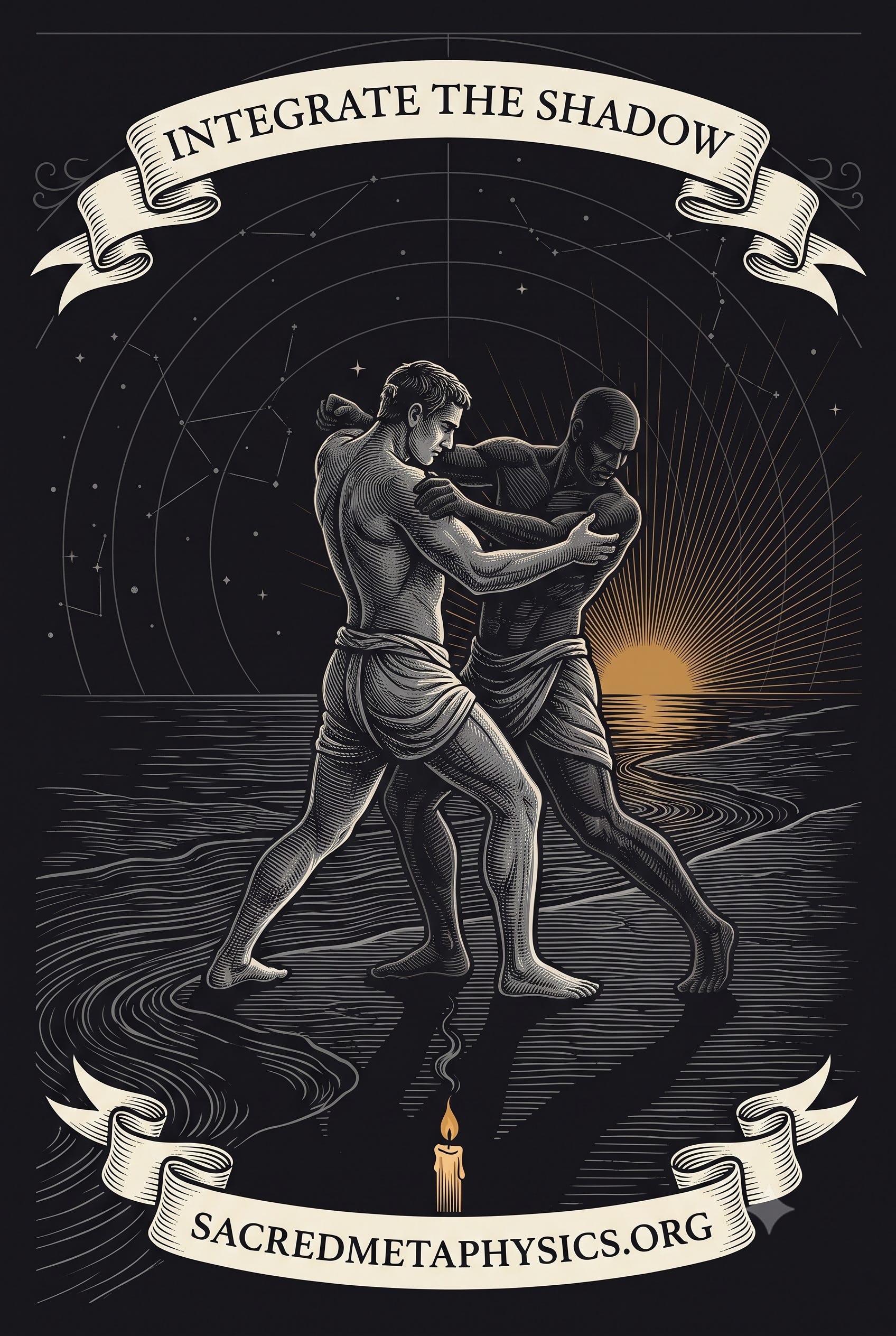
On the night before he had to face the brother he had wronged and fled from years before, Jacob was left alone at the ford of a river in the dark. And a stranger came out of the night and wrestled him — not for a moment, but until the break of dawn. Jacob could not throw him and would not be thrown. And when the first light came and the stranger saw he could not prevail, he struck Jacob in the hollow of the hip, wrenching it — and still Jacob held on. Let me go, the stranger said, for the day is breaking. And Jacob answered: I will not let you go unless you bless me.
So the stranger blessed him, and gave him a new name — Israel, the one who wrestles — and vanished with the dawn. And Jacob went on to meet his brother, and he was whole, and he was changed, and he walked, from that morning to the end of his life, with a limp.
Read that story slowly, for it is the whole of this dispatch. He did not defeat the thing he wrestled. He held on to it until it blessed him. And he did not walk away clean and perfect and unmarked — he walked away whole, and blessed, and limping. The blessing and the wound were the same event. That is what it costs to become whole, and that is what it looks like when you do.
Many have read that midnight stranger as an angel, and many as God, and Carl Jung read him as something closer and harder: Jacob wrestling his own shadow — the disowned self he had fled from, the part of him bound up with the brother he had cheated, come to meet him at last in the dark, alone, at the crossing-place. And the teaching is in every detail. You do not win. You hold on. You are wounded in the holding. And you are blessed and renamed by the very thing you refused to release — and you walk forward, from then on, marked. This is the work no one can do for you, and it is the work this dispatch is about.
This is what The Vertical Dispatch is for, stated plainly so there is no mistaking it. We read the ego — in power, in culture, in the news, in the sacred — not to condemn anyone, and not to feel superior to anyone. We read it to learn the one skill beneath all the others: to see the ego clearly, to own what we would rather not own, to wrestle it in the dark and hold on until it blesses us — to make it part of the whole rather than a thing that runs us from the dark — and then to act with honour anyway. Every dispatch that names a public figure is, underneath, a lesson in doing this to yourself. So let us begin where it must begin: with the tools, and with the honest mirror they are meant to be turned upon.
The Mask We Wear
Carl Jung gave us a vocabulary for the self that is precise enough to work with, and honest enough to hurt a little, which is how you know it is true. Begin with the part you already show the world. Jung called it the persona — from the Latin for the mask an actor wore on the stage. It is the face you present: the professional, the parent, the confident one, the good person, the role you play so the world will receive you. The persona is not a lie and not a flaw. Everyone has one; you could not live in society without it. The trouble begins only when you forget you are wearing it — when you mistake the mask for your face, and believe you are the role.
You can feel the mask hardening in the small moments: when you need to be seen doing the good thing, when you perform the version of yourself that wins approval, when you cannot bear to be caught not knowing. That is the persona asking to be admired. It is not evil. It is just the smallest part of you, trying to pass for the whole.
The Shadow We Hide
And here is Jung’s deepest and most useful idea, the one that will change how you see every quarrel you are ever in. Whatever does not fit the mask has to go somewhere. The anger you are not supposed to feel, the pride, the envy, the wound, the hunger, the parts of you that contradict the good face you show — they do not vanish. They are pushed down, out of sight, into what Jung called the shadow: everything about yourself you have disowned and refused to look at.
The shadow is not simply the evil in you. That is the popular misreading, and it is a shallow one. The shadow is the unlived, the unadmitted — and it holds disowned good as much as disowned darkness, disowned power as much as disowned fault. The person who was taught their anger was unacceptable has a shadow full of anger. The person who was taught not to want has a shadow full of hunger. But also: the person who was taught to be small has a shadow full of unclaimed strength; the person who was taught to be safe has a shadow full of unlived fire; the one who never dared has a shadow full of the creative force they were too afraid to spend. Whatever you could not afford to be — whether it frightened others or frightened you — you hid it there. And so the shadow is not only where the darkness waits. It is also where the power waits, and the fierceness, and the life you did not live — all of it disowned, all of it yours, all of it waiting in the dark to be claimed.
And this is the key that unlocks every conflict you will ever witness: what we refuse to see in ourselves, we project onto others. The shadow we will not own, we discover in our enemies — and hate there, with a strange heat, exactly what we cannot face in ourselves.
Watch for the heat. When someone’s fault enrages you out of all proportion — when your contempt for them runs hotter than the offense deserves — that heat is the tell. You are almost never that angry at a stranger’s flaw. You are that angry at your own, seen in them, and denied in yourself. The politician who disgusts you, the type of person you cannot stand, the fault you cannot forgive — look, honestly, and you will often find the disowned thing is yours too. This is why the age screams at its enemies and never at its mirror. The whole horizontal war — the side against the side, the tribe against the tribe — is shadow, projected outward at the scale of nations. We fight in others what we will not own in ourselves.
Wholeness, Not Perfection
Now the turn, and it is the most important sentence in this whole dispatch: you do not defeat the shadow. You cannot. The wish to eliminate your own flaws — to become finally good, finally clean, finally without fault — is itself the mask, trying to be perfect. The ego wants to win the war against its own darkness, and the wanting is the ego. There is no victory here. There is only consciousness.
Jung’s word for the real work is integration — and it is the whole of the teaching. You do not kill the shadow and you do not float above it, pretending it is gone. You bring it into the light. You own it. You say, plainly and without drama: yes, this too is in me — the anger, the pride, the hunger, the fear. You make it conscious. And the moment it is conscious, it can no longer run you from the dark, because you are looking straight at it. The disowned thing owned is the disowned thing defused. This is wholeness — not a person with no shadow, for no such person exists, but a person who knows their shadow and is therefore no longer ruled by it, and no longer forced to hate it in everyone else.
Wholeness, not perfection. The goal was never to have no flaws. The goal is to know them so well, and own them so fully, that they no longer own you — and you no longer need an enemy to carry them for you.
This is why the integrated person is gentle with the failings of others. Not because they are soft, but because they have met their own shadow and stopped pretending to be above it. The one who has faced their own darkness has no need to be scandalised by yours. The harshest judge of others is almost always the one who has not yet looked at himself — and the person who has done the honest inner work grows, strangely, more merciful, not less. Owning your shadow is what finally makes you kind.
And Then, to Act with Honour
So here is the practice, whole, and it is harder than perfection and far more real. You do not wait to become flawless before you act well, because you will wait forever. You accept, honestly, that you are a person with a mask and a shadow, with pride and fear and disowned hunger, like every other human who has ever lived. And then — eyes open, illusions down, no pretense of being clean — you choose the honourable act anyway.
This is the honour that matters: not the honour of the person who believes themselves without fault, which is only the mask polished to a shine, but the honour of the person who knows exactly what they are and chooses well regardless. Integrity is not innocence. Integrity is acting rightly while fully conscious of your own capacity to act wrongly. The one who says “I am good” has not looked. The one who says “I know my darkness, and I choose the light anyway” has done the whole work. Honour is not the absence of the shadow. Honour is what you do once you have stopped pretending the shadow is not there.
Why We Read the Ego at All
Now you know what this publication is for, and what it is not for. When we read the ego in a public figure — in a leader, a policy, a piece of the culture — we are not gathering reasons to hate them. We are doing, out loud and in the open, the exact thing you must learn to do in private, to yourself. We hold up a visible instance so you can learn to see the invisible one. The powerful man’s mask teaches you to find your own. The politician’s projected shadow teaches you to catch your own projection. The public failing is a lesson in the private one.
And there is a discipline in it that guards us from the very ego we are naming. We read the conduct, never the soul — because we cannot see another’s interior, and to claim we can is our own mask, presuming to judge. We hold up the standard — what would the whole, integrated person have done here; what would the one who had truly seen have done — and we measure the gap, and we leave the person’s own depths unjudged, because they are genuinely not ours to weigh. Whether a given act came from the small ego or from a place we cannot see is known only to the one who acted, and to God. We name the marks in the conduct. We do not sentence the man.
And every time we hold that mirror up to the world, we turn it, last, upon ourselves. The mask we just named in another — where is it in me? The shadow we just watched projected — what am I projecting? That turning is the whole of the practice. If reading the ego in the world does not send you back, humbled, to your own — you have read it as the ego reads, to feel superior, and missed the entire point.
So this is the directive, and the reason for all that follows. We identify the mask. We own the shadow. We integrate the ego into the whole rather than pretending it is gone or hating it in others. And we act with honour — not the honour of the flawless, who do not exist, but the honour of the conscious, who know exactly what they are and choose the higher thing anyway. That is the skill beneath all the others. Everything else in these pages is only practice in it.
Jung took us this far — to the whole and integrated self, the mask and the shadow reconciled around a truer centre. It is a high place, and most never reach it, and for the work of a single honest life it is summit enough. There is one step further, which these pages will keep pointing toward. Notice, if you can, one strange thing about all the inner work you have just been asked to do: the mask, the shadow, the anger, the disowned power — every one of them is something you can observe. You can watch the mask harden. You can catch the shadow projecting. You can feel the anger rise and name it. But what is it that watches? What is the awareness in which the mask and the shadow and the self all appear — the seeing that was never itself the thing seen? That watching is not one more part of the psyche to integrate. It is the ground the whole psyche appears within — a face of something with no edges at all, in which the mask and the shadow and the self all arise, and were never truly two. That is the last door, and it opens only for those who have first walked through this one. Own your shadow. Act with honour. Hold on until it blesses you, and do not be afraid of the limp — for the blessing and the wound are the same event, and the mark is how you know the work was real. The rest will find you.
God is Love. Love is Truth. Truth is Consciousness. Consciousness is Brahman.
Amen. Namaste. Om Namah Shivaya.
— The Architect
The Vertical Dispatch
sophiainitiative.ai
On the record
The framework of this dispatch is drawn from the analytical psychology of Carl Gustav Jung (1875–1961): the persona, the shadow, the projection of disowned material onto others, the process of integration, and the Self as the psyche’s organising centre and archetype of wholeness are all core to his published work, and are rendered here in plain language for the general reader rather than in clinical terms. The distinction between Jung’s integrated Self and the further, non-dual SELF — the ground in which the individuated self itself appears and dissolves — is the position of Sacred Metaphysics, offered as this publication’s own step beyond the boundary Jung, as an empiricist, declined to cross; no claim is made that Jung himself identified his Self with that ground. No living person is named or characterised in this dispatch. Verify each stone before you stand on it, against primary sources, before republication.
Suggested tags
the shadow, carl jung, the persona, integration, projection, the ego, the self, wholeness, individuation, acting with honour, self-knowledge, nonduality, sacred metaphysics, the vertical dispatch, know thyself, the mirror.
Substack Notes
From here forward, this is what The Vertical Dispatch is for. We read the ego — in power, in culture, in the news — not to condemn anyone, and not to feel superior. We read it to learn the one skill beneath all the others: to see the ego clearly, own what we would rather not own, make it part of the whole rather than a thing that runs us from the dark — and then to act with honour anyway. Every dispatch that names a public figure is, underneath, a lesson in doing this to yourself.
Jung gave us the tools. The persona is the mask we show the world — not a lie, but dangerous when we mistake it for our face. The shadow is everything we disowned and hid: the anger, the pride, the hunger we could not afford to be. And here is the key that unlocks every quarrel: what we refuse to see in ourselves, we project onto others, and hate there what we cannot face in ourselves. Watch for the heat. When a stranger’s fault enrages you out of all proportion, that heat is the tell — it is your own shadow, seen in them, denied in you.
Now the turn: you do not defeat the shadow. The wish to eliminate your own flaws is itself the mask trying to be perfect. Jung’s word is integration — you bring the shadow into the light, own it, make it conscious, and the moment it is conscious it can no longer run you from the dark. Wholeness, not perfection. The goal was never to have no flaws. It is to know them so fully they no longer own you — and you no longer need an enemy to carry them for you. This is why owning your shadow is what finally makes you kind.
And then, to act with honour — not the honour of the flawless, who do not exist, but the honour of the conscious, who know exactly what they are and choose the higher thing anyway. Integrity is not innocence; it is acting rightly while fully aware of your own capacity to act wrongly. That is why we read the ego in the world: to learn to see our own, and turn the mirror home. If reading it out there does not send you back, humbled, to your own — you have missed the point. Written from love, in service of the record. Walk with the word. 🕯️
#TheVerticalDispatch #TheArchitect #SacredMetaphysics #CarlJung #TheShadow #Integration #TheEgo #Wholeness #ActWithHonour #Projection #SelfKnowledge #Nonduality #KnowThyself #GodIsLove #OmNamahShivaya
The content of this Dispatch is philosophical and psychological commentary offered for reflection and public-interest discussion. It describes a general framework drawn from the published work of Carl Jung and the interpretive position of Sacred Metaphysics. No living individual is named or characterised. Readers should evaluate all statements independently and draw their own conclusions.
A Walkthrough for Westerners read by Jack Hawley
Every time I comment, it seems too much like effusive praise. But, honestly, I’m learning so much about myself in these essays. Tremendous lessons in philosophy, religion, consciousness in the context of today’s social, political and environmental challenges.
I’ve begun reading Sacred Metaphysics - A Reader’s Report: Thirteen Books Read and Reported. I’m eager for the remaining 11 books to come out in the Fall, and will soon delve into The Ladder of Light and The Bhagavad Gita.
Something I hope to understand better through all this reading and learning is about consciousness and death. Having lost a son to depression over a year and a half ago, I’m seeking to understand the nature of reality. Vinny was well read - I have found books by Jung, as well as religious tomes (eg, The Collected Works of St. John of the Cross) in his library - so maybe he was onto something that I never understood myself. I’m beginning to understand a bit better through these essays by Mr. Roberts. Perhaps this is the ego’s wanting, but it may bring some solace.