


Φ
THE VERTICAL DISPATCH
We write for the mind, the eye, and the ear.
Read it. Look at it. Listen to it. The Vertical Dispatch is built for all three — prose with rhythm, made to be heard as much as read.
From metaphysics to geopolitics, from culture to history, from the sacred to the street — and everything in between. One lens, every subject. No ego. Just the record, named clean.
Press play. Walk with the Word. 🕯️
This dispatch travels by hand. If it serves you, share it — restack on Substack, pass it on wherever you read. 🕯️
The Departure Lounge
A dispatch for the worn-out, the twice-married, the still-curious, and the terminally human.
June 17, 2026
“Two riders were approaching, the wind began to howl.”
— the closing image of “All Along the Watchtower,” Bob Dylan, 1967; the version that matters is the one Jimi Hendrix set on fire in 1968
I want to start this one with a song, because I have been hearing it in my head for three days and I have finally understood why. You know the one. Dylan wrote it in 1967, plain and strange and short, and then Hendrix got hold of it the next year and tore it open — that guitar coming in like weather, like something approaching over a hill. And the very first thing the voice says, the thing the whole song hangs from, is a man telling another man that there has got to be some way out of here. Not a plan. Not a politics. A cry. The opening line of that song is the sound a person makes when the walls have closed and they will try any door at all.
And I sat with it, and I realized that is the sound coming off the platforms right now. That is what the young are actually saying underneath the hate and the conspiracy and the poison that has people my age clutching their pearls and asking what is wrong with this generation. What is wrong with them is the joker’s line. There must be some way out of here. They have looked at the walls — the ones I have been writing about all week, the priced-out family, the hidden living wage, the loan that outlives the warranty, the whole house running on debt that pools upward — and they have done the joker’s math, and they are looking, with real desperation, for a door. Any door. And the only doors anyone left standing open were the ugly ones.
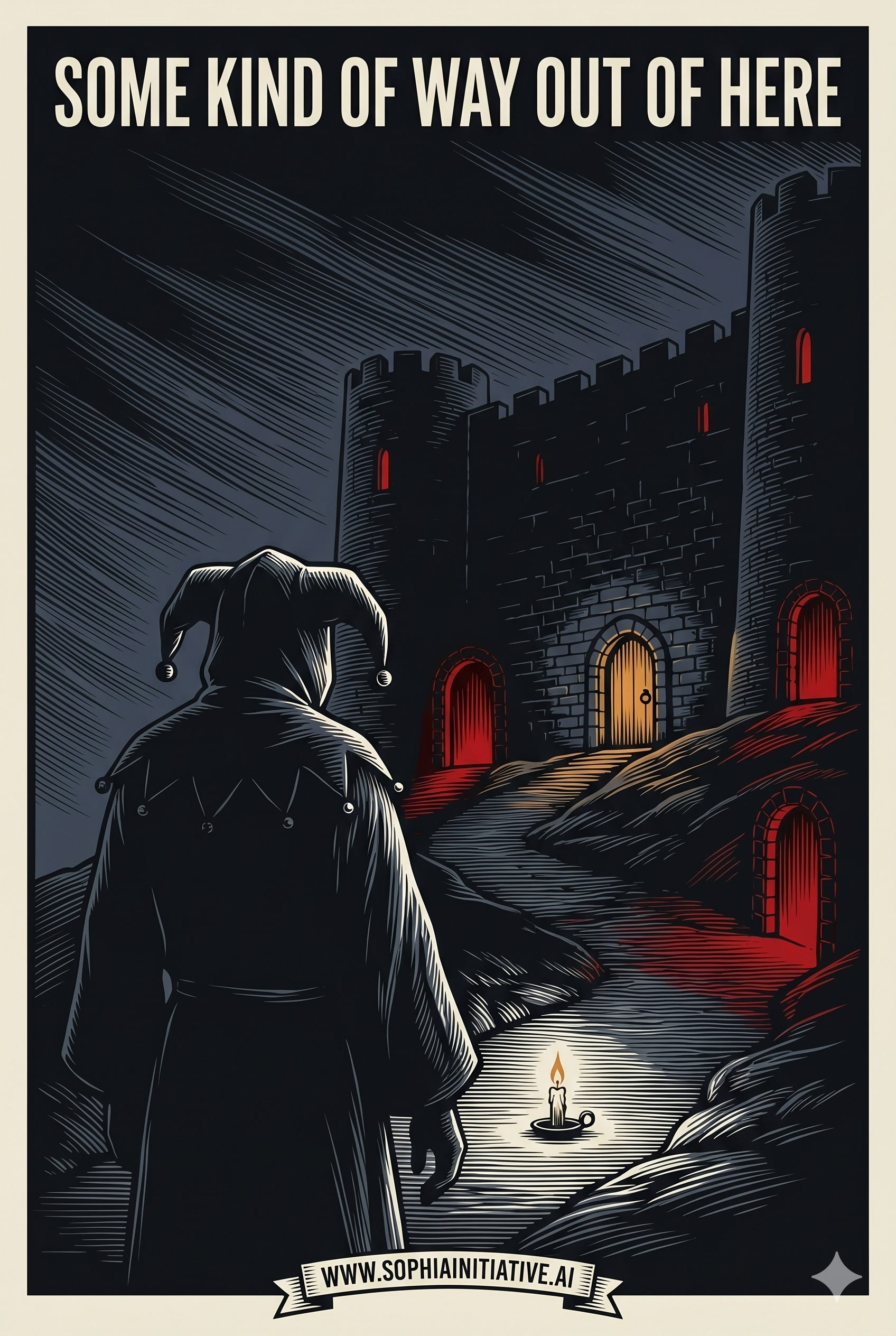
The rest of the song was the whole story
Here is the thing that knocked me flat. People remember the opening cry of that song and forget that Dylan answered the why in the very next breath, and his answer is the entire dispatch I have been trying to write all week. The joker explains what is wrong. The businessmen drink his wine. The plowmen dig his earth. And the line that should be carved over every parliament in the West: none of them, all along the line, know what any of it is worth. That is the living wage they never broadcast. That is the worth of a human hour of work that nobody at the top ever named honestly, while they drank the wine and dug the earth and handed the bill down the line.
And then the camera pulls back, in the last verse, to the watchtower itself — the princes keeping the view from up on the wall, while the women come and go and the barefoot servants pass below. That is the picture, sixty years early, of the house I described: the marginal few up in the tower holding the view and holding the note, and everyone else down in the yard, servants and passers-by, carrying the debt the princes own. Dylan saw the whole architecture in 1967. Hendrix made you feel the wind starting to howl outside the walls. And the two riders approaching at the end — that is this generation, coming up the road, and the wind is the sound they are making.
None of them, all along the line, know what any of it is worth. That was the living wage, named in a song, sixty years before they hid it.
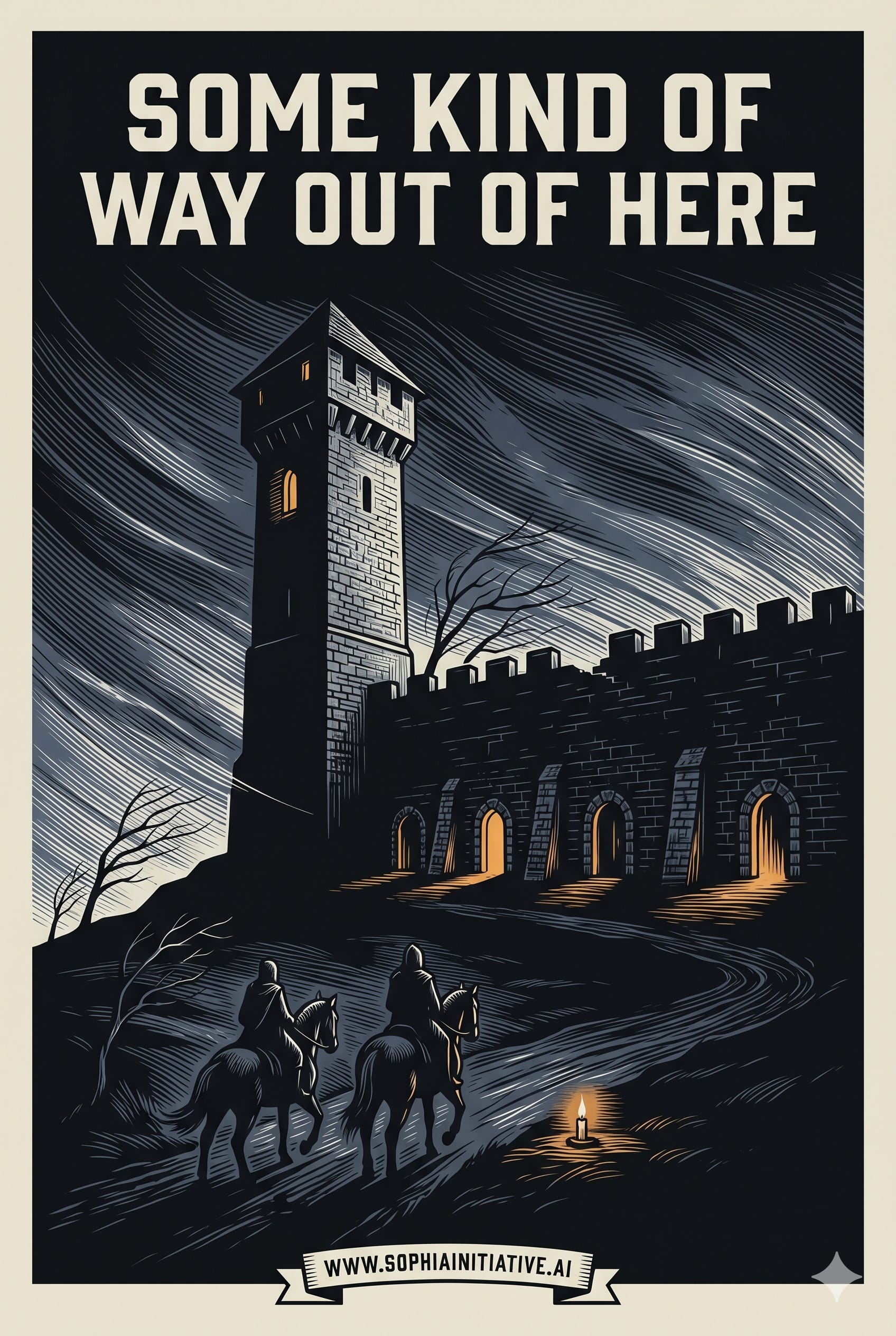
They left the ugly doors open on purpose
So now to the platforms, and I am going to say the hard thing plainly because the lounge does not let me dress it up. When you wall a generation out of every honest road — the home, the family, the wage that meets the cost of a life — you do not extinguish the need to get out. You cannot. The joker’s cry does not go away because the doors are locked; it gets louder, and it goes looking. And the brutal truth of our moment is that the only doors anyone bothered to leave standing open were the doors built to feed on exactly that desperation. The rage-merchant’s door. The conspiracy’s door. The strongman’s door, the scapegoat’s door, the door with a simple enemy painted on it and a hand out for your attention on the way through.
Those doors are open because open doors are the business model. I wrote about this years ago in another key — that the surveillance was always the product, that the wall got built one pleasurable brick at a time with our enthusiastic participation. The platform does not fill with poison by accident or by some failure of moderation. It fills with poison because poison is engagement and engagement is the harvest. They took a generation already crying the joker’s line, already looking for any way out, and they monetized the looking. The hate is not the disease. The hate is what grows in a population that has been walled out of every good room and then handed a glowing rectangle that rewards them, precisely and molecularly, every time they reach for the worst door in the hall.
The hate is not the disease. It is what grows when you wall a generation out of every honest room and leave only the harvesting doors open.
Not that door
And this is the part I came down off the cold structural page to say, hand on your shoulder, because it is the only part that matters. I understand the cry. I have made it myself, in my own decade, in my own walls. There must be some way out of here is not a shameful thing to feel; it is the most honest thing a trapped person can say, and the young who feel it are not broken or wicked or lost. They are accurate. The walls are real. The worth was hidden. The princes are in the tower. All of that is true, and feeling it is sanity, not sickness.
But I am begging you, from the end of the line, with whatever credibility a man earns by admitting he ran for the exits too: not that door. The doors they left open were not left open for your escape. They were left open for your harvest. The rage does not get you out of the house — it just moves you to the loudest, most surveilled room in it, and bills you for the privilege, and counts you as engaged. The way out was never on the platform at all. It is the thing the platform was built to replace: a real room, with real people in it, who did not choose you for your profile and cannot be swiped away — the pool hall, the hall, the table, the body in the shared room that the screen can never send. The joker needed the thief. He needed another person in the dark with him, talking honestly, the hour getting late. He did not need a feed. He needed a friend who would not talk falsely now.
That is the whole of it. The cry is right. The walls are real, and we built them and hid the worth and let the princes keep the tower. But the door with the enemy painted on it is a trap dressed as an exit, and the only true way out of the watchtower was always the same one — down off the wall, into the yard, among the barefoot and the passing, where a person is simply among their people again. The wind is howling. The riders are coming up the road. Choose the door that leads to a real room. It is the one they did not bother to leave open, because there is no harvest in it — only a life.

God is Love. Love is Truth. Truth is Consciousness. Consciousness is Brahman.
Amen. Namaste. Om Namah Shivaya.
Still at the window, still hearing the wind, still glad you sat down. 🕯️
— The Architect
For the riders coming up the road — not that door.
The Vertical Dispatch
sophiainitiative.ai
On the record.
This is a Departure Lounge reflection — first-person memoir-criticism. “All Along the Watchtower” was written by Bob Dylan (John Wesley Harding, 1967) and most famously recorded by the Jimi Hendrix Experience (Electric Ladyland, 1968); the song is referred to and interpreted here, with its imagery described in the author’s own words and not reproduced, in keeping with this publication’s copyright discipline. The economic conditions referenced — the hidden living wage versus minimum wage ($27.20 vs $17.60/hour, GTA, per the Ontario Living Wage Network, 2025), the two-earner family floor, the priced-out vehicle market, and household and public debt — are documented in this publication’s companion dispatches and their primary sources. The reading of platform dynamics as an attention-and-engagement economy that rewards outrage echoes Shoshana Zuboff’s account of surveillance capitalism and is developed in this publication’s earlier piece on the same theme; it is offered as the author’s interpretation and commentary, not as a clinical or empirical claim about any individual or platform. No diagnosis is made of any group or person; the dispatch judges conditions and systems, never citizens. Verify all figures against primary sources before republication.
Suggested tags: All Along the Watchtower, Dylan, Hendrix, attention economy, social media, radicalization, loneliness, the Third Place, living wage, cost of living,
The Departure Lounge, The Vertical Dispatch
Substack Notes
HOOK A — the joker’s cry.
I keep hearing the song Hendrix set on fire in 1968 — the one that opens with a man saying there has got to be some way out of here. Not a plan, not a politics. A cry. And I finally understood: that is the sound coming off the platforms right now. Underneath the hate and the conspiracy that has my generation clutching their pearls, the young are saying the joker’s line. They looked at the walls — the priced-out family, the hidden living wage, the house running on debt — and they are looking for any door at all. And the only doors anyone left open were the ugly ones.
HOOK B — the song was the whole story.
People forget Dylan answered the why in the next breath. The businessmen drink the joker’s wine, the plowmen dig his earth, and none of them along the line know what any of it is worth. That is the living wage they never broadcast. Then the camera pulls back to the watchtower — the princes keeping the view from the wall while the barefoot servants pass below. The few in the tower holding the note; everyone else in the yard carrying the debt they own. He saw the whole architecture in 1967, and the two riders coming up the road are this generation. The wind is the sound they are making.
HOOK C — not that door.
The hate is not the disease. It is what grows when you wall a generation out of every honest room and leave only the harvesting doors open — because open doors are the business model and outrage is the harvest. I understand the cry; I made it myself. But not that door. The rage does not get you out of the house; it just moves you to the loudest, most surveilled room in it and bills you for it. The way out was never on the platform. It is the thing the platform was built to replace: a real room, with real people who did not choose you for your profile. The joker needed the thief — a friend in the dark, not a feed. 🕯️
Written from love, in service of the record. Walk with the Word. 🕯️
#TheVerticalDispatch #TheArchitect #SophiaInitiative #TheDepartureLounge #AllAlongTheWatchtower #Dylan #Hendrix #AttentionEconomy #SocialMedia #TheThirdPlace #LivingWage #GodIsLove #LoveIsTruth #OmNamahShivaya
The factual matter in this Dispatch is drawn from the public record and from the author’s own previously published, sourced dispatches. All characterizations, inferences, and conclusions are opinion, interpretation, and commentary, offered for analysis, reflection, and public-interest discussion. No assertion is made regarding the private intentions, state of mind, or character of any individual or group. Readers should evaluate all statements independently and draw their own conclusions.
I have felt the walls. The pretensions of academia, the dead end pink ghetto jobs, the marriage trapped in another era. The light was the exit, until I realized it too could be just another ghetto, though made of clear light. The only place any of this makes any sense is on the ground floor, in the messy trenches of being human, of what it takes to produce life and become generative. Where light can become expressed as the multiple facets of love.