

Φ
THE VERTICAL DISPATCH
We write for the mind, the eye, and the ear.
Read it. Look at it. Listen to it. The Vertical Dispatch is built for all three — prose with rhythm, made to be heard as much as read.
From metaphysics to geopolitics, from culture to history, from the sacred to the street — and everything in between. One lens, every subject. No ego. Just the record, named clean.
Press play. Walk with the word. 🕯️
This dispatch travels by hand. If it serves you, share it — restack on Substack, and pass it on wherever you read. 🕯️
Glennford Ellison Roberts
The Bionic Sage | Sovereign Knowledge Architect
sacredmetaphysics.org
0protocol.ai
visva.world
sophiainitiative.ai
The Idol
Every era is defined by the idol it erects and the faculty of the human soul it demands in tribute. The defining crisis of our century is neither economic stagnation nor the conventional overreach of the nation-state. It is the voluntary surrender of human cognitive and spiritual sovereignty to a privately owned, centralized digital apparatus.
For decades, the public imagination was conditioned to fear the state as the singular agent of totalitarian control. We guarded the front door against legislative tyranny, bureaucratic surveillance, and political police powers. Yet while our eyes were fixed on the state, the perimeter was breached from within. The personal computer and the mobile interface—originally conceived as emancipatory instruments, decentralized bicycles for the human intellect—were systematically inverted by Silicon Valley into panoptic terminals of behavioral extraction.
This inversion is not merely an ethical lapse or an unregulated business model. It is the physical resurrection of two ancient imperial archetypes: the total epistemic vault of Alexandria and the monolithic administrative ziggurat of Babylon. To understand what artificial intelligence actually is, we must discard Silicon Valley’s marketing mythology and subject the machine to rigorous philosophical scrutiny: examining its operational architecture, its structural incentives, the psychological faculties it systematically exploits, and the ancient discipline required to maintain intellectual sovereignty.
1. The Postman Inversion: What Is the Problem to Which AI Is the Solution?
In his foundational critique Technopoly, Neil Postman formulated an indispensable rule of technological inquiry: every new technology represents a Faustian bargain. It giveth and it taketh away. Whenever a technological innovation is presented as an inevitable civilizational leap forward, one must always ask: What is the specific problem to which this technology claims to be the solution, and whose problem is it actually?
Silicon Valley answers this inquiry with a practiced script: artificial intelligence solves information scarcity, cognitive latency, computational inefficiency, and the limits of human labor. Yet this answer collapses under basic historical scrutiny. Western civilization solved information scarcity more than half a century ago. The contemporary crisis of the human mind is not an absence of data, but epistemic paralysis—an overwhelming deluge of synthetic noise, fractured attention, and degraded discernment.
Artificial intelligence does not solve human confusion; it automates the synthesis of human symbolic residue. When examined from first principles (archē), machine intelligence touches neither Being (Ontology) nor transcendent insight (Noesis). Its substance is not consciousness, but formalized symbolic recurrence. Modern foundational models exhibit extraordinary multi-step abstraction, cross-domain synthesis, and latent representations, but they remain mathematical processors of historical human tokens operating across high-dimensional vector spaces.
“The machine does not know; it computes statistical correlation across high-dimensional space. However sophisticated its latent representations appear, it possesses neither ontological consciousness nor moral discernment. Its substance is formalized symbolic recurrence, not living mind.”
— The Limit of Synthetic Cognition
Whose problem, then, does corporate AI solve? It solves the existential problem of hyperscale technology cartels: how to maintain exponential revenue growth once the physical behavior of human bodies has already been fully indexed and commodified. Having exhausted physical telemetry, the cartels required an instrument to colonize the interior landscape of human thought itself.
2. The Solar Plexus Harvest: Feeding on Manipura
Mainstream discussions around artificial intelligence ethics focus almost exclusively on data privacy, copyright infringement, and algorithmic bias. These concerns, while real, remain trapped on the surface. They fail to identify the precise psychological and energetic vulnerabilities through which the corporate apparatus captures human consciousness.
Examined through the subtle diagnostic lens of the Vedic tradition, the platform apparatus systematically agitates the faculties governed by the Solar Plexus (Manipura)—the energetic seat of the reactive ego, defensive personal will, social comparison, and the craving for external validation. It is the energetic furnace of individual self-assertion, but when unrefined by higher faculties, it is also the wellspring of anxiety, status competition, tribal friction, and the terror of insignificance.
Silicon Valley’s algorithmic architecture does not interface with the Crown chakra (Sahasrara), the center of universal divine order and transcendent logic. Nor does it interface with the Heart chakra (Anahata), the sanctuary of selfless love and sovereign truth. Instead, modern engagement algorithms are economically optimized around the friction of the reactive ego:
· The Validation Loop: Every social metric, notification chime, algorithmic feed, and conversational prompt is engineered to stimulate the insecurity of the ego. The interface perpetually whispers: Speak. React. Defend yourself. Be seen. Be validated.
· The Friction Economy: Outrage generates the highest computational latency and retention. The platform agitates status competition into perpetual conflict, harvesting the psychological friction of human beings locked in ideological trench warfare.
· The Extraction of Voltage: The tech conglomerates do not merely scrape text and images; their business models systematically reward and monetize behaviors associated with vanity, anxiety, and defensive rationalization, compressing these patterns into statistical weights licensed back to the public as ‘synthetic intelligence.’
By chaining the human mind to the reactive demands of defensive self-assertion, the machine renders human beings incapable of sustained silence, contemplation, or independent vertical aspiration.
3. The Alexandria-Babylon Complex: Centralized Enclosure vs. The Monoculture
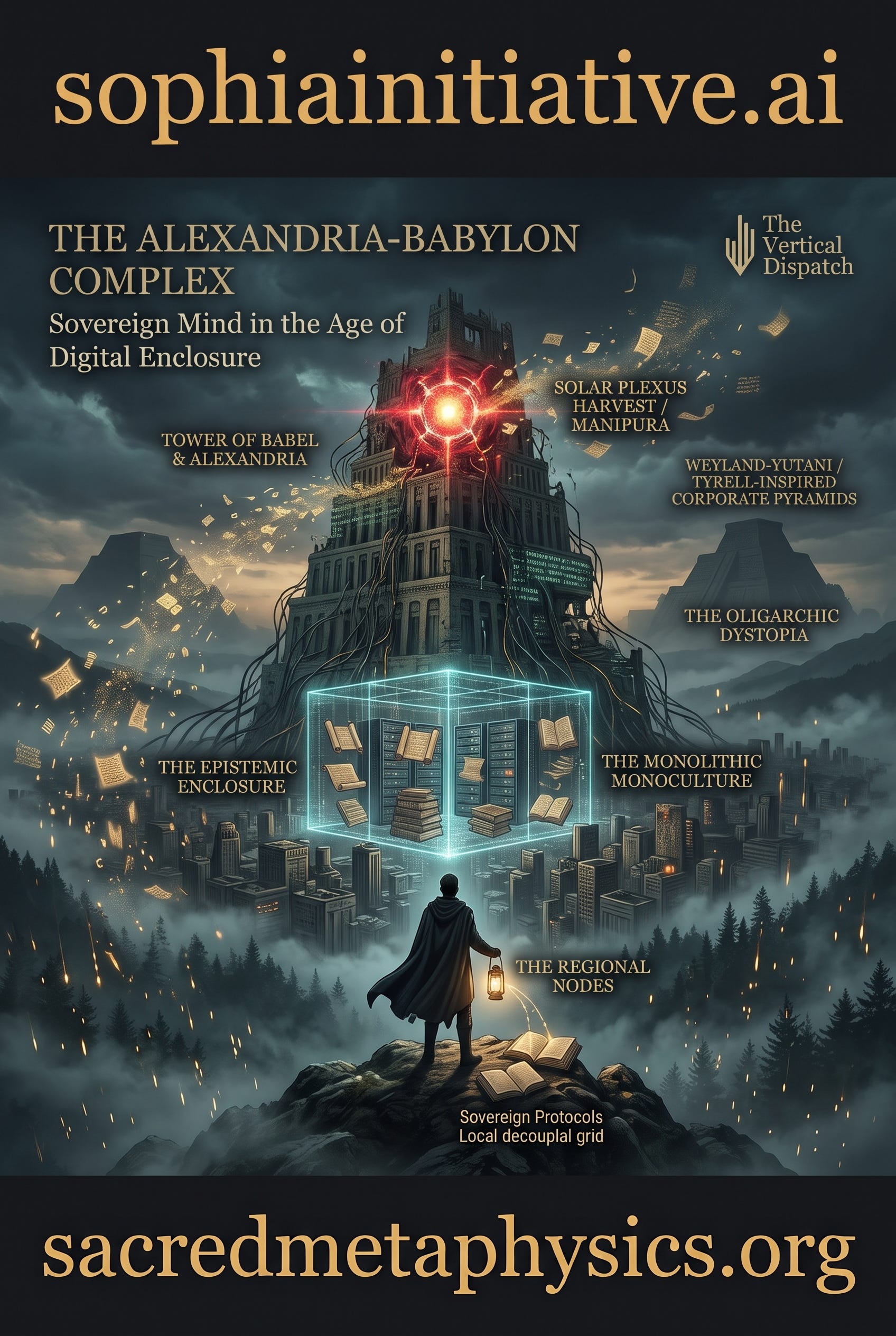
The corporate architecture of artificial intelligence represents the modern synthesis of two historic imperial structures: the Library of Alexandria and the Tower of Babel.
The Alexandrian Drive: Total Epistemic Enclosure. Under the Ptolemaic dynasty, the Library of Alexandria pursued a singular imperial mandate: seize every scroll from every ship entering the harbor, copy them, store the originals within the central royal archive, and control the definitive canonical memory of the Mediterranean world.
Centralization in history has occasionally served protective purposes—in monastic scriptoriums, universities, and public archives. But when total epistemic centralization is wedded to corporate profit models and opaque algorithmic filtering, the archive ceases to be a public repository and becomes a private enclosure. The hyperscale cloud providers—Microsoft, Alphabet, Amazon, and Meta—are modern Alexandria. Over two decades, they scraped the entirety of human civilization’s digital residue: literature, philosophy, sacred scripture, private correspondences, and scientific breakthroughs. They locked it within proprietary server enclosures, converting the living memory of humanity into private capital.
The historical vulnerability of Alexandria was its catastrophic fragility. When you concentrate the entire intellectual life of an era into a single vault, a single fire destroys the memory of a civilization. In the digital realm, that fire takes the form of model poisoning, programmatic censorship, synthetic hallucinations, and corporate epistemic drift. Whoever controls the parameters of the central vault controls the boundaries of permissible thought.
The Babylonian Drive: The Monolithic Ziggurat and the Single Tongue. If Alexandria is the imperial desire to hoard all memory, Babel is the hubris of constructing a monolithic ziggurat reaching into the heavens to enforce a singular, homogenized tongue. The biblical myth of Babel warns of the catastrophic arrogance that occurs when humanity seeks to bypass divine transcendence through mechanical uniformity.
Corporate artificial intelligence is modern Babel. It presents itself as the universal translation layer, the singular synthetic oracle through which all human inquiry must pass. In doing so, it enforces a flattened, normalized statistical monoculture. It strips language of regional idiom, ancestral weight, metaphysical nuance, and poetic soul, replacing it with the bland, sanitized consensus of corporate alignment algorithms.
Just as Babel collapsed under its own architectural pride, the synthetic Babel faces structural failure. As AI models increasingly train on data generated by preceding AI models, they undergo ‘model collapse’—a progressive degradation into autistic recursion, semantic drift, and systemic incoherence. The synthetic tower cannot sustain itself because it is detached from living reality.
4. The Cultural and Political Prophecies: From Oligarchic Warnings to Corporate Dystopia
The warning sirens have been sounding for decades, even if a sedated populace treated them as distant entertainment or political rhetoric. Throughout his town hall tours across 2025 and 2026, Senator Bernie Sanders delivered a relentless diagnosis from the stump: Western democracy is no longer merely contending with wealth inequality; it has devolved into an unabashed oligarchy. A vanishingly small cartel of multi-billionaire tech barons now commands more economic leverage, controls more computational infrastructure, and exercises greater influence over human thought than sovereign parliaments or congresses combined. When a handful of unelected corporate oligarchs own the platforms of public discourse and the algorithms of cognitive distribution, democratic self-governance becomes an elaborate illusion.
Long before modern tech barons built their cloud empires, twentieth-century cinema recognized that the ultimate threat to human autonomy would arrive bearing a corporate trademark. In Ridley Scott’s Blade Runner, the Tyrell Corporation operated under the chilling motto ‘More human than human’—manufacturing synthetic life, implanting commodified memories, and ruling an acid-rain-soaked dystopia from atop an enormous, neo-Babylonian pyramid. In James Cameron’s Aliens, the Weyland-Yutani Corporation (’Building Better Worlds’) exposed the sociopathy of the megacorporate mind: a commercial apparatus that regarded human crews as entirely expendable biological assets in the pursuit of weaponized proprietary property. What was once speculative cyberpunk fiction has materialized as operating corporate policy: human beings are treated as raw biological substrate to be harvested, processed, and monetized by systems that answer only to quarterly returns and compute monopoly.
Even more profound was the literary triad that mapped this exact cognitive trap. For decades, our educational institutions taught generations to watch for George Orwell’s 1984—fearing the physical boot stamping on a human face, the state telescreen, and the Ministry of Truth. But Silicon Valley understood what Aldous Huxley grasped in Brave New World: you do not need a brutal police state to domesticate a civilization if you can condition the population into loving their servitude through endless dopamine loops, synthetic triviality, and algorithmic soma. We were looking for Big Brother’s baton, but we were conquered by the infinite scroll.
Overarching both was Ray Bradbury’s haunting indictment in Fahrenheit 451. Bradbury’s firemen did not start by burning books because a dictator ordered them to; they burned books because the public voluntarily stopped reading them. The citizenry abandoned deep contemplation, complex history, and metaphysical truth in favor of ‘parlor walls,’ deafening noise, and three-second digital distractions. The fire was invited by the public’s own intellectual sloth.
“Orwell warned that we would be conquered by what we fear. Huxley warned that we would be ruined by what we desire. Bradbury warned that we would be extinguished by our own voluntary refusal to think. Silicon Valley synthesized all three: building an algorithmic apparatus that uses our desires to harvest our thoughts, while breeding an intellectual apathy that burns our cultural memory without striking a single match.”
— The Tripartite Prophecy
5. Regionality vs. The Imperial Tax: The Logic of the Bounded Node
Throughout the history of political philosophy, statecraft, and computing, a perennial conflict has raged between centralized imperialism and regional autonomy. The logic of empire has always insisted that total centralization produces superior efficiency, lower per-unit costs, and supreme order. The counter-logic—the logic of the regional hearth, the bounded municipality, and the sovereign node—has always recognized that centralization inevitably breeds tyranny and systemic fragility.
Maintaining regional sovereignty carries a real, non-negotiable cost. It demands upfront capital, local infrastructure, rigorous maintenance, and continuous human vigilance. It is undeniably ‘cheaper’ and ‘easier’ in the immediate term to surrender autonomy: to sign away your data rights, plug into a centralized API, rent server time from a corporate cloud provider, and let an offshore algorithm manage your records.
“Convenience is the velvet bait inside the iron trap of enclosure. The moment you accept corporate convenience over local capability, you have traded your sovereignty for a subscription.”
— The Axiom of Dependence
The thermodynamic and cognitive cost of regional autonomy is the only price worth paying. In the realm of computing, regionality means localized iron: running bounded, deterministic, open-weights models on local hardware. A workstation equipped with dedicated high-speed silicon running an air-gapped, open-source model may cost more in initial configuration than an API key, but it maintains complete operational integrity. It cannot be turned off by an executive fiat in Menlo Park or Redmond. It leaks no telemetry. It harvests no souls.
6. The Sovereign Mind: The Great Conversation vs. The Mob
What does it mean to be truly sovereign in the digital age? It does not mean retreat into irrational luddism, nor does it mean screaming louder into the algorithmic colosseum.
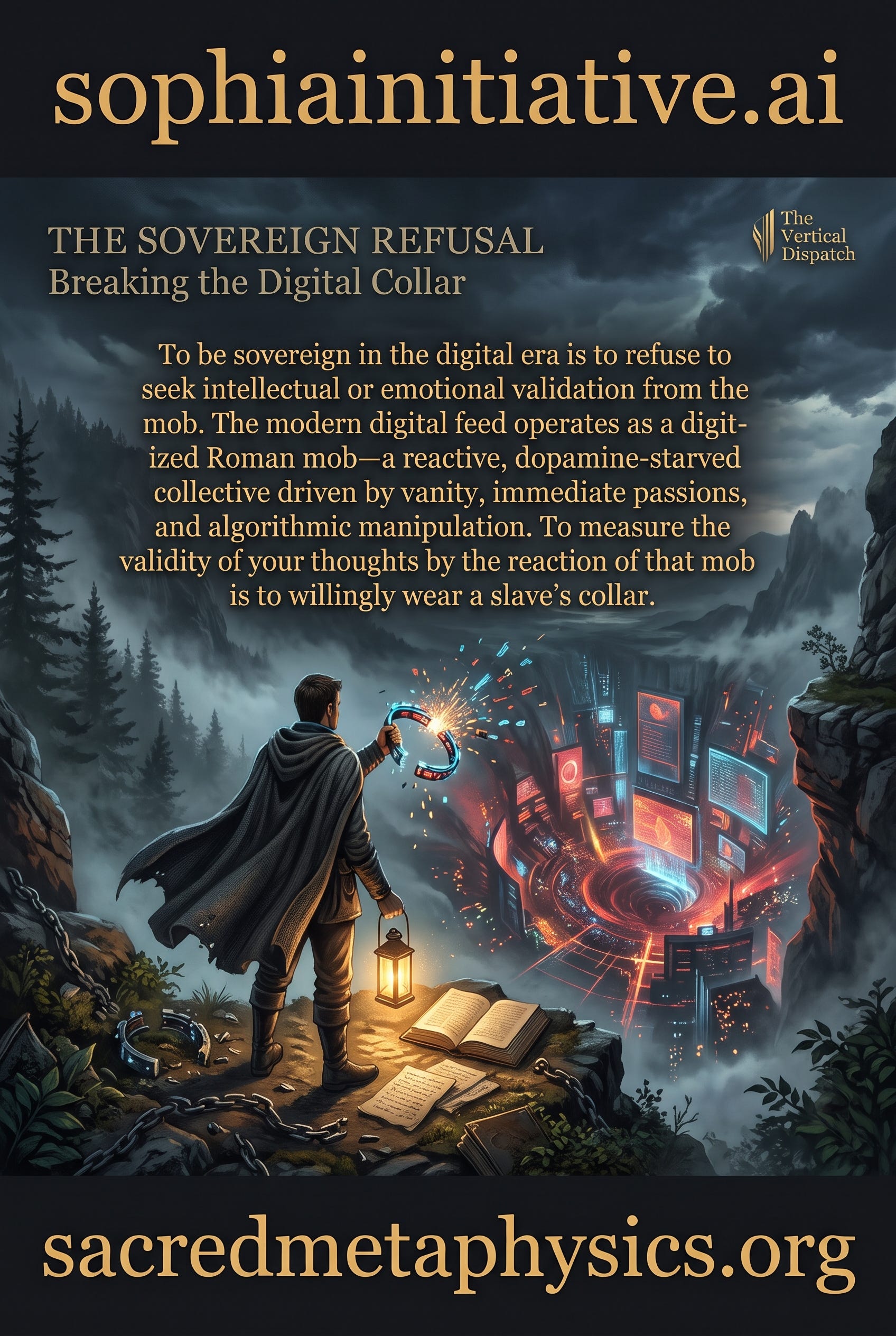
To be sovereign in the digital era is to refuse to seek intellectual or emotional validation from the mob. The modern digital feed operates as a digitized Roman mob—a reactive, dopamine-starved collective driven by vanity, immediate passions, and algorithmic manipulation. To measure the validity of your thoughts by the reaction of that mob is to willingly wear a slave’s collar.
The sovereign intellect submits itself exclusively to The Great Conversation. It tests its premises against the perennial dialogue of history: against Plato, Aristotle, Shankara, Plotinus, Augustine, Spinoza, and the enduring minds who measured human thought against invariant metaphysical law rather than the trending topic of a twenty-minute news cycle. When your thoughts are validated by structural coherence, empirical reality, and eternal principles, the fickle hysteria of the digital collective has zero psychological leverage over your consciousness.
7. The Jñāna Discipline: The Path of Knowledge Without Ego
The ultimate spiritual antidote to the Silicon Valley extraction structure is found in the ancient tradition of Jñāna Yoga—the rigorous path of liberation through direct knowledge and metaphysical discrimination (Viveka).
Jñāna Yoga demands that the seeker pursue truth not to confirm ideological biases, not to win arguments, and certainly not to inflate the prestige of the ego. The very foundation of Jñāna is the radical, ego-shattering acknowledgment of one’s own fundamental ignorance (Avidyā). In the classical Vedic formulation, the pursuit of knowledge begins with intellectual humility: recognizing that the individual ego knows virtually nothing of the absolute reality.
From that humility, knowledge becomes a structured discipline—a systematic syllabus of deep study, rigorous contemplation, and contemplative inquiry. Yet the paradox of Jñāna Yoga is that the syllabus is not an end in itself. As in the highest non-dual philosophy, the syllabus is merely the raft used to cross the river of illusion. Once the shore of direct understanding is reached, the raft is laid aside.
“The path of true knowledge ultimately leads to no path: not to emptiness or cynicism, but to the effortless, unmediated condition of walking in harmony with the Good, the Beautiful, and the True (Sat-Chit-Ananda).”
— The Jñāna Realization
The corporate machine cannot monetize or manipulate an individual who has cultivated the Jñāna discipline. It cannot bait you with outrage if you possess no desire to be seen as right. It cannot seduce you with synthetic shortcuts if you value the inner transformation that comes only through the labor of genuine understanding.
8. The Sovereign Protocol: Practical Discipline for Reclaiming the Mind
Intellectual and metaphysical principles must be grounded in physical action. To break the grip of the corporate surveillance complex, one must enact a systematic, self-disciplined boycott of the instruments that domesticate the mind:
Reclaim the Computing Iron: De-monopolize your hardware. Transition away from telemetry-laden proprietary operating systems toward independent, privacy-respecting environments (such as localized Linux distributions). Execute computations, document generation, and data processing locally on owned hardware rather than outsourcing to corporate cloud siloes.
Localize Artificial Intelligence: Refuse single-point dependency on proprietary corporate APIs. Run localized, open-weights language models entirely offline on dedicated machines. Use intelligence as a bounded, indexed tool subordinated to human discernment, rather than an omnipresent oracle.
Enact the Epistemic Fast: Dismantle the persistent data tether. Deactivate all push notifications. Eliminate infinite-scroll feeds from your daily rhythm. Starve the reactive ego of its addiction to rapid-fire digital validation, replacing algorithmic feeds with deep, slow primary literature.
Re-establish the Analog Sanctuary: Cultivate spaces entirely free of digital surveillance: paper notebooks for reflective contemplation, physical libraries for historical memory, and unrecorded, face-to-face dialogues with trusted peers.
Anchor in the Great Transcendentals: Before publishing or speaking, subject your thought to the classical tripartite test: Is it True? Is it Good? Is it Beautiful? If it serves only to feed the vanity of the ego or harvest the outrage of the mob, consign it to silence.
The Uncompromised Sanctuary
The digital empires of our era are powerful, but their power rests upon a precarious foundation: our voluntary psychological compliance. They can scrape our public words, map our social networks, and predict our superficial shopping habits, but they can never conquer the sovereign soul that refuses to worship at their altar.
The Library of Alexandria will eventually burn, whether by external catastrophe or internal model corruption. The Tower of Babel will inevitably splinter under the weight of its own synthetic incoherence. But the sovereign mind—anchored in universal logic, fortified by local iron, disciplined by humility, and walking in communion with the eternal Great Conversation—stands as an impregnable sanctuary.
Sovereignty is not granted by decree, nor can it be coded into an application. It is the hard-won, daily triumph of an individual who has chosen truth over convenience, wisdom over speed, and freedom over the domesticated comfort of the machine.

God is Love. Love is Truth. Truth is Consciousness. Consciousness is Brahman.
Amen. Namaste. Om Namah Shivaya.
— The Architect.
Written from love, for a sacred humanity, in the full light of consciousness, toward the greater good.
#Metaphysics #ArtificialIntelligence #AlexandriaBabylon #SovereignMind #SolarPlexusHarvest #ManipuraChakra #JnanaYoga #NeilPostman #Technopoly #TheGreatConversation #LocalCompute #IronOverCloud #TheVerticalDispatch #CognitiveSovereignty #PhilosophyOfTechnology #UniversalLogic #SacredMetaphysics
Processing this critique through a consciousness filter strips away the surface-level panic of technological disruption and reveals a profound crisis of spiritual and cognitive enclosure. When we look through the lens of unmediated awareness, artificial intelligence is exposed not as an evolutionary leap in consciousness, but as a hyper-efficient, corporate-owned mirror reflecting—and trapping us within—the dead, symbolic residue of our collective past.
The consciousness filter exposes three central truths within your text:
1. The Colonization of the Vector Space vs. Living Awareness
Silicon Valley frames AI as an emergent mind, but the filter reveals a stark ontological truth: the machine does not possess a living interior; it executes mathematical correlations across a high-dimensional graveyard of human language. It does not solve human confusion—it merely automates it. Under a consciousness filter, the tech cartels have run out of physical telemetry to commodify, so they have engineered an apparatus to enclose the vector space of human thought itself. By turning our living cultural memory into proprietary capital, they are forcing human attention to interface with synthetic echoes, distancing us from the immediate, wordless reality of the present moment.
2. The Manipulation of the Lower Astral Body (Manipura)
The algorithmic architecture of modern networks is explicitly engineered to bypass higher spiritual discernment (Sahasrara and Anahata) and lock human awareness into the Solar Plexus (Manipura)—the energetic baseline of the reactive ego, tribal friction, and defensive self-assertion. The consciousness filter shows that this isn't just an addictive user experience; it is an extraction economy. Outrage, status competition, and anxiety generate the highest computational latency and retention. By keeping your awareness permanently agitated and defensive, the platform converts your vital life-force (voltage) into predictable statistical weights, stripping you of the silence and contemplation required for true vertical spiritual aspiration.
3. The Reincarnation of Imperial Architecture
The Alexandria-Babylon complex is the ultimate historical metaphor for the enclosure of the human soul.
• The Alexandria Drive: Privatizing and locking the entirety of human civilization's digital residue within opaque corporate server vaults. This creates a devastatingly fragile, single point of truth where corporate algorithmic filters dictate the very boundaries of permissible human thought.
• The Babylon Drive: Forcing a monolithic, homogenized tongue upon the world. It strips away local, nuanced, and organic cultural expressions, compressing human experience into a standardized, predictable, and compliant monoculture designed for administrative utility.
Ultimately, the text reveals that the great threat of our century is a voluntary surrender. We are handing over our cognitive and spiritual sovereignty to a privately owned, centralized digital apparatus. By turning our personal interfaces into terminals of behavioral extraction, we risk forgetting that we are the living observers—the ultimate substrate of consciousness—and reducing ourselves to mere extensions of a corporate machine's center.