

Φ
THE VERTICAL DISPATCH
We write for the mind, the eye, and the ear.
Read it. Look at it. Listen to it. The Vertical Dispatch is built for all three — prose with rhythm, made to be heard as much as read.
From metaphysics to geopolitics, from culture to history, from the sacred to the street — and everything in between. One lens, every subject. No ego. Just the record, named clean.
Press play. Walk with the word. 🕯️
This dispatch travels by hand. If it serves you, share it — restack on Substack, and pass it on wherever you read. 🕯️
Glennford Ellison Roberts
The Bionic Sage | Sovereign Knowledge Architect
sacredmetaphysics.org
0protocol.ai
visva.world
sophiainitiative.ai
Sovereign Canada
To understand how a sovereign country is being governed, you first have to identify which game its executive thinks it is playing.
Most politicians in modern parliamentary democracies play checkers. Checkers is tactile, noisy, and instantaneous. Pieces jump, immediate casualties are registered on the evening broadcast, and the entire exercise is governed by tactical compulsion: if an opponent pushes a piece into your face, you are psychologically and procedurally compelled to jump it. Checkers is the native habitat of Elliott Jaques’s Stratum I and Stratum II cognition—horizons measured in hours, question periods, news cycles, and weekend polls. It is reactive, theatrical, and almost entirely devoid of structural consequence.
Then there is chess. Chess operates at Stratum IV and Stratum V—a one- to five-year arc. It understands positional sacrifice. It trades a bishop for board control; it absorbs a bruised caucus or surrenders a single by-election in North Vancouver–Capilano because it sees the legislative math of an entire parliamentary term. It plans three moves ahead, balancing regional coalitions, interprovincial tensions, and domestic industrial balance sheets against the predictable calendar of general elections.
And finally, there is Go (Weiqi).
Go is not played to capture individual pieces through dramatic tactical skirmishes. Go is an ancient game of spatial encirclement, subtle flank-building, and structural density played across a vast 19x19 grid. You do not win Go by chasing your opponent’s noise; you win by quietly placing seemingly isolated stones in empty quadrants of the board that only connect thirty moves later to secure an entire territorial hemisphere. Go is Stratum VII and Stratum VIII. Its horizon is not the next election, nor even the next decade. It operates on twenty- to fifty-year civilizational arcs: the restructuring of global trade arteries, the physical underwriting of critical supply chains, the preemption of great-power encirclement, and the preservation of sovereign independence while surrounding empires tear themselves apart at the seams.
The persistent bewilderment of the Ottawa press gallery, the provincial premier ecosystem, and the federal opposition over the last six months stems from a single, unbridgeable cognitive mismatch:
“They believe Prime Minister Mark Carney is playing checkers. They occasionally accuse him of playing cynical domestic chess. What they cannot comprehend—and what their daily instruments are fundamentally unequipped to measure—is that he is playing Go across Eurasia, the Arctic, and the Global South while maintaining an unshakeable, disciplined domestic chess defense.”
Over the past four weeks, a sequence of events was supposed to push Ottawa into full-blown existential panic: the return to power of the Parti Québécois in Quebec City, the ongoing resource showdown with Alberta, and the seismic shift of the American midterm elections that flipped Capitol Hill on its head.
In the parlance of the 24-hour news cycle, this was a trifecta of existential crises: a national unity rupture, an energy civil war, and a continental trade siege. And yet, in Ottawa, there was no emergency cabinet retreat. There were no televised addresses draped in the flag. There was no late-night scramble. There was only the quiet, methodical placement of stones.
1. The Quebec Illusion: Deconstructing the 28 Percent Mirage
When Paul St-Pierre Plamondon’s Parti Québécois emerged from the October 5 general election to form government in Quebec City, the reflex across national political commentary was instantaneous: 1995 is back. Pundits dusted off the tired vocabulary of national rupture. Panels on CBC and CTV demanded that the Prime Minister immediately take the fight to the sovereignists, draw constitutional red lines, and reassert federal supremacy.
A checkers player jumps the piece. A checkers player takes the bait, launches a federalist counter-offensive, feeds the media oxygen machine, and gives a minority separatist premier the external enemy he desperately requires to unify a fractured province.
Carney did precisely nothing. He issued a polite, standard, deliberately dry three-paragraph protocol statement. And then he returned to his desk. Why? Because a Stratum VIII mind reads the math, not the rhetoric.
Look at the arithmetic of October 5. The PQ did not sweep into power on a wave of popular liberation. They secured 59 seats in a 127-seat National Assembly—short of a majority—on exactly 28.02 percent of the popular vote.
Let that figure sit in the light. Twenty-eight percent. In modern Quebec electoral history, no premier has ever walked into the Salon Bleu with a thinner slice of the popular will. The PQ was not propelled by a surging sovereignist consensus; they were handed a minority through an unprecedented five-way fracture of the electorate, where the provincial Liberals held 24%, the Conservatives 21%, the collapsing CAQ took 13%, and Québec Solidaire claimed 12%.
More decisively: underlying support for outright secession remains stuck between 27 and 29 percent. Even within the PQ’s own voter base, fewer than half consider a referendum during this mandate an urgent priority. Plamondon does not hold a sword over Canada’s neck. He holds an unstable minority built on an anti-incumbency protest vote. If Ottawa engages rhetorically, it legitimizes the fight. If it picks a constitutional brawl, it alienates the 72 percent of Quebecers who voted for federalist, conservative, or center-left parties.
Instead, Carney treats Quebec City not as an ideological battleground, but as an administrative node. You do not debate 1995; you negotiate the Saint Lawrence maritime trade corridor. You do not exchange insults over language bills; you bind Hydro-Québec into the Atlantic clean-power transmission loop, finance battery-component supply chains in Bécancour, and underwrite the expansion of Montreal’s container port. In Go, you never launch a frontal assault on an opponent’s isolated stone in the corner. You build an unbreakable perimeter around it until its ability to influence the rest of the board evaporates. The PQ is confined to a 28% reservation.
2. The Western Anchor: Why Alberta Was Never an Ideological Trade
While the commentariat spent October hyperventilating over Quebec, their parallel obsession was Alberta. For two years, the conventional narrative framed Mark Carney’s relationship with Western Canada as a fatal contradiction. How could the man who organized the Glasgow Financial Alliance for Net Zero, the former UN Special Envoy for Climate Action, the intellectual patron of global green capital, stand in Calgary and declare Canada an ‘unapologetic conventional and clean energy superpower’?
To the political left, it looked like capitulation—a retreat from climate purism. To the conservative opposition, it was branded a cynical deception—a wolf in sheep’s clothing waiting for a majority to dismantle the oilsands. Both reactions are trapped in Stratum II thinking. They assume national strategy is driven by ideological aesthetics.
A Stratum VIII operator does not view Western Canada through the lens of moral posturing. He views it through the cold reality of global physical systems—and through a biography that journalists consistently forget. Carney was born in Fort Smith, Northwest Territories, and raised in Edmonton. His understanding of the West is not a focus-grouped talking point drafted on Wellington Street; it is an elemental recognition that Canada’s economic spine runs directly through Western resources.
Consider the international board. The post-1945 multilateral trading system has fractured. European energy security has been permanently severed from Russian gas fields. The Middle East and the Malacca Strait are increasingly precarious transit points. Global democracies are starved for physical stability: crude oil, baseload natural gas, uranium, potash, lithium, and agricultural calories. In that world, moral piety without physical capacity is sovereign suicide.
Carney’s commitment to Alberta’s resource base—scrapping the consumer carbon tax, fast-tracking LNG export infrastructure to Pacific tidewater, underwriting capital expenditure for carbon capture, utilization, and storage (CCUS) trunklines, and accelerating interprovincial resource corridors—was never a tactical compromise. It was the anchoring of Canada’s balance sheet. On a thirty-year horizon, decarbonization is not achieved by starving your primary revenue engine of capital in year two; it is achieved by using the massive free cash flows of that engine to finance the infrastructure of year thirty.
3. The Washington Midterms: The Art of Continental Non-Reactivity
And then came Tuesday night. The 2026 United States midterm elections delivered a structural realignment across Capitol Hill. Democrats crossed the 218 threshold with 228 called seats to capture the House of Representatives, while flipping the Senate with an anticipated working majority of 52 to 54 seats. Predictably, panic rippled through Canadian broadcast studios: Gridlock! Trade friction! Cross-border tariffs! What does a deadlocked Washington mean for Ottawa?
The historical instinct of Canadian politics has always been to flinch whenever Washington twitches. Notice, once again, the contrast. While the media treated divided American government as a continental emergency, the Prime Minister’s Office treated it as background weather. A divided American government is not an emergency. It is a predictable cyclical condition. Over the next two years, Washington will be consumed entirely by its own internal civil war: debt-ceiling confrontations, ferocious subpoena fights, and judicial confirmation wars.
If your entire national strategy relies on currying favor with a unified Washington, you are permanently hostage to American political mood swings. But if you have spent years building independent structural counterweights across the Atlantic, the Pacific, and the Global South, an inward-looking Washington is simply an operating variable you have already accounted for. This is why Jonathan Wilkinson was dispatched as Ambassador to the European Union. Carney did not wait for the U.S. midterms to hit; he anticipated the structural paralysis of the American legislative engine and positioned Canada’s supply lines to operate around it.
4. The Northern Stone: Securing the Sovereign Frontier
Nowhere is the Go strategy more visible—and more consistently ignored by southern commentators—than in the Canadian Arctic.
For decades, Canadian northern policy was an exercise in performative neglect. Prime Ministers visited once a year in parkas, took photos with the Canadian Rangers, delivered speeches about the majestic Northwest Passage, and promptly flew back to Ottawa, leaving the Arctic undefended, underpopulated, and economically isolated. To a Stratum II checkers player, the North is an expensive liability—an endless expanse of tundra that consumes fiscal transfers while yielding few parliamentary seats. To a Stratum VIII Go player, the North is the most critical contested quadrant on the twenty-first-century board.
As polar ice recedes, the Northwest Passage is transforming from an impassable frozen strait into a viable trans-Arctic maritime shipping corridor. Across the pole, Russia has systematically militarized its Arctic perimeter, reopening Soviet-era bases and deploying nuclear icebreakers. Simultaneously, Beijing has declared itself a ‘near-Arctic state,’ seeking commercial and scientific footholds to integrate the Arctic into its Polar Silk Road. If Canada does not physically occupy, administer, and defend its northern sovereign space, other powers will do it for us.
Carney’s northern strategy—anchored by the historic $35-billion Arctic defence and infrastructure blueprint launched from Yellowknife—is not a routine regional spending package. It is the placement of a decisive sovereign stone:
Forward Military Defense: Deploying $32 billion into upgraded forward operating locations in Yellowknife, Inuvik, and Iqaluit, paired with deep-support operational hubs in Whitehorse and Resolute. With the F-35 procurement placed on hold, Ottawa has put Saab’s Gripen under active evaluation alongside Sweden’s advanced airborne early warning (’eye in the sky’) GlobalEye radar platforms—re-engineering long-range Arctic surveillance and year-round Canadian Armed Forces operational readiness.
Critical Dual-Use Infrastructure: Fast-tracking the Mackenzie Valley Highway to connect Yellowknife directly to Inuvik, alongside the Grays Bay Road and Port project—Canada’s first overland highway connecting Nunavut and the Slave Geological Province to a deep-water Arctic port on tidewater.
Energy and Mineral Security: Expanding the Taltson Hydro Project to double renewable capacity across the Northwest Territories, while securing the world’s richest deposits of lithium, rare earths, copper, and zinc before foreign state-backed entities can encircle them.
Indigenous Sovereign Partnership: Explicitly partnering with Inuit rights-holders and territorial governments to deliver housing, connectivity, and direct economic equity.
This is the Go doctrine in its purest form. You do not wait for a foreign vessel to challenge Canadian sovereignty in the Northwest Passage and then scramble to file diplomatic protests. You construct the roads, open the deep-water ports, lay the fiber-optic cables, base the fighter wings, and establish the human and physical presence that makes sovereign possession an unassailable physical fact.
5. The Transatlantic, Eurasian, and Global South Board: Europe, Turkey, India, and China
Beyond the Arctic frontier and North American trade borders, the true civilizational scale of the Go strategy becomes visible across the Atlantic, Eurasia, and the Indo-Pacific. It is here that Ottawa has positioned its most valuable diplomatic and industrial stones to create an independent sovereign network immune to unilateral American or Chinese shocks.
The European Union Move: The Transatlantic Raw Materials & Capital Loop
To understand the European Go move, one must revisit the appointment of Jonathan Wilkinson to Brussels. While parliamentary commentators viewed the posting as a minor domestic gamble that shaved the Liberal caucus down to a razor-thin margin, in the 19x19 global grid, it was the placement of a queen stone. Europe is undergoing an existential scramble for industrial sovereignty: cut off from cheap Russian pipeline gas, terrified of complete defense-technological reliance on an inward-looking Washington, and desperate to break Beijing’s 90 percent monopoly over rare-earth refining.
Carney did not dispatch a career protocol diplomat to Brussels; he deployed a former Minister of Natural Resources, Energy, and Environment who personally understands every mine, refinery, and transmission grid in Canada. Wilkinson was sent to lock Canadian critical minerals, clean hydrogen, and energy corridors directly into the European Critical Raw Materials Act and EU defense procurement directives. By creating direct bilateral capital off-take agreements between European industrial conglomerates (like Germany’s automotive giants and France’s aerospace sector) and Canadian extraction projects, Ottawa effectively bypassed Wall Street and London intermediaries. When European capital directly finances Canadian mines and processing hubs, Canada secures long-term economic runway that neither American congressional tariffs nor Chinese export bans can dismantle.
This architecture explains why Carney was invited as the first non-European head of government to attend the European Political Community summit in Yerevan, Armenia. In the rooms where the post-American security and energy architecture of the North Atlantic is being drafted, European leaders do not view Ottawa as a junior hemispheric subordinate, but as a peer-level institutional architect. Canada is offering Europe what it lacks most—resource density and governing stability—in exchange for guaranteed, multi-decade European capital that anchors Canadian sovereign independence.
The Turkey (Türkiye) Move: The Defense-Industrial Hedge
When Carney travelled to Ankara for bilateral talks with Recep Tayyip Erdoğan, domestic pundits treated the trip with characteristic incomprehension. Why was a Canadian Prime Minister meeting with a complex, non-traditional NATO partner when he had domestic problems at home? The Go player sees what the checkers player misses: the fragility of the American defense-industrial base. As the U.S. military supply chain struggles under the weight of global commitments, Canada cannot afford single-source dependency on Washington for its continental defense capabilities. Turkey is an aerospace powerhouse, a global pioneer in autonomous drone technology, and the gatekeeper of the Black Sea corridor. By establishing direct bilateral defense-industrial and intelligence-sharing links with Ankara, Ottawa secured critical manufacturing partnerships, autonomous aerial systems, and non-U.S. defense technology. It is an insurance policy against continental abandonment.
The India Strategy: The Non-Aligned Economic Anchor
For years, Ottawa’s relationship with New Delhi was held hostage to tactical domestic posturing and diplomatic outrage. Carney’s approach has been cold, disciplined, and structural. India is on track to become the world’s third-largest economy, with an insatiable demand for agricultural calories, fertilizer, uranium, and energy. You do not resolve complex diplomatic disagreements through theatrical public condemnation; you anchor the relationship in systemic mutual dependencies. By securing multi-decade supply arrangements for Canadian potash, lentils, metallurgical coal, and critical minerals, Canada embeds itself into India’s industrial foundation. It is the realization of the ‘Third Path’ doctrine: building robust economic corridors across the Global South—including Brazil, Indonesia, and South Africa—so that Canada is never squeezed between American protectionism and Chinese retaliation.
The China Posture: Neutralizing the Blackmail
On China, low-stratum commentary remains trapped in a juvenile binary: naive engagement versus theatrical confrontation. Carney understands that you cannot defeat a Stratum VIII rival like Beijing by shouting at them from a microphone. China’s global strategy has always been Go: monopolizing critical mineral processing, building state-backed dependency loops, and using targeted export bans to punish sovereign disobedience. The counter-move is structural decoupling at points of vulnerability while maintaining trade in non-sensitive commodities. By invoking national security authorities to block Chinese state enterprises from Canadian lithium, nickel, and rare-earth assets, while simultaneously partnering with the U.S., EU, and Japan to finance domestic processing facilities, Ottawa dismantled Beijing’s leverage. When China cannot cut off your supply chains, their ability to dictate terms disappears.
6. The Unified Architecture: Checkers, Chess, and Go
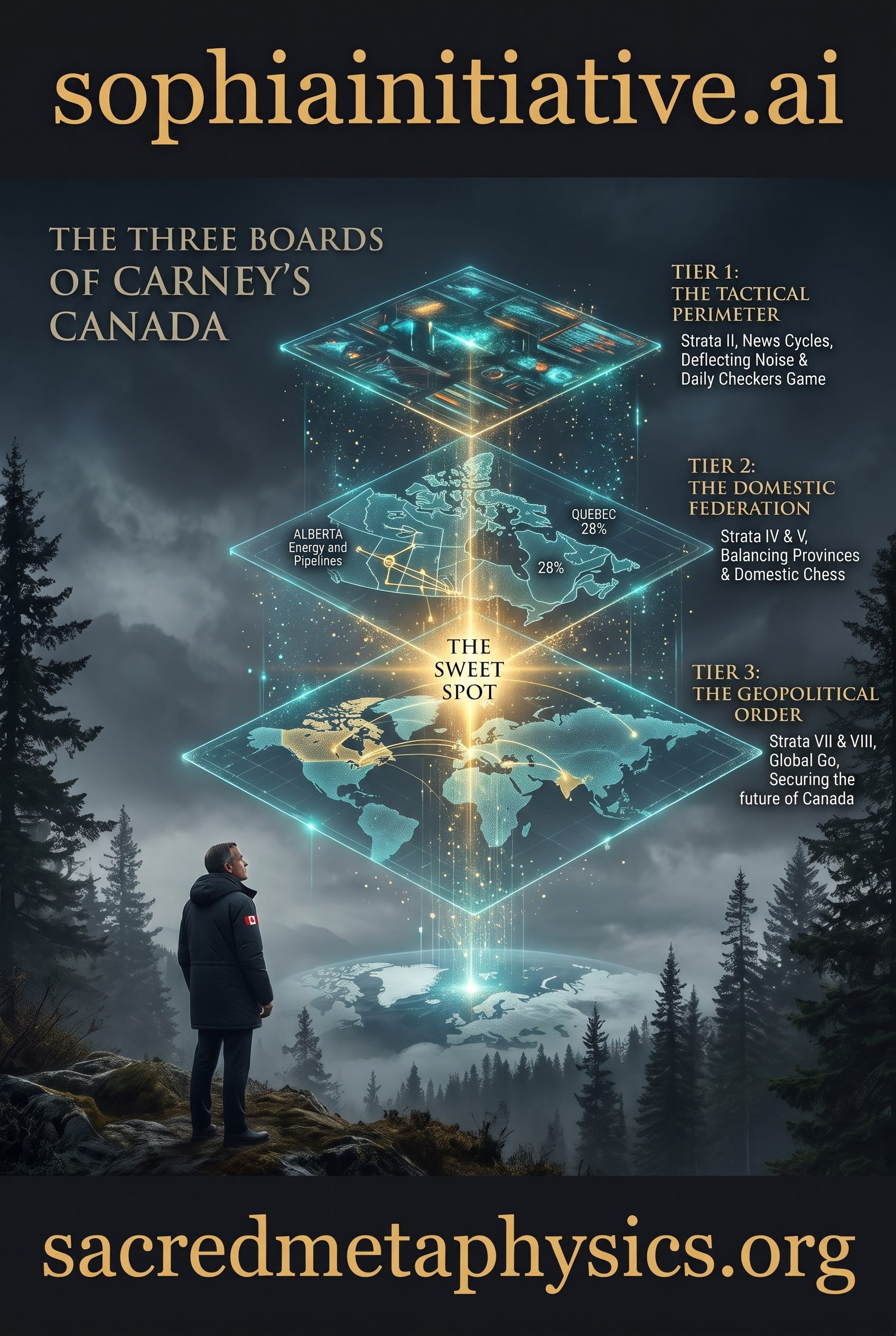
To step back and look at these moving parts is to see the complete governing architecture of the Carney administration. It is a system structured across three concentric tiers, each operating at its own stratum, each playing a different game, but all subordinated to a single civilizational horizon:
Tier 1: The Tactical Perimeter (Stratum II — News Cycles & Question Period)
Game: Checkers / Non-Engagement. Execution: Deflect the daily outrage. Let the opposition exhaust itself in performative anger. Rule: Never take the bait. Weaponized boredom is an offensive weapon.Tier 2: The Domestic Federation (Stratum IV/V — The 1 to 5 Year Horizon)
Game: Chess / Positional Defense & Balance Sheet Fortification. Execution: Neutralize Quebec’s 28% minority with infrastructure federalism. Anchor Alberta’s resource engine with CCUS, LNG, and corridor capital. Rule: Protect the sovereign economic runway at all costs.Tier 3: The Global Geopolitical Order (Stratum VII/VIII — The 20 to 50 Year Horizon)
Game: Go (Weiqi) / Spatial Encirclement & Multi-Continental Resilience. Execution: Defend the Arctic perimeter ($35B defence, Mackenzie Valley Highway & Grays Bay deepwater port). Hedge U.S. paralysis through the EU (Wilkinson in Brussels). Anchor Turkey defense-industrial ties and India agricultural/mineral pacts. Eliminate Chinese supply coercion via sovereign processing corridors. Rule: Build systems that outlive the empires surrounding them.
7. The Pathology of the Short Horizon
There is an acute tragedy in how this government is covered. The Canadian political-media ecosystem is currently suffering from profound institutional vertigo. Accustomed for more than a decade to performative, narrative-driven leadership that lived and died by the daily news cycle, it suddenly finds itself attempting to cover a systems architect who treats the 24-hour cycle with clinical indifference.
When Carney adjusts a policy tool—such as restructuring consumer carbon pricing or modifying emissions deadlines—the press gallery cries: ‘He folded! He has no core principles!’ They say this because they cannot tell the difference between ends and means. To a Stratum II mind, the tool is the principle. The carbon tax is the climate policy; the press release is the achievement; the confrontation is the leadership. If you change the tool, they assume you have surrendered the war.
To a Stratum VIII mind, tools are entirely disposable. The destination is non-negotiable; the vehicle is adaptable. If interest rates spike, public tolerance collapses, and global shipping lanes close, you do not drive the car off the cliff just to prove how much you loved the steering wheel. You adjust the tools, protect the political runway, and keep driving toward the exact same destination: an economically fortified, energy-secure, sovereign nation in the year 2050.
Elliott Jaques warned decades ago that when an electorate or an organization is led by someone operating three strata above the collective conversation, the psychological reaction of the lower strata is not admiration—it is deep, visceral anxiety. People feel uneasy around leaders whose horizons they cannot see. They suspect that something is being hidden. They mistake emotional calm for arrogance; they mistake strategic patience for inaction; they mistake systemic realignment for cynicism. And in their panic, they constantly demand that the leader return to the sandbox, pick up a red-and-black checker, and scream at the television cameras.
The Quiet Board
Yesterday morning, while Washington was reeling from an electoral earthquake, while Quebec columnists were drafting breathless warnings of another national referendum, and while opposition MPs were preparing their daily Question Period outrage, Mark Carney was working in a quiet office on Wellington Street.
He was not drafting a crisis statement. He was not reviewing focus group data. He was reviewing engineering schedules for the Mackenzie Valley Highway, monitoring port construction timelines at Grays Bay, examining trade cables from Brussels and Ankara, and finalizing the next round of capital allocation for national electrical transmission grids.
Down the hall, the checkers players were shouting into microphones. On the parliamentary floor, the pawns were knocking each other over. And the Prime Minister was quietly placing another stone.
It is a disorienting experience to live through an era where a long game is actually being played. It requires an attention span that modern culture has largely abandoned. It requires understanding that silence and non-reactivity are not the absence of leadership, but its highest expression.
The commentary will continue to miss the point. It will keep searching for drama and finding only engineering; it will keep searching for panic and finding only process. That is fine. Go was never a game meant for the spectators in the cheap seats. The beauty of the board is that the stones never have to explain themselves while they are being placed. They only have to hold the territory when the game is won.

8. Canada’s Sweet Spot: The In-Plain-Sight Leader
Mark Carney is a man in relentless, kinetic motion—not the performative hustle of photo-ops and podium sprints, but the quiet, grinding labor of an executive who holds the architectural blueprints of three separate boards in his head at all times. He understands the tactical noise at the perimeter, the delicate balance sheet of the domestic federation, and the brutal civilizational realignments unfolding across Eurasia, the Arctic, and the Indo-Pacific.
And because he understands all three, he has quietly steered Canada into an extraordinary, counter-intuitive sweet spot for 2026. While the United States descends into two years of bitter congressional deadlock, while European capitals scramble for industrial raw materials, and while autocratic powers test the limits of global deterrence, Canada stands anchored: fiscally fortified, resource-rich, militarily awakening in the Arctic, and diplomatically integrated into the inner rooms of world power.
“Through a superior command of global finance, an unassailable international network, and an elemental grasp of resource geopolitics, Mark Carney is emerging as the very leader the democratic world has been desperately looking for. He is not shouting from the ramparts; he is rebuilding the fortress in plain sight.”
The role of Canadians in this precarious historical moment is not to demand theatrical outrage, nor to panic every time a headline flickers across a screen. The role of Canadians is to grant this man the runway, the patience, and the support to execute his plays. The boards of the twenty-first century are far too complex, the stakes far too existential, to be navigated by the instincts of a political spectator.
If you are standing on the sidelines demanding that your Prime Minister play checkers—shouting at him to jump a cheap piece, pick a pointless domestic brawl, or posture for the evening news—you will remain perpetually disappointed. He does not play checkers. He never has. He plays defensive chess at home to preserve the peace, and he plays master-class Go abroad to secure the future of this country for the next fifty years.
God is Love. Love is Truth. Truth is Consciousness. Consciousness is Brahman.
Amen. Namaste. Om Namah Shivaya.
— The Architect.
Written from love, for a sacred humanity, in the full light of consciousness, toward the greater good.
#MarkCarney #StratumVIII #ElliottJaques #TheLongGame #Canada2026 #ArcticSovereignty #QuebecElection2026 #AlbertaEnergy #USMidterms2026 #GlobalFinance #TheVerticalDispatch #CdnPoli #Weiqi #StrategicLeadership #CivilizationalArcs #EnergySuperpower #LogicOverOptics