


Φ
THE VERTICAL DISPATCH
We write for the mind, the eye, and the ear.
Read it. Look at it. Listen to it. The Vertical Dispatch is built for all three — prose with rhythm, made to be heard as much as read.
From metaphysics to geopolitics, from culture to history, from the sacred to the street — and everything in between. One lens, every subject. No ego. Just the record, named clean.
Press play. Walk with the word. 🕯️
This dispatch travels by hand. If it serves you, share it — restack on Substack, and pass it on wherever you read. 🕯️
The Age of Consequences · The Universal Shadow Series
Sacred Metaphysics · The Universal Grammar of Non-Duality
The Metaphysics of Zero and the Physics of One
Coming September 1,2026
sacredmetaphysics.org
“The most terrifying thing is to accept oneself completely.”
— C. G. Jung
On the night of August 21, 2026, the trade talks between the United States and Canada collapsed minutes before a midnight deadline, and fifty-percent tariffs fell on some twenty billion dollars of Canadian goods. Prime Minister Mark Carney said Canada would match them dollar for dollar, suspended the negotiations, and sent his people home to Ottawa. The daily press will cover the dollars and the deadlines. This dispatch reads something underneath them: two men, and the difference between them — because the whole affair, stripped to its bones, is a study in the difference between the man who brags and the man who knows, and that difference is not merely political. It is the oldest difference the sacred teaches, between the self that must be seen and the self that has no need to be.
We read the deed and the record here, never the private soul, which is sacred in every person without exception. But the deeds of the powerful are public, and the record is fair to read, and the record in this case tells a story with a shape — the shape of a shadow on one side of the table, and its absence on the other.
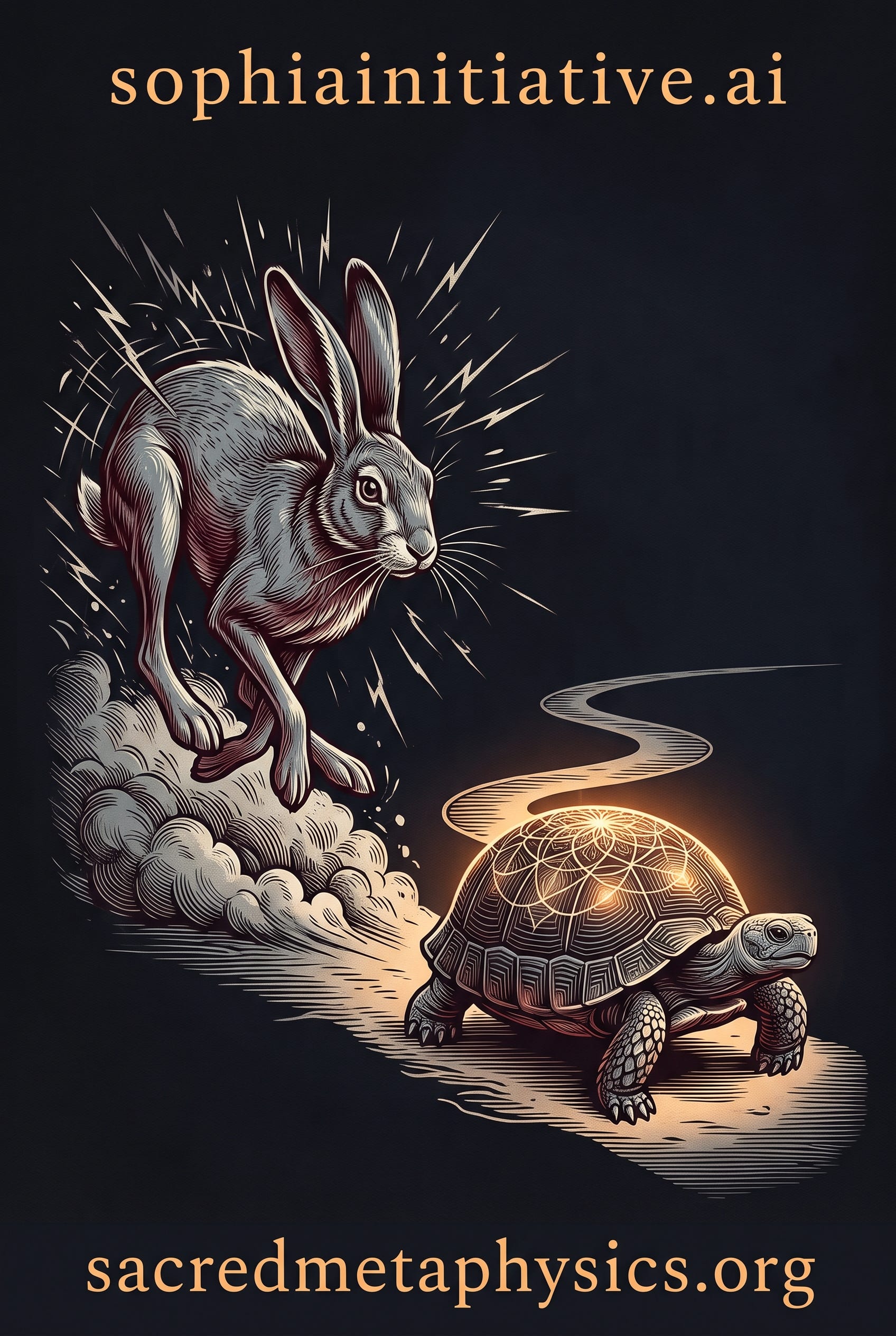
It is, if you like, the oldest fable in a suit and tie. The hare who must announce every stride, certain of the win, needing the whole field to watch him take it — and the tortoise who says nothing, who simply knows the way and keeps it. The one who needs the world to see him win, and the one who needs nothing at all, and wins. Aesop knew, twenty-five centuries ago, that the noise is not the strength, and that the steady self-possessed thing arrives while the loud one is still performing. The fable has not aged. It only put on a suit.
Why Canada, and Why the Mirror
Begin with the question that puzzles the honest observer: of all the nations on earth, why pick this fight with Canada? Not a rival, not an adversary, not a hostile power — the nearest neighbour, the closest ally, a fellow democracy that has built and defended the democratic order for a century and a half, that stood at Vimy Ridge and on the Normandy beaches and through the long cold vigil after. Why strike the friend? And why, at the same time, court and flatter the world’s autocrats, who reflect nothing back? The pattern makes no economic sense. A nation genuinely defending its commerce does not first tax its closest partner while embracing its declared opponents.
The tell is written into the tariffs themselves. When the administration built them, it exempted energy, potash, critical minerals, and fish — precisely the materials American industry and agriculture cannot replace. The fight was designed to spare what the machine truly needs and to strike the symbolic goods: the hockey sticks, the wine, the cement. Which means the fight was never, at its root, economic. And when a conflict’s stated reason cannot account for its real shape, this Series has learned to look for what the symbol is hiding. What it hides here is the oldest mechanism Jung named: the shadow projected onto the mirror. We make an enemy of the one who most resembles us, because the resemblance is unbearable, and the neighbour who shares our language and our system and our continent is the nearest mirror there is. The autocrat, who reflects nothing, is easy to embrace. The friend, who reflects everything, must be made the enemy. Read through the shadow, the inversion is not a contradiction. It is the signature.
The Man Who Brags
Now the two men. The American president has told us, plainly and often, that no one knows more than he does — about trade, about taxes, about deals, about the economy. We may take him at his word; indeed we must, for it is his own testimony about himself. And a man who knows trade better than anyone alive knows the thing every first-year student of it knows: that a tariff is paid by the importer, not the exporter — that the American company pays the duty at the border and passes it to the American family at the shelf. He knows, by his own account of his own genius, that his own citizens pay. And still he tells them the foreigner pays. Set aside every question of his soul, which is not ours to judge; the deed on the record is a man telling the people who will bear a tax that someone else will bear it, while claiming the very expertise that would make the statement a knowing one. The reader may draw the necessary conclusion. We need only lay it down.
There is a second tell, and it is the deeper one, because it is the mark Jung taught us to read. The man brags. Constantly, compulsively, he announces his own greatness — the best deals, the greatest economy, the smartest man in the room. And the bragging is not strength. In the psychology of the depths it is the opposite: it is the sound an inflated persona makes when it cannot bear the truth beneath it. The self that is secure has no need to announce itself; the self that must constantly proclaim its size is defending an emptiness it dare not face. This is the shadow at work — the disowned self so unbearable that the mask must be pumped ever larger to hide it, and the larger the brag, the larger the void it is built to conceal. The braggart is not a strong man performing strength. He is a frightened one performing it, which is a different thing entirely, and the record of the boasting is, read rightly, the record of the fear.
The Man Who Knows
Across the table sat a different kind of man, and the contrast is the whole lesson. Mark Carney spent his working life in the actual knowledge of money — a central banker who governed the Bank of Canada through one crisis and the Bank of England through another, a man whose entire profession was the sober, unglamorous, deeply technical understanding of how economies actually move. He knows trade the way a surgeon knows anatomy: from the inside, by having done it, under pressure, when the cost of being wrong was a nation’s livelihood. And here is the sign of the man who is actualized, the mark the sacred traditions and the depth psychology both recognize: he does not brag about it. He has never needed to announce that no one knows economics better than he does. The knowledge is simply there, quiet, load-bearing, requiring no performance — because a self that truly possesses a thing has no need to proclaim it. The proclaiming is what the empty self does. The silence is what the full one does.
This is why, on the plain record, the braggart was never going to win this contest. Not because Canada is the larger power — it is not. But because the man who merely performs knowledge cannot outnegotiate the man who possesses it, any more than a man who talks about swimming can out-swim one who swims. Carney could read the deal the way his profession trained him to read it — he could see whether it was worthy, whether it could be trusted, whether the terms would hold or dissolve. And this Series has noted before that Carney appeared willing to let the American president have his public victory, to grant him the appearance of the win, because a mature actor does not need the ego-prize and can afford to let the other man have it. But he would grant the appearance only for a deal that was sound. He would not sign a losing proposition for his country merely to let a braggart claim a triumph. When the terms, in his judgment, became unfair and unreliable — in his own words, unfair, uneconomic, and calling into question the reliability of any deal — he walked. Because Canada, as he said, has what the world wants, and a man who knows the true value of what he holds does not sell it cheap to soothe another man’s vanity.
The Cost, and Who Bears It
Between these two men fell the cost, and the cost is borne, as it always is, by those who did not choose it. On both sides of the border the workers whose industries depend on the crossing now wake into hardship; the families who will pay the higher price the tariff becomes by the time it reaches a shelf; the small enterprises caught in machinery two governments built over their heads. Bilateral trade ran to some three hundred and seventy-six billion dollars in the first half of this year alone, a volume second only to Mexico and double that with China. Into that vast and delicate exchange a wall has dropped, and matching Canadian retaliation will follow, and the people on both sides absorb the blow while the principals dine and travel and post in capital letters about who is winning.
This is the mark of the deed, read cold: the many bear the cost, and the author of it bears none. A trade war begun to feed a need — the need to have an enemy, to perform a victory, to fill the void the bragging is built to hide — and paid for by workers and families who needed no enemy and sought no victory. Judge not the soul, which is sacred. Judge the deed, which is public. And the deed lays hardship on millions to serve the vanity of one.
The Verdict of the Shadow
We render no verdict here, because it is not ours to render, and the only judge this Series recognizes in such matters is the logic of the shadow itself — which needs no court, and passes its own sentence, and has never once failed to carry it out. The shadow disowned consumes outward: first the deputies and allies, discarded one after another; then the institutions; now the neighbour, the decent friend made into the enemy. And history’s ledger is without exception at this scale — the darkness that will not be faced destroys all around it, the people first, and comes home to its host at the very last. That is not a prophecy we author. It is the law the record of the twentieth century wrote in full, and the reader may hold it against the present and conclude what the pattern warrants.
This Series has traced that law in full elsewhere — the roster of the twentieth century’s shadow-figures and the order in which their darkness fell, the people first and the host at the last. Those who wish to follow the pattern to its historical reckoning will find it in the companion dispatch, The Shadow Comes Home. Here it is enough to name that the law exists, that it has no recorded exception at the scale of a state, and that it is already visible in the widening circle of the present.
But the deeper verdict is the quiet one, and it belongs to the two men at the table. The braggart, whatever he wins or loses in dollars, has already lost the only contest that finally matters — for he is ruled by the void he will not face, driven to perform a greatness he does not feel, unable to stop announcing himself because to fall silent would be to meet the emptiness. And the man who knows, who has no need to announce, who could let another claim the victory and walk away from a bad deal without a wound to his pride — he has the thing the braggart counterfeits: a self at rest in itself, actualized, with nothing left to prove. That is the sign this Series was built to read. Not the size of the boast, but its absence. The full self is silent about its fullness. Only the empty one shouts. The tortoise never announced that he would win. He only knew the way, and kept it, while the hare told the whole field how fast he was.
The Mirror, As Always
And the Series turns, as it must, because the lesson is not finally about two men in a trade war — it is about the shadow, which is every reader’s to meet. Each of us carries the temptation to brag, to perform a strength we do not feel, to make an enemy of the mirror rather than face what it shows. The braggart is only the law written large, at the scale where a whole world can read it. His disease is the common one, magnified by power until it fell upon nations. And the cure is the one this whole publication points at from the first: to turn, and meet the disowned self, and integrate it — so that one no longer needs the enemy, or the boast, or the performed victory, because the emptiness they were built to hide has been faced and filled. The man who knows did not become that man by winning. He became it by having nothing left to prove. That is offered not as praise of one leader over another, but as the mirror for us all: the self at rest makes no noise, and the noise we make is the measure of the self we have not yet met.
God is Love. Love is Truth. Truth is Consciousness. Consciousness is Brahman.
Amen. Namaste. Om Namah Shivaya.
— The Architect.
The Vertical Dispatch
sophiainitiative.ai
On the record (as of August 22, 2026)
U.S.–Canada trade talks collapsed the night of August 21, 2026; 50% tariffs took effect on approximately US$20 billion of Canadian goods under Section 338 of the Tariff Act of 1930 (first use of that provision to impose tariffs; applies even to USMCA-compliant goods). Energy, potash, critical minerals, and fish were exempted. Prime Minister Mark Carney stated Canada would “match those tariffs dollar for dollar,” suspended talks, and called the late U.S. changes “unfair, uneconomic,” adding “Canada has what the world wants.” Bilateral trade totaled roughly US$376 billion in the first half of 2026 (U.S. Census), second only to Mexico. Mark Carney served as Governor of the Bank of Canada (2008–2013) and Governor of the Bank of England (2013–2020) before entering Canadian politics; this professional background is a matter of public record. Characterizations of either leader’s temperament are the author’s interpretation of public conduct, offered as commentary; no assertion is made regarding the private state of mind, character, or soul of any individual. The reading of bragging as a sign of an inflated persona, and of the shadow’s projection and trajectory, is drawn from the published works of C. G. Jung. Figures are volatile and current only to the date stamped; verify against primary sources before republication. Held for second-eye review before publication. Walk with the word.
Suggested Tags
Canada, United States, tariffs, trade war, Carney, the shadow, Jung, the persona, projection, humility, self-actualization, the age of consequences, Section 338, geopolitics.
Substack Notes
The night of August 21, U.S.–Canada trade talks collapsed and 50% tariffs fell on $20 billion of Canadian goods. The press will cover the dollars. This dispatch reads what is underneath: two men, and the difference between the one who brags and the one who knows — which is the oldest difference the sacred teaches, between the self that must be seen and the self that has no need to be.
Why Canada? The tariffs spare energy, potash, and critical minerals — the materials American industry cannot replace — and strike the hockey sticks and wine. So the fight is not economic. Read through Jung, it is the shadow projected onto the nearest mirror: the friend made the enemy while autocrats are courted. And the American president has told us no one knows trade better than he does — so he knows his own citizens pay the tariff, and tells them they do not. The braggart performs a greatness he does not feel; the constant boast is the sound an inflated persona makes over the void it dare not face.
Across the table sat a central banker who governed through two crises and never once needed to brag about it — the sign of the actualized self, which is silent about its fullness because it possesses the thing the braggart counterfeits. He was willing to let the other man have his public victory, but not to sign a losing deal for his country to soothe a vanity. The many bear the cost; the author bears none. We judge the deed, never the soul. And the only judge of the rest is the shadow’s own logic: it consumes the many first and comes home to its host last. The self at rest makes no noise; the noise we make is the measure of the self we have not yet met.
Written from love, in service of the record. Walk with the word. 🕯️
#TheVerticalDispatch #TheArchitect #SophiaInitiative #Canada #Tariffs #Carney #Jung #TheShadow #ThePersona #TheAgeOfConsequences #GodIsLove #LoveIsTruth #OmNamahShivaya
The factual matter in this Dispatch is drawn from the public record and is current only to the date stamped; trade and tariff figures are volatile and subject to rapid change. All characterizations, inferences, and conclusions are opinion, interpretation, and commentary, offered for analysis, reflection, and public-interest discussion. No assertion is made regarding the private intentions, state of mind, character, or soul of any individual. Readers should evaluate all statements independently and draw their own conclusions.
🇨🇦💙 Totally agree - Gr8 post! I’d add Carney’s finesse with weaving macro economics with pattern recognition of menacing chaotic factors. Sovereignty, business confidence, large new support outlays, currency volatility and cross-border supply-chain fragmentation. Carney is the man, the only man for these times. 🦬
There is a book entitled “Meeting The Shadow.” This piece illustrates the whole thesis of the book, of the concept. We all have a “shadow” side - that side of us that we’re not real pleased with, usually not acknowledged because of that truth. The Knowledge Architect, again, illustrates this thesis beautifully using as the foremost example of the difference between Prime Minister Mark Carney and President Donald trump. Read this and understand. 🇨🇦