


“What I’ve learned about President Trump is you don’t go to him and say, ‘Oh, you better not do that because it’ll hurt me.’ That is like the last thing that is going to win him over. You say, ‘Hey, why don’t we work together? Because I’m going to help you, this is going to make America great.’”
That is the Premier of Alberta. Speaking to reporters. At Canada’s largest annual conservative conference. In Ottawa. On Canadian soil. Describing her strategy for protecting Canadian interests by speaking to the American President in the language of American greatness.
She said it out loud. In public. With apparent satisfaction.
Read it again and consider what it documents. Not what she intended to communicate — she intended to communicate competence, pragmatism, the sophisticated operator who knows how power works. What it actually documents is a Canadian elected leader who has concluded that the most effective instrument available to her for defending her province is to subordinate the framing of that defence to the ego of a foreign head of state. Not to argue Canadian interest. Not to invoke treaty obligation or mutual benefit or the documented interdependence of two continental economies. To make America great.
That is not a negotiating strategy. That is a posture. And it is the posture that the entire Maple MAGA weekend has been circling without fully naming until this moment.
Danielle Smith named it herself.
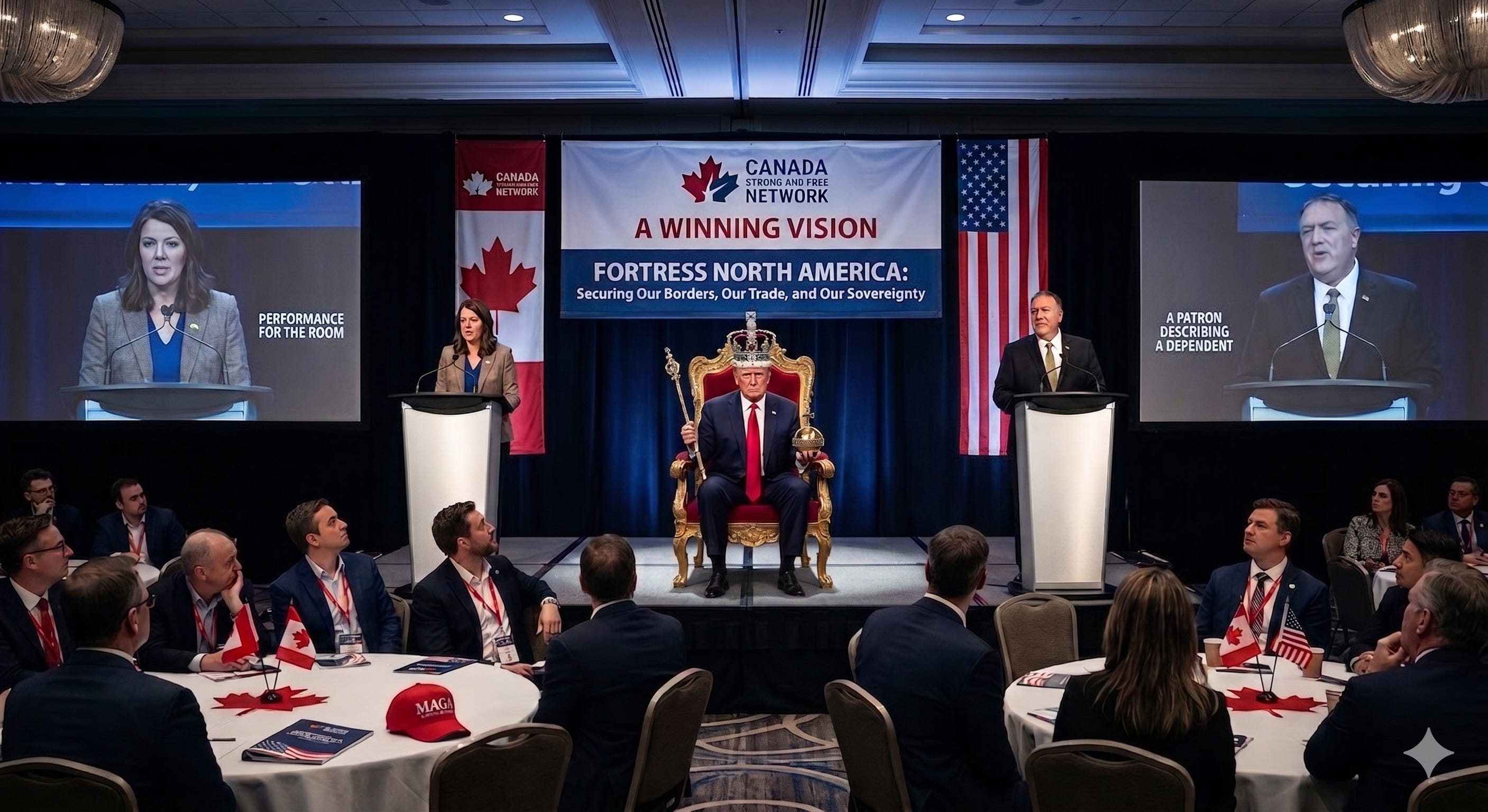
The Stage and the Hallway
Smith got a warm reception at the Canada Strong and Free conference on Friday, where she was introduced as an example of how politicians can put conservative policies into practice. On stage she delivered what observers and at least one political scientist described as a year-old speech — a polished presentation of her United Conservative Party’s record, perfectly calibrated for the room. Lower taxes. Reduced red tape. Efforts to put an end to the era of wokeism. Appreciative cheers. A safe landing.
She did not address separatism on stage. She did not address Pete Hoekstra’s absence. She did not address the foreign interference concerns raised by First Nations leaders about the referendum petition circulating in her province. She did not address the documented meetings between Alberta separatist organizers and members of the Trump administration. She gave the room what the room came for — validation of the conservative record — and left the difficult material for the hallway.
This is not criticism. This is political management at its most competent level. A leader who understands her audience gives the audience what it needs in the room and does the real governance work outside it. Smith is not a Stratum VI thinker in the Jaques model — she does not hold the 10 to 20-year time horizons of a Carney or a Stubb — but she is a Stratum IV-V operator at the upper ceiling of that range, and she demonstrated it in the gap between what she said on stage and what she said to reporters afterward.
The problem is not the competence. The problem is what the competence is in service of.
The Empty Chair
U.S. Ambassador Pete Hoekstra did not make his planned appearance at the conference. A spokesperson for the U.S. Embassy said Hoekstra stayed in Washington for meetings at the White House with senior officials in Trump’s administration. Canadian Affairs
He had other things to do.
The man whose administration Smith has learned to speak to in the language of American greatness — the man whose government has imposed tariffs on Canadian goods, floated the annexation of Canadian territory, and whose Ambassador called Canada’s federal election campaign anti-American — sent his regrets. He was needed in Washington.
The Canadians in the room waited. He did not come.
This is the sovereignty argument in a single scheduling decision. The conference billed as a conversation about Canadian strength and freedom — with a session literally titled Fortress North America: Securing Our Borders, Our Trade, and Our Sovereignty — was missing the American official who was supposed to validate that framing from the outside. He was at the White House. The Canadians were in the Westin Ottawa ballroom, six hundred of them, waiting for an American to tell them what their sovereignty looks like.
He sent Pompeo instead. Pompeo told the crowd Canada should “move past the irritation” with Trump and remember which countries share its values. He argued that China is not a reliable partner and said Carney’s efforts to deepen ties with Beijing are misguided and “short-sighted.” “Canada is important to the United States. We are incredibly important to Canada,” he said.
Canada is important to the United States. Not: the United States values Canada as a sovereign partner. Not: the tariffs were wrong and will be corrected. Canada is important to us. That is the language of a patron describing a dependent. And the room received it without apparent objection because the room has spent three days being trained by the Leadership Institute, addressed by Breitbart’s bureau chief, and told by its own leaders that the path to Canadian sovereignty runs through making America great.
The empty chair was the most honest moment of the conference. Hoekstra’s absence said what his presence would have obscured. The Americans have other things to do. The Canadians can wait.
The Brexit Warning and What It Reveals
Smith told reporters she’s always taken the independence push seriously and that she’s spoken about it with Carney, who was in the United Kingdom “at the time that Brexit was not taken as seriously by political leaders.” She said she doesn’t want to see a repeat of the surprise Brexit result.
This is the most analytically interesting thing Smith said all weekend and it has received almost no attention.
She is telling us that she believes Alberta separatism is real enough to produce a Brexit-style surprise — a result that catches the political class flat-footed because they did not take the underlying sentiment seriously until it was too late to manage. She is telling us that she has had this conversation with Carney. She is telling us that both of them are operating in the shadow of that possibility.
“I know that there are people who are frustrated, disappointed, given up. And it’s my job, and I think Carney sees it as his job, to make the case about how we can work through these differences,” Smith said.
That is not the language of a leader who believes the separatism conversation is fringe or performative. That is the language of a leader who is genuinely frightened of the Brexit scenario and is using the pipeline MOU with Carney as the instrument to demonstrate that Canada can still deliver for Alberta before the frustration crosses the threshold from sentiment to referendum.
Smith said her efforts to advance a memorandum of understanding with Carney on a potential pipeline to the Pacific coast are meant to “demonstrate that co-operative federalism works.”
Cooperative federalism. That is the phrase she used. At a conference where the movement she nominally leads has spent three days being trained by American operatives, addressed by Trump’s Secretary of State, and waiting for an American ambassador who did not show up — the Premier of Alberta is telling reporters that her strategy is cooperative federalism with the Liberal Prime Minister she was introduced as an alternative to.
She is holding two completely contradictory positions simultaneously and managing both with considerable skill. On stage: the conservative champion, the end of wokeism, the record of success, the base-rallying performance. In the hallway: the cooperative federalist, the Brexit-frightened pragmatist, the Premier who is negotiating a pipeline deal with Mark Carney because she understands that the alternative is a result that nobody in that ballroom actually wants when they consider what it costs in practice.
This is not hypocrisy in the simple sense. This is the governing reality of a movement that has painted itself into a corner — the separatist energy in the base is real, the economic consequences of separation are catastrophic, and the only path through is to keep the base believing in the grievance while quietly doing the work that makes the grievance less likely to explode into a referendum outcome.
The performance is for the room. The governance is for the province.
The problem with that strategy is that the room is getting louder and the governance is getting harder.
The Cognitive Profiles: What the Public Record Tells Us
The Vertical Dispatch applies a standing analytical standard to every major political figure in its reporting. Using the Jaques Requisite Organization framework and the PIAAC literacy scale, assessed exclusively from documented public record, without malice and without flattery. The standard is applied here to both Smith and Jivani.
Danielle Smith holds a Bachelor of Arts in Economics from the University of Calgary and a Master’s degree in Communication Studies from the same institution. Before politics she worked as a journalist, radio host, and columnist — careers that require the synthesis of complex information for public consumption but do not require the multi-decade systems modeling that defines Stratum VI-VII cognition in the Jaques framework. Her political career has demonstrated consistent Stratum IV-V operation — competent provincial management, responsive to immediate electoral pressures, capable of holding three to five-year planning horizons with genuine skill. The evidence from this weekend confirms that ceiling. Her on-stage performance was calibrated precisely to the room’s emotional needs. Her hallway governance — the Brexit warning, the pipeline MOU, the cooperative federalism framing with Carney — shows a leader who understands the tactical horizon clearly. What is absent from the documented record is any evidence of the 10 to 20-year structural modeling that would qualify as Stratum VI. She does not appear to have asked what Alberta separatism looks like in 2040 if the pipeline is not built and the grievance becomes constitutional. She is managing the fire. She has not designed the firebreak. In PIAAC terms Smith operates at Level 3 to 4 — analytically capable, rhetorically fluent, comfortable with complex policy material within familiar domains. She reads the room with precision. The dispatch you are reading operates at Level 4 to 5. That gap is not personal. It is structural. And it explains why the Trump quote — which she offered as evidence of sophistication — is actually evidence of the ceiling.
Jamil Jivani is the more complex cognitive case and the more revealing one. He was labelled illiterate by the public school system at age 16, turned his life around through mentorship, attended Humber College and York University, and then earned his Juris Doctor from Yale Law School in 2013. At Yale he was Program Director of the Marshall-Brennan Constitutional Literacy Project, President of the Yale Black Law Students Association, and interned at the office of Cory Booker. He practiced corporate law at Torys LLP, held research and teaching appointments at Osgoode Hall Law School, and was appointed Senior Fellow for Diversity and Empowerment at the Macdonald-Laurier Institute. That formation — from functional illiteracy at 16 to Yale Law School — is one of the most remarkable biographical arcs in Canadian federal politics. It deserves to be named as such. Research NesterTire Review
The Jaques assessment is Stratum IV to V. The Yale JD demonstrates genuine analytical capacity and the ability to operate in multi-variable legal and policy environments. The subsequent career — community advocacy, radio, think tank work, politics — has not produced the institutional formation that builds Stratum VI cognition. Jivani is a skilled communicator and a genuine policy thinker within defined domains. He is not a systems architect. In PIAAC terms he operates at Level 3 to 4 — the upper range of the competent professional class, capable of sophisticated argument within a defined ideological framework.
What the public record also shows is that Jivani’s ideological framework was formed in significant part through his Yale friendship with JD Vance — a relationship that includes reading a Bible verse at Vance’s wedding and running a fantasy football league together for the better part of a decade. Personal relationships of that depth and duration shape a mind’s priors in ways that no amount of analytical capacity fully overrides. When Jivani tells a Canadian conservative conference that voters who responded to the annexation threat were anti-American bigots driven by hysteria, he is not offering an analysis. He is defending a friend whose administration produced the threat. That is not a cognitive failure. It is a loyalty operating as a conclusion. The PIAAC framework cannot measure that. The Jaques framework cannot measure that. But the documented record can name it. Performance Plus
Both profiles are now part of the standing record. The Vertical Dispatch will apply this standard consistently across the series and across all subsequent political reporting. Cognitive level is not destiny. But it is context. And context is what this publication exists to provide.
The Jivani Footnote
The conference closed with a panel that included Conservative MP Jamil Jivani, who counts U.S. Vice-President JD Vance as a close personal friend. Jivani said he doesn’t believe a majority of Canadians bought into the “hysteria” around Trump’s threats to annex Canada and the trade war during the last election. “I don’t think the majority of Canadians became anti-American bigots overnight,” he said.
The electorate that chose Carney over Poilievre — that chose the manager over the fighter, that rewarded the candidate who named American threats as threats rather than partnership opportunities — is being characterized by a Conservative MP as having been driven by hysteria and anti-American bigotry.
The people who voted for the other side are bigots.
This is the closed system completing its loop. Entry Two identified it in Poilievre’s keynote — the framing that converts every criticism into evidence of persecution. Jivani has applied it to the entire Canadian electorate. Eight million people who looked at the annexation threat and the tariffs and the Hoekstra tirade and decided this was a genuine sovereignty crisis were not exercising democratic judgment. They were being hysterical bigots.
That is the closing note of a conference themed A Winning Vision. Not a plan to win back the voters who left. Not an acknowledgment of what the election result was telling the movement. A characterization of those voters as people whose judgment cannot be trusted.
The posture is holding. The room is shrinking. The word on the door is Strong.
And the ambassador did not show up.

The Vertical Dispatch monitors Canadian governance and sovereignty through the framework of AIG — Artificially Intelligent Governance — a formal model in which decisions of civilizational consequence are subjected to structural analysis rather than managed through ideological performance. The series concludes with Entry Four: What the Monitor Saw.
#MapleMAGA #CdnPoli #CSFN2026 #DanielleSmith #MikePompeo #JamilJivani #JDVance #PeteHoekstra #AlbertaSeparatism #CanadaSovereignty #CCP #ConservativeParty #MakeAmericaGreat #FortressNorthAmerica #TheVerticalDispatch #AIG #ArtificiallyIntelligentGovernance #RequisiteOrganization #PIAAC #StratifiedSystems #CanadaStrong #WinningVision #Poilievre #MarkCarney #Alberta #Brexit #PipelineDeal #CooperativeFederalism #Ottawa #VerticalDispatch
I’m curious how post Carney meeting this week, when Smith was so ungracious in her comments about Carney and Canada you square this circle?
She was clearly playing to her base and not to the confederation.
I might also raise the point of incompetence in the management of the province. I can’t recall any other premier with so many scandals that are unresolved or that she cared so little about resolving.
China is more reliable than the current USA and we never want to embrace the MAGA mindset of grievance, white supremacy and worshiping the billionaires. We are Canada and we are better than that. 🇨🇦