


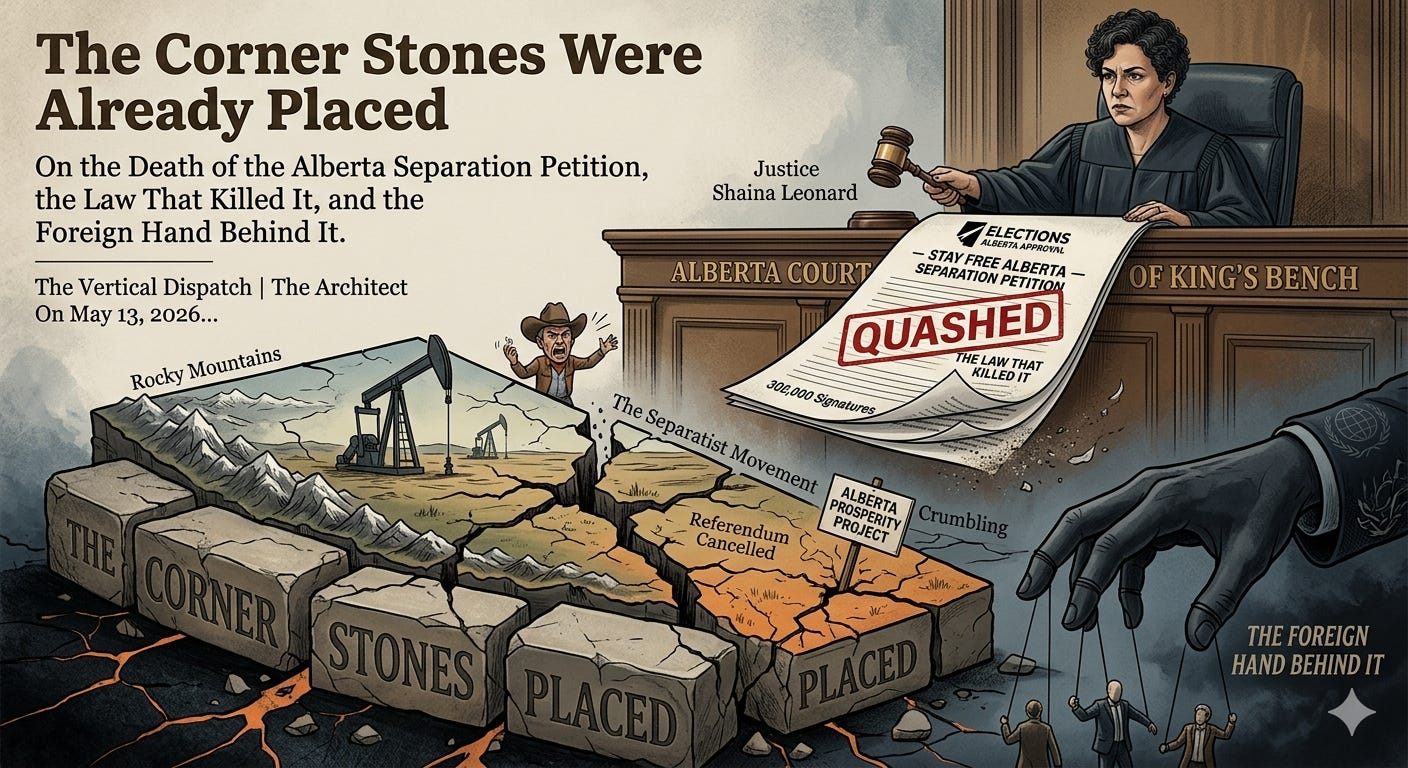
On May 13, 2026, an Alberta Court of King’s Bench justice quashed the Elections Alberta approval of the Stay Free Alberta separation petition. Justice Shaina Leonard ruled, without ambiguity, that the petition should never have been issued. Three hundred and two thousand signatures. A provincial government that argued in court for the process to proceed. A referendum scheduled for October. All of it — gone.
The separatists will appeal. They have said so. Jeffrey Rath, the cowboy-hatted lawyer who is simultaneously the Alberta Prosperity Project’s legal counsel, its primary public spokesman, and a man under active Law Society discipline for conduct a judge described as “unreasonable, persistent and disruptive” — issued a statement calling the ruling a violation of natural justice containing “numerous errors of law.”
He will file. The appeal will fail.
What follows is a reckoning in three parts: the law that ended this, the land that made the law inevitable, and the foreign hand that was shaping this movement from the beginning.
I. The Constitutional Wall
Why the appeal is theatre
The ruling rests on Section 35 of the Constitution Act, 1982 — the provision that recognizes and affirms existing Aboriginal and treaty rights. This is not statute law. It cannot be amended by a provincial legislature. It cannot be circumvented by creative process design. It is bedrock, and thirty years of Supreme Court jurisprudence has been building on top of it.
The duty to consult was established in the Haida Nation trilogy of 2004: when the Crown has knowledge of a potential Aboriginal claim and contemplates conduct that might adversely affect it, the duty attaches. Not after. Not when the government feels ready. Before. The principle in Mikisew Cree (2005) extends it further: once a Crown institution controls and enables a process that could adversely affect treaty rights, the duty is engaged regardless of how the Crown characterizes what it is doing.
The province’s argument in court was that the petition was merely a “political discussion” — that citizen initiative is not Crown action, and that the duty to consult would only arise after a referendum passed and the government moved to implement separation. This was creative. It was also constitutionally untenable. Elections Alberta is a Crown institution. The Citizen Initiative Act is Crown legislation. The province’s own lawyers appeared in court defending the process. You cannot mount a credible argument that a process operated by Crown institutions, enabled by Crown statute, and defended in court by Crown counsel constitutes something other than Crown conduct.
Justice Leonard saw through it. So will every appellate court she is reviewed by.
The one argument with marginal legal texture on appeal is the timing question: at precisely what point in a referendum process does the Section 35 duty attach? This is genuinely unsettled at the margins. But “genuine legal texture” and “reversible error” are different things. The facts here are so unfavourable to the appellant — a year of First Nations raising alarms while the province did nothing, a government that actively litigated for the petition — that even the most sympathetic appellate panel would struggle to find error in Leonard’s conclusion.
The Alberta Court of Appeal will likely uphold the ruling. If Stay Free Alberta seeks leave to the Supreme Court of Canada — granted in roughly ten to fifteen percent of applications — the SCC would need to identify a question of national legal importance sufficient to justify hearing the case. There is arguably one present: the precise trigger-point for Section 35 duties in citizen-initiated referendum processes. The SCC might grant leave for that reason alone. And then it would almost certainly rule against the appellants on the merits, producing binding precedent that makes every future separation attempt even harder.
The appeal is not a path to victory. It is, at best, a deferral.
II. The Territorial Fact
Why this was always structurally impossible
Here is the number that reframes the entire separation argument before a single constitutional provision is cited.
One hundred percent.
Every square kilometre of the Province of Alberta sits within the boundaries of a numbered treaty. There is no gap. There is no unceded corner. Treaty 4 covers the southeast. Treaty 6 covers the centre. Treaty 7 covers the south, from the Red Deer River to the American border. Treaty 8 covers the north — the largest treaty in Canadian history by land area, encompassing most of what produces the fiscal grievance at the heart of the separatist movement. Treaty 10 traces portions of the eastern edge. The province is, in its entirety, treaty territory.
The Athabasca oil sands — the third-largest proven oil reserve on earth, the revenue source that sustains Alberta’s claim to being unfairly taxed by Ottawa, the economic engine that makes separation arithmetically conceivable — sit in Treaty 8 territory. The Athabasca Chipewyan First Nation, one of the primary Treaty 8 signatories, is one of the plaintiffs who brought this case and won it.
Let that sit.
The fiscal grievance upon which the entire separatist enterprise rests — the argument that Alberta sends billions to Ottawa and receives too little in return, that the province’s resource wealth is being exploited by the federation — is prosecuted on borrowed ground. The wealth is extracted from land that belongs, under legally binding nation-to-nation agreements, to peoples who did not sign those agreements with the Province of Alberta. They signed with the Crown in right of Canada. The Dominion. The federation the separatists wish to leave.
This is not a political point. It is a territorial one. Treaties are not domestic legislation that a provincial government can modify or repeal. They are international instruments — agreements between sovereign nations — that predate the province’s existence and that, under Section 35, are constitutionally entrenched. Alberta separating from Canada does not extinguish those treaties. It raises the immediate and unanswerable question of which Crown inherits the obligations, and whether a newly sovereign Alberta would be required to assume them under international law. These are questions that have no clean answers — and no separatist document, including any produced by the Alberta Prosperity Project, has come within reach of addressing them.
The First Nations who brought this case understood the geometry before the petition collected its first signature. They held the corner stones. The board was already theirs.
There is a typology that may be useful here. Checkers players see pieces. Chess players see positions. Go players see the whole board before the opening move. The separatist movement played checkers: mobilize grievance, collect signatures, deal with First Nations after. Justice Leonard played Go. The corner stones — treaty rights, Section 35, the duty to consult — were already placed. There was no path through them. There never was.
III. The Foreign Hand
Who was actually behind this
Jeffrey Rath is simultaneously the lawyer who argued this case on behalf of Stay Free Alberta, and the co-founder of the Alberta Prosperity Project — the organization that built the movement, organized the petition infrastructure, and, beginning in April 2025, made a series of trips to Washington, D.C. that should have triggered a federal response and did not.
Three meetings. The first on April 22, 2025. The second on September 29. The third on December 16 — this one held inside a Sensitive Compartmented Information Facility. A SCIF is a secure room used for classified government business. It is fitted with advanced soundproofing, reinforced access controls, and barriers to all electronic surveillance. To enter one, you surrender every device on your person. The United States government does not convene meetings in SCIFs to discuss civil society groups it regards as marginal.
Rath described the third meeting as lasting several hours, focused on “the ways the US government could support Alberta independence when the timing was right.” He reported that officials left the meetings to brief people in direct reporting lines to the Oval Office. He characterized the entire administration as “extremely enthusiastic about a free and independent Alberta.”
The APP had also been seeking a $500 billion line of credit from the U.S. Treasury to bankroll a newly sovereign Alberta following a successful referendum.
U.S. Treasury Secretary Scott Bessent appeared at the World Economic Forum in Davos in January 2026 and publicly called Alberta “a natural partner for the U.S.” He said Albertans “have great resources” and want “sovereignty” and desire “what the U.S. has got.” The State Department confirmed the meetings, describing them as routine engagements with “civil society types” in which “no commitments were made.” A senior State Department official subsequently said there would not be a fourth meeting. The White House offered the same anodyne framing.
Meanwhile, Elections Alberta has been attempting to force the Alberta Prosperity Project to disclose its donor list and financial records since early January 2026. The APP has defied two formal notices from an investigator. It has refused to register as a third-party advertiser despite spending more than the statutory threshold. Its lawyer — Rath — accused the elections commissioner of “baseless accusations” and bias. The Court of King’s Bench, in the same period, heard directly from Justice Leonard that financial records requested from the APP had not been provided.
We do not know who funded this movement. We know it received over a million dollars in donations in 2022. We know its funding since January 2026 remains undisclosed. We know its leaders met three times with Trump administration officials — including once in a classified facility — while simultaneously running a petition to fracture Canada. We know that the U.S. Treasury Secretary publicly endorsed the outcome they were seeking. We know that a Canadian national security expert filed an affidavit in these proceedings warning that the APP had effectively “laid out a welcome mat for U.S. foreign interference.”
We know that Danielle Smith’s government had Mitch Sylvestre — the CEO of the APP and head of Stay Free Alberta — as a constituency president within the United Conservative Party. We know that Smith’s lawyers defended the petition process in court while the foreign interference questions were being litigated around the same proceeding. We know that neither Smith nor Carney called what they were observing treasonous, though the Premier of British Columbia used exactly that word.
What we are looking at is not a grassroots expression of western alienation. It may have drawn on genuine alienation — the fuel was real. But the engine, the architecture, the legal infrastructure, and the Washington engagement were not organic. They were built by a small group of men who were simultaneously players in the provincial Conservative establishment, counsel in a case they were also funding and organizing, and interlocutors with the Trump administration in classified settings.
The court stopped the petition. The law held.
But the questions that remain are not legal. They are sovereign. Who paid for this? Who directed it? What was actually discussed in that SCIF in December? What commitments, if any, were made off the record that the on-record statements were designed to obscure? And why did the federal government, facing the most aggressive campaign of foreign interference in a Canadian domestic political process since the Quebec referendums, respond with language so measured it might have been written to prevent any response at all?
Coda
The Alberta separation petition is dead, for now. Justice Leonard did her job. The First Nations who brought the case — the Athabasca Chipewyan, the Blackfoot Confederacy, the Siksika, the Kainai, the Piikani — did what the Crown refused to do. They enforced the law that the Crown’s own constitution established. They protected a treaty relationship that the province’s government was willing to let a foreign-influenced movement override.
That is not a small thing. It is, in fact, the whole thing.
A government that claims to speak for Alberta’s sovereignty while refusing to consult the peoples whose sovereignty preceded Alberta’s existence — and while its movement’s leadership meets in classified rooms with a foreign power that has explicitly named the dismemberment of Canada as a strategic objective — is not advancing Alberta’s interests. It is advancing someone else’s.
The corner stones were already placed. The board read clearly, to anyone who knew how to read it. The separation movement never did.
Your commentaries are unprecedented. Well done
Thank you to Indigenous People and the Crown. I hope that full exposure of the secret dealing backers will follow.