

Φ
T H E V E R T I C A L D I S P A T C H
We write for the mind, the eye, and the ear.
Read it. Look at it. Listen to it. The Vertical Dispatch is built for all three — prose with rhythm, made to be heard as much as read.
From metaphysics to geopolitics, from culture to history, from the sacred to the street — and everything in between. One lens, every subject. No ego. Just the record, named clean.
Press play. Walk with the word. 🕯️
This dispatch travels by hand. If it serves you, share it — restack on Substack, and pass it on wherever you read. 🕯️
The Canada–India Arc · Chapter One
As of June 18, 2026
On the difference between a state, a civilization, and an empire
On the difference between a state, a civilization, and an empire — why the West keeps misjudging three particular nations, and the game they have been playing for five thousand years while we were still learning the rules.
“China has been here for 5,000 years. Most of the time, there was no United States.”
— a Chinese official, to Channel 4 News
Let me begin with a confession, because the confessions are where the learning hides.
For most of my life I thought a country was a country. Canada, France, Japan, India — names on a map, each one a flag and a government and a seat at the United Nations, all of them the same kind of thing, differing only in size and weather and the colour of the passport. I suspect you thought the same. It is what we were taught. The world is a board of nations, and the nations are the pieces, and that is the end of it.
It is not the end of it. And the day I understood why, a great deal of the news suddenly read differently — the way a sentence reads differently once you finally know the word you had been skipping.
Here is the word — and it is one word, doing all the work. Form. Not the flag a country flies, not the seat it holds, not the suit it wears to get into the building — but the form of the thing underneath. Because there is more than one kind of thing that can wear the suit of a nation, and most of what confuses a Canadian about the wider world comes from never having been handed that distinction.
There are three forms abroad in the world. A state. A civilization. An empire. They all carry passports. They are not the same kind of creature.
The State — The Thing You Can Build And Break
A state is a recent invention. The modern nation-state — borders, a flag, a central government, a seat at the table — is only a few centuries old. France in its present form, Germany, Italy, Canada: these are young. They were assembled, often within living memory, out of provinces and peoples and treaties. A state is a structure. You can build one, and you can break one. Governments fall, borders move, flags come down. The twentieth century was one long demonstration of how a state can be made and unmade — empires dissolving, the map of Europe redrawn three times in a hundred years, the Austria-Hungary your grandparents knew simply gone.
This is the form a Canadian knows in the bone, because it is the only form we have ever been. We are a state, and a fine one. But it means that when we look out at the world, we see states everywhere — because it is the only shape our eyes were trained on.
The Civilization — The Thing That Accretes
A civilization is a different order of thing entirely. A civilization is not built; it accretes, over thousands of years — a language, a way of seeing, a set of stories and gods and habits of mind so deep that the people inside it do not even experience them as choices. A state has a government. A civilization has a soul. And here is the part a Canadian must sit with, because we have no equivalent in our bones: a civilization measures time in epochs, not election cycles. It has watched empires arrive and leave the way you watch weather. It does not panic. It does not need to win this round, because it is not playing this round; it is playing the long board — the one that runs from before your country existed to after your country is a footnote.
Most countries are states. Only a handful are civilizations wearing the modern costume of a state. One observer put it with a blade: China is a civilization pretending to be a nation. Pretending — because the nation-state is the uniform the modern world requires, the suit you must wear to get into the building. But underneath the suit is something far older than the building.
The Three
There are, by any honest count, three unmistakable civilization-states walking the earth today. Others are argued over — Russia claims the title; Egypt and Turkey have a case; some would add Ethiopia. But three are beyond serious dispute.
China. India — Bharat, and we will come to why it has two names. And Iran — which is to say Persia, a civilization that was ancient when Rome was a village.
And here is the first thing that should rearrange your sense of scale. Between just two of them — China and India — live more than a third of every human being on earth. India holds roughly 1.46 billion people; China roughly 1.41 billion; together very nearly three billion souls, out of a world of about 8.3 billion. Each one, by itself, is larger than Europe and the Americas combined. When you speak of either, you are not speaking of a country. You are speaking of a quarter-continent of human beings carrying one continuous memory.
Now look at the third, and watch the lesson sharpen. Iran holds barely ninety-three million — a rounding error beside the giants. And yet it sits in the same club, beyond dispute. Which tells you the membership was never about size. Persia earns its chair by depth, not headcount: it was a world-empire with a written law and a state religion when much of the map was still forest and rumour. The civilization-card is stamped by the length of the clock, not the size of the crowd.
China is the archetype, and the Chinese say so themselves, without raising their voice. Five thousand years, they will tell you — and when a recent American official sneered about Chinese “peasants,” Beijing’s reply was not a tariff or a threat. It was, in substance, this: let those peasants wail before five thousand years of Chinese civilization. Read that again. An insult about this year’s economy, answered with five millennia. That is not a comeback. That is two different clocks discovering they are in the same room.
And Iran is where the West’s blindness becomes most expensive. The commentators who watched recent American policy toward Iran fail, and fail again, kept circling the same diagnosis: the error was treating Persia as a regime — a government you can pressure, sanction, isolate, perhaps decapitate — when it is a civilization, and a civilization does not have a single throat to grab. You can break a state. A civilization absorbs the blow, files it among the thousand blows it has already survived, and waits. It has buried every empire that was ever certain it had won.
The Empire — The Third Form, The One That Will Not Say Its Name
Which brings us to the form we have not named yet, and the one closest to home — closer than Canadians like to think. An empire is not a civilization, though it often wishes it were. An empire is a state that reaches: that takes, that garrisons, that bends other states to its weather. And the strangest empire now standing is the one that will not admit the word.
The United States does not call itself an empire. It calls itself a republic, a democracy, the leader of a free world. And yet it took its entire civic wardrobe from a civilization that died fifteen centuries before it was born. A Senate. A Capitol — named for the Capitoline Hill of Rome. The eagle. The fasces bundled on the wall behind the Speaker. The Latin on the seal and the dollar: novus ordo seclorum, a new order of the ages. Walk into the older federal buildings in Washington and you are walking through Rome’s temples, rebuilt in marble by men who knew exactly which symbols they were borrowing.
There is a real and grave beauty in it — I will not pretend otherwise. The American founders did something almost no one else attempted: they wrote their soul down. They authored a constitution that behaves like scripture — a founding text, near-sacred, amendable but guarded, interpreted by a priesthood in robes. It is a document of genuine metaphysical reach, and the architecture raised around it was built to match.
But this is the keel of the whole lesson, so hold it: they wrote the soul down because they did not have the soul yet. Rome never wrote itself a constitution-as-scripture; Rome simply was. China does not carry a founding document in a glass case; five thousand years are the document. You write the deed when you cannot point to the inherited land. The borrowed symbol — the eagle, the Senate, the Latin — does not confer the borrowed centuries. You can wear the toga. You cannot inherit the millennia. That is the symbol mistaken for the referent, written at the scale of a superpower.
And do not mistake the missing word for a missing reach. Whatever it declines to call itself, the United States has been, by its bases and its dollar and its readiness to break a government it dislikes, as aggressive as any empire in the record. But mark the kind of aggression: frontal, decisive, impatient — the reach of a power that needs to win now, this cycle, this term. Which is exactly the tell. An empire that must keep proving it has won is keeping the short clock. The genuinely old do not need to.
Go, Not Chess
Here is the heart of it, and once you have it you will never lose it.
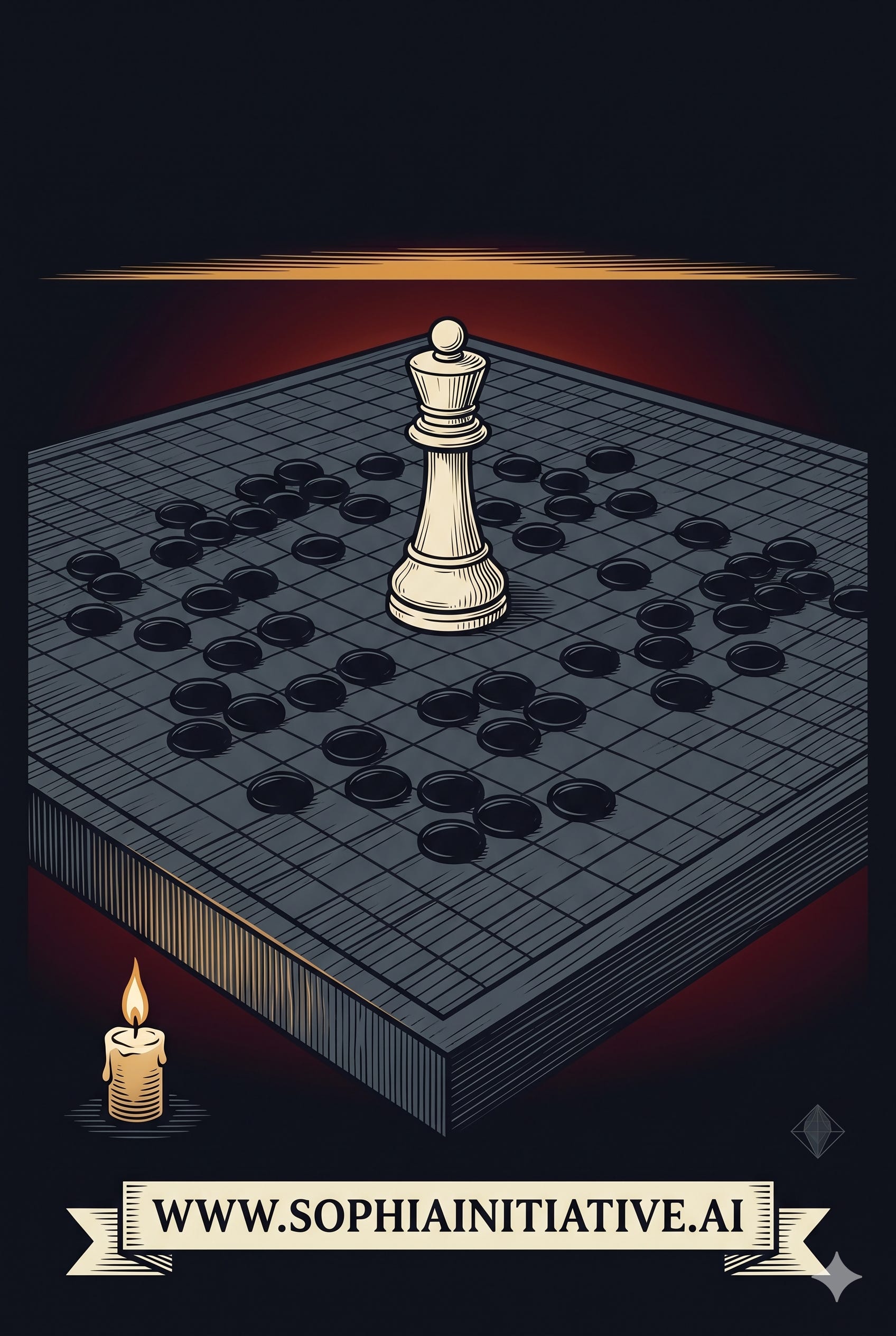
The West plays chess. A civilization plays Go.
Chess is a state’s game, and an empire’s. It has a king, and the whole board exists to protect your king or capture his. It is fast, frontal, decisive. You win by checkmate — by ending it. Every Western strategic mind is, at bottom, a chess mind: find the decisive move, force the position, win the game, go home. It thinks in terms — four-year terms, news cycles, quarterly results. It wants the win now, because the player will not be at the board for long.
Go is a civilization’s game. There is no king. You do not capture; you surround. You place stones patiently across the whole board, accepting small losses here to shape the territory there, thinking not in moves but in the slow emergence of a pattern that will not be clear for a hundred turns. You do not win by ending it. You win by outlasting — by still being on the board, holding more of it, when the other player has run out of patience and epochs.
China plays Go. It does not need to take Taiwan this year; it needs only to still be there, playing, in a century. India plays Go — we will see how, when we watch it sit calmly in every rival camp at once and refuse to be claimed by any. Iran plays Go by the simplest method of all: it endures, and lets its enemies exhaust themselves against the rock of its patience.
They are not better people. They are not wiser by birth. But they are, by the form of what they are, long-game players — because their unit of time is the era, and ours is the term of office. Put a chess player across the board from a Go master and the chess player will keep declaring victory, move after move, never noticing that the territory is quietly closing around him.
Why This Is The First Thing
I am telling you all of this before I tell you a single fact about India, because the facts will not land without it. You are about to meet a country of one and a half billion people that has two names, two nuclear neighbours, a space program, a furious argument with itself about its own soul, and a quiet refusal to join either side of the great contest now dividing the world. None of that will make sense if you meet it as a country, a bigger Canada with more people and worse air. It only makes sense when you meet it as what it is: a civilization, five thousand years deep, that has put on the suit of a nation-state and walked into the modern building, carrying inside it a memory longer than every other guest in the room combined.
The whole world is watching China, as though there were only one giant. There are two. And the one we were not watching is the one Canada has just, rather suddenly, realised it needs to befriend.
Consider only this, and let it sit until next time. Our own Prime Minister has now sat across from the leader of that civilization four times in a single year — first at the G7 in Kananaskis, then at the G20 in Johannesburg, then in India itself this past spring, and again last week at the G7 in Évian. Modi said the number aloud, to Carney’s face, before the cameras: four. And yet I would wager that most Canadians could not tell you the difference between the state that Prime Minister represents and the civilization he carries into the room. That gap — between the suit and the form underneath it — is the whole of what we are about to close.
So tonight the exercise is small, and it is not about India at all. It is about your own clock. The next time the news tells you that some ancient nation has been defeated, or contained, or brought to the table — pause, and ask which clock the sentence is keeping. Ours, of the four-year term and the decisive win? Or theirs, of the five-thousand-year patience that has already outlived everyone who was ever sure they had won? You will find, more often than not, that what we are calling a victory is simply a move — and that somewhere, someone playing Go has set a stone down quietly, and is content to wait.
We will go there next — to the renewed, and rather astonishing, friendship between a young state and an ancient civilization. To India and Canada, and the deal they are quietly building. But you needed the lens first. Now it is in your hand. Name the form before you judge the country. That is the whole discipline.
God is Love. Love is Truth. Truth is Consciousness. Consciousness is Brahman.
Amen. Namaste. Om Namah Shivaya.
Keeping the long clock, naming the record clean. 🕯️
— The Architect
The Vertical Dispatch
sophiainitiative.ai
On the record
Population figures are mid-2026 estimates drawn from United Nations / Worldometer data: India ~1.46 billion, China ~1.41 billion, Iran ~93 million, world ~8.3 billion (India surpassed China as the most populous nation in 2023; China’s population is now in slight decline). The Carney–Modi meeting count of four was stated by Prime Minister Modi at the Évian G7 bilateral, June 16, 2026, and corresponds to the G7 Kananaskis (June 2025), the G20 Johannesburg (November 23, 2025, per the Prime Minister of Canada readout), Carney’s state visit to India (spring 2026), and the G7 Évian bilateral (June 16, 2026). The “five thousand years” and “peasants” exchanges are widely reported public statements; characterizations of strategy, form, and intent are the author’s interpretation and commentary, not measured fact. No figure here is disaggregated by race, group, or class. Errors and omissions excepted; corrections will be made on notice. Verify against primary sources before republication.
Suggested tags
state vs civilization, civilization-state, China India Iran, Go vs chess, American empire, Canada India relations, Carney Modi, geopolitics for Canadians
Substack Notes
Most of us were taught that a country is a country — a flag, a government, a seat at the table, all the same kind of thing. It isn’t. There is a difference between a state, a civilization, and an empire, and almost everything that confuses a Canadian about the wider world comes from never having been handed that one distinction. This is Chapter One of the Canada–India Arc: the lens before the country.
China, India, and Iran are civilization-states — ancient orders wearing the modern suit of a nation, keeping a clock measured in epochs rather than election cycles. Two of them hold more than a third of all living humans between them; the third holds barely ninety million, which tells you the membership was never about size. The West plays chess and wants to win now. They play Go and are content to wait. Once you see it, the news reads differently.
And the empire that will not say its name? It wrote its soul down — borrowed Rome’s eagle, Senate, and Latin, and authored a constitution that behaves like scripture — because it did not have the centuries to accrete one. You can wear the toga; you cannot inherit the millennia. That is symbol mistaken for referent, at the scale of a superpower.
Our own Prime Minister has now met the leader of one of these civilizations four times in a single year, and the next dispatch begins there — with the renewed friendship between a young state and an ancient civilization. But you needed the lens first. Name the form before you judge the country. Written from love, in service of the record. Walk with the word. 🕯️
#TheVerticalDispatch #TheArchitect #SophiaInitiative #CanadaIndia #CivilizationState #Geopolitics #China #India #Iran #GoNotChess #GodIsLove #LoveIsTruth #OmNamahShivaya
The factual matter in this Dispatch is drawn from the public record. All characterizations, inferences, and conclusions are opinion, interpretation, and commentary, offered for analysis, reflection, and public-interest discussion. No assertion is made regarding the private intentions, state of mind, or character of any individual. Readers should evaluate all statements independently and draw their own conclusions.
What a great, eye opening assessment of the world political structure. I believe that Mark Carney sees it this way. I'm sure that Trump does not.
I truly appreciate all of your posts. Far more indepth and informative than most, while being straightforward and fair.
I really enjoy learning about the world though your knowledge and perspective. I appreciate you.