


Φ
THE VERTICAL DISPATCH
We write for the mind, the eye, and the ear.
Read it. Look at it. Listen to it. The Vertical Dispatch is built for all three — prose with rhythm, made to be heard as much as read.
From metaphysics to geopolitics, from culture to history, from the sacred to the street — and everything in between. One lens, every subject. No ego. Just the record, named clean.
Press play. Walk with the word. 🕯️
This dispatch travels by hand. If it serves you, share it — restack on Substack, and pass it on wherever you read. 🕯️
Building Canada Strong · The Age of Consequences
June 2026 — reformatted for the archive, June 15, 2026.
WHERE PART II LEFT OFF
Part I read the ledger; Part II built the directive — the citizen’s fare and the world fare, the return ticket, the train as the hotel, the towns as the destination, and a two-tier pricing structure in which the world’s guests finance the citizen’s crossing. The instrument is complete on paper and it pays its own way. What remains is to prove it runs across the whole calendar and opens to the whole world — because a winter country that cannot sell its winter has not finished the argument. Part III turns the train through all four seasons and out to the planet.
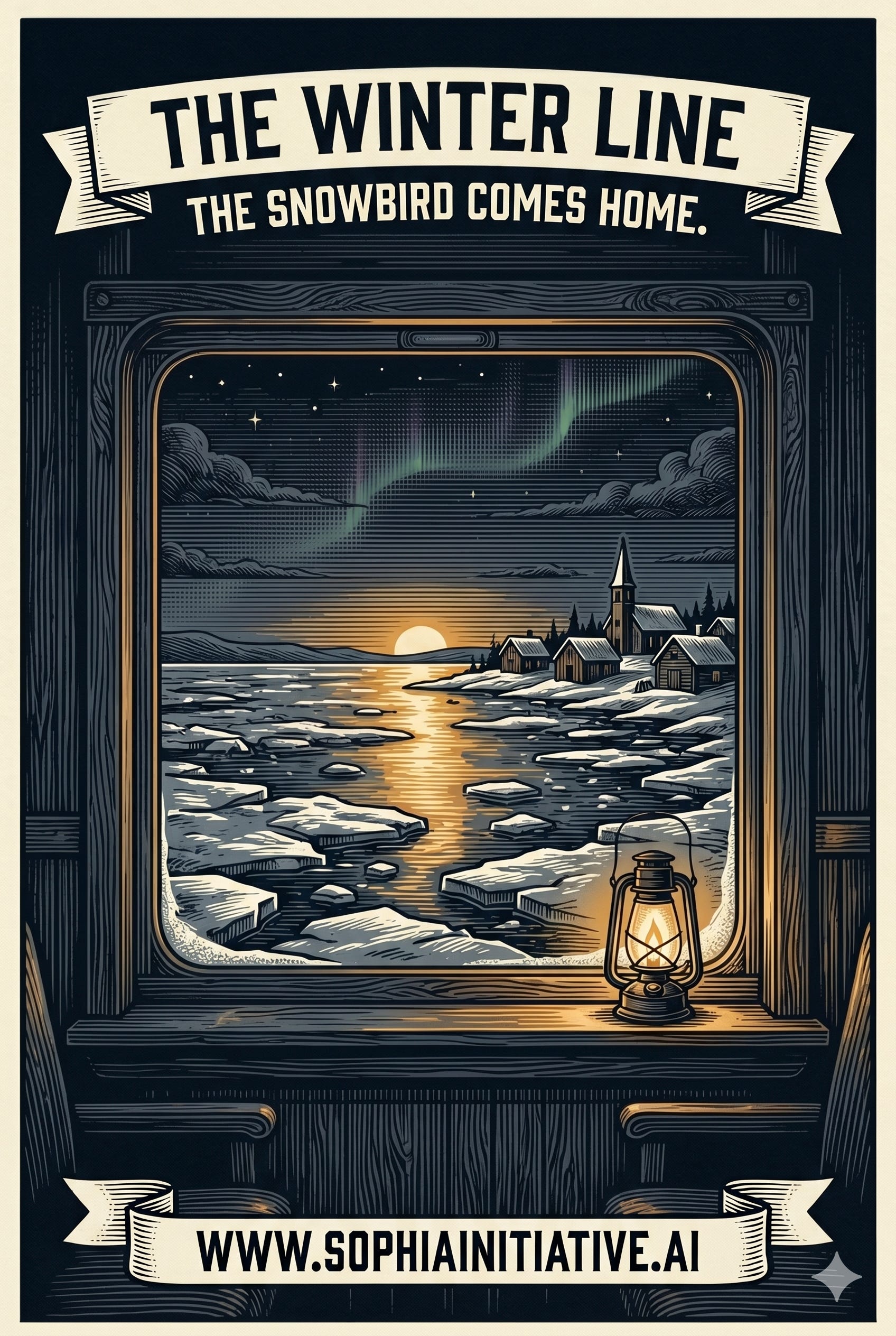
THE WINTER LINE
A summer program is half a program, and in this country the missing half is the defining one. The directive’s winter season is the winter line: Toronto to Alberta, the ski train, the snowbird inversion. I rode a winter train once, along a frozen bay in January, and I am telling you the winter is not the off-season of this country’s beauty. It is the main event.
Begin with the history, because this is restoration twice over. The Rockies were not a destination that happened to get a railway. They were a railway product. The Canadian Pacific built the great mountain hotels — Banff Springs, Chateau Lake Louise — for one explicit purpose: to fill its trains. The mountains-by-rail model is not an innovation to be tested. It is the original business architecture of Canadian transcontinental rail, dormant for seventy years while the assets it created became some of the most valuable resort properties on the continent.
The format runs today on two other continents, and the European record deserves precision because it mirrors Canada’s own story beat for beat. Colorado operates a dedicated winter train from Denver into the ski country. Europe runs overnight ski trains from Paris and Amsterdam into the Alps — skiers board on a Friday evening, sleep in a berth, and step off at the lifts the next morning, with London feeding in by Eurostar connection. The current Paris night train carries hundreds of berths plus a dining car, serves the great resorts of the Tarentaise, and ran its first season at eighty-five percent occupancy — strong enough that a second overnight route from Amsterdam, Rotterdam, Antwerp, and Brussels launches next winter. No mountain highway in a whiteout. No airport ski-bag surcharge. No hotel night burned on transit. And here is the mirror: France had killed these trains. In 2016 the French transport ministry axed sleeper services across the country in a single stroke — overnight Paris-to-Alps routes that had run nightly for decades, eliminated despite their popularity. Then France did what Canada has not yet done: it admitted the mistake, restored the night train, and watched it sell out. The cull, the regret, the resurrection, the full berths — the entire arc the winter line proposes has already been run, recently, by a G7 country, with the results on public record.
But understand the limit of the European model, because the winter line goes one decisive step further. The European night train is a ferry: it delivers you Saturday morning, turns around that evening with a different load of passengers, and your berth was transit, not lodging — stay the weekend and you are paying resort accommodation like everyone else. The winter line’s train is not a ferry. It is the lodge. Board Friday evening after work in Edmonton, Calgary, Montreal, or Ottawa. Sleep while it rolls. Wake Saturday morning at the mountain and ski all day. Walk back in the evening not to a hotel desk but to your own berth — the train parked on a siding at the resort, lit and warm, dining car serving — and sleep there. Ski all day Sunday. And Sunday evening, while you sleep a third night in the same bed, the train pulls out for home, setting you down in the city Monday morning in time for work.
Run the arithmetic on that weekend and see what it actually is. Two full days of skiing in the Rockies or the Laurentians. Zero vacation days consumed — the entire journey happens between Friday’s last shift and Monday’s first. Zero hotel nights purchased — the berth is the lodging, three nights of it, included in the fare. The two scarcest resources the working family owns, the vacation allowance and the accommodation budget, both come home untouched. No operator in Europe offers this. The only place the parked-train-as-hotel exists anywhere today is the ultra-luxury cruise rail market — the white-glove trains that stable in a siding each night while guests sleep aboard at thousands of dollars a berth. The operational concept is fully proven; the logistics of a stabled train at a mountain siding are cruise-ship-at-berth logistics, a water line and shore power, nothing exotic. What has never been tried is running it at a citizen’s price — which is, by now, this dispatch’s refrain: the luxury market keeps proving the format, and the country keeps declining to notice that it owns the rails the format runs on. The winter line applies the architecture to the longest ski commute in the western world — and on the transcontinental version, the same principle runs at week scale: the train parks under the mountain and serves as the base lodge for the entire stay, from Union Station and back, with the family’s vacation days spent on snow instead of transit.
The European night train is a ferry — it delivers you and leaves. The winter line’s train is the lodge: two full days on the mountain, three nights in your own berth, zero vacation days, zero hotel bills. Friday after work to Monday before work, and the Rockies in between.
Two points of interest before leaving the mountain, and they answer the only objection the resort towns could raise. The first: the parked train does not take money off the hill — it puts money on it. The berth competes with the highway and the airline, not the hotel; and the skier who arrives with the accommodation line of the family budget unspent is a skier who spends it where they stand — lift tickets, lessons for the kids, rentals, the mountainside lunch, the gear shop, the après. The hill receives a higher-spending customer; the hotels keep the week-long destination trade. The only loser at the mountain is the gas station on the way home.
The second is lighter on its face and serious underneath: the winter line is the only ski weekend in Canada with no designated driver. Every Saturday night at every hill in this country, the après ends early and carefully, because somebody at the table has to pilot the family down a mountain highway in the dark, or has the long drive home hanging over Sunday. On the winter line, nobody drives. Both of dad’s hands are free all weekend — one for the card game, one for the glass. The dining car is the après, the worst navigational error available after the third round is missing your own berth by one door, and on Sunday night the most relaxed citizen in the country is poured into a bunk and delivered to Monday morning rested and employable. Beneath the smile sits the sober dividend, and the medical literature carries it: studies of alpine skiing risk find that, hour for hour, the slope is no more dangerous than riding in a car. Sit with what that means. The highway hours that bracket every ski day — driven tired after a day of exertion, in the dark, in winter, on mountain roads — carry more fatal risk than the mountain the family came for. The dangerous part of the Canadian ski weekend is not the skiing. It is the getting home. The winter line removes those hours from the equation entirely.
Now place the winter line against the redirection data from Part I. The Canadian winter travel dollar has flowed south for two generations — the snowbird migration, the Florida condominium, the Arizona golf season. That flow is precisely the traffic now collapsing, with land crossings driving the steepest declines. The winter line is the snowbird inversion: the same dollars, the same season, the same appetite for escape — redirected west instead of south, into Canmore and Golden and Jasper instead of Fort Lauderdale and Phoenix. The four and a half billion dollars that left the American tourism economy last year is looking for somewhere to land. The winter line is somewhere.
And the winter line runs east as well as west — because the east is where Canada already proved the model, and already destroyed it once. Mont Tremblant did not become the destination anchor of eastern skiing by highway. It was built by a train. From the late 1920s onward, the ski trains of the P’tit Train du Nord hauled thousands of Montrealers into the Laurentians every winter weekend — the most famous ski-train culture in North America, with the resort growing up around the railhead at Mont Tremblant station. Then the country did what the ledger predicts: passenger service was killed in 1981, the line abandoned by the end of the decade, the rails lifted — and the corridor converted into a recreational trail that was named, without apparent irony, the P’tit Train du Nord, after the train that was destroyed to create it. The most beloved ski railway on the continent survives as a signpost on its own grave. The eastern winter line is not an innovation. It is a resurrection, and the burial site is already marked.
The eastern line’s crown, though, sits further down the river. Le Massif de Charlevoix holds the biggest vertical drop east of the Rockies and falls toward the St. Lawrence so steeply that the skier descends facing the river ice — and it is the one ski mountain in Canada that sits on an operating rail line, with the Train de Charlevoix running the shore beneath it. The proof of concept for this entire dispatch already exists in Charlevoix, at boutique scale, waiting for a country to notice. String the eastern line together and it reads itself: Montreal to the Laurentians restored, Quebec City for Carnaval and Mont-Sainte-Anne, Charlevoix by the river, and onward on the Ocean’s existing spine to the Maritimes — where the honest accounting says the hills of New Brunswick and Nova Scotia are regional treasures rather than destination giants, and where the east’s true winter product is the one I rode in January of 1970: the window itself, the frozen bay, the villages in snow, the light off the ice. The western line sells the mountain. The eastern line sells the window. The country needs both, because the country is both.
And there is a third dividend, quieter than the economics: energy and safety. A passenger train moves a traveller several times more efficiently than a private automobile and dramatically more efficiently than a short-haul flight. One winter train across the Prairies is hundreds of cars not on the Trans-Canada in January — which is also hundreds of families not driving Rogers Pass in a whiteout. The fuel dividend and the safety dividend arrive together. And a serious national rail program is a natural anchor customer for grid expansion: electrified passenger rail running on Canadian hydro and nuclear is travel sovereignty and energy sovereignty shaking hands.
The CPR built the mountain hotels to fill its trains. The directive fills the trains to rebuild the country. Same architecture, inverted purpose, and the winter is where it pays.
THE WORLD’S WINTER DOOR
Everything to this point has been about keeping Canadian dollars home. Now turn the machine around, because the same train runs in both directions — and the second direction is export revenue. Canada holds some of the finest big-mountain snow on earth, and the worst arrival architecture in the developed ski world. Picture the actual journey as it exists today. A skier from Tokyo, London, or Sydney lands at Calgary or Vancouver, jet-lagged, with two bags and a ski case — and their path to the hill is a rental car, in winter, on the icy Trans-Canada, having possibly never driven on snow, in a country they have been inside for ninety minutes. Or it is a patchwork of shuttle buses and luggage hauls. The product is world-class. The front door is a parking lot.
Run the access audit mountain by mountain, because the pattern is not neglect — it is dismantlement. Banff and Lake Louise, the flagship: ninety minutes to two and a half hours from the Calgary rental counter on the winter Trans-Canada. Banff had passenger rail for over a century — the CP line the mountain hotels were built on — until the 1990 cuts documented in Part I removed it. The station still stands in Banff. The track still runs past it, carrying freight. The country’s most famous mountain town lost its train not to geography or economics but to a single order-in-council, and the rental counter at the Calgary airport is that decision’s daily monument. Whistler, the largest resort on the continent: two hours up the Sea to Sky from Vancouver — and the rail line runs directly to the village, with no scheduled train on it since service was ended in the early 2000s and the corridor leased away. Rails to the door of North America’s biggest ski resort, and a parking problem. Jasper is the lone survivor — the Canadian still stops there, twice a week. And Tremblant, the eastern anchor: its railway is the bicycle path already mourned above. Now hold the audit against the Swiss benchmark: Zurich airport to car-free Zermatt takes roughly the same elapsed time as Calgary airport to Lake Louise — and the visitor never touches a steering wheel, never sees a rental counter, and the bags ride through from the aircraft to the village. Same hours. Different civilization. Canada did not fail to build winter access. It built it, and then dismantled it at every major mountain it owns.
The country that solved this built the most successful mountain tourism economy on earth. In Switzerland, the train station sits inside the Zurich airport terminal; bags can be checked through to the resort; and the crown jewel, Zermatt, is car-free by law — reachable only by rail. The Swiss made the train the front door of the Alps, and the world’s visitors experience the no-car arrival not as a limitation but as the luxury itself: the holiday begins on the airport platform, not after the white-knuckle drive. And the proof that skiers will cross the planet for snow is a quarter-century old — Niseko in Japan built an entire regional economy on Australians flying ten hours for powder. The long-haul demand is established. Canada has more snow, bigger mountains, and a vast head start in terrain. What it has never built is the chain: plane, platform, berth, hill.
Now put numbers on the door, with sources named and estimates flagged as estimates. The Vanat International Report on Snow and Mountain Tourism — the industry’s standard reference — counted 399 million skier visits worldwide in 2024-25, an all-time record, surpassing the previous high of 392 million set before the pandemic. The demand is not merely recovered; it has never been higher. Canada sits eighth among ski nations, at 17.5 million visits in a weak snow year and past 20 million in a strong one. And here is the figure that defines the opportunity: only about twelve percent of Canada’s skier visits are international — and of that thin slice, two-thirds are Americans, most of them arriving by car from across the border. The long-haul skier — the traveller who flies across an ocean for snow, the market on which Niseko built its 740,000 annual foreign visitors and on which Japan now earns the better part of two billion dollars a year in inbound ski tourism — barely appears in Canada’s books at all. Zermatt alone hosts roughly two million overnight stays a year in a town no car can enter. The world’s record-setting winter demand is real, measured, and growing. Canada’s capture of it is a rounding error. That is not a weakness to be lamented. That is the measured size of the open door.
The winter line is that chain. The international arrival boards in Calgary, Vancouver, or Toronto, sleeps or dines while the country approaches the windows, and steps off at the mountain — no rental counter, no winter roads, no navigating a foreign country in its hardest season, with the parked train answering even the accommodation search. And the policy door is already open: the Canada Strong Pass explicitly extends its benefits to international visitors — Ottawa has already decided the world gets the citizen’s welcome; it simply has not built the vehicle that delivers it. With the Canadian dollar sitting low against the world’s currencies, the country is on sale at the precise moment its snow is unmatched and its access is unbuilt. Close the chain and the machine runs in both directions at once: Canadian dollars retained on the domestic side, foreign dollars captured on the inbound side, the same berths, the same towns, the same train. The sovereignty leak — run in reverse, at the world’s expense, for once.
One final note for this section, offered with some authority on how the selling side actually works. The instinctive response to a tourism gap is a marketing response — a bigger campaign, a new brand platform, another season of advertising. But examine the spending and the explanation dissolves. The world’s national tourism agencies all operate in the same budget band, low hundreds of millions; published comparisons of national promotion budgets show Britain, France, Australia, and the rest separated by tens of millions, not orders of magnitude, and Canada’s national agency spends within that same band. Switzerland does not outspend Canada on advertising in any way that could explain a ski economy of twenty-six million visits in a country the size of Nova Scotia. The differentiator was never the advertising. It is that Switzerland’s marketing sells a railway, and Canada’s sells a rental car queue. Marketing creates demand; it cannot create delivery — and every visitor the world’s best campaign converts still lands at Calgary and meets the counter. Here is the paradox in its final form: the one thing the entire world already associates with Canada, universally, without a single dollar of promotion, is winter. It is the country’s strongest brand asset and its weakest-delivered season — a brand the nation owns outright and cannot ship. No campaign resolves that. Only the train does. You cannot market your way out of a product problem, and winter access is not a message. It is infrastructure.
Switzerland made the train the front door of the Alps and the world walked through it. Canada has better snow and no door. The winter line builds the door — and the Strong Pass has already invited the world.
NORTH OF THE CITIES
One correction to the postcard before this section closes, because the postcard sells eastern winter short. Ask a visitor what winter in eastern Canada means and they will name the city festivals — Winterlude on the canal in Ottawa, the Carnaval de Québec with its 431,000 annual visits. Both are genuine, both are loved, and both are the front porch. The house is north of the cities. The real Canadian winter — the one the festivals are a brochure for — lives in the Gatineau hills, the Laurentians, the Shield lakes, the snowmobile country that begins where the suburbs end. The festivals put winter on a city square for a fortnight. The country puts it on ten million square kilometres for five months. And the train, historically and structurally, is the instrument that connects the one to the other: the city platform to the northern snow. The P’tit Train du Nord did not run between cities. It ran north, out of them. That was the whole point of its name.
And the wider winter north of the cities is not a sentiment — it is an economy with numbers attached, and one of those numbers should reorder how this country thinks about itself. Cross-country skiing counts roughly two million Canadian participants. Ontario’s lakes alone hold over a million licensed anglers in a multi-billion-dollar fishery whose proudest season is the hard-water months. But the giant is the machine Canada invented: the snowmobile, built by Joseph-Armand Bombardier in Valcourt, Quebec, mass-produced as the Ski-Doo from 1959. The Canadian Council of Snowmobile Organizations puts the sport’s annual economic impact near eight billion dollars — larger than the entire downhill ski industry’s reported spending — across more than half a million registered machines. And the number that stops the breath: the organized snowmobile trail network in this country runs 121,297 kilometres. VIA Rail’s entire national network is roughly 12,500. Sit with the comparison. Canadian citizens — volunteer clubs, local groomers, ordinary families north of the cities — built and maintain a winter transportation network ten times the length of the national passenger railway, with their own hands and their own dues, while the state let the rails rot. The winter nation this dispatch proposes is not a fantasy awaiting construction. It already exists, built from below. It is simply waiting for the train to reach it.
And at the far north end of the line sits the proof that the entire Zermatt argument has already run its experiment on Canadian soil. Churchill, Manitoba: no road in, reachable only by rail or air — a genuine car-free world destination, the polar bear and aurora capital, drawing some 25,000 visitors a year into roughly 88 million dollars of visitor spending by Travel Manitoba’s accounting, in a global aurora tourism market that industry analysts now size near two billion dollars and growing. Canada already owns what Switzerland built. And — by now the reader can recite the pattern — Canada nearly lost it the same way it lost the Chaleur: the Hudson Bay line washed out in 2017 and sat severed for eighteen months while its private owner declined the repairs, restored only when the public stepped back in. The two-day train from Winnipeg across the tundra still runs; Ms. Pettis writes of friends who ride it home and of her own hope to make the journey someday. The directive simply asks the country to see what is already on the timetable: the northern lights at the end of a railway, the world’s winter door already standing open at the top of the map, creaking on hinges nobody maintains.
Canadians built 121,000 kilometres of winter trails with volunteer hands while the state let 12,000 kilometres of railway rot. The winter nation already exists, north of the cities. It is waiting for the train.
THE FOUR-SEASON TRAIN
Before leaving the seasons, close the wheel — because a winter-and-summer case in a four-season country repeats the very mistake the ledger of Part I documents. Every cut in that sixty-year record fell hardest on an asset that looked idle part of the year. An instrument that earns twelve months is financeable armour; an instrument that earns six is a subsidy case waiting for the next October announcement. The cruise industry — this dispatch’s recurring witness — survives on exactly this principle: the same ships, rotated through different products by season, so the capital never sleeps. The directive’s fleet must do the same, and Canada’s shoulder seasons are not filler. They may be the easiest sells the country owns.
Fall is the colours, and the world already travels for them. New England has built a multi-billion-dollar season on autumn leaves; Japan’s maple-viewing tradition sends its travellers across oceans for colour as a matter of culture — and the maple on Canada’s flag is not a metaphor. The Shield and Laurentian hardwoods stage a show the equal of either, and the proof that Canadians will board a train purely to look at it is already on the national record: the Agawa Canyon train out of Sault Ste. Marie demonstrated for decades that a wilderness canyon unreachable by road — the Group of Seven’s own painting country — could fill coaches with nothing on the bill but October. The fall train is the Moving Village in its gentlest register: the dome cars full, the seniors’ cars booked out after the families return to school, every small-town harvest market on the line receiving its evening. Spring is the sugar. Canada produces roughly three-quarters of the world’s maple syrup, and the sugar-shack season — the cabane à sucre, March into April — is the most distinctively Canadian food ritual in existence, sitting almost entirely within reach of the Quebec and eastern Ontario corridors. Add Ottawa’s tulips, a festival born of the Dutch royal family’s wartime gratitude and a ready-made international story, and the whales returning to Tadoussac and the Fundy shore, and spring requires no invention at all. The shoulder seasons even carry their own demographic logic: they belong to the travellers the summer crowds displace — the retired couple, the empty nesters, the grandmother keeping her own counsel in the dome car.
So the wheel, complete: summer is the crossing, fall is the colours, winter is the snow, spring is the sugar. Four products, one fleet, the same berths and the same towns earning in every quarter — and a national instrument that no future government can call idle, because it never is.
Summer is the crossing. Fall is the colours. Winter is the snow. Spring is the sugar. Four products, one fleet — and an asset that never sleeps is an asset no October announcement can kill.
CHECKERS, CHESS, GO
The typology applies, as it always does.
Checkers is the airfare subsidy: a discount on flying over the country, reactive, one move at a time, leaving the territory untouched and the towns unvisited. Chess is the Canada Strong Pass as it stands: a genuinely intelligent multi-piece instrument — parks, museums, youth fares — coordinated toward a defined objective, but played on a board whose edges Ottawa has accepted as given. The board’s edge, in this case, is the assumption that the journey itself is a private cost.
Go is the rail directive. Go is not about capturing pieces; it is about placing stones across the whole board until the territory connects itself. Every evening layover is a stone. Every family car is a stone. Every winter departure is a stone placed on the half of the board a summer program leaves empty. Every season added to the wheel is a stone. Every town that builds its seasonal economy around the train’s arrival is a stone. Played over a generation, the stones join — and the territory between Toronto and Vancouver stops being the space Canadians fly over and becomes the space that makes them Canadian. That is the long game, and it is the only game a country this large can actually win.
FOR CANADIANS, BY CANADIANS
The problems were three and they were named in Part I: the cost of seeing Canada, the two weeks a working family actually has, and the distance that has turned the country into flyover territory for its own citizens. The solution is one instrument, built in Part II and run across the calendar in Part III: the citizen’s fare, the world fare that finances it, the return ticket, the train as the hotel, the towns as the destination, in all four of this country’s seasons and open to all the world’s travellers. The customers have already arrived — four and a half billion redirected dollars looking for somewhere Canadian to land, and a record 399 million skiers worldwide looking for new snow. The format is proven on three continents. The history is not an obstacle but a blueprint: this railway has been a school, a post office, and the binding of Confederation before, and the Gaspé restoration proves that what was lost to neglect can be rebuilt when the country decides it matters.
And the proof that the demand is real does not come from a consultant’s model. It comes from a writer in Manitoba who can still smell the platform in Winnipeg sixty years later, from her grandmother’s three rules, from a teenager on the Chaleur in January of 1970 who never forgot the light off the frozen bay. The country is already aboard, in memory. The directive simply brings the train back to meet it.
Thank you, Joanne.
The parks are free. The museums are open. The principle is conceded. The seasons are four and the door is open. All that remains is the distance — and the distance is the country.


God is Love. Love is Truth. Truth is Consciousness. Consciousness is Brahman.
Amen. Namaste. Om Namah Shivaya.
— The Architect.
The Vertical Dispatch
sophiainitiative.ai
On the record. Reproduced in house format for the archive; body text unchanged. Load-bearing facts to verify against primary sources before republication: the Canadian Pacific mountain-hotel history (Banff Springs, Chateau Lake Louise built to fill the trains); the European night-ski-train record (Paris and Amsterdam to the Alps; the 2016 French sleeper cuts and subsequent restoration; ~85% first-season occupancy; new Amsterdam–Rotterdam–Antwerp–Brussels route); Colorado’s winter train; the alpine-skiing-risk medical literature comparison to car travel; the P’tit Train du Nord ski-train history and 1981 service end; Le Massif de Charlevoix and the Train de Charlevoix; the Banff/Lake Louise, Whistler, Jasper, and Tremblant rail-access audit; the Swiss/Zermatt car-free benchmark; Niseko (Japan) inbound-ski figures (~740,000 foreign visitors; ~US$2 billion inbound ski tourism); the Vanat International Report figure of 399 million global skier visits 2024-25 and Canada’s ~17.5–20 million visits, ~12% international of which ~two-thirds American; Zermatt’s ~2 million overnight stays; national tourism-agency budget comparisons; cross-country skiing (~2 million Canadians); Ontario angling (1 million+ licences); the snowmobile economy (Bombardier/Ski-Doo from 1959; ~$8 billion annual impact; 500,000+ registered machines; 121,297 km organized trail network vs VIA’s ~12,500 km); Churchill, Manitoba (rail/air access only; ~25,000 visitors; ~$88 million visitor spending per Travel Manitoba; the 2017 Hudson Bay line washout and 18-month severance); the Agawa Canyon tour train; Carnaval de Quebec (~431,000 visits); and Canada’s ~75% share of world maple syrup. Verify against the Vanat Report, Travel Manitoba, the Canadian Council of Snowmobile Organizations, VIA Rail, and the named operators before republication. Errors and omissions excepted.
Suggested tags:
the four-season train, the winter line, the weekend that costs nothing, ski train, snowbird inversion, the world’s winter door, Zermatt, Niseko, north of the cities, Ski-Doo, Valcourt, Churchill, aurora tourism, Tremblant, Le Massif, P’tit Train du Nord, Agawa Canyon, maple syrup, fall colours, Checkers Chess Go, Building Canada Strong, The Age of Consequences, AIG, Project 2046
Substack Notes
A summer program is half a program, and in a winter country the missing half is the defining one. Part III turns the train through all four seasons. The winter line is the heart: board Friday after work in Edmonton, Calgary, Montreal, or Ottawa, sleep while it rolls, ski all weekend, and sleep in your own berth on a train parked at the resort — zero vacation days, zero hotel nights, home Monday morning. Europe proved the night-ski train, killed it in 2016, then restored it to sold-out berths. Canada has better snow and no door.
Turn the machine around and it earns export revenue: the world set a record 399 million skier visits in 2024-25, and Canada captures a rounding error of the long-haul market because its front door is a rental-car counter on an icy highway. Switzerland made the train the front door of the Alps; Zermatt is car-free by law and hosts two million overnight stays. And the winter nation already exists, built from below — Canadians maintain 121,297 km of volunteer snowmobile trails against VIA’s 12,500 km of railway the state let rot.
The wheel closes: summer is the crossing, fall is the colours, winter is the snow, spring is the sugar — four products, one fleet, an asset no future government can call idle. The proof of demand is not a consultant’s model. It is a writer in Manitoba who can still smell the Winnipeg platform sixty years on, and a teenager on the Chaleur in January 1970 who never forgot the light off the frozen bay. The country is already aboard, in memory. The directive brings the train back to meet it. Thank you, Joanne. Walk with the word. 🕯️
Written from love, in service of the record. Walk with the word. 🕯️
#TheCountryYouSleepThrough #PartThree #TheFourSeasonTrain #TheWinterLine #TheWeekendThatCostsNothing #SkiTrain #SnowbirdInversion #TheWorldsWinterDoor #Zermatt #Niseko #NorthOfTheCities #SkiDoo #Valcourt #Churchill #AuroraTourism #Tremblant #LeMassif #PTitTrainDuNord #AgawaCanyon #MapleSyrup #FallColours #CheckersChessGo #AIG #TheVerticalDispatch #TheArchitect #Substack #CanadianPolitics #NationBuilding #SovereignReconstruction #Project2046 #SophiaInitiative #GodIsLove #LoveIsTruth #OmNamahShivaya
The factual matter in this Dispatch is drawn from the public record. All characterizations, inferences, and conclusions are opinion, interpretation, and commentary, offered for analysis, reflection, and public-interest discussion. No assertion is made regarding the private intentions, state of mind, or character of any individual. Readers should evaluate all statements independently and draw their own conclusions.
Love trains in every season! Great solution for a Canadian geography!
Spring, for me, will always include the Apple Blossom Festivals in the Annapolis Valley, NS. The train can reach them, too.