

“To be a physician is to be present at the door between two worlds, and to know which side of the door you are on at any given moment.”
— in the spirit of Dr. Jonathan Hullah, The Cunning Man, Robertson Davies, 1994
The Vertical Dispatch · Special Edition
The CanLit Files · The Teaching of Canada
A Book Review by Glen Roberts, The Architect
May 23, 2026
I. The Last Book of a Man Who Knew It Might Be the Last
Robertson Davies published The Cunning Man in 1994. He was eighty-one years old. He had been writing novels since 1951. He had given the country the Salterton trilogy, the Deptford trilogy, the Cornish trilogy, three plays of consequence, decades of essays and reviews and addresses, the founding mastership of Massey College at the University of Toronto, and an interior life so thoroughly stocked with Jungian instruments and ecclesiastical furniture and operatic gesture that the man could not write a sentence without the sentence reaching for the whole library behind it. He died in December 1995, fourteen months after the book appeared.
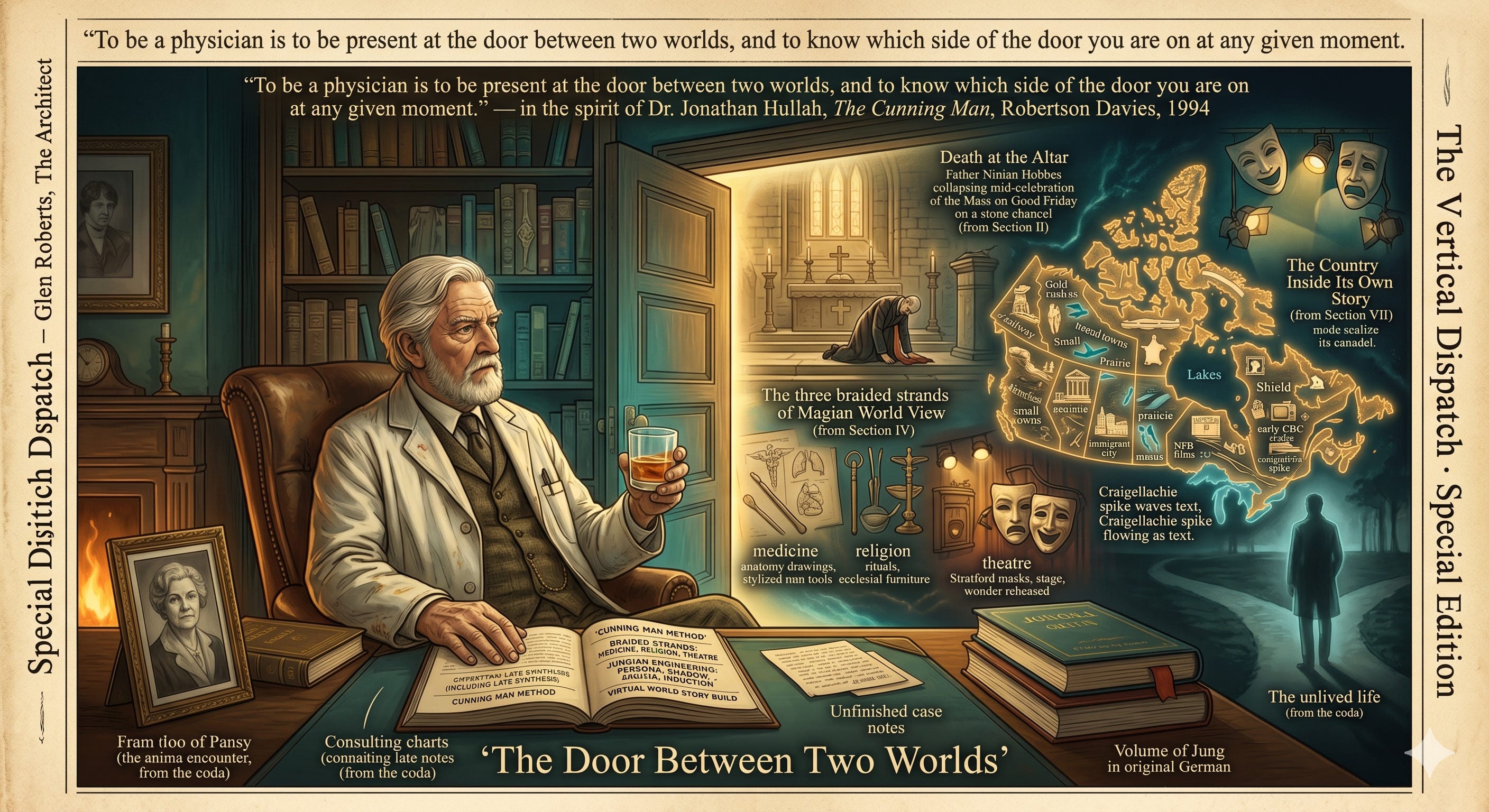
The Cunning Man is the last novel. He knew it might be. The book reads the way a serious physician’s last patient note reads when the physician has decided to put on paper everything the case taught him in case no one else asks. It is the late synthesis. It is Davies at the end of the consulting day, after the office has emptied and the journalist has left, sitting with a glass of something amber and committing to the chart the lessons of a working life. The novel is not a summary. Davies did not write summaries. It is a final demonstration, performed at length, of the method he had spent forty years building.
The country received the book with respectful reviews and moved on. It did not become Fifth Business. It did not become The Rebel Angels. It did not enter the syllabus. It sits, three decades later, on the shelf where most last novels by major writers sit — read by the completists, taught occasionally by the brave, and almost entirely missed by the audience it was written for. The audience it was written for, in 1994, was the audience Davies had been writing for all along — the four million Canadians who could read at the level the work required, who carried the cultural inheritance the country had built across the twentieth century, and who were now entering the period of the inheritance’s greatest test. Davies, at eighty-one, could see the test coming. He wrote the book that would matter most when the test arrived. The test has arrived. The book has been on the shelf the whole time.
This review is the close reading the novel has not had. It is also, by the operation of the novel itself, an introduction to the larger question the novel raises about what stories do, what physicians do, what cultures do when they have forgotten how to do either. The book is the door. Davies wrote the door knowing the door was the point. The review walks through it.
II. Hullah, Spook, and the Death at the Altar
The narrator is Dr. Jonathan Hullah. He is seventy years old. He is a Toronto physician of a particular and now extinct kind. He was trained at the College of St. John and the Holy Ghost — Spook, the fictional college Davies used in The Rebel Angels and returns to here, modelled on Massey College and on the older Anglican collegiate tradition the University of Toronto inherited and never quite digested. Hullah keeps an office on a quiet street. He sees patients across long arcs of their lives. He knows their parents and their children. He attends their dinners. He marries them. He buries them. He calls himself, at intervals through the book, a cunning man, in the old English sense — the village healer who held the position before the medical profession became a profession, before the priesthood and the medicine and the magic were separated into specialized trades, before the modern division of labour decided that the body could be managed in isolation from the life.
The novel begins with a death. Father Ninian Hobbes, the high-Anglican priest of the church across the road from Hullah’s office, collapses at the altar on Good Friday, mid-celebration of the Mass of the Pre-Sanctified, and dies before the congregation can finish the response. The death is sudden. The death is also, on certain readings, beautiful — a priest dies in the act of his vocation on the holiest day of the Christian year, in front of his people, at the moment of the sacrament. The diocese decides it was a heart attack. The diocese also, quietly, begins the file on whether it was a miracle. A miracle would be inconvenient. A miracle would require investigation. A miracle, if confirmed, would make the dead priest a candidate for canonization, which the Anglican Communion in Canada is not structurally equipped to process. The diocese prefers the heart attack. The file on the miracle remains open, in a desk drawer, where it will stay.
Forty years later, a young journalist named Esme Barron knocks on Hullah’s door. She is writing a series on old Toronto. She has heard there is a story about a priest who may have died miraculously. She has heard Hullah was there. She would like the story. Hullah agrees to talk. He tells her, over the course of the novel, the story she came for and a great deal more. The journalist is the device. Hullah’s seventy years are the novel.
This is the architecture. A death at the altar. A journalist at the door. A physician who knew everyone involved, who has spent his life learning to read lives, who has been waiting, perhaps without knowing it, for someone to come and ask the right question. Davies built the structure to be transparent. The novel announces what it is doing. It does not announce why.
III. The Cunning Man Tradition — What Davies Was Naming
The English phrase cunning man — and its feminine companion, cunning woman — refers to a figure who existed in English and Welsh and Scottish village life from the medieval period through the early twentieth century. The cunning man was the local practitioner of folk medicine, charm, herbal remedy, midwifery, divination, and what would now be called, awkwardly, pastoral counsel. He held a place in the community that the formal church and the formal medicine of the time did not adequately fill. He treated the body. He read the dreams. He composed the charm against the toothache and the prayer against the fever. He knew which families had which troubles going back generations. He attended births and deaths. He functioned, at the level of the parish, as the keeper of the integrated story of the people he served. He was, in the old phrase, the wise one. He was tolerated by the church when he was tolerated and burned by it when he was not. He survived, in the corners of village life, into the modern period and then, in the twentieth century, was finally extinguished by the rise of the credentialed professions that absorbed his functions and discarded the part of his practice that could not be credentialed.
Davies knew this history. He had read it across his life. He had absorbed it through his Welsh inheritance — Davies was Welsh by descent, raised in Ontario but with the Welsh keeping of the older traditions alive in the family — and through his Anglican formation, which kept open, in its high-church wing, the practices the Reformation had elsewhere suppressed. Davies also knew, from his Jungian reading, that the cunning man had survived in the modern world by going underground, into the figure of the analyst, into the figure of the spiritual director, into the figure of the family doctor of the older sort who still understood that the patient was a life and not a case. Hullah is that survival. The novel is the case Davies makes for keeping the survival alive.
Hullah practises an integrated medicine that the credentialed system around him does not quite know what to do with. He takes long histories. He listens. He asks about the marriage, the work, the church attendance, the dreams, the parents, the secrets, the inherited material the patient cannot name but is carrying. He prescribes when prescription is what is needed. He also, when prescription is not what is needed, suggests a holiday. He suggests a confession. He suggests the patient finally write the letter to the dead father that the patient has been not-writing for thirty years. He understands his job as the management of the whole person across the whole arc, and he understands that the medical bureaucracy has, in his lifetime, organized itself to make his job impossible.
Davies wrote Hullah in 1994 already mourning him. The cunning-man function was disappearing from Canadian medicine in real time as the novel was being composed. The family doctor of the old type — the one who knew the whole family, attended the births, kept the long file in his own head, made the house call when the house call was what the case required — was already being replaced by the assembly-line clinic, the fifteen-minute slot, the specialized referral, the electronic record. Davies saw the trajectory. He did not write a polemic against it. He wrote a novel that simply showed the reader what was being lost by showing the reader a man who still practised the lost thing, in detail, across seventy years, in a Toronto that was itself a record of the loss.
IV. The Braided Strands — Medicine, Religion, Theatre
The novel braids three strands that Davies had been working with for forty years and had never before woven this tightly. Medicine, religion, and theatre. They are the three institutions Hullah moves between across his seventy years, and they are the three institutions Davies considered the surviving carriers, in the modern West, of the Magian World View — the older way of seeing in which the world is alive, ritual does real work, and the boundary between the natural and the supernatural is permeable in both directions.
Medicine. Hullah’s daylight craft. The chapter on his medical school years at Spook is one of the great Davies set-pieces — the operating theatre, the anatomy lab, the cadavers, the brilliant and broken students, the professors who taught medicine as a craft and the professors who taught it as a creed, the young Hullah finding his way to the older tradition by reading the right books in the library at night while his classmates studied the syllabus. Hullah graduates as a physician. He also graduates, by his own private effort, as something the curriculum did not formally produce. He becomes a cunning man in a white coat.
Religion. The church across the road from his office. The high-Anglican parish of St. Aidan’s, where Father Hobbes presides for decades and where the death at the altar will eventually happen. Hullah is not a believer in the simple sense. He is something more useful — a serious participant in the theatre of the sacred, who understands that the liturgy does work on the soul regardless of what the soul believes about the metaphysics. He attends the Eucharist. He observes the parish. He befriends the priest. He learns the diocese’s internal politics. He carries, in his medical practice, an understanding of the human condition that the church’s anthropology informs and that the medical school’s anthropology omits.
Theatre. The third strand. Hullah’s closest friend across his life is the painter and stage designer Pansy Todhunter, whose milieu is the Toronto theatre world of the mid-century — the early CBC, the small companies, the Crest Theatre, the founding of Stratford. Hullah moves through this world as observer and friend. Davies, who helped found Stratford and who wrote plays before he wrote novels and who lived in the theatre his whole life, gives Hullah a sustained education in the third surviving carrier of the Magian. The theatre is where the modern personality is permitted, for the duration of a performance, to enter a world that does work on the person without the person being required to formally believe the world is real. The theatre is where wonder is rehearsed.
The three strands are braided in Hullah’s life and in the novel’s structure. They are also braided in the death at the altar, because Father Hobbes’s death is at once a medical event — a man dies, the body is examined — a religious event — a priest dies in the act of his vocation, on Good Friday, in front of the congregation — and a theatrical event — a death is staged, at the front of a lit chancel, before a seated audience, with the full liturgical costuming and choreography. Davies built the central event of the novel to be simultaneously the three things he had spent his life arguing were the same thing seen from three angles. The death is a Davies sentence rendered in flesh and altar cloth.
V. The Jungian Engineering, Now Invisible
The previous dispatch in this series — the dispatch on Davies titled The Bomari — named the four Jungian instruments Davies used across his work. The persona. The shadow. The anima. The process of individuation. The Deptford trilogy taught them by demonstration. The Cornish trilogy applied them to the academic and artistic worlds. By the time Davies arrived at The Cunning Man, he had earned the right to stop naming them. The Jungian engineering is in every chapter, and the engineering is now invisible — built into the architecture of the prose, the structure of the chapters, the management of Hullah’s memory, the deployment of the women in his life, the slow accumulation of the shadow material across the seventy years the novel covers.
Hullah’s anima encounters are distributed across the book. Pansy Todhunter is one. The medical student he should have married and did not, Esme Barron’s mother as it turns out, is another. The aristocratic Englishwoman who taught him, at a country house in his youth, what the high European inheritance felt like from the inside, is a third. Each woman is a teacher. Each encounter changes Hullah. Hullah, narrating at seventy, can name the teaching now. He could not have named it at the time. Davies builds this carefully. The novel is a record of an integrated life that did not feel integrated while it was being lived — it felt, while it was being lived, like a series of accidents and choices and missed chances that only revealed their pattern when the man sat down at seventy to tell the journalist what had happened.
This is the deepest Davies move in the novel and the one most easily missed by the reader who does not know what to look for. The Jungian individuation arc, which the Deptford novels rendered as visible drama, is here rendered as the texture of a life remembered. Hullah does not have a Liesl. Hullah does not have a Magnus Eisengrim. Hullah has had a long Toronto practice, three or four important friendships, a quiet professional life, no marriage, no children, and a continual attention to the patients and the parish and the city. The integration is the attention. The work is the practice. Davies, in his last novel, is saying that individuation does not require dramatic events. It requires sustained attention. The cunning man is the figure who sustains it.
The shadow material in the novel is correspondingly subtle. Hullah’s shadow is not a stone in a snowball or a vat of dung in a basement. It is the unlived life — the marriage he did not make, the children he did not have, the path he did not take when, as a young physician, he could have moved into the credentialed mainstream and become a different kind of doctor. He has carried the unlived life with him for fifty years. He is not regretful in the small sense. He has done the work on it. The unlived life is integrated, named, present in the room with him, and he is the wiser physician for having stayed in conversation with it across the decades. The novel is, among other things, the most patient piece of writing Davies ever did about the integration of the road not taken.
VI. What the Novel Does to the Reader
This is the hinge of the review. Everything until now has been about what the novel is. What follows is about what the novel does.
The Cunning Man performs an operation on its reader. The operation is the same operation Hullah performs on his patients. The novel takes the reader into a world — Hullah’s Toronto, his office, his parish, his medical school, his theatre friends, his seventy years — and keeps the reader inside that world for the duration of the book. The reader is not informed about the world. The reader is inducted into it. By page two hundred, the reader knows the smell of the office, the sound of Father Hobbes’s footsteps on the chancel stone, the way Pansy laughs, the particular Toronto light at six o’clock on a winter afternoon in the year nineteen-thirty-eight. The reader has not been told these things. The reader has been brought into them. When the reader closes the book, the reader does not put the book away. The reader has been somewhere. The somewhere stays.
This is what serious fiction has always done at its best. Davies knew it. Davies practised it deliberately. He understood the novel as a technology for taking the reader into a world that does not exist on any map and producing, in the reader, the lived experience of having been there. The technology is older than the printing press. The technology is the story told around the fire, the story sung by the bard, the story performed in the theatre, the story painted on the wall of the cave. The novel is one form of the technology. It is not the only form. It is the form Davies worked in.
Hullah does the same thing to his patients. He takes the patient’s history, but he does not take it as a checklist. He takes it as a story. He listens for the shape, the missing pieces, the gaps the patient is walking around, the figures in the background the patient has not yet noticed. He retells the patient’s life back to the patient in a way the patient could not have told it from inside. The patient, on hearing the story told properly, is no longer outside the story. The patient is inside it. From inside the story, the patient can see what was invisible from outside. The diagnosis is the induction. The cure, when there is one, follows from the induction. Hullah is a physician because he is a storyteller who knows what stories are for.
This is what Davies is naming. The cunning man’s craft is the induction of the patient into the patient’s own life as a story the patient can stand inside. The novelist’s craft, at its best, is the induction of the reader into a world the reader can stand inside. The two crafts are the same craft, working on different scales. The cunning man does it for one person at a time. The novelist does it for the readers of the novel, however many they turn out to be. The result, in both cases, is the same — the person on the receiving end is no longer outside a description of a life. They are inside the experience of one. The description has become the world.
That is what the novel is for. That is what stories are for. That is what the cunning man knew and the credentialed professions forgot.
VII. The Country Inside Its Own Story
Now extend the operation. If a physician can take a patient into the story of the patient’s own life and produce, by the induction, the integration the patient could not produce from outside — and if a novelist can take a reader into the world of a novel and produce, by the induction, the experience of having lived inside that world — then the question follows. Can a culture take a population into the story of the culture’s own life, and produce, by the induction, the integration the population could not produce from outside?
The answer is yes. The answer has always been yes. Every culture that has ever cohered has cohered because the population was inducted into the shared story by some means — by the bards, by the priests, by the festivals, by the architecture, by the songs sung at the kitchen table, by the books read in the parlour, by the films watched in the dark, by the histories taught in the school. The induction was the technology of cultural continuity. The population that has been inducted into the story stands inside the story. The population that has not been inducted stands outside any story and is held together, if it is held together at all, by lesser means — by administration, by economic interest, by the temporary pressure of a common adversary. Cultures held together by lesser means do not last.
Canada was inducted into its own story across the twentieth century by a small number of practitioners who understood the work and did it at scale. The popular historians who wrote the railway and the gold rush and the trench into the country’s shared imagination. The novelists who wrote the small towns and the prairie and the immigrant city into the country’s interior life. The painters who put the Lakes and the Shield and the West onto the walls of the National Gallery and into the schoolrooms and the calendars. The filmmakers of the National Film Board. The radio voices of the early CBC. The poets who put the spike being driven at Craigellachie into the country’s memory in a single long narrative poem that schoolchildren learned by heart. The country, by the middle of the twentieth century, was inside its own story. The induction had been done. The population could feel itself standing inside the shared world.
The induction has been weakening for thirty years. The historians who taught at the kitchen table have died and their successors have not been promoted. The novelists are still writing but the country has stopped reading them at the level the work requires. The painters are in the galleries but the schoolrooms no longer reproduce them on the wall. The filmmakers have been defunded. The radio voices have been replaced by international content. The poems are no longer learned by heart because they are no longer taught. The induction technology is still on the shelf, but the practitioners have aged out and the population has slipped out of the story. The country is now held together, increasingly, by the lesser means — by administration, by economic interest, by the temporary pressure of a common adversary. A country held together this way does not last. The signs of the not-lasting are visible. The previous dispatches in this series have catalogued them.
VIII. The World the Story Builds
There is a phrase that is being used a great deal in 2026 to describe the technology of induction the new century is building. The phrase is virtual world, and the phrase has been hijacked by an industry that mostly means goggles, and visors, and synthetic environments rendered in real time by graphics engines, and the sale of the goggles and the visors to a consumer base that will tire of them in a decade. That is one kind of virtual world. It is not the kind this review is naming.
The older virtual world — the one Davies practised and Hullah practises and every cunning man practised before either — is the world the story builds in the listener’s mind, and which the listener then stands inside, by the operation of the story alone. No goggles. No screen. No graphics engine. The technology is the language and the structure and the patient attention of the teller, and the receiving capacity of the listener, and the shared imaginative space the two of them generate by the act of telling and receiving. The virtual world is generated between the storyteller and the audience and is as solid, in its effects, as any rendered environment. More solid. The virtual world the story builds outlasts the technology that renders it. The Iliad is still a virtual world three thousand years after Homer. The Cunning Man is still a virtual world. The reader who closes the book has been there. The reader carries the place inside them. The place persists.
This is the older meaning of the phrase, and it is the meaning the present moment most urgently needs to recover. The new technology is not the enemy of the older virtual world. The new technology is, potentially, an instrument by which the older virtual world can be extended and made more accessible than at any point in human history. The novel on the page reaches the four million Canadians who read at the level. The novel inducted into a virtual world by an instrument capable of carrying the full induction — voice, image, music, the lit chancel and the operating theatre and the country house and the Toronto winter light at six in the afternoon — could reach considerably more. The question is not whether the technology will be used. The technology will be used. The question is whether it will be used to render the cunning-man induction at scale, or whether it will be used to render the goggles-and-visors version that sells the consumer base a synthetic environment evacuated of the older technology entirely.
Davies could not have written this paragraph in 1994. He could feel the shape of it. He wrote a novel that, read in 2026, is the manual for the move the country has not yet made. Hullah is the figure. The patient brought into the story of the patient’s own life is the operation. The country brought into the story of the country’s own life is the application. The technology by which the application is performed is not yet decided. Davies left the technology question open because he could not see it from where he stood. He left the principle closed. The principle is the cunning-man induction. The principle is now the project.
IX. The Verdict on the Book
The Cunning Man is the most undervalued of Davies’s major novels. It is not the most accomplished — Fifth Business is the most accomplished, and will remain so. It is not the most ambitious — the Cornish trilogy is the most ambitious, taken as a single work. It is the most distilled. It is the novel a writer writes when he has decided to put the whole practice on a single canvas, at a manageable scale, in a voice the reader can spend seven hundred pages inside without fatigue. It is the late work of a serious craftsman who has stopped showing off and started teaching by demonstration.
The novel is funny in the way Davies is always funny — by precision of observation, by the deployment of vocabulary at exactly the wrong moment, by the willingness to let a character be ridiculous without letting the ridiculousness disqualify the character’s seriousness. Father Hobbes is ridiculous. Father Hobbes is also a serious priest who dies in the act of his vocation on Good Friday. Both are true. Davies holds both. The reader, by page two hundred, can hold both. The capacity to hold both is itself a form of the literacy the dispatch series exists to defend.
The novel is also, on its medical side, the most patient defence of integrated medicine ever written in Canada. The Hullah office is the Canadian family practice the country needs and the country has organized itself to make impossible. The fifteen-minute slot did not make Hullah’s practice impossible. The fifteen-minute slot is the symptom. The cause is the decision, made across the second half of the twentieth century, that the body could be managed without reference to the life. Davies wrote the rebuttal in the form of a novel, because he understood that an argument cannot rebut a structural decision of that magnitude but a story can. The story is the rebuttal. The novel is on the shelf. The rebuttal is still in print. The medical profession is not required to read it. The medical profession that does read it is changed.
And the novel is, on its third side, the last word Davies wrote on the question that organized his life. What does a person do, in the modern West, with the inheritance of the older worlds the modern West dismissed? The Magian World View. The cunning-man tradition. The sacramental imagination. The serious theatre. The Jungian descent. Davies’s answer, across forty years and seven novels, was always the same. The person does the work of integration. The person carries the older world forward in the body and the practice and the friendships and the attention. The person becomes, in their own life, the survival of the inheritance the surrounding culture has ceased to transmit. Hullah is that person. The novel is the demonstration. Davies, at eighty-one, was that person himself. The novel is also his confession.
The verdict is unambiguous. Read it. Read it slowly. Read it the way the cunning man would read a long patient history — with the attention the case requires, in the time the case requires, with the willingness to be changed by what you are reading. The book is on the shelf. The doors of the cunning man’s office are still open in the imagination of any reader who will sit down with the novel for the week it takes to read properly. The induction is still available. The virtual world the book builds is still standing. The technology by which it stands is the technology of patient, serious, sustained narrative attention — the same technology the bards used, the same technology the cunning men used, the same technology Davies used, and the same technology the country must now decide whether to extend into the next century or allow to be replaced by the synthetic substitute the consumer market is preparing to sell in its place.
Coda. The Office at the End of the Day
Picture the office. The Toronto street outside is dark. The journalist has left, hours ago, with her notebook full. Hullah is alone. The fire is low. He is seventy. He has told the whole story for the first time, to a stranger, on the chance that the stranger will know what to do with it. He does not know whether she will. He has done his part. The story is now outside him, on her tape, in her notebook, in whatever piece she writes for whatever magazine that will publish it before the magazine itself is sold to an aggregator and quietly retired.
Hullah pours a glass. He sits. He looks at the room. The room is full of the seventy years. The framed photograph of Pansy on the desk. The medical books on the shelf. The volume of Jung in the original German that he has never quite read all the way through and never quite stopped opening at random. The thin stack of unfinished case notes on the patients he will see tomorrow, because the practice does not stop, because the cunning man does not retire, because the work is the life and the life is the work and the man who has done the work for fifty years does not know how to do anything else.
The reader, by the last page, is in the room with him. The reader is also tired. The reader has been on a long induction. The reader has stood inside Hullah’s life for the duration of the book and is now being released, gently, back into the reader’s own. The release does not erase the induction. The induction stays. The reader, going about the reader’s own life in the days after closing the book, finds that the office is still there in the back of the mind, that Hullah is still there, that the cunning-man tradition is now a thing the reader knows about and can name and can begin to look for in the world around them. The book has done its work. The world the book built persists in the reader. The reader is, by the operation of the book, changed in a small but durable way.
That is what stories do. That is what the cunning man does. That is what the country was once held together by, and what the country has been losing, and what the country must now decide whether to rebuild — by which means, with which technologies, at what scale, in service of which story.
The decision is the next twenty years. The instrument is on the shelf. The novel is the door.
Open it.
The Bomari. Robertson Davies and the Restoration of the Buried Self.

“What’s bred in the bone will not out of the flesh.”
God is Love. Love is Truth. Truth is Consciousness. Consciousness is Brahman.
Amen. Namaste.
#TheCunningMan #ReadDavies #SpecialEdition #CanLitDispatch #TheTeachingOfCanada #BecomeTheBook #TheVirtualWorld #AgeOfConsequences
This account is just stunning! Although I managed to “get it,” what you were trying to convey, it will require at least a second read, along with a read of the novel - one I think worth purchasing, vs a quick read of a copy from the library. A small thing - I just about hooted with joy at the proper spellings and use of “practice and practise.” Thank you. Your work is phenomenal! Thank you for that too. I was introduced briefly to Robertson Davies by my English prof the first year I attended university - as a mature student at age 32. We “did” his novel “Fifth Business.” I still have it. As an aging senior, I think I will get much more out of it now - and especially after reading this piece of yours. Getting on it! Be well. Take care.