

THE VERTICAL DISPATCH
We write for the mind, the eye, and the ear.
Read it. Look at it. Listen to it. The Vertical Dispatch is built for all three — prose with rhythm, made to be heard as much as read.
From metaphysics to geopolitics, from culture to history, from the sacred to the street — and everything in between. One lens, every subject. No ego. Just the record, named clean.
Press play. Walk with the words. 🕯️
The Foundation Series · The Age of Consequences
As of June 2, 2026
— without malice and without excuse
“Not everything that is faced can be changed. But nothing can be changed until it is faced.”
— James Baldwin
This dispatch does not argue toward a policy, and it does not propose a remedy — not yet. It does the older and harder thing first, the thing James Baldwin named as the precondition of all change: it tries to face something. The something is this. Across the developed world, at the same time, by every measure we have, people are lonelier, more isolated, more adrift from one another and from any shared sense of why they are here, than at any point we have been able to measure. That is not a feeling. It is a record. And the work of this piece is simply to look at the record without flinching and without spin — to do, in the older language, a kind of shadow work: to turn and look at the thing the civilization has built and would rather not see.
A word on that, before we begin, because it is the keel of an honest looking. The shadow is not someone else’s. It is not a villain to be named and blamed. The work asks the one doing it to notice their own resistance to seeing — and so, reader, if at some point in what follows you feel the impulse to argue, to wave the thing away, to say it has always been so: notice that impulse. It may be worth sitting with rather than obeying. That is the practice. Not a weapon to win an argument — an invitation to look. We aim the looking up, at what we built, and inward, at our reluctance to face it. Never down, at any person, for the way they have tried to survive inside what was built.
I. The Rooms We Lost
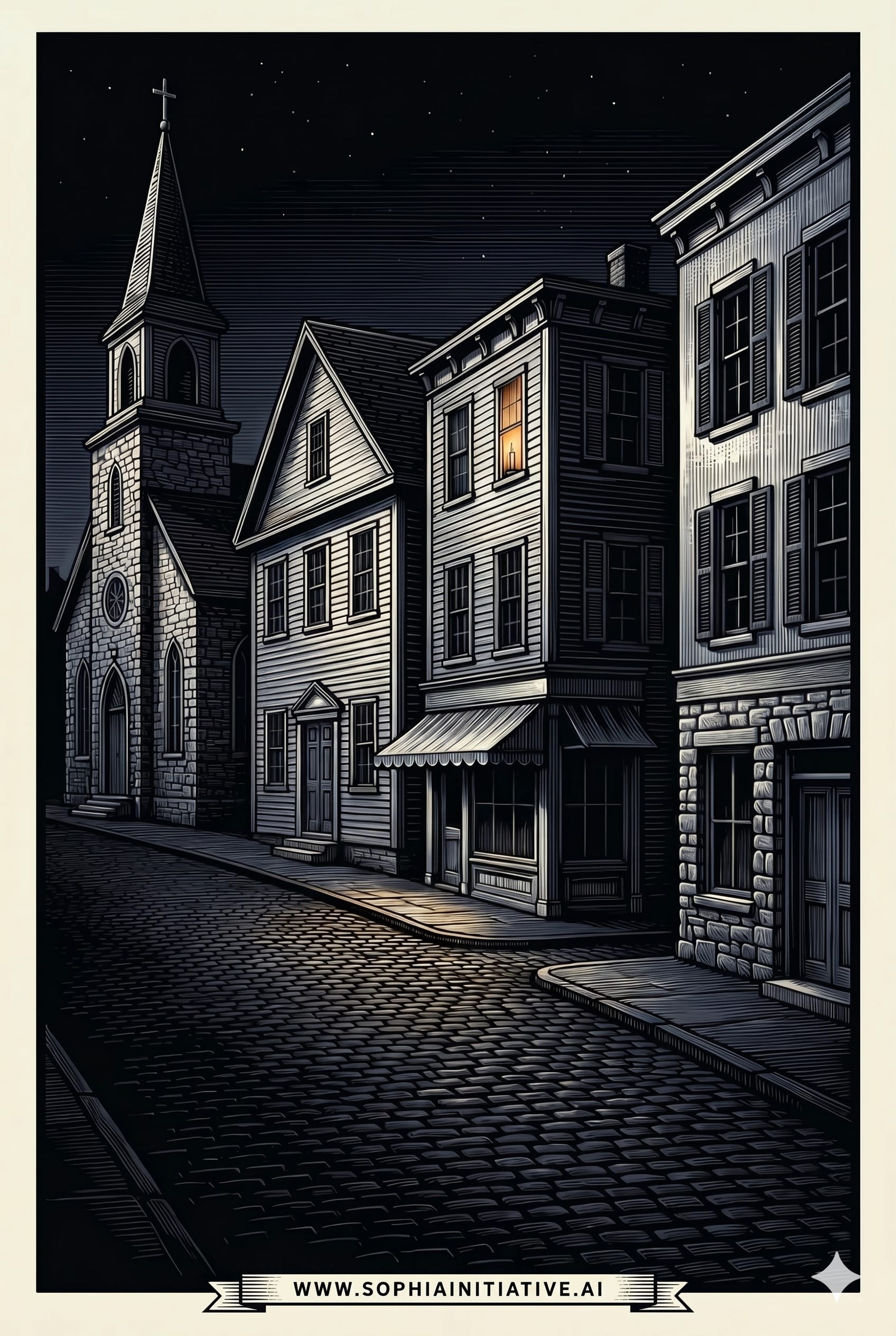
Begin where a life is actually lived. The sociologist Ray Oldenburg gave us the working term in 1989: the third place. The first place is home; the second is work; and the third place is everything between them — the café, the pub, the barbershop, the corner store, the church hall, the lodge, the community centre — the informal rooms where, in Oldenburg’s phrase, regular and voluntary and happily anticipated gatherings happen, and where a person is simply among their people without transaction or appointment. Oldenburg argued these rooms were the anchors of community and the soil of a democracy, and that even in 1989 they were already thinning. He was early. He had no idea how fast they would empty.
Count the rooms as they went. The house of worship was, for most of human history, the most widespread third place there was — the weekly gathering that asked nothing but presence. In Canada, more than a third of the population now reports no religious affiliation, and only about a fifth attend services monthly. In the United States, a majority once attended at least monthly; that majority is gone, with well over half now seldom or never attending. The civic rooms went the same way: the political scientist Robert Putnam, in Bowling Alone, documented across half a million interviews the quiet collapse of the bowling leagues, the service clubs, the parent associations, the union halls — the dense web of belonging that an earlier generation simply assumed. And the gathering institutions that remain are, many of them, in retreat or in transformation. The YMCA branch in Woodstock, Ontario closed in September 2025 when membership fell below three hundred, down from over five hundred just four years earlier; and across the movement, the community-recreation function — come and belong — has given ground to targeted social services for the most vulnerable, because survival is the need that does not go away. That pivot is honourable, not a failure. But notice what it marks: the room that was once for everyone to gather in has become, of necessity, a place to keep the most desperate alive. The belonging function did not get funded. The triage did. And so a count can be made, room by room, of the places where a person used to be known.
II. The Square, the Mall, and the Feed
Now follow the public room across seventy years, because its history is the dis-embedding made visible. Before the suburb and the shopping mall, the town square and the main street were mixed places — commerce and civic life and idle gathering overlapping in one space that belonged, in some sense, to everyone. Then, in the 1950s, the architect Victor Gruen gave us the enclosed mall, and the public square was, step one, privatized: the gathering moved indoors, onto private property, and the reason to be there narrowed to the reason to buy. It was still a room with bodies in it — the teenagers at the mall on a Saturday were at least there, together — but the commons had become a storefront.
Then came step two, and the mall itself emptied. E-commerce hollowed the enclosed mall through the 2000s and 2010s; in Canada, 2025 was a watershed, with Hudson’s Bay closing all its stores and leaving department-store anchors vacant for the first time in a decade. And the gathering migrated again — this time out of physical space altogether, onto the platforms, which announced themselves, without irony, as the new town square. But a square is a place where bodies stand together on shared ground; the feed is a thing each person scrolls alone, in a different curated version, no two of them standing in the same place at all. They named it the square and built its opposite: maximum connection, zero communion. The honest evidence is that the online room is not nothing — for some, especially the isolated and the marginalized, a well-moderated digital space is a genuine source of belonging and even a lifeline, and the research says so plainly. But the same research says, just as plainly, that it supplements and does not replace; that virtual connection alone is not enough; that the body in the shared room is the thing the screen cannot send. Square to mall to feed. Embedded, then privatized, then dissolved. And at the end of it, a generation told it lives in a town square, standing each alone in the dark, glowing.
III. What the Empty Rooms Cost
This is the place to put the numbers down, plainly, because they are the record and the record is the thing we are facing. In May 2023 the United States Surgeon General declared loneliness and isolation a public-health epidemic. The figure underneath it is the one to hold: Americans spent about twenty minutes a day in person with friends by 2020, down from a full hour two decades earlier — and among the young, ages fifteen to twenty-four, the drop in time spent with friends was on the order of seventy percent. Lacking social connection, the advisory found, raises the risk of early death by nearly a third — a harm the report set beside smoking. The friendship recession is real and measured: the share of American adults reporting no close friends rose from three percent in 1990 to twelve percent by 2021, while those with ten or more fell from a third to barely an eighth; and the hours spent with friends fell from a steady six and a half a week to about four in the space of five years before the pandemic even arrived. Britain and Japan have each appointed a Minister for Loneliness. In Canada, more than one in eight report feeling lonely always or often, and among men living alone the share reporting social isolation runs far higher still.
Then came the pandemic, and what had been a slow tide became a flood. For the better part of two years the rooms did not merely thin; they were shut by decree, all of them at once — the church, the pub, the gym, the hall, the classroom — and a whole population was taught, as a matter of public safety, that presence was a hazard and the screen was the safe way to work and learn and worship and grieve. The lesson took. When the doors were permitted to open again, a great many never reopened at all, and a great many people never came back through the ones that did; the habit of apartness, learned under emergency, had hardened into a way of living. The pandemic did not begin the emptying of the rooms — the record shows it was decades underway. What the pandemic did was accelerate it past the point of slow decline, compress twenty years of dis-embedding into twenty-four months, and normalize the empty room as the ordinary condition of a life. It was the flood after the long drought had already cracked the ground.
And the deepest tradition of the discipline saw this coming more than a century ago. Émile Durkheim, founding the study of suicide in 1897, found that it varies inversely with the integration of the groups a person belongs to — that the loosening of the bonds to family, faith, and community is not a private sorrow but a measurable social fact with a measurable cost in lives. He called the condition of normlessness that follows the breaking of those bonds anomie. He was studying, in the language of his century, the cost of the empty rooms. The rooms are emptier now than he could have imagined, and the cost is arriving in the data of every developed nation at once: the youth-mental-health indicators declining across nearly every country that measures them, the distress concentrated most heavily in the cohort that came of age after the rooms had gone. That much is not in dispute.
IV. The Great Dis-Embedding
Why did the rooms empty? The deepest answer the modern record offers comes from the Canadian philosopher Charles Taylor, and it is worth naming carefully because it reframes the whole picture. Taylor’s diagnosis, in A Secular Age, is not simply that religion declined. It is that the West underwent what he calls the great dis-embedding: the liberation of the individual from the older cosmic and social orders that had located a human life inside something larger — a sacred frame, an inherited place, a story that said why. We gained, in the process, an unprecedented freedom; Taylor does not pretend that freedom is nothing. But we came to live inside what he calls the immanent frame — the sense that reality is fully contained in the material world, with nothing transcendent beyond it — and inside that frame the older sources of meaning and belonging became, at best, one option among many, and at worst unimaginable. The self was dis-embedded: lifted out of the structures that used to hold it, and handed the whole weight of its own meaning to carry alone.
This is the hinge of the entire dispatch, so let it be said with care. When the structures that once gave a person a self — a faith, a vocation held for life, a community that knew them, a place in an order that meant something — when those structures dissolve, the self does not disappear. It becomes a project. A thing each person must now build, alone, from materials they must find for themselves, with no inherited blueprint and no room full of others building alongside them. And a generation handed that task — construct a self, from nothing, by yourself, while every room that used to help is closing — is a generation under a weight no previous one carried. The proliferation of anxious, effortful, ever-revised identity in our time is not, at root, a fashion or a failing. It is the predictable shape of selfhood after the dis-embedding: the human being made a lonely project, in Bauman’s liquid world where every bond is provisional and every identity must be built again each morning. The shadow here is not the young person scrambling to know who they are. The shadow is the civilization that tore down every room in which a self used to be quietly given, and then wondered why the young could not find one.
There is a simple, almost diagrammatic way to see why the scramble is so frantic, and it comes from a frame nearly everyone half-remembers: Abraham Maslow’s hierarchy of needs. Maslow placed the human needs in an order of prepotency — the body first (food, shelter), then safety (security, predictability), then, third, love and belonging — friendship, family, a place in a group — and only above belonging the fourth rung, esteem: status, recognition, the need to be regarded as someone. Modern psychology rightly holds the strict ladder loosely; people pursue several needs at once, and the rigid pyramid is a frame, not a measured law. But the insight survives the caution, and it lands precisely here. Belonging is the third rung, and the emptied rooms were the belonging infrastructure — the church, the lodge, the league, the hall where a person had a place in a group. Pull that rung out, and a generation is left trying to climb from safety straight to esteem with the step between them gone. They reach, with great intensity, for the fourth rung — I am someone, I am part of something — because the third rung that was supposed to carry them there has been removed. Maslow saw it in 1943 and named it almost exactly: the person deprived of a place in his group, he wrote, will hunger for it and strive with great intensity to reach it. The frantic modern reach for identity is that striving — aimed at a rung that is no longer there to stand on.
And this is where the present piece meets its companion. An earlier dispatch of this publication, The Unmarked Soul, looked at the same wound from the other side: the symbols worn without the cosmology behind them — the sacred mark chosen from a catalogue, the rite without the passage, the tribe’s colours worn as a costume rather than earned as a commitment. That is what the reach for the fourth rung looks like when the third is gone: the markings of belonging, acquired without the belonging. The two dispatches are one argument seen from two angles. The rooms emptied, the belonging rung was pulled out — and so the self, denied a place in a group, reaches for the symbols of having one. The hunger is honest. It is the oldest human need, Maslow’s third, reaching across a gap that was opened beneath it. We do not judge the reach. We name the gap, and the civilization that opened it.
V. The Honest Doubt
Now the discipline turns on itself, because shadow work that refuses its own doubt is not shadow work but sermon, and the keel of this publication is that the opposing case must be made at its full strength. There is a serious answer to everything above, and it deserves to be heard, not dismissed. It runs like this. Every generation has believed the social fabric was fraying: the Victorians feared the railway and the penny post would dissolve community; the sociologists of the 1950s mourned the lost village and the lonely crowd. The declinist is a permanent figure, and he is always sure that this time it is real. Perhaps community has not collapsed but transformed — the Discord server, the gaming guild, the subreddit are genuine rooms to those inside them, and for the marginalized young they can be safer and more accessible than any physical hall. Perhaps the “loneliness epidemic” is partly an artifact of how we measure and frame it; researchers have found a “loneliness paradox,” in which telling people that solitude is dangerous may itself deepen their loneliness. And it remains true, on the same surveys that show the friendship recession, that roughly half of people report rarely or never feeling lonely at all. Half the room, by that measure, is fine.
That case is real, and an honest looking holds it without blinking. But here is what survives it, and why this time is not simply the old lament in new dress. The Victorians feared the railway; they did not have the American Time Use Survey showing in-person friend-time cut nearly in half in five years. The 1950s mourned the village; they did not have a Surgeon General measuring a seventy-percent collapse in the hours the young spend with one another, or a count of the houses of worship and the union halls and the community gymnasiums actually closing their doors. The difference between this declinism and every previous one is not the volume of the worry. It is the instrument. For the first time, the fraying can be measured, room by room and hour by hour, and the measurement holds across every developed nation at once. The doubt is honest and it trims the claim — it is not the end of the world, and new rooms are genuinely being built. But it does not dissolve the record. It only asks us to face it precisely, which is the whole of the work.
VI. The Facing
So we arrive where Baldwin said we would have to: at the facing, before any changing. What the record shows, faced cleanly, is this. The rooms where a human being used to be embedded — held, known, given a self without having to manufacture one — have emptied, one by one, across a single long lifetime: the square into the mall, the mall into the feed; the church and the lodge and the league into memory; the community hall into a triage station for the desperate. And into the vacuum rushed the only thing the dis-embedded world had left to offer: the self as a solitary project, built alone, in a glowing rectangle that calls itself a square. The loneliness is the measure of the emptied rooms. The crisis of meaning is the measure of the lost frame. And the distress of the young is the measure of a weight no generation should be asked to carry alone — the whole construction of a self, with every room that used to help it shut.
This dispatch promised no remedy, and it keeps that promise, because the facing is the work and the facing is not yet done in a civilization that mostly will not look. But Baldwin’s sentence has a second half, and it is not despair. Not everything that is faced can be changed — but nothing can be changed until it is faced. The doomsayer says the rooms are gone and the dark has won. That is the easy reading, and it is the false one. The rooms can be rebuilt; they have been built before; they are built, even now, by every family that keeps a table, every congregation that keeps a hall, every small society of people who decide to be among one another again, in a body, in a place, on shared ground. What this piece asks is only the first thing: to turn, and look, and name what has emptied — in the world, and in ourselves, and in our own reluctance to see it. The turning is the beginning. Whether there is more to build, and how, is the question of the dispatches that will follow. For now, the work is to face the empty rooms, and to feel honestly what their emptiness has cost.
And there is one last thing to say about the cost, in the plainest terms the lens allows. Loneliness is the air the untethered ego learns to breathe — the self cut loose from the rooms, and from the One the rooms once pointed it toward, mistaking its separation for its nature and drawing every breath as if it were always meant to be alone. That is the deepest emptiness under all the measured ones: not merely that the halls are dark, but that a soul can forget it was ever joined to anything. The image belongs to a song Roger Waters once wrote about a cruel and lonely world and the single small flame held against it — and the image is right. Against a world gone cold, one kept candle is not a small thing. It is the whole of the answer in miniature: the light that says the room can be lit again, that the separation was never the truth, that the keel still holds in the dark water. This publication ends every dispatch with that one small flame, and it is no decoration. It is the argument.
The waters are rough. The keel holds. We begin by looking.

The loneliness is the measure of the emptied rooms. To face that is not despair — it is the first thing, and the only thing from which anything can be built.
God is Love. Love is Truth. Truth is Consciousness. Consciousness is Brahman.
Amen. Namaste. Om Namah Shivaya.
— The Architect
For Ellison, who read the wave without fear, and set the boat so the boys glided safe over it.
The Vertical Dispatch
sophiainitiative.ai
On the record: Ray Oldenburg, The Great Good Place (1989) — the “third place” concept. Religious attendance: Canada — 2021 census, over one-third report no religious affiliation; ~22% attend monthly (StatCan / Angus Reid, 2025); note the documented signs of stabilization and comparatively higher commitment among some young Canadians (Cardus / Canadian Bible Society, 2025), given as the counter-case. US — majority now seldom/never attend; ~31% weekly (Gallup, 2025). UK — attendance below pre-pandemic levels, lowest among the young (British Social Attitudes, 2025). Robert Putnam, Bowling Alone (2000) — decline of civic/social capital. Abraham Maslow, “A Theory of Human Motivation” (1943) — love/belonging is the third level of the hierarchy of needs, esteem the fourth; presented as an illuminating frame, with the explicit note that modern psychology treats the strict ladder loosely and the model is criticized as more speculative than empirically established; the reading of the emptied third places as the “belonging rung” and the identity-reach as a scramble for the esteem rung is the Architect’s interpretation. Companion to an earlier filing, The Unmarked Soul (May 2026), which treats the same condition from the symbolic side; cross-referenced as one argument seen from two angles. YMCA: Woodstock, Ontario branch closed Sept 2025, membership below 300 (from 500+ in 2021), per local reporting; the sector’s pivot toward social-services functions is characterized as honourable triage, not failure. Town square / mall: Victor Gruen and the enclosed mall (1950s); Hudson’s Bay store closures and GTA retail vacancy (2025). Online community: evidence that digital spaces can supplement but generally do not replace in-person belonging, with genuine benefit for isolated/marginalized users (StatCan 2025; Digital Wellness Lab 2025; LGBTQ+ digital-support research 2025) — presented both ways. US Surgeon General Advisory (May 2023): ~20 min/day in person with friends in 2020 (from ~60 two decades earlier); ~70% drop in friend-time among ages 15–24; loneliness associated with ~30% higher risk of early death. Friendship data: Survey Center on American Life, American Perspectives Survey (2021) — “no close friends” 3% (1990) to 12% (2021); “10+” 33% to 13%; American Time Use Survey — friend-time ~6.5 hrs/week falling to ~4 hrs 2014–2019. UK and Japan Ministers for Loneliness (2018, 2021). Canada loneliness: StatCan (Feb 2025), >13% lonely always/often. Durkheim, Suicide (1897) — anomie; suicide varies inversely with social integration. Youth mental-health decline: OECD (2026) and multiple national datasets confirm worsening indicators; the data is NOT presented as proving a single cause. The thinkers are summarized in their own terms with their strongest scholarly critiques noted: Charles Taylor (A Secular Age, 2007 — the dis-embedding, the immanent frame); John Vervaeke (the meaning crisis); Philip Rieff (the therapeutic); Viktor Frankl (the will to meaning); Hartmut Rosa (resonance); Zygmunt Bauman (liquid modernity). Causation of youth distress is explicitly contested and presented both ways: Haidt/Twenge (smartphones/social media as primary driver) vs. Odgers/Przybylski (effect sizes small, causation not established) — neither side disputes that mental health has worsened; the dispute is the driver. The rise in attention- and identity-related diagnoses is multi-causal (genuine increase, improved recognition/expanded criteria, and environmental factors); no diagnosis and no group is characterized as inauthentic, and nothing here is a judgment of any individual or group. The dis-embedding reading of identity-as-project is the Architect’s interpretation, offered as reflection. The counter-case (community transformed not collapsed; the “loneliness paradox”; ~half report rarely/never lonely; declinism is perennial) is given at strength in Section V. This Dispatch judges systems and conditions, never individuals. Date-stamped June 2, 2026. Errors and omissions excepted; corrections will be made on notice. Verify all figures against primary sources before republication.
#TheEmptiedRooms #TheThirdPlace #TheMeaningCrisis #Maslow #Belonging #CharlesTaylor #Durkheim #Loneliness #BowlingAlone #TheDisEmbedding #TheUnmarkedSoul #Community #JamesBaldwin #FoundationSeries #TheAgeOfConsequences #TheVerticalDispatch #TheArchitect #SophiaInitiative #GodIsLove #LoveIsTruth #OmNamahShivaya
Substack Notes
There is a count that can be made, room by room, of the places where a person used to be known. The café and the pub and the barbershop. The church hall, the union hall, the lodge, the league. The sociologist Ray Oldenburg called them the “third place” — the rooms between home and work where you were simply among your people, and which he said were the anchors of a community and already thinning in 1989. They have emptied faster than he dreamed. The houses of worship, the civic clubs, the community gymnasiums — the Woodstock YMCA closed in 2025 — one by one, the rooms have gone dark.
Follow the public room across seventy years and you see the whole story: the town square privatized into the shopping mall, the mall hollowed by e-commerce, and the gathering migrated onto platforms that call themselves the new “town square” and are its opposite — a billion people each scrolling alone, in a different version, no two standing on the same ground. Maximum connection, zero communion. And the cost is in the record: twenty minutes a day with friends, down from an hour; a seventy-percent collapse in friend-time among the young; “no close friends” risen from three percent to twelve.
The philosopher Charles Taylor named the deep cause: the “great dis-embedding,” the lifting of the self out of every order that once held it and gave it meaning, and the handing of the whole weight of selfhood to each person to carry alone. Maslow put it in a single diagram: belonging is the third rung of human need, and the emptied rooms were the belonging infrastructure. Pull that rung out, and a generation is left reaching past it for the fourth — esteem, “I am someone” — grabbing for the markings of belonging without the belonging itself. When the rooms that used to give you a self close, the self becomes a project — built alone, from nothing, with no blueprint. That is the weight on the young. It is not their failing. It is the shape of selfhood after the rooms went dark.
This piece proposes no remedy — not yet. It does the older thing first, the thing Baldwin said comes before all change: it faces the record without flinching, and asks the reader to notice their own reluctance to look. The doomsayer says the rooms are gone and the dark has won. That is the false reading. The rooms can be rebuilt — they have been before — and the facing is where the rebuilding begins. The waters are rough. The keel holds. We begin by looking. 🕯️
The factual matter in this Dispatch is drawn from the public record. All characterizations, inferences, and conclusions are opinion, interpretation, and commentary, offered for analysis, reflection, and public-interest discussion. No assertion is made regarding the private intentions, state of mind, or character of any individual. Readers should evaluate all statements independently and draw their own conclusions.
As I read, it was easy to generate many examples of this process unfolding in my corner of the world. Some deeply personal examples and some more communal. Thank you for helping us to see and say it more clearly. Namaste.
There is a paradox here. Embededness is deeply a part of the 2.5 Stage,/Blue. Collectively oriented. Yet People often left their villages for greater freedom. (Old German saying: city air makes free). Robertson Davies Fifth Business illustrates this village tone well.
The next stages (Expert and Achiever) are primarily individually oriented. As people develop, the old groupings of church or clubs hold less appeal. Feel old fashioned.
Perhaps we are at an in between place where the old traditional groupings are stale and the new ones, with subtler expressions aren’t yet robust.
I do observe that both my daughters have strong local neighborhood connections based on their young kids. Female based. Wondering what communities the women are creating?