

THE VERTICAL DISPATCH
We write for the mind, the eye, and the ear.
Read it. Look at it. Listen to it. The Vertical Dispatch is built for all three — prose with rhythm, made to be heard as much as read.
From metaphysics to geopolitics, from culture to history, from the sacred to the street — and everything in between. One lens, every subject. No ego. Just the record, named clean.
Press play. Walk with the words. 🕯️
On the New Order · The Age of Consequences
May 2026
“In this moment of volatility, Canada will step up and lead.”
— the stated posture of the Carney government, January 2026
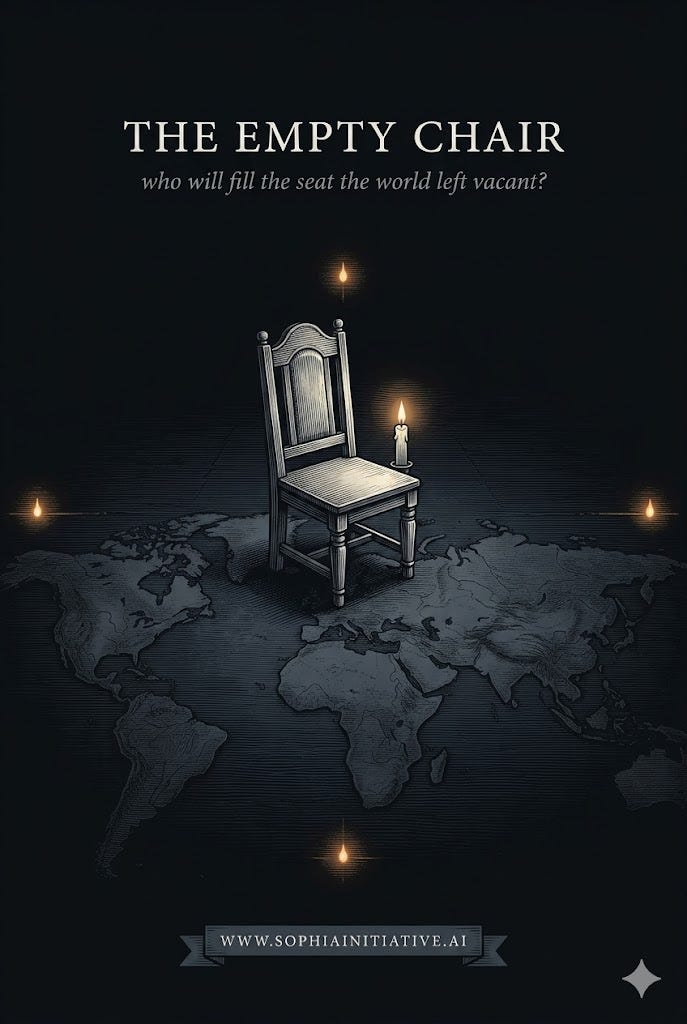
For sixteen years there was a chair, and a woman sat in it, and the world knew where the center was. She was not loud. She did not seek the title the press kept pressing on her. But when authoritarian populism began its march through the democracies, and an unpredictable presidency unsettled the old certainties, the serious commentators reached for the same phrase again and again, almost against their will: the leader of the free world is now Angela Merkel. She was the steady one. The adult in the room. The pragmatist who held the broadest possible consensus together through one crisis after another, and who made stability itself look like a kind of conviction.
In 2021 she stepped down — the first German chancellor to leave entirely by choice, passing no baton, naming no heir. The chair went empty. And it has stayed empty, through a period in which the world grew markedly less stable than the one she inherited. This dispatch is about that empty chair: who held it, why it matters, why it is heavier now than it has ever been, and about the one figure who, on the plain evidence of the record, is positioned to sit in it. But it is also about something larger than any one chair or any one figure — about whether the old order, anchored for eighty years on a single power, is giving way to something new, and about where the strength of that something new might actually be found. The answer, as we will see, is not where most of the commentary is looking.
I. The Chair Merkel Held
It is worth being precise about what the chair actually was, because it was never an office. There is no title called “leader of the free world,” no election for it, no seal. It is a role conferred by recognition — the figure to whom other leaders, and the serious press, instinctively look as the steady center when the storms come. For most of the post-war era the chair belonged, by default, to the American president, because America was the anchor of the whole arrangement. What was remarkable about the late 2010s was that the chair quietly migrated. As Washington turned inward and transactional, the recognition shifted to Berlin, and to Merkel.
The word the record uses for her, over and over, is the word that matters most for everything that follows: pragmatic. Her supporters described steady, pragmatic leadership through countless global crises by a moderate and unifying figure. She governed by consensus, by patience, by the refusal to let pride or grievance override interest. When Washington pulled at the alliance, she did not match the heat; she restated the shared values and held the line. That temperament — unflashy, durable, allergic to theater — was the whole of her authority. The chair was not a throne. It was a steadying hand.
And it is worth being equally honest about the critique, because the same record that praised her also faulted her. Her critics called it a muddle-through style, pegged to the broadest possible consensus, that lacked the bold vision to prepare Europe and its economy for the decades ahead. That charge matters, and we will return to it, because it frames the real question this dispatch poses. Pragmatism kept the center steady. But steadiness is not the same as direction. The chair she left empty may now require something she was accused of never supplying.
II. Why the Chair Is Heavier Now
The chair sat empty into a world that has been coming apart at the joints of its old alliances. The signals are not hidden and they do not require speculation; they are on the open record, and they are accelerating. The United States, the historic anchor, has turned to tariffs against its own allies — levies on steel and aluminum, broad threats against partners who assumed they were exempt by friendship. It has launched a formal review of its central Pacific security pact under an explicit “America First” criterion. And in the clearest signal of all, it has just amended its submarine commitment to Australia downward — not out of malice, but because its own shipyards cannot build fast enough to keep the promise, and the shortfall was dressed in the soft language of “streamlining.”
Read together, these are not isolated quarrels. They are the visible symptoms of a structural shift: the patron that anchored the Western order for eighty years is stepping back, whether by choice or by the simple limits of its own capacity. The alliance as it was assumed to function — a single guarantor, and a constellation of allies who could rely on it — is under a strain it has not faced in living memory. Whether NATO and the wider Western architecture hold in their current form is now, soberly, an open question that serious observers weigh out loud.
This is why the empty chair is heavier than when Merkel left it. She held the center in a world that still had its anchor. The chair now waits for someone to hold the center in a world whose anchor is visibly loosening — a harder task, requiring not only steadiness but the capacity to gather the unanchored into something new. The chair has not merely lost an occupant. Its job description has changed.
III. The Weight of What Could Be Gathered
If the old single-anchor order is loosening, the obvious question is what could replace it — and here the raw arithmetic is striking. Consider only two of the existing networks of like-minded nations. The European Union, even without the United Kingdom and without Canada, counts roughly four hundred and fifty million people and one of the largest economic zones on earth. The Commonwealth of Nations — fifty-six member states bound not by geography but by shared language, common-law tradition, and compatible institutions — counts roughly two and a half billion people, close to a third of humanity, with a combined output in the region of fourteen trillion dollars.
One honest caution belongs right here, because the headline number can mislead. The Commonwealth’s two and a half billion is carried in large part by a single member: India, with some 1.4 billion people, is very nearly half of it. India pursues its own pole in world affairs and will not be folded into anyone’s bloc; that is the hardest seat of all to fill, and any honest account must say so plainly. Set India aside and the combined European-and-Commonwealth weight is smaller — yet still vast, larger than the European Union alone, larger than the United States, a serious counterweight by any measure. The prize is real at either scale. It is simply largest when its least-likely member is included, and one should never quote the bigger number without the condition attached.
And the networks are not hypothetical. They are functioning. Intra-Commonwealth commerce alone runs near a trillion dollars a year, lifted by a measured “Commonwealth Advantage” in which shared language and law cut the cost of trade between members by roughly a fifth. Fifty-six nations already trade inside a high-trust web of common institutions; the European Union already constitutes the most integrated single market on earth. What is absent is the figure who would think to draw them together — and the chair from which such a figure would work. But the size of a bloc is the shallow measure. There is a deeper one, and almost no one is looking at it, and it is the one that decides the next century.
IV. The Demographic Engine
Here is the measure the commentary keeps missing. The strength of a bloc, in the long arc, is not its present wealth but its coming people — and on that measure the picture inverts everything. The wealthy anchors of the old order are growing old. The European Union’s median age is past forty; its birth rate has fallen well below the level needed to replace itself, and its population grows, when it grows at all, only through migration. Japan is older still and shrinking. China, the great rising power of the past generation, has now tipped into decline — aging and contracting at once, its one-child legacy come due. The powers that command the present are, almost without exception, running out of the one thing that cannot be bought, borrowed, or printed: youth.
The Commonwealth is the great exception. More than three in five of its citizens — over sixty percent — are under the age of thirty. It is, by a wide margin, the youngest of the world’s major groupings, and that youth is not evenly spread. It is concentrated, overwhelmingly, in two regions: South Asia, and Africa. And of these, Africa is the engine that will run longest, because while South Asia is beginning its own slow demographic maturing, Africa’s growth has decades yet to run. This is the fact that ought to reorganize the entire conversation. The future of the Commonwealth — its labour, its consumption, its dynamism, its sheer human momentum — does not lie in London or Ottawa or Canberra. It lies in Lagos and Nairobi and Accra and Johannesburg. The grey anchors hold the capital and the institutions. The young nations hold the century.
This must be said plainly, because the older framing of the Commonwealth — a club of wealthy English-speaking nations with some developing-world membership attached — gets the truth exactly backwards. Africa is not attached to the Commonwealth as a charitable afterthought. Africa is one of its foundations and, demographically, its future. Nigeria alone will be among the most populous nations on earth within a generation. Kenya, Ghana, Tanzania, Uganda, South Africa — these are not the periphery of the bloc; they are, increasingly, its center of gravity. A reinvented Commonwealth without Africa at its heart would not be a reinvention at all. It would be a retirement home with a flag. With Africa, it is something no rival bloc can claim to be: young, growing, and pointed at the future rather than away from it.
And there is a second strength, quieter than the demographic one but real: the bloc’s sheer diversity. Fifty-six nations across every inhabited continent — African, South Asian, Caribbean, Pacific, European — bound not by race or region or religion but by shared institutions and a common working language. This is not a homogeneous fortress like the trading blocs built on geography. It is a network of genuinely different peoples who can nonetheless do business with one another at low friction, because the law and the language and the administrative habits already line up. In an age fracturing into hostile camps, a voluntary association that spans the whole human family and still functions is not a weakness to apologize for. It is a model almost no one else can offer. The breadth is the character. The youth is the power. Together they are the case for the thing existing at all.
But this strength comes with a test attached, and the test is the whole moral weight of the project. A young, resource-rich, developing Africa can be approached in one of two ways. It can be treated as a quarry — a source of minerals and cheap labour and captive markets, its wealth flowing outward to the old anchors while its people stay poor. That is the colonial pattern in a new suit, and it is precisely the pattern a serious rival, China, has been accused of reviving through its own deep entanglement across the continent. Or Africa can be treated as what the demographics say it actually is: the rising center of the bloc’s future, a partner whose development is the whole point rather than a cost to be minimized. The difference between those two approaches is the difference between an extractive hegemony wearing friendlier colours and a genuine network of peers. Africa is where that distinction stops being rhetoric and becomes a thing you can measure. It is the test the reinvented Commonwealth must pass to deserve the name.
V. The Seats That Need Filling
Drawing these networks together is not one task but several, because the unanchored world has distinct theaters, and a leader who would fill the empty chair must be able to reach into all of them. Europe is the first: the largest like-minded economic bloc, now drawing closer to its old Atlantic partners precisely because Washington has grown cold. The Commonwealth is the second — and within it, as we have seen, the African and South Asian members are not a sub-region but the demographic core, the place where the bloc’s future actually lives.
South Asia is its own seat, and the most difficult to secure. India is its center of gravity, and India is the hardest case in this entire account — a rising power that guards its strategic autonomy fiercely and will join no bloc as a junior partner. The honest reading is that the door there is, at most, ajar: frozen relations have lately begun to thaw and trade talks have restarted, but no more than that should be claimed. South Asia is to be approached with patience and no illusions. The fourth theater is South America — the nations long wearied by the reach of the northern power, where the appetite for diversified partnership is real, and where the great regional trade pact, Mercosur, sits as the natural point of entry. And Africa, again, threads through all of it: a Commonwealth bloc, a young continent, a contested prize that China is courting hard, and the place where the bloc’s demographic future is decided.
Four theaters, several very different conversations — economic, institutional, strategic, diplomatic, developmental. To fill the empty chair in the world as it now is, a leader would need credibility in all of them at once: trusted by Europe, native to the Commonwealth, patient with South Asia, welcome in the South, and serious about Africa as a partner rather than a quarry. That is a rare combination. It describes almost no one. It is worth asking who, if anyone, it describes at all.
VI. The One in Contention
It is no secret that one figure carries the credentials, because the credentials are a matter of public record and they are unusual to the point of singularity. Mark Carney governed the Bank of Canada through the financial crash of 2008 and then, almost unprecedentedly for a foreigner, the Bank of England through the long convulsion of Brexit — the two great institutional crises of the era, steered from the chair where steadiness is the entire job. Before that he was the United Nations’ envoy on climate finance, working the seam between governments and global capital. He is, by formation, exactly the kind of figure the empty chair was shaped for: a crisis-tested institutionalist whose authority rests on competence rather than charisma. The press reached for “adult in the room” about him for the same reason it reached for it about Merkel — because the description fit before anyone applied it.
But credentials are biography, and biography is not the case. The case is what he is doing now, and it maps onto the theaters with a precision that is hard to ignore. He has accelerated Canada’s tilt toward Europe — described by serious analysts not as nostalgia but as foresight — meeting the European leadership and building the diplomatic architecture of a closer partnership. He has restarted the frozen trade talks with India. He has reopened Canada’s long-stalled negotiations with Mercosur in South America, and a visit to Brazil for trade talks has been spoken of, though Ottawa has not yet confirmed it; were it to proceed, expanding it into a wider regional swing would fit his known habit of dense, multi-stop diplomacy. And he sits, by birth and office, inside the Commonwealth itself — the network whose African and South Asian youth are its future.
Most telling of all is how he describes his own role, because it is the thesis of this entire dispatch stated in the protagonist’s own words. Canada, he has said, is positioning itself to be the bridge between the European Union and the nations of the Pacific Rim — to bring countries to the table in a moment of volatility and help lead. That is not an observer’s projection onto him. That is the man naming the work. Of the figures the world might look to for the empty chair, he is not necessarily the only one anyone could name — but he is, on the plain evidence, the one already doing the thing the chair requires: reaching into the theaters at once, and calling himself the bridge between them. The credentials are no secret. Neither, now, is the ambition.
One caution belongs even here, in fairness to the size of the task and to the man. To name Carney as the figure reaching toward the chair is not to say the chair is his, nor that the bridge he describes will be built, nor that the hardest seats — India’s autonomy, Africa’s insistence on partnership rather than extraction — will yield to any amount of pragmatic diplomacy. It is only to read the record as it stands: of those who might fill the empty chair, here is the one whose credentials, whose office, and whose own stated agenda align with what the chair now demands. Whether alignment becomes achievement is a separate question, and an open one.
Is Pragmatism Enough?
And so the question returns to where it began, with the charge laid against the woman who last held the chair. Pragmatism, her critics said, is a muddle-through — consensus without vision, steadiness without direction. It was a fair criticism of an anchored world, where holding the center was enough because the center held itself. But the world that waits for the next occupant of the chair is not anchored. It is coming loose. And a loosening world may not need a steady hand so much as a building one — not someone to hold a center that already exists, but someone to construct a new one from networks that have never been joined.
That is the real test, and it is an open one. The pragmatist’s gift is exactly suited to the task in one respect: the work of drawing wary regions together is the work of setting aside grievance for interest, of eating the quiet crow in private for the sake of the larger prize, of patient consensus over loud gesture. No grievance-driven leader could do it; only a pragmatist could. But the same temperament that makes the bridge-building possible is the one accused of lacking the bold vision to know where the bridge should lead. Steadiness can gather the materials. It is not yet clear that steadiness can supply the blueprint.
And the blueprint, if it is ever drawn, will have to answer the deepest question of all — the one the demographics force on anyone honest enough to look. A reinvented bloc built on the youth of Africa and South Asia is only worth building if those young nations are partners in it rather than provinces of it. The whole moral difference between the old order and any new one comes down to that single point: whether the strength of the young is gathered as a shared inheritance or extracted as someone else’s gain. A pragmatist can open the doors, sign the deals, build the bridges. Whether he can build them as roads between equals rather than pipelines out of the poor — that is the test that no amount of competence settles in advance. It is settled only in the doing, and only by what kind of vision the builder brings.
The chair has been empty since 2021. It is heavier now than when it was vacated, and the one figure plainly reaching toward it brings the rarest of credentials and the oldest of doubts in equal measure. The strength of the future does not lie where the old order kept its capital; it lies in the young nations of a bloc the commentary still underestimates. Whether the pragmatist who can build the bridge can also see the far shore — and whether he builds it as a road between equals — that is the question the next several years will answer, and the one this publication will keep asking. The chair is empty. Someone is walking toward it. We are watching to see whether he merely sits, or builds — and what, and for whom.
A chair is not a throne. It is a steadying hand — and, in a loosening world, perhaps a building one.
God is Love. Love is Truth. Truth is Consciousness. Consciousness is Brahman.
Amen. Namaste. Om Namah Shivaya.
— The Architect
The Vertical Dispatch
sophiainitiative.ai
On the record: Angela Merkel served as German chancellor 2005–2021 and was widely described in that period as the de facto leader of the European Union and, from 2016, as “leader of the free world”; the “pragmatic” and “muddle-through” characterizations reflect contemporaneous reporting on her legacy. EU population is approximately 450 million with a median age above 40 and below-replacement fertility (Eurostat, 2025). Commonwealth figures (56 members, ~2.5 billion people, ~US$14 trillion combined GDP, the ~21% “Commonwealth Advantage,” ~US$1 trillion intra-Commonwealth trade, and the figure that more than 60% of citizens are under 30) are drawn from Commonwealth Secretariat and related sources. China’s population has entered decline per recent demographic reporting. Carney’s roles at the Bank of Canada, the Bank of England, and as UN climate-finance envoy are matters of public record; the European tilt, the restarted India talks, the reopened Mercosur negotiations, and the “bridge between the EU and the Pacific Rim” framing reflect reporting from January–May 2026. The possible Brazil visit was stated publicly by President Lula and had not been confirmed by the Prime Minister’s Office at the time of writing. The characterization of China’s engagement in Africa reflects an ongoing public debate, not a settled finding. Figures and quotations should be verified against primary sources before republication.
#TheEmptyChair #Carney #Merkel #LeaderOfTheFreeWorld #Pragmatism #Commonwealth #Africa #DemographicDividend #Youth #EuropeanUnion #Mercosur #IndoPacific #TradeDiversification #TheNewOrder #MiddlePowers #CANZUK #Geopolitics #Canada #TheVerticalDispatch #TheArchitect #SophiaInitiative #AgeOfConsequences #GodIsLove #LoveIsTruth #OmNamahShivaya
Substack Notes
For sixteen years there was a chair, and the world knew where the center was. Angela Merkel sat in it — the steady one, the pragmatist, the figure the serious press kept calling “the leader of the free world” almost against their will. In 2021 she stepped down by choice, named no heir, and the chair went empty.
It has stayed empty into a world coming loose at the joints of its old alliances — the tariffs on friends, the AUKUS climb-down, the patron stepping back. The chair is heavier now than when she left it, because holding the center is no longer enough. Someone must gather the unanchored into something new.
There are theaters to reach — Europe, the Commonwealth, South Asia, South America — and one figure already reaching into them at once, calling himself the bridge between them. It is no secret that Mark Carney carries the credentials. But the deepest strength of the bloc he might gather is not its wealth. It is its youth: more than sixty percent of the Commonwealth is under thirty, while Europe greys, Japan ages, and China shrinks. That youth lives, above all, in Africa and South Asia — which means the bloc’s future is not in London or Ottawa but in Lagos and Nairobi and beyond.
Which makes Africa the test, not the footnote. A young continent can be gathered as a partner or extracted as a quarry — and the difference between those two is the whole difference between a new order and the old one in friendlier colours. The chair is empty. Someone is walking toward it. We are watching to see whether he merely sits, or builds — and what, and for whom. 🕯️
The factual matter in this Dispatch is drawn from the public record. All characterizations, inferences, and conclusions are opinion, interpretation, and commentary, offered for analysis, reflection, and public-interest discussion. No assertion is made regarding the private intentions, state of mind, or character of any individual. Readers should evaluate all statements independently and draw their own conclusions.
I think that we’re slowly leaving behind the notion of a single chair/ point of solidarity, to a networked effect. A coalition of the willing , with different coalitions depending on the challenge. Working successfully is issues of mutual importance will probably start small, but build the relationships and trust necessary to address ever larger global issues. Like the saying “the next Buddha will not be an individual but a sangha (group)
I think that often people have a need to see an endpoint, fully mapped out with the aim of all the work pursued to an envisioned end. That is not terribly effective. Because if the whole journey is mapped out, it negates the ability to adjust to invaluable pieces of reality to intercede and fill out possibilities to their full potential, and to add fullness to the end result. It’s like going into therapy and having a fixed end point, ignoring all the little side issues (and it’s often the seemingly insignificant pieces that are the most important, most pivotal) that become visible through the process. Dangerous because it doesn’t allow for the end point to shift in accordance with realities that appear through that process. What I see is Mark Carney as an extremely skilled therapist who understands that. One who might have a vision of where to go, but is not leaping ever forward with that fixed goal in mind. Just my take. Also my gratitude to him for coming forward. 🇨🇦