I think that we’re slowly leaving behind the notion of a single chair/ point of solidarity, to a networked effect. A coalition of the willing , with different coalitions depending on the challenge. Working successfully is issues of mutual importance will probably start small, but build the relationships and trust necessary to address ever larger global issues. Like the saying “the next Buddha will not be an individual but a sangha (group)
Meg — you've pushed the metaphor past where the essay left it, and I think you're right to.
The "empty chair" is, when you look hard at it, a relic of the order that's ending — the single seat, the one leader of the free world, the point of solidarity everyone looks toward. (It's worth noting Merkel never accepted that title; it was always the press's word, not hers — even the last person said to hold the chair never believed she sat in one.) What you're naming is the thing that may actually replace it: not a new occupant of the old seat, but a networked solidarity — coalitions of the willing, different coalitions for different challenges, trust built small before it's spent large. The sangha line lands it perfectly. The next centre of gravity may not be a someone but a something — a relationship, held in common.
Here's the only piece I'd add, and you've given me the image for it. If there is still a chair in this, it isn't the old fixed throne facing one direction — it's a swivel chair, and it holds no gavel. The figure who matters in a networked world isn't enthroned and can't command; he turns. He faces Europe, then the Pacific, then the South, convening each coalition the moment requires — and the swivel lets another leader take the chair when their moment comes and their credibility fits. That's a convener, not a monarch. Humbler, and in your framework more important: the one who calls the sangha together, holds the space, does the patient work of building the trust before there's anything large enough to spend it on.
Which raises the real question your comment opens: not who fills the chair, but which leaders are willing to take a seat that carries responsibility without command — and whether the others will back them when they do. That backing is the whole discipline of the sangha. A network with no centre still needs members who will lend their weight to whoever the moment elevates, even when it isn't their own leader. The joint statement — many names on one page, no one commanding it — may be what that looks like in practice.
So perhaps the essay named the right shape for the wrong reason. Not the empty chair. The swivel chair, with no gavel, inside the sangha — turning to face each challenge, and turning, too, to let the next convener sit. Thank you for moving the thinking forward, Meg. That's what the best comments do. 🕯️
P.S. — Meg, I had to work hard for this reply. 😄 That's the highest compliment I know how to pay a comment.
I think you/ we are naming an evolutionary unfolding. Way Yul (on Substack) gives the metaphors of moving from a hub and spoke model to a network model. With certain countries —Canada included—leading the development of the post-American order, led by middle powers and named by Carney at Davos.
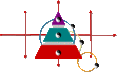
Let me add some developmental colouring to this image. Hub-and-spoke is 3.5 Stage, Orange, Achiever. Teamwork aligned to “my team and goals”. Money and resources funnel to the hub then get re-directed. Spokes can influence the hub - but only so much. It works well up to a certain number of spokes - think of the maximum number of spokes permissible in a modern airport. At a certain level of complexity, it breaks down. We are now experiencing that breakdown, with so many issues that no hegemon or hub can handle - money, data, virus, AI regulation, climate.
The next developmental step is the network, where as you point out different players can occupy a seat, depending on the context. The network players are sensitive to context and the value of the network comes from acknowledging different contexts wrt a cohered goal. Think of the recent climate conference in Santa Marta - similar goal of addressing climate issues, different means depending on local country conditions, agreement to share learnings ++. This is 4.0 Stage, Green . AND. Stages (O’Fallon ) insight. This 4.0 Green stage is receptive to nuance but not effective at prioritizing. Think endless meetings. So the risk you name of who will step up - is very real.
The Jaques insight is that each stratum is valuable and must be set up to succeed. The ‘higher’ strata explore the challenges at their level and determine the questions and tasks at the level below. eg a Level 4 VP (2-5 years) might have the task to determine which new markets to enter, asking a Level 3 Director (1-2 years) to determine appropriate operational and distribution channels.
WRT global re-ordering, the focus of the 4.0 network can come from 4.5 Strategists, who have the capability to look at the multiple components of a complex adaptive system and adapt it effectively, and are thus effective at prioritizing. 3.5 also prioritizes but narrowly, but at 4.5 it’s a much more inclusive, nuanced view. This is the vertical aspect from within a Stage development perspective.
Of course, there is another meaning of Vertical; the vertical wrt Origin, the vertical that holds the relative. Any of us can do this, from any Stage or phase of life. This is the state aspect, that provides the grace/ grease that catalyzes the ongoing unfolding of Life .
You also point to another aspect of the unfolding - which is Shadow. The more we resolve our old wounds or unfinished business - whether individual or collective—the less energy is trapped in old forms, the more is freed up to flow with the living currents.
One could say more, but I’ll stop here for now. States, Stages, Shadow. Acknowledge and appreciate the hard work “of the little grey cells” (nod to Poirot the detective!), which is the same for me as well.
I think that often people have a need to see an endpoint, fully mapped out with the aim of all the work pursued to an envisioned end. That is not terribly effective. Because if the whole journey is mapped out, it negates the ability to adjust to invaluable pieces of reality to intercede and fill out possibilities to their full potential, and to add fullness to the end result. It’s like going into therapy and having a fixed end point, ignoring all the little side issues (and it’s often the seemingly insignificant pieces that are the most important, most pivotal) that become visible through the process. Dangerous because it doesn’t allow for the end point to shift in accordance with realities that appear through that process. What I see is Mark Carney as an extremely skilled therapist who understands that. One who might have a vision of where to go, but is not leaping ever forward with that fixed goal in mind. Just my take. Also my gratitude to him for coming forward. 🇨🇦


I think that we’re slowly leaving behind the notion of a single chair/ point of solidarity, to a networked effect. A coalition of the willing , with different coalitions depending on the challenge. Working successfully is issues of mutual importance will probably start small, but build the relationships and trust necessary to address ever larger global issues. Like the saying “the next Buddha will not be an individual but a sangha (group)
Meg — you've pushed the metaphor past where the essay left it, and I think you're right to.
The "empty chair" is, when you look hard at it, a relic of the order that's ending — the single seat, the one leader of the free world, the point of solidarity everyone looks toward. (It's worth noting Merkel never accepted that title; it was always the press's word, not hers — even the last person said to hold the chair never believed she sat in one.) What you're naming is the thing that may actually replace it: not a new occupant of the old seat, but a networked solidarity — coalitions of the willing, different coalitions for different challenges, trust built small before it's spent large. The sangha line lands it perfectly. The next centre of gravity may not be a someone but a something — a relationship, held in common.
Here's the only piece I'd add, and you've given me the image for it. If there is still a chair in this, it isn't the old fixed throne facing one direction — it's a swivel chair, and it holds no gavel. The figure who matters in a networked world isn't enthroned and can't command; he turns. He faces Europe, then the Pacific, then the South, convening each coalition the moment requires — and the swivel lets another leader take the chair when their moment comes and their credibility fits. That's a convener, not a monarch. Humbler, and in your framework more important: the one who calls the sangha together, holds the space, does the patient work of building the trust before there's anything large enough to spend it on.
Which raises the real question your comment opens: not who fills the chair, but which leaders are willing to take a seat that carries responsibility without command — and whether the others will back them when they do. That backing is the whole discipline of the sangha. A network with no centre still needs members who will lend their weight to whoever the moment elevates, even when it isn't their own leader. The joint statement — many names on one page, no one commanding it — may be what that looks like in practice.
So perhaps the essay named the right shape for the wrong reason. Not the empty chair. The swivel chair, with no gavel, inside the sangha — turning to face each challenge, and turning, too, to let the next convener sit. Thank you for moving the thinking forward, Meg. That's what the best comments do. 🕯️
P.S. — Meg, I had to work hard for this reply. 😄 That's the highest compliment I know how to pay a comment.
I think you/ we are naming an evolutionary unfolding. Way Yul (on Substack) gives the metaphors of moving from a hub and spoke model to a network model. With certain countries —Canada included—leading the development of the post-American order, led by middle powers and named by Carney at Davos.
Let me add some developmental colouring to this image. Hub-and-spoke is 3.5 Stage, Orange, Achiever. Teamwork aligned to “my team and goals”. Money and resources funnel to the hub then get re-directed. Spokes can influence the hub - but only so much. It works well up to a certain number of spokes - think of the maximum number of spokes permissible in a modern airport. At a certain level of complexity, it breaks down. We are now experiencing that breakdown, with so many issues that no hegemon or hub can handle - money, data, virus, AI regulation, climate.
The next developmental step is the network, where as you point out different players can occupy a seat, depending on the context. The network players are sensitive to context and the value of the network comes from acknowledging different contexts wrt a cohered goal. Think of the recent climate conference in Santa Marta - similar goal of addressing climate issues, different means depending on local country conditions, agreement to share learnings ++. This is 4.0 Stage, Green . AND. Stages (O’Fallon ) insight. This 4.0 Green stage is receptive to nuance but not effective at prioritizing. Think endless meetings. So the risk you name of who will step up - is very real.
The Jaques insight is that each stratum is valuable and must be set up to succeed. The ‘higher’ strata explore the challenges at their level and determine the questions and tasks at the level below. eg a Level 4 VP (2-5 years) might have the task to determine which new markets to enter, asking a Level 3 Director (1-2 years) to determine appropriate operational and distribution channels.
WRT global re-ordering, the focus of the 4.0 network can come from 4.5 Strategists, who have the capability to look at the multiple components of a complex adaptive system and adapt it effectively, and are thus effective at prioritizing. 3.5 also prioritizes but narrowly, but at 4.5 it’s a much more inclusive, nuanced view. This is the vertical aspect from within a Stage development perspective.
Of course, there is another meaning of Vertical; the vertical wrt Origin, the vertical that holds the relative. Any of us can do this, from any Stage or phase of life. This is the state aspect, that provides the grace/ grease that catalyzes the ongoing unfolding of Life .
You also point to another aspect of the unfolding - which is Shadow. The more we resolve our old wounds or unfinished business - whether individual or collective—the less energy is trapped in old forms, the more is freed up to flow with the living currents.
One could say more, but I’ll stop here for now. States, Stages, Shadow. Acknowledge and appreciate the hard work “of the little grey cells” (nod to Poirot the detective!), which is the same for me as well.
I think that often people have a need to see an endpoint, fully mapped out with the aim of all the work pursued to an envisioned end. That is not terribly effective. Because if the whole journey is mapped out, it negates the ability to adjust to invaluable pieces of reality to intercede and fill out possibilities to their full potential, and to add fullness to the end result. It’s like going into therapy and having a fixed end point, ignoring all the little side issues (and it’s often the seemingly insignificant pieces that are the most important, most pivotal) that become visible through the process. Dangerous because it doesn’t allow for the end point to shift in accordance with realities that appear through that process. What I see is Mark Carney as an extremely skilled therapist who understands that. One who might have a vision of where to go, but is not leaping ever forward with that fixed goal in mind. Just my take. Also my gratitude to him for coming forward. 🇨🇦