

THE VERTICAL DISPATCH
We write for the mind, the eye, and the ear.
Read it. Look at it. Listen to it. The Vertical Dispatch is built for all three — prose with rhythm, made to be heard as much as read.
From metaphysics to geopolitics, from culture to history, from the sacred to the street — and everything in between. One lens, every subject. No ego. Just the record, named clean.
Press play. Walk with the words. 🕯️
Building Canada Strong · The Age of Consequences
As of June 3, 2026
— without malice and without flattery
“The word must match the world, or both are lost.”
On June 2 and 3, 2026, the Office of the United States Trade Representative announced the result of an investigation under Section 301 of the Trade Act of 1974 and proposed new tariffs on sixty economies — a ten per cent surcharge on fourteen of them, including Canada, Mexico, the United Kingdom, and the European Union, and twelve and a half per cent on some forty-six others, among them China, Japan, India, and Brazil. The stated ground was a single grave phrase: that these nations had failed to impose and effectively enforce a ban on imports of goods made with forced labour. It is, for now, a proposed action, open to public comment through early July; but the word has been spoken, and it is the word, not yet the tariff, that this dispatch is concerned with.
We want to be exact and we want to be fair, because the subject is grave and the temptation to heat is real. Forced labour is among the darkest things one human being does to another, and a policy that genuinely sought to drive the products of true coercion out of the world’s supply chains would deserve support, not scorn. That aim is legitimate. There is real forced labour in the world — the coerced and the trafficked and the unfree — and a great power using its market to press against it is not, in principle, doing wrong. We grant that plainly, at the outset, because the argument that follows is not that the goal is false. It is that the word has come loose from its meaning — and that a moral word, used as a weapon abroad while left unexamined at home, begins to hollow out. This is what we call the false proposition: not a lie, exactly, but a claim that has stopped pointing at the thing it names.
What the Word Actually Means
Begin with the definition, because the keel of this publication is that the symbol is not the referent, and “forced labour” is a symbol with a precise referent in international law. The International Labour Organization, in its founding convention of 1930 and its indicators reaffirmed in 2025, defines forced labour not by how little a job pays but by coercion: work exacted from a person under the menace of a penalty, to which the person has not offered himself voluntarily. The hinge is the penalty and the absence of consent — the threat, the confinement, the document withheld, the punishment for refusal. A low wage, however cruel, is not by itself forced labour in the law’s meaning, because the worker may still walk away. This distinction is not a technicality to be brushed aside. It is the entire moral content of the word, and we hold to it precisely so that the word keeps its weight.
Hold that definition up, then, and turn it homeward — not in accusation, but in the plain light of the same standard. For there is one place inside the United States where labour is exacted, by law, under the menace of a penalty, from persons who cannot walk away. It is written into the nation’s founding charter.
The Mirror the Word Will Not Face
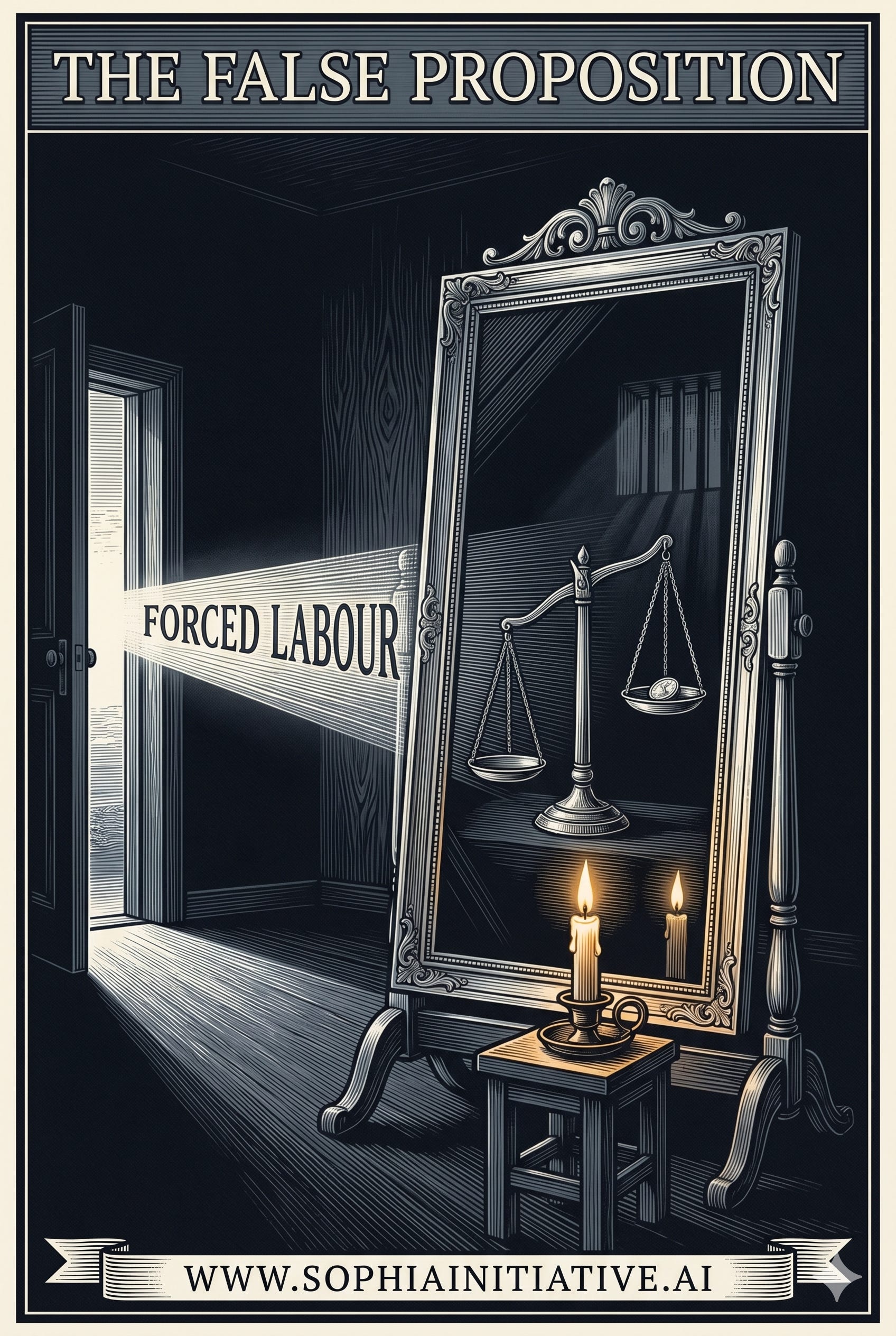
The Thirteenth Amendment to the United States Constitution abolished slavery and involuntary servitude — with seven words of exception: “except as a punishment for crime whereof the party shall have been duly convicted.” That clause is not a dead letter. It is the legal foundation of a vast prison-labour economy. Incarcerated workers in the federal system earn between roughly twenty-three cents and just over a dollar an hour; in several states — Texas, Arkansas, Georgia, Alabama among them — they earn nothing at all. More than sixty per cent of imprisoned people are required to work, and refusal can itself be punished. By the International Labour Organization’s own three-part test — menace of a penalty, involuntariness, work exacted under coercion — this is the one labour system in America that meets the definition the United States is now exporting as a tariff. The word, aimed at sixty foreign nations, has never once been made to face the prison wall at home.
This is the false proposition in its sharpest form. A nation invokes the precise legal meaning of forced labour against its trading partners while maintaining, in its own constitution, the precise legal thing the word describes. We make no claim about anyone’s private conscience; the discipline of this publication forbids it, and the record does not need it. We claim only what is on the public record: that the word and the world have come apart, and that the gap between them is exactly where a moral term begins to decay into a mere instrument.
The Other Mirror: The Wage and the Word
There is a second reflection, fainter than the first because it is not forced labour in the law’s strict sense, but it bears on the same question of whether the word still matches the world. The American federal minimum wage has stood at seven dollars and twenty-five cents an hour since July of 2009 — the longest freeze in the nation’s history. Inflation has eaten nearly half its value; in real terms it is worth about ten dollars and sixty cents in today’s money, and less than half what the minimum wage was worth at its peak in 1968. A full-time worker earning it grosses fifteen thousand and eighty dollars a year. By the Massachusetts Institute of Technology’s living-wage calculation, a single adult needs about twenty-nine dollars an hour to meet a basic standard of living; the federal minimum is roughly a quarter of that. Even in Arkansas, the lowest-cost state, a living wage runs near fourteen dollars — nearly double the federal floor. And atop the wage sits the absence: no guaranteed health coverage, where employer insurance averages over nine thousand dollars a year; no federally mandated paid sick leave; no required pension.
Let us be precise, because precision is the whole point: this is not forced labour. A worker at the federal minimum may legally quit, and so the menace-of-penalty test is not met. It is something the law has no grand word for — economic compulsion, the quiet pressure of survival rather than the overseer’s threat. But mark the relevant fact for a dispatch about a word: the same federal government now wielding “forced labour” against sixty nations has set its own wage floor at a level a person cannot live on, and has chosen, administration after administration, to leave it there. The current President’s stated position is that the federal minimum should remain low and that states may set their own — which is a defensible policy view, and we present it as his, not ours. But it means the word “forced labour” is being defined, at the federal level, by a government that does not regard a sub-subsistence federal wage as any kind of compulsion at all. The word points only outward. It has been built so that it cannot point home.
Where Canada Stands
And here is the part that should be said plainly to Canadians, because Canada has been swept into this tariff as one of the fourteen nations in the ten-per-cent tier, accused, in effect, of failing to keep forced labour out of its supply chains. Look at the record. Canada’s federal minimum wage stands at seventeen dollars and seventy-five cents an hour as of 2025, rising to eighteen-fifteen in 2026, and it is indexed to inflation each year so that it cannot quietly rot the way the American floor has. Canada passed, in 2023, the Fighting Against Forced Labour and Child Labour in Supply Chains Act, which bans the import of goods made wholly or in part by forced or child labour and requires companies to report on their supply chains. Canada’s minimum wage sits near seventy per cent of a living wage; the American federal minimum sits at twenty-five. By every measure named in this dispatch, the accusing nation’s own labour floor stands lower than the floor of the ally it is now tariffing.
The Prime Minister’s response, on June 3, was measured and correct: that Canada has a strong legislative regime against forced labour in supply chains, and that if the existing laws need strengthening, Parliament can strengthen them. That is the right register — not defensiveness, not nationalism, simply the record. Canada is not the country with the unfaced mirror. It is being asked to pay a surcharge for a standard it already meets more fully than the nation imposing it. The tariff is aimed, in truth, at supply chains touching China; Canada is collateral, swept into a blanket phrase that has stopped distinguishing the ally from the adversary because the word itself has stopped doing fine work.
Why a Word Comes Loose
This is the deeper matter, and it is why a proposed tariff is worth a dispatch in a publication that mostly writes of metaphysics and meaning. A moral word — forced labour, justice, freedom, dignity — carries its weight only so long as it stays anchored to the reality it names. Used with care, inward as well as outward, it keeps its edge; it can still cut to the truth of a thing. Used only as a weapon, aimed always at others and never at the self, it slowly empties. It becomes a lever, a tariff schedule, a pretext — and the danger is not merely the hypocrisy, which is the shallow reading. The danger is the hollowing: that a civilization which uses its gravest moral words without ever turning them homeward will, in time, lose the ability to recognize the things those words name, even when they stand in its own house, written into its own founding law. That is how a people can hold the precise legal definition of forced labour in one hand, and the constitutional exception permitting it in the other, and feel no tremor between them.
Final Thoughts: The Word and the World
The keel of this publication was learned from a man who read the water without flinching and set his small boat at the angle that carried his people safe over the wave. He did not pretend the wave was smaller than it was, nor larger; he named it true, and steered by what he named. That is all this dispatch asks of a word. Name the thing truly. If forced labour is the standard — and it is a worthy standard, one the world should hold — then hold it whole: at the foreign factory and at the domestic prison wall, in the supply chain abroad and in the wage floor at home. A standard applied only outward is not a standard; it is a weapon wearing the robes of one.
We write this not to shame a nation we count as kin, but to steady a thing larger than any nation: the bond between the word and the world, which is the bond all meaning hangs from. Canada need not flinch at this tariff; its record stands, and it should say so plainly and keep building. And the great republic to the south, which has within its gift the means to make its words and its world agree — to lift the wage it has frozen, to face the exception it has written — will find, if it does, that the word forced labour grows sharp again in its hand, sharp enough to cut where it truly should. The candle is not held up to expose a neighbour. It is held up so the word can find its way back to the thing it once meant. The waters are rough. The keel holds. Walk with the words.

God is Love. Love is Truth. Truth is Consciousness. Consciousness is Brahman.
Amen. Namaste. Om Namah Shivaya.
— The Architect
The Vertical Dispatch
sophiainitiative.ai
On the record — sources (as of June 3, 2026). Tariff action: Office of the U.S. Trade Representative, Section 301 determination announced June 2–3, 2026 (proposed additional tariffs of 10% on 14 economies including Canada, Mexico, the U.K. and EU, and 12.5% on ~46 others including China, Japan, India, Brazil; public comment period through early July, hearing scheduled July 7; a proposed action, not a final order). Reported by AP, Bloomberg, CNBC, NBC, Washington Post, June 2–3, 2026. Forced-labour definition: International Labour Organization Forced Labour Convention No. 29 (1930) and ILO Indicators of Forced Labour (2025 revised edition) — work exacted under menace of a penalty and without voluntary offer; wage level is not itself part of the definition. Thirteenth Amendment exception and U.S. prison labour: U.S. Constitution, 13th Amendment; federal UNICOR wages ~$0.23–$1.15/hr, several states $0; ~65% of incarcerated people required to work (Bureau of Prisons; Prison Policy Initiative; Business & Human Rights Resource Centre, 2025). U.S. federal minimum wage: $7.25/hr since July 24, 2009; ~$15,080 annual full-time; ~48% real decline since 2009 and below its 1968 peak (U.S. Dept. of Labor; BLS inflation data). Living wage: MIT Living Wage Calculator (2025, single adult ~$28.72/hr nationally; Arkansas ~$13.59); employer health-insurance average premium ~$9,325 single (KFF Employer Health Benefits Survey 2025); no federal paid-sick-leave mandate (U.S. Dept. of Labor). President’s stated position on the federal minimum wage is presented as his policy view, on the public record. Canada: federal minimum wage $17.75/hr (April 2025), $18.15 (April 2026), CPI-indexed (Government of Canada); Fighting Against Forced Labour and Child Labour in Supply Chains Act (Bill S-211, in force 2024) banning forced/child-labour imports; Prime Minister Carney’s June 3, 2026 remarks. All characterizations and the “false proposition” and “mirror” framings are interpretation and commentary; no claim is made about any individual’s private intentions. Errors and omissions excepted; corrections will be made on notice. Verify against primary sources before republication.
#TheFalseProposition #ForcedLabour #Tariffs #Section301 #USTR #MinimumWage #LivingWage #725 #ThirteenthAmendment #PrisonLabour #ILO #SupplyChains #CanadaStrong #BuildingCanadaStrong #ElbowsUp #MarkCarney #TheWageAndTheWord #SymbolNotReferent #TheAgeOfConsequences #ThreeDoorsDown #ReadingTheRiver #TheEleventhProvince #TheVerticalDispatch #TheArchitect #SophiaInitiative #GodIsLove #LoveIsTruth #OmNamahShivaya
Substack Notes
On June 2–3, the U.S. proposed tariffs on sixty nations — Canada among the fourteen in the ten-per-cent tier — on the grounds that they failed to keep forced labour out of their supply chains. This dispatch is about the word, not the tariff. Forced labour is a real evil and a legitimate thing to fight; we grant that plainly. But the word has a precise meaning in international law — coercion, work exacted under menace of a penalty — and by that exact meaning, the one labour system inside the U.S. that fits it is the prison labour permitted by the Thirteenth Amendment’s own exception: federal wages of cents an hour, several states paying zero, refusal punishable. The word is aimed at sixty foreign nations and has never been made to face the wall at home.
There is a fainter second mirror: a $7.25 federal minimum wage, frozen since 2009, worth a quarter of a living wage, with no required health coverage or pension. That is not forced labour in law — a worker can quit — but it is economic compulsion the same government does not regard as compulsion at all. The word points only outward. It has been built so it cannot point home.
Canada’s record stands clean by contrast: a $17.75 federal minimum indexed to inflation (about 70% of a living wage, against the U.S. 25%), and a 2023 law already banning forced-labour imports. Carney’s reply was the right register — the record, not defensiveness. Canada is collateral in a tariff truly aimed at China, swept into a blanket phrase that has stopped telling the ally from the adversary.
The deeper point is the keel: a moral word used only as a weapon, aimed always outward and never homeward, slowly hollows — until a people can hold the definition of forced labour in one hand and the constitutional exception permitting it in the other, and feel no tremor between them. Name the thing truly, or lose the word. Walk with the words. 🕯️
The factual matter in this Dispatch is drawn from the public record. All characterizations, inferences, and conclusions are opinion, interpretation, and commentary, offered for analysis, reflection, and public-interest discussion. No assertion is made regarding the private intentions, state of mind, or character of any individual. Readers should evaluate all statements independently and draw their own conclusions.
The US is in an economic death spiral and everything they do makes it worse because the Orange man doesn't understand tariffs. In time the courts will also find these illegal because and I quote "Tariffs are a tax on the people of the county who levies them."