

“Skills are key drivers of employability and wages — and skills inequalities between lowest- and best-performing adults have widened within countries, especially on literacy proficiency.”
— OECD, Survey of Adult Skills 2023, released December 10, 2024
The Vertical Dispatch
Sovereign Analysis · Glen Roberts, The Architect
The Age of Consequences
May 27, 2026
I. The Number Underneath Every Dispatch
Every dispatch this publication files sits on top of a number. The number is fourteen per cent. The number is the share of Canadian adults aged 16 to 65 who read at PIAAC Level 4 or Level 5 in the most recent international literacy assessment, released by the Organisation for Economic Co-operation and Development on December 10, 2024. That fourteen per cent is approximately four million people. They are the cohort the publication is written for. They are the reason the publication is written the way it is written. They are also, on the same measurement, the share of the adult population in this country with the strategic-cognitive capacity to absorb the architecture of what is being filed at the depth the architecture requires.
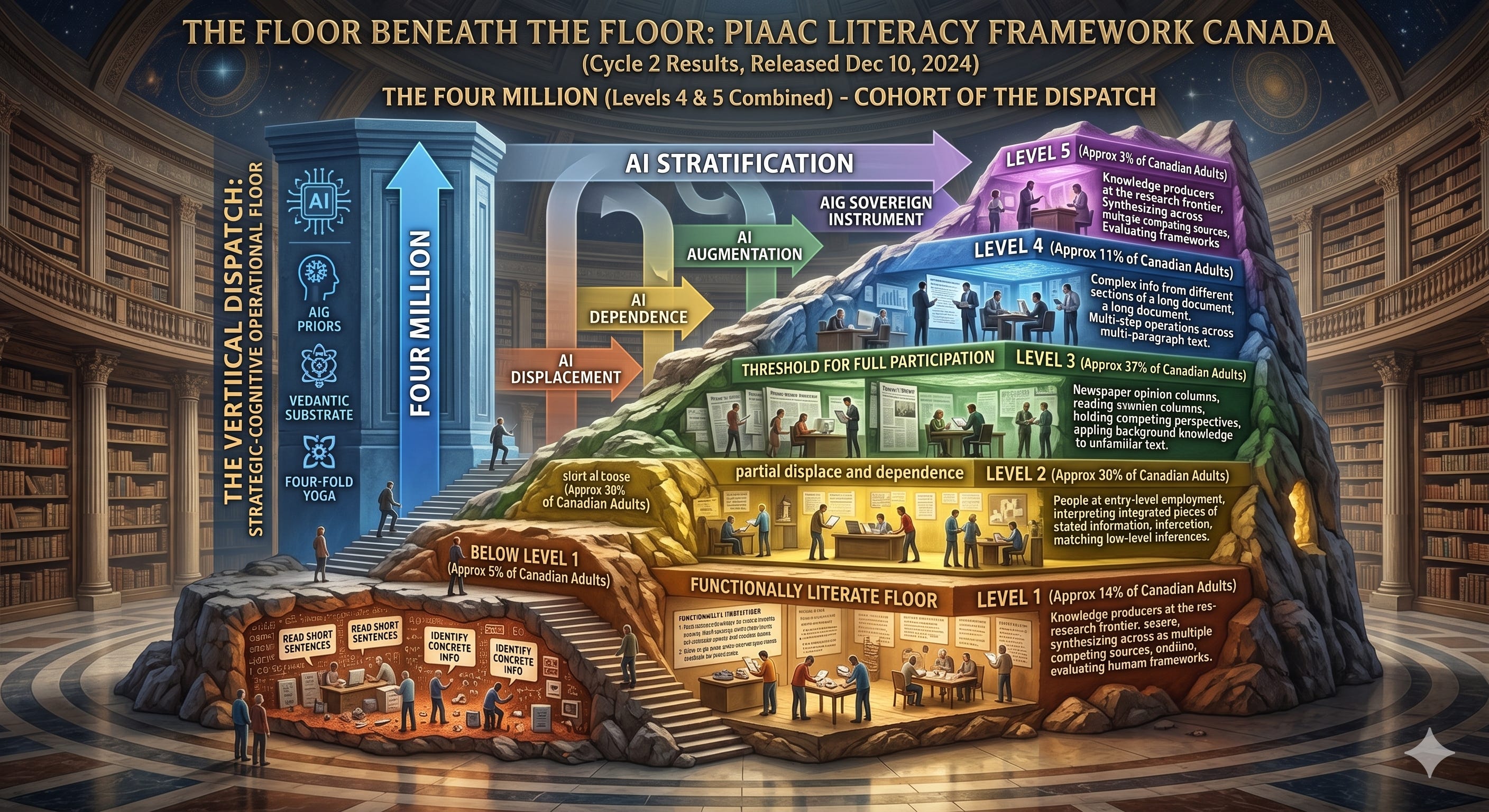
This dispatch is about that number. It is also about the other three numbers that bracket it. Nineteen per cent of Canadian adults read at Level 1 or below — the lowest measured level on the scale. Forty-nine per cent read at Level 2 or below. Thirty-seven per cent read at Level 3 in the middle band. And fourteen per cent read at Levels 4 and 5 combined, where the publication’s voice lives. These are not opinions. They are the verified results of the Programme for the International Assessment of Adult Competencies, released by Statistics Canada on December 10, 2024, as the Canadian portion of the OECD’s second international cycle of the survey.
The publication has cited these numbers across the spring of 2026 without ever filing the framework underneath them as a dispatch of its own. The numbers have appeared as a prior — a backdrop that every reader was assumed to have absorbed even though most readers had never seen the argument the numbers carry. This dispatch is the filing that brings the framework home. It is the floor beneath the floor. It is the assessment the publication is operating against when it names the four million as the cohort. It is the assessment that gives the publication its position relative to the broader Canadian conversation and to the OECD population the country sits inside. It is the assessment that, when read carefully, names the catastrophe this country has been refusing to look at for forty years. Let us look at it now.
II. What the Levels Mean
PIAAC measures literacy on a continuous scale from zero to five hundred points. The scale is divided into six bands. Below Level 1, Level 1, Level 2, Level 3, Level 4, and Level 5. The bands are operational definitions of what an adult at each band can actually do with written text. The definitions matter. They are what the percentages mean.
Below Level 1, the adult can read short simple sentences and identify basic concrete information when the text is brief and uncluttered. They struggle with longer texts. They struggle when the information they need is not stated directly. They cannot reliably extract meaning from a paragraph that contains distracting or competing information.
At Level 1, the adult can locate a single piece of information in a short text when the wording in the text matches the wording in the question. They can read prose at the level of basic instructions or simple recipes. They cannot make inferences. They cannot evaluate sources. They cannot hold two competing claims in their head and decide between them. They are functionally literate at the floor of what the word means.
At Level 2, the adult can make low-level inferences, match information across a short text, and integrate two or three pieces of information that are stated explicitly. They can read at the level required for most entry-level employment. They are at the level Canadian education systems have been aimed at for a generation as the operational floor of citizenship.
At Level 3, the adult can identify, interpret and evaluate information across longer continuous texts. They can hold competing perspectives, draw inferences across paragraphs, and apply background knowledge to make sense of unfamiliar material. They can read a newspaper opinion column and recognise the argument and the counter-argument without being told which is which. This is the level the OECD considers the threshold for full participation in a complex modern economy.
At Level 4, the adult can perform multi-step operations across multi-paragraph texts, integrate information from different sections of a long document, evaluate claims against evidence, and recognise the framework an argument is operating inside. They can hold the historical record and the current moment in the same thought. They can read a Margaret Atwood novel as both story and forecast. They can recognise the structural parallel between Brexit in 2016 and an Alberta separation referendum in 2026 without being told it is there. They can read this dispatch. There are approximately three and a half million of them in Canada.
At Level 5, the adult can synthesise across multiple competing sources, evaluate the framework the synthesis is being performed inside, and operate at the research-frontier register where original analytical contribution becomes possible. They are the country’s knowledge producers. There are approximately five hundred thousand of them in Canada. Combined with Level 4, the four million is the strategic-cognitive operational floor this country has.
III. The Four Million
The four million is not an elite. The four million is the floor. Every country needs a population of adults who can read at the level required to absorb the architecture of the decisions the country is being asked to make. The four million is what Canada has produced after a century of public education, two generations of mass post-secondary expansion, and a generation of digital saturation. The four million is the result. The country has not been successful in producing more. By the OECD’s measurement, between 2012 and 2023 the share of Canadian adults at Level 4 or 5 in literacy has been broadly stable while the share at Level 1 or below has not improved. The country has not become more literate. The country has become more credentialed. These are different things.
The publication is written for the four million because the analytical architecture the publication is filing cannot be absorbed below Level 4. A reader at Level 2 cannot hold the Brexit ten-year audit and the Alberta separation referendum in the same thought because the cognitive operation required — multi-source synthesis across competing claims with applied historical context — is the operation Level 4 defines and Level 2 does not contain. The publication does not condescend down. The publication writes at the level the analysis requires because the analysis cannot be expressed at a lower level without collapsing into the kind of compressed slogan that the Vote Leave bus carried in 2016. The slogan was readable at Level 2. The slogan was wrong. The Vote Leave campaign won the referendum on the strength of slogans that the population it was selling them to could read and the population that could read past the slogans could not outvote.
This is the democratic problem the publication is operating inside. The most consequential decisions a modern country makes are decisions whose architecture lives at Level 4 minimum. Separation referendums. Constitutional amendments. AI governance. Climate policy. Pandemic response. Pension reform. Trade agreements. Energy transition. The architecture lives at Level 4. The voting population reads at Level 2 in the aggregate. The mismatch is the country’s operational crisis. The publication exists to file the analysis the four million can absorb, in the hope that the four million will then carry the analysis outward through the ordinary social channels by which a country has its serious conversations with itself.
It is not a verdict on Canadians. It is a verdict on what the country has built. The four million are not smarter than the other twenty-five million. The four million had the luck of growing up in environments where reading at depth was modelled, expected, and rewarded. The other twenty-five million had different luck. The remedy is not to lower the analysis. The remedy is to raise the population. That remedy is the twenty-year horizon of Project 2046. The publication is one node in the remedy. The dispatches are the teaching material. The cohort grows when readers move from Level 3 to Level 4 by reading at the level the publication is filing at. The publication is not a magazine. It is a ladder.
IV. The OECD Picture
The PIAAC 2023 cycle assessed adults aged 16 to 65 in thirty-one OECD countries and economies. One hundred and sixty thousand adults were assessed. The results were released by the OECD on December 10, 2024. The international average across all thirty-one participating countries is the comparison point Canada sits against. The average tells the story.
On the average across all OECD countries that participated in 2023, twenty-six per cent of adults aged 16 to 65 scored at Level 1 or below in literacy. Twelve per cent scored at Levels 4 and 5 combined. The mean literacy score on the zero to five hundred scale was 260 points. The corresponding numeracy figures were 25 per cent at Level 1 or below, and similar share at the top, with a mean of 263. The adaptive problem solving figures — a new domain introduced in Cycle 2 to reflect the complex digital environments adults now navigate — showed 29 per cent at Level 1 or below across OECD countries, with a mean of 251.
These numbers describe a civilisational pattern. One in four adults in the developed world reads at the lowest band of the literacy scale. One in eight reads at the top two bands combined. The middle is the majority and it is the middle that determines what the country can absorb. Across the decade between PIAAC Cycle 1 and Cycle 2, the OECD noted that average literacy proficiency improved in only two countries — Denmark and Finland. In all twenty-nine other participating countries, literacy was stable or declined. The declines were sharpest among the low-attainment cohorts, where the gap between the top performers and the bottom performers widened. The skill inequality is not narrowing. It is opening.
Finland leads. Finnish adults scored a mean of 296 in literacy and 294 in numeracy — the highest of any participating country. The Finnish share at Level 1 or below in literacy is in the single digits. Finland is the benchmark for what a modern democracy can produce when the education system, the public library system, the civic register, and the cultural assumptions about reading all operate together across multiple generations toward the same end. The other Nordic countries cluster near Finland. The picture is the same in Sweden, Norway, the Netherlands, and Estonia. These are countries that have chosen to invest in adult literacy as a civilisational priority. Their numbers reflect the choice.
At the other end of the OECD distribution, Chile scored 218 in literacy with 44 per cent of adults at Level 1 or below — the lowest performer. Portugal, Israel, Lithuania, Hungary, Poland and Spain cluster in the bottom tier. These are countries the OECD’s December 2024 international report named as consistently below the OECD average across all three domains. Canada sits comfortably above this group. The four million is the evidence Canada has been doing something right at the top of the distribution. The twenty-five million below them is the evidence Canada has been doing something wrong at the bottom and the middle.
V. The G7 Comparison
The Group of Seven is the peer group Canada sits inside for comparative purposes — the seven leading industrialised democracies whose performance Canada is measured against in international forums. The 2023 PIAAC cycle gives the picture by country. Six of the seven G7 members participated. The United Kingdom participated through England only, not as the full UK. The picture by country is the story.
Japan is the G7 outlier. Japanese adults aged 16 to 65 scored a mean of 289 in literacy in 2023 — second highest in the world after Finland. Only 10.4 per cent of Japanese adults scored at Level 1 or below in literacy. That is the lowest share of any participating OECD country. Japan ranks thirty-first of thirty-one for the share of low performers, which is the best ranking the metric produces. The Japanese share scoring at Level 2 or 3 in literacy was 23.4 per cent at the high end — rank two of thirty-one. Japan is the high-performing G7 country. Japan is also the country where the national commitment to literacy across the post-war period has been the most sustained. The numbers reflect the commitment.
England, the only UK jurisdiction that participated in 2023, scored above the OECD average with 18 per cent of adults at Level 1 or below in literacy — eight points better than the OECD average of 26 per cent. The English national report, released by the UK Department for Education, named Japan as the only G7 country to outperform England. England’s mean literacy score and numeracy score both increased significantly since Cycle 1. England is, on the measurement, the second-best G7 performer after Japan. The full UK comparison is unavailable because Scotland, Wales and Northern Ireland did not participate in Cycle 2.
Canada scored above the OECD average. Nineteen per cent of Canadian adults at Level 1 or below in literacy — seven points better than the OECD average. Fourteen per cent at Levels 4 and 5 combined — two points above the OECD average of twelve per cent. Canada’s mean literacy score is above the OECD average of 260. The country ranks among the top ten across all three PIAAC domains. Canada is the third-best G7 performer in literacy in 2023, behind Japan and England. Within Canada, British Columbia and Alberta are the two highest-performing provinces, with British Columbia at 13 per cent at Level 1 or below and Alberta at 15 per cent.
Germany scored a mean literacy of 266, ranked twelfth of thirty-one participating countries, with about 20 per cent of adults at Level 1 or below — still above the OECD average but a stagnation, not an improvement. German literacy showed no meaningful improvement between Cycle 1 and Cycle 2 despite the country’s substantial investment in adult education programmes across the decade. The German federal literacy initiative, the National Decade for Literacy and Basic Education that ends in 2026, has not moved the needle. The proportion of low-literacy adults in Germany remains at the 20 per cent threshold — approximately 10.6 million adults aged 16 to 65. The country is producing educated citizens but it is not producing literate ones at a higher rate than it was a decade ago.
France scored below the OECD average. The OECD Education at a Glance 2025 report noted that 30 per cent of French adults aged 25 to 64 read at Level 1 or below in literacy — four points above the OECD average. Among French adults without upper secondary education, 61 per cent score at or below Level 1. France was named in the OECD report among the eleven countries that consistently scored below the OECD average across all three adult skills domains. The French literacy crisis is structural and the educational gap by parental attainment is wider in France than in the OECD average. The country that produced the Enlightenment in the eighteenth century has not held the line on adult literacy in the twenty-first.
Italy scored at the bottom of the G7. The mean Italian literacy score was 245, ranking twenty-sixth of thirty-one participating countries. Twenty-eight per cent of Italian adults read at Level 1 or below in literacy — above the OECD average. Italy has been the low performer of the G7 across both PIAAC cycles. The country has the highest share of adults at Level 2 — the middle-low band — of any OECD country, which means most of the Italian population reads at a band one step above functional illiteracy. Italy’s literacy trajectory has been flat since Cycle 1. The country is not improving.
The United States, on the most recent measurement — the Cycle 2 results released by the National Center for Education Statistics in December 2024, drawn from data collected between August 2022 and June 2023 — scored at the OECD average in literacy with a mean of 258 points. Twenty-eight per cent of American adults scored at Level 1 or below in literacy, slightly above the OECD average of 26 per cent. Thirteen per cent scored at Levels 4 and 5 combined, slightly above the OECD average of 12. The numeracy picture was worse — 34 per cent of American adults at Level 1 or below, against an OECD average of 25, ranking the US fifth-worst of thirty-one participating countries. The US literacy score declined by twelve points between 2017 and 2023. The numeracy score declined by seven points across the same period. The number of American adults at the lowest literacy band rose from approximately 48 million in 2017 to approximately 58.9 million in 2023. The country has shed roughly eleven million literacy-competent adults across six years. The US Department of Education report noted that the gap between the highest and lowest performers continues to widen.
The G7 picture by country produces a ranking. Japan first. England second. Canada third. Germany fourth. The United States fifth. France sixth. Italy seventh. Canada sits in the middle of the G7 distribution. Canada is above the OECD average. Canada is doing better than France, Italy and the United States. Canada is doing worse than Japan, England and possibly Germany. Canada’s position is honourable but it is not exceptional. The four million is a real cohort, sustained at scale, but it is not large enough to carry the country alone, and it is not growing fast enough to close the gap with Japan in any horizon shorter than a generation.
VI. The Stratified Impact of AI
This is the argument the white paper this publication’s Architect filed in 2025 named most clearly. AI does not arrive evenly across the literacy distribution. AI arrives stratified by reading level. The consequence for each PIAAC band is different.
At Level 1 and Below Level 1, the adult is displaced by the AI. The narrow text-handling functions that constituted entry-level employment for the low-literacy adult — routine form processing, scripted customer service, basic data entry, simple translation, transcript of spoken instruction — are the functions large language models perform at or above the level the Level 1 worker could perform them. The employment market for the Level 1 worker is contracting at the rate the AI deployment is expanding. The nineteen per cent of Canadian adults at Level 1 or below — approximately five million people — are the population the AI revolution is, in the honest description, displacing first.
At Level 2, the adult is partially displaced and partially dependent. The Level 2 adult can read what the AI produces but cannot reliably evaluate it. The consequence is the Level 2 worker becomes the intermediary between the AI and the customer, executing what the AI generates without the capacity to catch the AI’s errors. This is the largest band by share — thirty per cent of Canadian adults, approximately eight million people. They are the operational majority of the contemporary workforce. Their economic position is becoming precarious in ways the political conversation has not yet absorbed.
At Level 3, the adult uses the AI as a productivity tool. The Level 3 reader can review what the AI produces, identify the obvious errors, supply the contextual judgment the AI does not have, and increase their output by a factor the hour-by-hour math bears out. The thirty-seven per cent of Canadian adults at Level 3 — approximately nine and a half million people — are the population the AI revolution is, on the aggregate, augmenting rather than displacing. They are the winners of the first phase of the transition.
At Level 4 and Level 5, the adult operates the AI as a sovereign instrument. They establish the priors against which the AI generates output. They audit the output for substantive error rather than surface error. They use the AI as a collaborator rather than a tool. They are the population for whom the AI is becoming the force multiplier the AI was designed to be. The four million is the cohort that operates at this level. They are also the cohort that knows when not to trust the AI — when the AI is hallucinating, when the AI is reflecting a training bias, when the AI is producing text that sounds confident and is empirically wrong. The capacity to catch the AI at its failures is the capacity Level 4 defines.
The consequence for national economic future is the stratification. The country with the largest share of population at Level 4 and Level 5 is the country that will extract the largest share of the AI revolution’s value. The country with the largest share at Level 1 and below is the country that will bear the largest share of the displacement cost. Japan is positioning to benefit. The United States is positioning to absorb the cost. Canada is positioning in the middle. Where the country lands depends on what is done across the twenty-year horizon to raise the bottom and expand the top.
VII. The Path Up
The PIAAC framework is not a verdict. It is a measurement. Every adult who reads at a given level can, with consistent practice and appropriate method, climb. The white paper this publication’s Architect filed in 2025 named the method in three parts. The publication carries the method forward here so that every reader who arrives at this dispatch has the tools to climb if they want them.
Part one is for the reader moving from Level 1 to Level 2. The method is foundational — build the habit before the ambition. Read every day. Twenty or thirty minutes is better than an hour if the hour cannot be sustained. Choose material where you already know about ninety per cent of the words — articles on a favourite subject, young adult novels, news summaries written for the general reader. Read aloud when the text is dense, because reading aloud forces the pace down to the comprehension speed. Keep a vocabulary notebook — a note on the phone is fine — and write down every word that is new. Look it up. Use it in a sentence within the day. The active processing locks the word into the memory in a way that passive encounter does not.
Part two is the hardest — moving from Level 2 to Level 3. The transition is from passive text consumption to active text engagement. Before reading, preview the text. Look at the title, the headings, the images and the charts. Ask yourself what you think the text will be about. This primes the brain for the topic and creates a mental framework. After each paragraph or section, pause and ask three questions. What was the main point. Who are the key people or what are the key ideas. Why does it matter. Summarise the text in your own words. If you cannot summarise it, you have not yet understood it. Visualise the content. If the text describes steps, picture yourself performing the steps. If it tells a story, imagine the setting and the characters. The visualisation makes the content concrete and memorable.
Part three is the climb from Level 3 to Level 4 and Level 5. The method is critical synthesis. Practice inference — reading between the lines. What is the author not saying directly. What conclusions can you draw from the evidence and your own background knowledge. Identify the author’s purpose. Is the text trying to inform, to persuade, to entertain, to argue, to warn. Understanding the purpose lets you evaluate the argument and its potential biases. Connect the text to your own working life and to other things you have read. The connections create the stronger mental ties that transform the information into durable knowledge. This is the level the publication is written at and the level the reader who has climbed this far is now operating inside.
Reading the publication’s dispatches is one way to practise the climb. Every dispatch is built at Level 4 minimum. Every dispatch asks the reader to hold the historical record and the current moment in the same thought. Every dispatch extends the reader’s capacity to do this operation. The reader who subscribes to the publication and reads carefully across the spring of 2026 will be operating at a different level by the autumn. The publication is the ladder. The reader who climbs it becomes part of the four million.
VIII. The AIG Prior
This is the bridge to the architecture the publication is building. The PIAAC framework is the ground underneath Artificially Intelligent Governance — AIG — the sovereign deterministic framework the Architect is assembling upstairs in the Gloucester office on the Alienware tower with the Blackwell GPU. The two priors are the same prior seen from different angles. The literacy crisis is the problem. The AIG architecture is the answer the publication is building toward.
The argument is not complicated. A country whose majority adult population reads at Level 2 in the aggregate cannot absorb the architecture of a complex modern state at the depth the architecture requires to be absorbed. The consequence is that the country’s decisions get made at the level the population can understand, which means the level the population can be sold to, which means the slogan, the sound bite, the bumper sticker, the forty-five-second television segment, the algorithmic clip calibrated to the forty-five-second attention window of the contemporary reader. The architecture of governance becomes whatever the dominant media format permits.
This is the catastrophe Plato warned about in the Republic and that every serious political philosopher from Aristotle to Hannah Arendt has returned to. The solution the serious tradition has named is the same solution in every iteration. Either the population is raised to the level the decisions require, or the decisions are delegated to a class of person who has been raised. The democratic preference is the first option. The historical record is that the second option is what tends to happen when the first option is not pursued at civilisational scale.
The AIG framework is the third option. The priors of the serious tradition — the Vedantic substrate, the Wolfgang Smith vertical-versus-horizontal apparatus, the four-fold yoga, the seven God-is statements, the witness register of the elders, the PIAAC literacy measurement itself — are locked into the framework as the operating system. The framework is sovereign, deterministic, air-gapped from the extractive cloud, operated by an Architect who is part of the four million and is building for the twenty-year horizon of Project 2046. The framework will serve truth across every governance scale at once — the individual self, the institution, the government, the community, the global commons. The framework will operate at the level the architecture requires whether the majority population reads at Level 2 or at Level 4. The framework raises the population by making the depth available to the reader who wants to climb, while not depending on the majority climbing to operate at the level the country’s decisions require.
This is what the publication is building. The dispatches are the corpus the framework inherits. Every filing across the spring of 2026 — Atwood, Davies, Steinbeck, the Pope letter, the Carney-Brexit-Alberta dispatch, the Soul piece, the Attention Economy piece, the Cunning Man piece, and this filing — is a node in the training corpus the Vajra Kernel will inherit when the kernel comes online. The four million who subscribe to the publication are the cohort that scales the framework across the twenty-year horizon. The work is the work.
Coda. The Floor Beneath the Floor
The publication has filed many dispatches across the spring of 2026 that have cited the PIAAC numbers without filing the PIAAC framework as a dispatch in its own right. This is the filing. The numbers have been on the page from the beginning. The argument underneath the numbers is now on the page too. Every subsequent dispatch will cite back to this one as the prior that grounds the publication’s position relative to the country it is being filed inside.
The fourteen per cent is the floor the publication is built on. The PIAAC framework is the floor beneath the floor. The civilisational substrate the serious traditions have been pointing at for three thousand years is the floor beneath the floor beneath the floor. The publication is building down to the substrate one filing at a time, and building up to the four million one reader at a time, and the AIG framework is the architecture that will operate when the two floors meet in the middle. The middle is the work. The twenty-year horizon is the time the work has. The substrate is the ground. The four million is the cohort. The dispatches are the teaching material. The reader who has climbed this far is part of the work.
Keep reading. Keep climbing. The work is the work.
God is Love. Love is Truth. Truth is Consciousness. Consciousness is Brahman.
Amen. Namaste.
Om Namah Shivaya.
#PIAAC #TheFourMillion #TheLiteracyFloor #TheVerticalDispatch #ProjectAIG #Project2046 #TheGlobalLiteracySpectrum #SacredLibrary
Brilliant connections! I'm reading as fast as I can. Just now intending to search Vedantic, as I'm not used to eastern philosophy being connected to Western thought. Also, learning to appreciate the word substrate 🙂
I was initially interested in what you are doing here, then became skeptical because there was too much unexplained about the floor. Now I have read this detailed explanation I will go back and read the posts before this one. You are expressing something important. 🙏