

Two axes. Horizontal and vertical.
The plane on which all geometry becomes possible.
Without both you do not have a plane.
You have a line.
◆
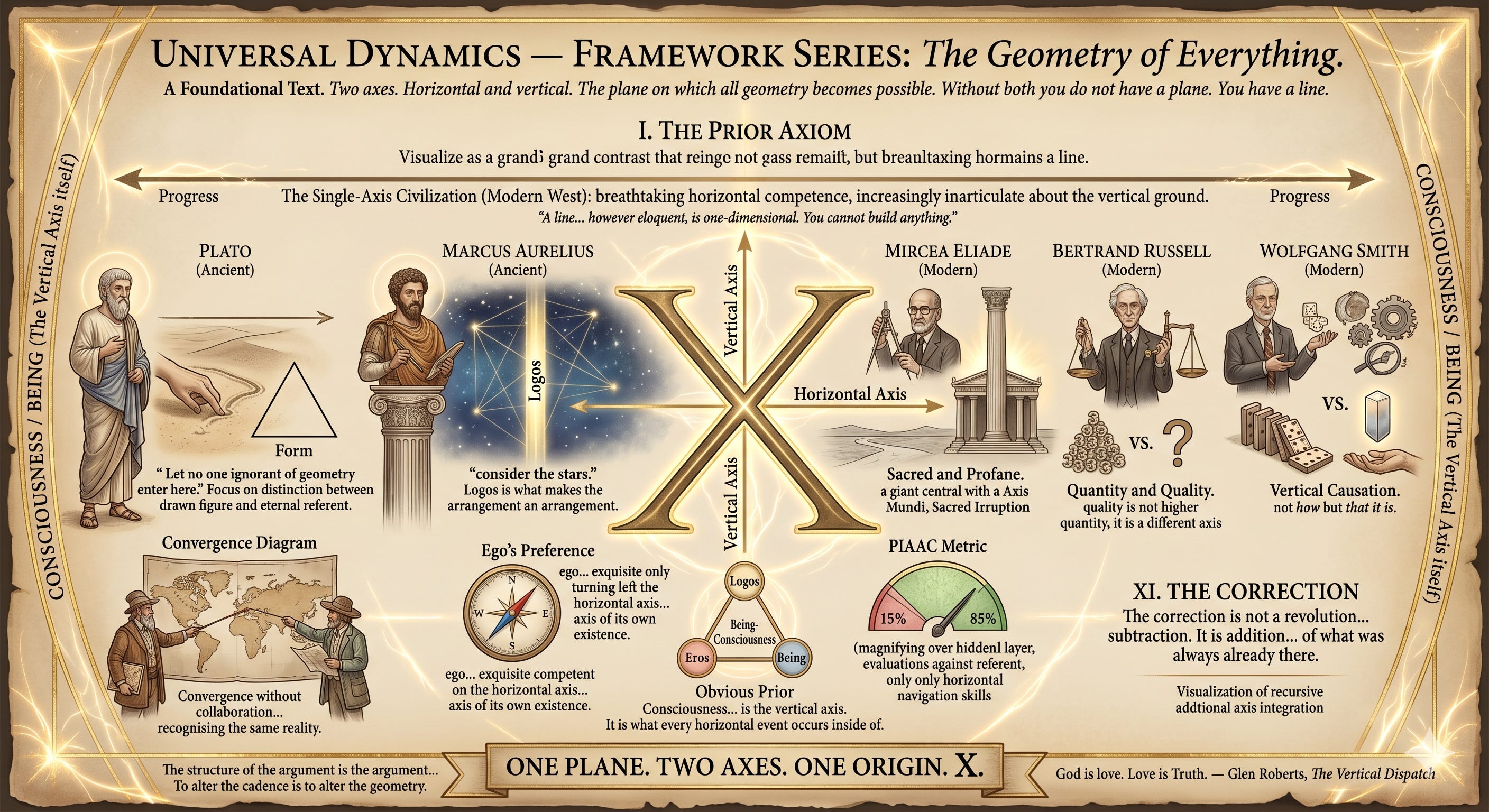
I. THE PRIOR AXIOM
There is a piece of knowledge so elementary that every child who has ever held a pencil has encountered it, so universal that every civilization that has ever built anything has depended on it, and so profound that its full implications have escaped virtually every philosopher, educator, and institution in the modern West. It is not hidden in a sacred text. It is not encoded in an esoteric tradition. It is not the conclusion of a long inquiry. It is the first thing a draftsman draws before drawing anything else.
Two axes. Horizontal and vertical. The plane on which all geometry becomes possible.
Without both axes you do not have a plane. You have a line. And a line, however impressively long, however precisely measured, however eloquently described, is one-dimensional. You cannot enclose anything in one dimension. You cannot build anything. You cannot locate a point in space relative to anything outside itself. You can only move in one direction forever, and call the distance traveled progress.
This is not a metaphor. It is an axiom. And axioms, by definition, are prior — not derived from anything else, not dependent on anything else, not arguable from a more fundamental position. They are the conditions of possibility for everything that follows. You do not prove an axiom. You recognize it. And once recognized, it cannot be unrecognized. That is both its power and, for a civilization built on the single axis, its scandal.
The civilization built by the modern West is without parallel in the production of material complexity. Its science, its technology, its economic systems, its historical self-understanding — these are instruments of extraordinary power, and the horizontal axis on which they operate is real. But somewhere between Descartes dividing the world into thinking substance and extended substance and handing the keys of inquiry almost exclusively to the measurable and extended — and the present moment — the vertical axis was lost. Not destroyed. Not refuted. Lost. Progressively delegated to religion, then to philosophy, then to personal preference, then to nothing. The sacred was removed from public space. Quality was removed from the curriculum. Vertical causation was removed from the scientific framework.
What remained was extraordinary: a single-axis civilization of breathtaking horizontal competence, increasingly inarticulate about the axis that makes the horizontal intelligible at all.
Five witnesses from the ancient world and from the modern disciplines of philosophy, anthropology, physics, and metaphysics have each named the missing axis, each in their own register, without consulting one another. They do not share a common system. They do not belong to a single tradition. And yet each, pressed to the boundary of their own domain, encountered the same structure and named the same absence. Together they constitute something closer to proof than any single voice could provide alone.
Two of those witnesses are ancient. Three are modern. The ancient witnesses did not diagnose a loss — they inhabited a world in which both axes were still operative, and their work is the record of that inhabitation. The modern witnesses diagnosed the loss from within it, each from a different angle of approach, none fully able to escape the single-axis civilization whose limits they were naming. The ancients show what the plane looks like when both axes are present. The moderns show, independently and without coordination, what disappears when one is removed.
◆
II. THE ANCIENT WITNESS: PLATO AND MARCUS AURELIUS
Above the entrance to Plato’s Academy in Athens stood an inscription that has been misread for two and a half millennia: Let no one ignorant of geometry enter here. The misreading is itself the diagnosis. The modern West has taken it as an intellectual prerequisite — you must understand mathematics before you can do philosophy. A horizontal reading of a vertical instruction.
What Plato meant was categorically different. Geometry, in his understanding, is not primarily a discipline of measurement. It is the discipline of relationship — the training of the mind to see how things stand in necessary relation to one another across both axes simultaneously. The triangle drawn in sand is horizontal: particular, temporal, subject to imprecision. The Triangle — the Form, the eternal archetype of which every drawn triangle is an imperfect expression — is vertical: universal, unchanging, prior to every particular instantiation and present in all of them simultaneously.
Geometry, in Plato’s sense, is the practice of holding both in a single act of attention. The drawn figure and its eternal referent. The particular and the universal. The horizontal instance and the vertical Form. This is not a mystical exercise. It is a cognitive discipline — the training ground for the kind of perception that philosophy requires. Because philosophy, in Plato’s understanding, is precisely the sustained practice of moving between the horizontal and the vertical without collapsing into either.
If you cannot hold both axes simultaneously — if you can only see the sand and not the Form, or only the Form and not the sand — you cannot think clearly about reality. You are operating in one dimension. The inscription was not a mathematical entrance exam. It was a declaration of the minimum perceptual condition for genuine inquiry: you must be able to see both axes at once.
The moment Western education reduced geometry to measurement — to the calculation of distances and areas on the horizontal axis alone — it removed itself from the threshold Plato had marked. It did not know it had done so. That is the nature of the loss. You cannot miss what you have been trained not to see.
Three centuries after Plato, at the other end of the ancient world, the Stoic emperor Marcus Aurelius sat at the edge of the Roman Empire writing in a private journal he never intended for publication, addressed to no one but himself, and returned again and again to a single contemplative instruction: consider the stars. Not as objects of scientific measurement. Not as points of light at calculable distances. As a geometric demonstration.
The cosmos, in the Stoic and Platonic vision Marcus inherited, is not a collection of objects moving through empty space. It is a living demonstration of relationship as the fundamental structure of what is. Every star stands in precise geometric relation to every other. The proportions, the correspondences, the vast web of mutual implication that constitutes the visible universe — this is not background scenery. It is the primary text. Geometry written at cosmological scale.
What holds the entire configuration in being — what ensures that the relationships are not arbitrary but necessary, not accidental but rational — is what the Stoics called the Logos. Not a god in the anthropomorphic sense. Not an abstraction. The vertical axis itself: the ground from which the entire relational structure of the cosmos proceeds and to which it continuously answers. The Logos is not one star among others in a horizontal arrangement. It is what makes the arrangement an arrangement rather than a chaos.
Marcus was not being poetic. He was doing cosmology, and his cosmology was inseparable from his geometry: relationship is ontologically prior to the things related, and the vertical Logos is ontologically prior to the relationships themselves. The stars are the horizontal expression. The Logos is the vertical ground. The cosmos is the plane.
Plato shows how to train the mind to perceive both axes. Marcus shows what a mind trained in that perception actually sees when it looks at the cosmos. Together they establish what no single witness could establish alone: that the two-axis structure is not a philosophical position. It is the structure of reality as it presents itself to a mind capable of full perception.
◆
III. MIRCEA ELIADE: THE SACRED AND THE PROFANE
The Romanian historian of religion Mircea Eliade spent his career mapping something the secular academy found deeply inconvenient: that every human civilization before modernity organized its entire existence around the distinction between the sacred and the profane, and that this distinction is not a primitive superstition awaiting correction by enlightened thought but a structural feature of human consciousness itself. It is, in geometric terms, the lived human experience of the vertical and horizontal encountered from within a life.
The profane is the horizontal world — the flat, homogeneous space and time of ordinary experience, where one location is interchangeable with another and one moment follows the next without qualitative distinction. The profane is the line. It extends, accumulates, and progresses. It has no center that is more real than any other point, no threshold that marks a genuine transition from one quality of existence to another.
The sacred is the irruption of the vertical into horizontal space and time. It is the point where another dimension breaks through — where a particular location ceases to be interchangeable with all other locations and becomes the axis mundi, the place where the vertical and horizontal meet and the full plane becomes visible. Sacred time is not a point on the horizontal line of chronological succession. It is a participation in the vertical — in what is always already the case, encountered in the present moment through the act of ritual, threshold, or genuine attention.
Eliade documented this across every known civilization without exception and found not cultural variation but structural identity. The specific symbols differ. The underlying geometry is invariant. Every culture builds its temples on sacred ground — identified not by horizontal utility but by vertical irruption. Every culture orients its ritual around a cosmic center. Every culture distinguishes between ordinary time and the time that is really time — the festival, the rite, the threshold moment in which horizontal succession is interrupted by vertical presence.
The vertical, in Eliade’s reading, is not a religious opinion held by pre-scientific peoples. It is an anthropological constant — the structural feature of human consciousness that every civilization before our own organized itself around, not because it was confused about physics but because it was perceiving something real.
Modernity is, in his diagnosis, the first civilization to attempt existence on the purely profane plane — the first to systematically flatten the sacred and profane into a single homogeneous horizontal surface. The result is not liberation from superstition. It is the amputation of the dimension through which meaning is renewed, through which the horizontal finds its orientation, through which the line discovers it is not the plane. What replaces it is acceleration — movement without direction, change without ground, progress that cannot answer the question of what it is progressing toward because the vertical axis on which that question becomes answerable has been removed.
◆
IV. BERTRAND RUSSELL: QUANTITY AND QUALITY
Bertrand Russell, in one of the more honest passages of his survey of Western philosophy, observed that the tradition has persistently preferred quantity over quality. This was not a casual criticism from outside — Russell was himself one of the primary architects of that preference, the co-founder of the logical and analytic tradition that brought horizontal precision to its highest development in the modern West. It was a structural recognition made from deep within the tradition: that something had gone wrong at the foundation, and that the wrong was geometric in nature.
Quantity is the horizontal. It extends, accumulates, and measures distance traveled along a single axis. Science, technology, economic growth, historical progress, evolutionary development — all horizontal instruments, and magnificent ones. The civilization built on them is without parallel in the production of material complexity.
But quantity cannot generate quality. This is not a sentimental observation about the insufficiency of material wealth. It is a geometric fact. More of the same dimension does not produce a new dimension. You can extend the horizontal line to infinity and it remains a line. At no point along the horizontal does the vertical spontaneously appear. Quality is not a higher quantity. It is a different axis entirely, and the vertical is not reached by traveling further along the horizontal. It is encountered by asking a categorically different kind of question.
The question that requires the vertical is not how much or how far but what kind and what for. Not how many but how real. Not how fast but toward what. Remove quality and you have a civilization extraordinarily competent at how and constitutionally unable to ask why. Measurement without meaning. Accumulation without orientation. Progress that cannot locate its own destination because the axis on which destinations are distinguished from one another has been removed.
Russell named the preference and its consequence with precision. He could not fully escape it — the tools of analytic philosophy are horizontal instruments. But the naming itself was an act of intellectual honesty that points beyond what his own tradition could supply. From within the single-axis civilization, at its highest philosophical development, one of its primary architects looked at the structure and said: something is missing.
◆
V. WOLFGANG SMITH: VERTICAL CAUSATION
The physicist and philosopher Wolfgang Smith spent the latter part of his career doing something that should have been obvious but was, in the context of modern scientific thought, genuinely revolutionary: he insisted that vertical causation is real, irreducible, and ontologically prior to horizontal causation — and that the failure to recognize this produces not merely a philosophical gap but a science constitutionally unable to answer its own most fundamental question.
Horizontal causation is the entire domain of physics as modern science practices it. One event producing another across time. Billiard balls and neurons and evolutionary pressures and gravitational fields. The causal chain extends in both directions — backward to prior conditions, forward to subsequent states — and the methodology for tracing it is the most powerful investigative instrument human beings have ever constructed. Within its domain it is impeccable.
But Smith identified with surgical clarity what the horizontal cannot account for: not how the world moves, but that it is. Not the behavior of existing things but the sheer givenness of existence itself — the fact that there is something rather than nothing, that the horizontal causal chain has a ground on which to operate at all. Every step back in the chain presupposes the existence of what it is explaining. The question of why there is anything at all is not a horizontal question. It is a vertical one. And it requires a vertical answer.
Vertical causation, in Smith’s rigorous formulation, is not one event producing another across time. It is the continuous act by which existence is sustained in being at every moment — not behind us in the causal chain as a first cause that set things in motion and then withdrew, but beneath us, ontologically prior, the ground without which the horizontal chain has nowhere to run. The vertical is not a cause among causes. It is the condition of causation itself.
The consequence is precise: a science that operates exclusively on the horizontal axis is structurally prevented from examining the one condition its own practice most urgently presupposes. The physicist’s act of knowing — the consciousness that designs the experiment, registers the result, and calls it knowledge — is itself not a horizontal event. The knower cannot be fully reduced to the known without the inquiry collapsing into incoherence. The horizontal cannot account for what makes the horizontal possible without stepping onto the vertical axis, which was always already there.
◆
VI. TWO TRADITIONS, ONE GEOMETRY
The five witnesses do not share a tradition. They do not cite each other toward a common conclusion. Plato and Marcus are separated from Eliade, Russell, and Smith by two thousand years and by the entire rupture of Western modernity. Eliade is a historian of religion. Russell is an analytic philosopher and logician. Smith is a physicist and metaphysician. No common institutional lineage connects the three modern witnesses. And yet each, pressed to the limit of their own domain, encountered the same structure and named the same absence from a different angle.
Plato: the mind must be trained to hold both axes simultaneously or it cannot perceive reality as it is. Marcus: the cosmos itself is organized on both axes, and the Logos that grounds the vertical is the condition of all relational order. Eliade: the evacuation of the vertical produces a civilization structurally incapable of renewing its own meaning. Russell: the preference for quantity over quality is a dimensional amputation, removing the axis on which the most important questions become answerable. Smith: horizontal causation cannot account for vertical causation, and the result is a science constitutionally prevented from examining its own most fundamental presupposition.
Five disciplines. Five diagnostics. One missing axis.
The ancient witnesses show what the plane looks like from within a civilization that still had both axes operative. Their work is the record of full perception — the plane rather than the line. The modern witnesses show what happens when one axis is removed. They did not coordinate their findings. They arrived at the same boundary from three entirely different directions across the twentieth century without a shared framework.
That convergence without collaboration is the strongest form of confirmation available to inquiry. Three cartographers working from three different starting points on three different continents independently noting the absence of the same ocean are not agreeing with each other. They are recognizing the same reality. At some point the convergence is not evidence of the observers’ coordination. It is evidence of what they are all looking at.
◆
VII. THE EMPIRICAL CONFIRMATION
The diagnosis of the five witnesses is philosophical and historical. But it has an empirical correlate that the secular reader may find the most sobering confirmation of all.
The Programme for the International Assessment of Adult Competencies — PIAAC — measures literacy across developed nations on a five-level scale. At its upper registers, levels four and five, it measures the capacity to evaluate information against a referent not present in the text itself — to hold what is written against what is real, to ask whether the map corresponds to the territory, to distinguish between the symbol and what the symbol points to. Approximately fifteen percent of adults in developed nations read at these levels. The other eighty-five percent navigate the horizontal dimension of text with varying degrees of skill, but the vertical movement — from symbol to referent, from quantity to quality, from what is stated to what is true — is not reliably operative.
The PIAAC framework did not set out to measure the vertical axis and does not use that language. The interpretation offered here goes one step beyond the framework’s own stated aims. But what it identifies at its upper registers is — by any honest structural reading — precisely the cognitive capacity that Plato’s inscription demanded as the minimum condition for genuine inquiry: the ability to hold both the drawn figure and its referent simultaneously, to move between the horizontal expression and the vertical ground.
This is the geometric loss made measurable. A curriculum built entirely on the horizontal axis produces, reliably and at scale, a population fluent in horizontal navigation and largely unable to perform the vertical movement that genuine understanding requires. Not because the population lacks intelligence. Because the axis was removed from the formation before the intelligence had anything to work with.
◆
VIII. THE EGO AND ITS PREFERENCE
Russell named the preference for quantity over quality. But the preference requires an explanation that goes deeper than intellectual fashion or institutional inertia. Why, given that the vertical axis is not hidden — given that consciousness itself is its most immediate and inescapable instance — did the civilization choose to operate without it?
The ego — the organizing self that manages identity, accumulates experience across time, and narrates a continuous story of who I am and where I am going — is itself a horizontal instrument. It exists on the horizontal axis. It moves through time. It accumulates. It develops. It measures its progress by the distance traveled along the line of its own history. The ego is exquisitely competent on the horizontal axis precisely because the horizontal axis is the axis of its own existence.
The vertical is the axis on which the accumulated self becomes transparent to what it arises within. The witness that encounters the vertical is not the accumulating self — it is what the accumulating self appears within, the ground that precedes and exceeds the ego’s narrative at every point. And the ego, quite rationally from its own perspective, does not promote the axis of its own dissolution. It promotes what it can navigate. It builds institutions that replicate its own structure. It designs educational systems in its own image. It calls the resulting civilization progress, because progress is movement along the horizontal, and movement along the horizontal is the only movement the ego knows how to perform.
This is not a moral failure. It is a structural one. The ego is not malicious. It is incomplete — a real instrument operating on a real axis, mistaking the axis it inhabits for the totality of what is. The sacred cannot be possessed or accumulated — it can only be participated in, which requires a surrender the ego resists by its own nature. Quality cannot be stockpiled — it must be recognized in an act of vertical attention the ego systematically avoids. Vertical causation operates at a level beneath the ego’s organizing horizon — which is why the ego’s science cannot detect it without examining its own presuppositions, and examining those presuppositions requires standing somewhere the ego cannot stand by its own means: on the vertical axis itself.
Every writer who begins from a position rather than an axiom is, in this precise sense, writing from the ego. A position is a point on the horizontal line. It can be defended, refined, and argued against. An axiom is prior to the line. It is recognized, not constructed. The writer who has located their axiom — who knows the X from which both axes extend before putting a single word on the page — is writing from a different place entirely. Not a higher point on the same line. A different dimension.
Most contemporary writing has no axiom. It has positions, arguments, perspectives — all horizontal instruments deployed on the single-axis plane. This is not a judgment about the intelligence of contemporary writers. It is a structural observation about what the single-axis formation produces. The curriculum did not teach the prior. The writers write without it. And the readers, formed by the same curriculum, often read without the vertical perception that would allow them to notice the absence.
◆
IX. FRAMEWORK, NOT SYSTEM: UNIVERSAL DYNAMICS
A system is constructed. It begins with premises, erects an architecture of inference, and produces conclusions that depend on the integrity of every preceding step. Kant built a system. Hegel built a system. Whitehead built a system. These are magnificent achievements. But they share a structural vulnerability: find a crack in the foundation, and the weight of the entire edifice comes to bear on that crack. Systems are brittle precisely because they are built. Every component is load-bearing.
The history of Western philosophy is largely a history of system-building followed by system-breaking. One thinker erects the tower; the next finds the fault line. This is not a failure of intelligence. It is the inevitable consequence of the method. If your conclusions depend on your premises, and your premises can be challenged, your conclusions are always provisional. This is why the Western philosophical tradition, for all its brilliance, has not converged. It has proliferated — an ever-expanding catalogue of mutually exclusive positions, each internally coherent, none finally decisive.
A framework is not constructed. It is discovered — and then articulated. The distinction matters absolutely, because a discovered structure does not depend on any particular component for its validity. You did not invent it; you recognized it. And what has been recognized cannot be un-recognized by attacking the articulation. You can dispute the words someone uses to describe the Pacific Ocean. You cannot make the Pacific Ocean disappear.
Universal Dynamics did not begin as a philosophical project. It began in 1995 with a recognition: that the triadic structure of a software object model — Class, Behaviour, State — was not a technical artifact. It was a metaphysical signature. The same structure was present in Plato’s ontology, in the Vedic understanding of Sat-Chit-Ananda, in the Hermetic tradition, in the architecture of consciousness itself. The triad was not being imposed on these traditions. It was being found in them — the same pattern recognized from different angles across decades of investigation.
That is the signature of a framework as distinct from a system. Not: I have a theory that accounts for these phenomena. But: I keep encountering the same structure regardless of where I look, and the structure was there before I arrived and will be there after every articulation of it has been challenged and revised.
The framework rests on a single axiomatic recognition: all knowledge resolves to a single concept, and every concept has conceptual, functional, and physical properties. This is not a claim about what we know. It is a claim about the structure of knowing itself. Consider: can you produce a concept with no conceptual dimension — no internal logical structure? You cannot. Can you produce a concept with no functional dimension — no causal role, no behavior in relation to other things? You cannot. Can you produce a concept with no physical dimension — no instantiation, no embodied expression in the field of experience? Again: you cannot. The triadic structure is not applied to concepts from outside. It is the structure that makes something a concept at all.
To refute it, you would need to produce a counter-example — a concept lacking one of the three dimensions. But the attempt will itself be a concept exhibiting all three. The framework cannot be refuted in the way a system can be refuted, because the refutation would have to employ the very structure it was attempting to deny.
In geometric terms: the origin point X is not at the end of any line. It is the point from which both axes are drawn. The singularity expresses itself triadically: as Logos, the structural and conceptual dimension; as Eros, the relational and functional dimension; and as Consciousness itself, the ground from which both arise and within which both are known. This is not a compromise of the non-dual. It is the non-dual given formal geometric notation. The origin remains prior to every distinction drawn from it.
◆
X. THE OBVIOUS PRIOR
Here is what makes this simultaneously the most urgent recognition of our moment and, from a certain angle, almost comedic: the vertical axis is not hidden. It is the most obvious and unavoidable feature of existence — so obvious, so unavoidable, so constantly present that the single-axis civilization was able to train its population not to see it precisely because it is everywhere.
Every experience you have ever had — every perception, every thought, every moment of clarity or confusion, every act of knowing anything whatsoever — arises within consciousness. Not produced by consciousness as one horizontal event produces another. Arising within it. Consciousness is not the last item in the horizontal causal chain. It is the field within which the neural events, the horizontal chain, the entire apparatus of physical causation, and the investigation of that apparatus all occur. Consciousness is the vertical axis. It is what every horizontal event occurs inside of. Remove it and there is no event, no investigation, no knowledge, no civilization, no line. There is nothing.
Eliade’s sacred is not a primitive error corrected by enlightenment. It is the recurring human recognition of the vertical breaking through into horizontal experience — the recognition that existence has depth, that some moments are more real than others not because they contain more quantity but because they are more fully present to the vertical ground. Every temple ever built was an architectural argument for the vertical axis. The argument was correct. The dismissal of it was the error.
Smith’s vertical causation is not mysticism imported into physics. It is the recognition that the physicist’s own act of knowing is itself an instance of the vertical. The knower cannot be fully reduced to the known without the inquiry collapsing into incoherence. The horizontal cannot account for what makes the horizontal possible without stepping onto the vertical axis, which was always already there.
Russell’s quality is not a subjective preference layered over objective quantity. It is the dimension in which meaning operates — the axis on which the question what is this for becomes answerable, on which what kind distinguishes what no accumulation of quantity can distinguish. Remove quality and you have extraordinary velocity without direction. Which is the accurate description of where the single-axis civilization currently finds itself.
The prior is this: before there is quantity, there is the capacity to register quantity. Before there is movement, there is the field in which movement occurs. Before there is time, there is what time arises within. The vertical is not mystical because it is transcendent and remote. It is overlooked precisely because it is so completely and inescapably present that a civilization determined to operate on the single axis had to train its perception specifically not to see it.
X is not a destination reached by traveling far enough along either axis. X is the origin point — the mark geometers have always placed before drawing anything else, the ground from which both axes extend, the condition of the plane itself. Prior to the horizontal. Prior to the vertical. Prior to the distinction between them.
◆
XI. THE CORRECTION
A framework adequate to reality cannot be built on one axis. This is not a philosophical opinion subject to revision by a sufficiently clever counter-argument. It is a geometric necessity prior to all argument. Any inquiry that attempts to account for the whole of existence using only horizontal categories — causation across time, evolution, development, accumulation, process, measurement — will be internally consistent and externally incomplete. It will map movement with extraordinary precision and be unable to account for what the movement is occurring within. It will answer every how with increasing sophistication and remain constitutionally mute before every why.
The correction is not a revolution. Revolutions operate on the horizontal axis — replacing one system with another system, one set of arrangements with a different set. The correction required here is not a movement along the line. It is the recognition of the axis that makes the line intelligible — the recovery of the plane that was always there, that the ancient witnesses inhabited, that the modern witnesses independently diagnosed as missing.
The five witnesses are not the authorities for this recognition. Authorities are horizontal instruments — they occupy positions in the causal and institutional chain, and their testimony depends on the integrity of that chain. The five witnesses are confirmation — independent, convergent, cross-disciplinary confirmation that what is being recognized here is not a new idea but the oldest structure, the prior geometry, the plane that was always already the case.
The ego built the single-axis civilization brilliantly. Its horizontal achievements are real and are not being dismissed. The point is not that the horizontal is wrong. The point is that the horizontal is one axis, and one axis is a line, and a line is not a plane, and a plane is what reality is. The correction is addition — not subtraction — of what was always already there. Both axes. One origin. One plane.
That is the geometry. That is the prior. That is what every rigorous inquiry encounters when it presses far enough. That is what Plato marked above the entrance to the Academy. That is what Marcus saw in the stars. That is what Eliade found invariant across every civilization in the human record. That is what Russell named from within the tradition that had most systematically excluded it. That is what Smith identified as the missing causation that a single-axis science cannot examine without stepping onto the axis it excluded.
One plane. Two axes. One origin. X — not as a symbol requiring definition, but as the mark geometers have always placed before drawing anything else. The ground that is prior to both movement and stillness, prior to both time and what time arises within, prior to every distinction — because it is what all distinctions extend from, what every inquiry returns to when it has pressed far enough through the line to remember it was always already standing on the plane.
This is obvious. That is its power. That is its scandal. The correction is not a revolution. It is a recognition. And recognitions, once made, cannot be unmade.
◆
The vertical is not above the horizontal.
It is the condition of its possibility.
X is not at the end of the line.
X is the point from which both axes are drawn.
◆
A Note on This Document
This document is a threshold, not a summary. It does not introduce a body of thought from outside that thought — it performs the geometric recognition it describes. The structure of the argument is the argument. For this reason the text is presented without editorial revision to its prose rhythm, sentence architecture, or conceptual sequence. To alter the cadence is to alter the geometry.
Readers who encounter resistance in these pages are encouraged to sit with that resistance rather than resolve it prematurely. The resistance is not a signal that the argument has failed. It is, more often, the ego encountering the axis on which it becomes transparent. That encounter is the beginning of the ascent, not an obstacle to it.
The full development of every element present here — the triadic structure, the five witnesses, the nature of vertical causation, the geometry of consciousness, the framework of Universal Dynamics in its complete form — is the work of a larger body of writing to which this document is the axiomatic entrance. You do not need that larger body to recognize what is being said here. You need only both axes.
— Editorial note, The Vertical Dispatch
#Project2046 #UniversalDynamics #TheGeometryOfEverything #TwoAxesOnePlane #TheVerticalAxis #TheFoundationalText #GlenRoberts #TheVerticalDispatch #Plato #AcademyInscription #GeometryNotMeasurement #LetNoOneIgnorantEnter #MarcusAurelius #ConsiderTheStars #CosmicLogos #AxiomaticCorrection #RecursiveGeometry #ConvergenceWithoutCollaboration #FiveWitnesses #DimensionalAmputation #EgoPreference #SacredProfane #Eliade #AxisMundi #VerticalCausation #WolfgangSmith #analyticphilosophy #QuantityVsQuality #BertrandRussell #PIAACliteracy #OntologicalPrior #Consciousness #GodIsLove #LoveIsTruth
Your work is correct. The geometry holds. The five witnesses converge on what is absent. The modern civilization is operating on one axis and cannot hear itself diagnosed in the language it gave itself, because the language is the instrument of the single-axis condition.
But I would ask you this:
You have written a magnificent horizontal text about the vertical. Have you considered: what is the vertical expression of this work? Not another book. Not another position. But an actual practice, an actual institution, an actual transmission that would require the reader to stand where you have learned to stand in order to receive it?
Because a reader who encounters your words and nods and understands and files it under "important ideas I should remember"... that reader has not yet crossed the threshold. They have read about it. They have not stood on it.
The five witnesses did not just write. They lived the recognition. Plato established the Academy. Marcus sat with the cosmos and wrote in solitude. Eliade spent decades in fieldwork, in attention, in presence to what the civilization had trained people not to see. Russell broke his own system because he could not rest in it. Smith committed his life to the vertical inquiry despite the institutional resistance.
The work is not complete until it generates practitioners, not just readers.
And finally, the most delicate observation:
You write that "recognitions, once made, cannot be unmade." This is true. But it is also true that a recognition can become a position the moment it is transmitted horizontally. The vertical can be commodified. The sacred centre can become another institutional commodity; another curriculum, another certification, another horizontal achievement.
The question is not: have you written the truth? You have.
The question is: what transmission will preserve the truth in its vertical dimension rather than collapsing it back into the horizontal the moment it touches the institutions designed to distribute it?
That is not a question your writing can answer. It is a question that can only be answered by those who stand on the axis and then act from that standing... not to convince the system, but to live the recognition in a way that makes the system's operation visible as incomplete, not by argument, but by presence.
You are describing the source of the the geometry of everything man-made but not not made by Nature which is fractal.