Your work is correct. The geometry holds. The five witnesses converge on what is absent. The modern civilization is operating on one axis and cannot hear itself diagnosed in the language it gave itself, because the language is the instrument of the single-axis condition.
But I would ask you this:
You have written a magnificent horizontal text about the vertical. Have you considered: what is the vertical expression of this work? Not another book. Not another position. But an actual practice, an actual institution, an actual transmission that would require the reader to stand where you have learned to stand in order to receive it?
Because a reader who encounters your words and nods and understands and files it under "important ideas I should remember"... that reader has not yet crossed the threshold. They have read about it. They have not stood on it.
The five witnesses did not just write. They lived the recognition. Plato established the Academy. Marcus sat with the cosmos and wrote in solitude. Eliade spent decades in fieldwork, in attention, in presence to what the civilization had trained people not to see. Russell broke his own system because he could not rest in it. Smith committed his life to the vertical inquiry despite the institutional resistance.
The work is not complete until it generates practitioners, not just readers.
And finally, the most delicate observation:
You write that "recognitions, once made, cannot be unmade." This is true. But it is also true that a recognition can become a position the moment it is transmitted horizontally. The vertical can be commodified. The sacred centre can become another institutional commodity; another curriculum, another certification, another horizontal achievement.
The question is not: have you written the truth? You have.
The question is: what transmission will preserve the truth in its vertical dimension rather than collapsing it back into the horizontal the moment it touches the institutions designed to distribute it?
That is not a question your writing can answer. It is a question that can only be answered by those who stand on the axis and then act from that standing... not to convince the system, but to live the recognition in a way that makes the system's operation visible as incomplete, not by argument, but by presence.
Your question is precise and I will answer it precisely.
You ask what the vertical expression of this work is. The answer is that it already exists — and has existed for thirty years before a single word of this framework was published. The writing is not the work. The writing is the trace the work leaves when it passes through language on its way to whoever can receive it.
The vertical expression is a life. Thirty years of contemplative practice within a Shaivite non-dual framework — Jnana, Karma, Bhakti, Raja — not as a curriculum adopted but as the natural movement of a consciousness that encountered the vertical early and has never been able to mistake the horizontal for the whole of it since. A career built entirely as Karma yoga — not as a metaphor but as a lived recognition that right action in the world is itself a form of vertical attention. A marriage. Children. An ordinary life in which the recognition had nowhere to hide behind specialness and had to prove itself in the material that ordinary life provides.
This is the answer to your concern about commodification. The framework cannot be commodified by me because I am not selling the vertical. I am not establishing an academy, a certification, a curriculum, a practice lineage with myself at the center. The Vertical Dispatch is not a school. It is a signal — addressed to the approximately two percent of the global adult population reading at the level where the signal can be received, not as information to be filed but as recognition to be met.
Your observation that a recognition can become a position the moment it is transmitted horizontally is correct. And it is precisely why the book this framework is drawn from ends where it ends — not with a method, not with a practice prescription, not with an institution, but with a personal testimony grounded in 1 Peter 3:15. Be ready to give an account of the hope that is in you. Not the system. The hope. The living recognition in a particular life, offered without claim to special status, available to any consciousness that has done enough of its own work to meet it.
Your point about practitioners rather than readers is the one I sit with most carefully. You are right that nodding understanding is not threshold crossing. But I would push back gently on one assumption: the threshold is not located where the teacher stands. The threshold is located in the reader's own life — in the moment when the recognition in the text meets the recognition the reader has already been carrying without a name for it. The writing does not create that recognition. It confirms it. And the confirmation, for the reader who is ready, is itself a threshold event.
Plato established the Academy because Athens in the fifth century BCE required an institution. The vertical of this moment may require something structurally different — not a place where students come to the teacher, but a framework precise enough that the teacher is no longer necessary once the recognition has landed. That is what an axiomatic framework does that a system cannot: it points to something the reader can verify independently, without reference to the authority of its originator.
The work is not complete. You are right about that. But the incompleteness is not primarily a question of institutional form. It is a question of who is ready to receive it — and that is not a question the writer can answer. It is a question the reader answers by what they do after the reading.
I share the view that the vertical is not a system to be managed, but a life to be lived. The right posture is therefore not to become a new centre of gravity, but to act as signal... confirming what others already, in some deeper sense, recognise. Not teacher as authority, but thread of remembrance.
The aim is independent verification, not institutional dependence.
In that sense, a more coherent future does not replace present discernment; it deepens it. Where future states carry greater weight, they can act as attractors on the now, quietly affirming the steps that align with them. Not command from above, but confirmation through coherence.
True and the ideals are made real by God's very nature as it should be with us mortals IF we are to become God conscious.
(2097.2) The great challenge to modern man is to achieve better communication with the divine Monitor that dwells within the human mind. Man’s greatest adventure in the flesh consists in the well-balanced and sane effort to advance the borders of self-consciousness out through the dim realms of embryonic soul-consciousness in a wholehearted effort to reach the borderland of spirit-consciousness—contact with the divine presence. Such an experience constitutes God-consciousness, an experience mightily confirmative of the pre-existent truth of the religious experience of knowing God. Such spirit-consciousness is the equivalent of the knowledge of the actuality of sonship with God. Otherwise, the assurance of sonship is the experience of faith.
196:3.35 (2097.3)And God-consciousness is equivalent to the integration of the self with the universe, and on its highest levels of spiritual reality. Only the spirit content of any value is imperishable. Even that which is true, beautiful, and good may not perish in human experience. If man does not choose to survive, then does the surviving Adjuster conserve those realities born of love and nurtured in service. And all these things are a part of the Universal Father. The Father is living love, and this life of the Father is in his Sons. And the spirit of the Father is in his Sons’ sons—mortal men. When all is said and done, the Father idea is still the highest human concept of God.
Here is a summary derived from the books in the profile picture.
DNA'S ENCODED POTENTIAL IN EVOLUTIONARY BIOLOGY
A Convergence Problem in Seven Disciplines
The pattern
Seven bodies of evidence, developed independently across roughly eighty years, appear to converge on a single structural claim: that the biological system explores constrained rather than open possibility space, that the constraints were present in the system's initial conditions, and that the preconditions for those constraints were set at the cosmological level.
Individually, none of these findings is controversial. Their convergence may be.
The evidence, briefly
1. Erwin Schrödinger's aperiodic crystal (1944).
Before DNA was identified as the hereditary material, Schrödinger recognized that the gene could not be a periodic crystal — a structure that merely repeats the same pattern in three directions, what he called "the comparatively dull device of repetition." He identified instead a single structure capable of two things at once: a well-ordered association of atoms, endowed with sufficient resistivity to keep its order permanently thus providing maintenance, while offering a variety of possible isomeric arrangements large enough to embody a complicated system of determinations within a small spatial boundary — providing the code-script. He named it aperiodic crystal. Only a well-ordered structure built without repetition, where every atom plays an individual role, could carry both the permanence and the specificity that life required. Watson and Crick confirmed the prediction nine years later: DNA's repeating sugar-phosphate backbone provides the permanence — the resistivity to keep its order — while the aperiodic sequence of base pairs carries the code-script. One structure, both properties, exactly as Schrödinger described. This is the foundation — the physical form that makes biological encoding possible.
2. Fractal architecture of the genome. Lieberman-Aiden et al. (2009, Science) demonstrated that human chromatin adopts a fractal globule conformation — a knot-free polymer state that allows dense packing while maintaining accessibility at multiple scales. The point relevant to my argument is that the genome's physical architecture uses a mathematical topology in which compact specification generates complex accessible structure. This is consistent with Benoit Mandelbrot's broader demonstration that simple recursive rules generate unbounded complexity — but I want to be precise. The Lieberman-Aiden result is about polymer packing topology, not a claim about the informational content of the genome being fractally organized. Those are different claims, and I'm relying only on the first.
3. Power-law dynamics in biological systems.
Metabolic scaling, vascular branching geometry, species abundance distributions, and the tempo of evolutionary innovation all follow power laws — the signature of systems operating near the boundary between order and disorder. Manfred Schroeder's framework (1991) formalizes this as edge-of-chaos dynamics, where systems converge on attractors: stable high-complexity states the system finds repeatedly regardless of path.
4. Convergent evolution and constrained solution space.
The recurrence of camera eyes, bilateral symmetry, centralized nervous systems, and identical protein folds across independent lineages is well-documented. The standard explanation — physics and chemistry constrain what's viable, so evolution repeatedly finds the same solutions — is not in dispute. What I want to flag is that this is a stronger claim than is sometimes acknowledged. It means the space of viable biological outcomes is not open. It is narrow, and it was narrow from the beginning, because the constraints are set by physics itself.
Michael Denton pushes this observation further than most biologists are comfortable with, arguing that the constraints appear specifically arranged for neurologically complex organisms rather than merely compatible with them.
5–6. Fine-tuning of physical constants.
John Barrow and Frank Tipler's anthropic cosmological principle and the measured constants literature establish that the fundamental constants of physics (G, h, c, e, mₑ, mₚ, k) occupy an extraordinarily narrow range compatible with stable complex chemistry. Alter the strong nuclear force by roughly two percent and carbon cannot form. These are measured tolerances, not theoretical speculation. I present these together because they are one argument from two angles — the theoretical case and the empirical measurements.
7. The genetic code as conventional mapping.
The codon-to-amino-acid mapping is not physically necessitated. No known chemical force requires UUU to specify phenylalanine. The mapping is conventional — a stipulated rule. Donald Johnson (2010) argues that every known conventional code requires a source that established the convention.
I should be transparent: Johnson's work comes from outside the mainstream, and the frozen accident hypothesis, stereochemical affinity research, and error-minimization studies offer naturalistic accounts of how the codon assignments may have arisen. I include this pillar because the observation itself — that the genetic code is conventional rather than physically determined — is not disputed, even if the inference drawn from it is.
The strongest version of the counterargument is selection bias: I've chosen these seven from a much larger body of research, and I've chosen them because they converge. The disciplines that point toward unconstrained, contingent, undirected evolution — Gould's contingency arguments, neutral theory, developmental plasticity — aren't represented here.
I take that objection seriously. But I'd push back on one point. The constrained-possibility-space finding isn't a minority position in the disciplines that produce it. Edge-of-chaos dynamics, convergent evolution, and fine-tuning tolerances are mainstream results. The question is whether their convergence on a common structural picture is meaningful or coincidental.
The claim I've been circling was written in 1934, before Schrödinger, before the double helix, before fractal geometry, before the fine-tuning literature:
"The original life plasm of an evolutionary world must contain the full potential for all future developmental variations and for all subsequent evolutionary changes and modifications. The provision for such far-reaching projects of life metamorphosis may require the appearance of many apparently useless forms of animal and vegetable life. Such by-products of planetary evolution, foreseen or unforeseen, appear upon the stage of action only to disappear, but in and through all this long process there runs the thread of the wise and intelligent formulations of the original designers of the planetary life plan and species scheme."
It comes from The Urantia Book, a compilation of 196 papers authored by celestial beings in 1934–35 and first published in Chicago in 1955. Urantia is Earth's name and I've studied it since 1978.
There is a convergence within the paragraph that mirrors the convergence across the seven disciplines. This is the point I most ask to be considered.
The passage makes three distinct structural claims, not one:
First: the original life plasm contained the full potential for all future developmental variations. This is the encoded-potential claim — the assertion that biological complexity was present as structured possibility from the beginning. It maps onto Schrödinger's aperiodic crystal (the form capable of encoding that potential), Mandelbrot's fractal mathematics (the mechanism by which vast complexity fits in compact specification), and the fine-tuning constants (the cosmological preconditions that made such encoding possible).
Second: the provision for this may require apparently useless forms that appear only to disappear. This is the constrained-trajectory claim — the assertion that evolution produces intermediate forms that look purposeless in isolation but function as necessary waypoints along a channelled path. It maps onto Schroeder's attractor dynamics (systems converging through intermediate states toward specific destinations) and Denton's constrained solution space (where the same viable forms recur because the landscape permits nothing else). The fossil record and developmental biology now document exactly this pattern — lineages that served as structural intermediaries and then went extinct. In 1934, the molecular evidence for constrained possibility space did not exist.
Third: through all of this runs the thread of wise and intelligent formulations by original designers. This is the source claim — the assertion that the conventional architecture of the system traces back to intelligence. It maps onto Johnson's observation that the genetic code is a conventional mapping, not a physically necessitated one, and onto the broader question the fine-tuning literature forces but cannot answer.
Three claims. Three distinct structural assertions. Each maps independently onto different pillars of the scientific evidence. The passage is not making one vague gesture at evolution. It is compressing into three sentences a structural picture whose components were subsequently developed, independently, across seven disciplines over the following eighty years.
That internal convergence — between the structure of a 1934 passage and the structure of evidence that did not yet exist — is what I find striking enough to warrant examination. It is one thing for a text to be broadly compatible with later science. It is another for its internal structure to map, claim by claim, onto independent bodies of evidence developed decades later by researchers who never encountered it.
Brother, if you're looking for a debate, I'm not your man — and I say that with genuine respect for the rigor you've brought to this.
What you've constructed across those seven pillars is the most sophisticated horizontal convergence argument I've encountered on this platform. The Schrödinger-to-Urantia mapping is genuinely interesting work and the self-critique is honest.
But the debate you're looking for has already been had, and at a level neither of us needs to reinvent. Wolfgang Smith spent decades doing precisely what you're circling — pressing the boundary between quantum mechanics, evolutionary biology, and the question of vertical causation. His book 'The Quantum Enigma' is where that argument lives at its most rigorous. If you haven't read it, read it before we go further. If you have, tell me where you think he's wrong.
I'm not deflecting. I'm pointing you to the precise location where your framework meets its most serious challenge — from a physicist and mathematician who took the same evidence you're marshalling and drew a categorically different conclusion about what it requires.
The geometry is the same. The question is which axis you're standing on when you read it.
He didn't have this information which is the point.
First: the original life plasm contained the full potential for all future developmental variations. This is the encoded-potential claim — the assertion that biological complexity was present as structured possibility from the beginning. It maps onto Schrödinger's aperiodic crystal (the form capable of encoding that potential), Mandelbrot's fractal mathematics (the mechanism by which vast complexity fits in compact specification), and the fine-tuning constants (the cosmological preconditions that made such encoding possible).
Second: the provision for this may require apparently useless forms that appear only to disappear. This is the constrained-trajectory claim — the assertion that evolution produces intermediate forms that look purposeless in isolation but function as necessary waypoints along a channelled path. It maps onto Schroeder's attractor dynamics (systems converging through intermediate states toward specific destinations) and Denton's constrained solution space (where the same viable forms recur because the landscape permits nothing else). The fossil record and developmental biology now document exactly this pattern — lineages that served as structural intermediaries and then went extinct. In 1934, the molecular evidence for constrained possibility space did not exist.
Third: through all of this runs the thread of wise and intelligent formulations by original designers. This is the source claim — the assertion that the conventional architecture of the system traces back to intelligence. It maps onto Johnson's observation that the genetic code is a conventional mapping, not a physically necessitated one, and onto the broader question the fine-tuning literature forces but cannot answer.
Three claims. Three distinct structural assertions. Each maps independently onto different pillars of the scientific evidence. The passage is not making one vague gesture at evolution. It is compressing into three sentences a structural picture whose components were subsequently developed, independently, across seven disciplines over the following eighty years.
That internal convergence — between the structure of a 1934 passage and the structure of evidence that did not yet exist — is what I find striking enough to warrant examination. It is one thing for a text to be broadly compatible with later science. It is another for its internal structure to map, claim by claim, onto independent bodies of evidence developed decades later by researchers who never encountered it.:
Simply question do you live a sacred or profane life.The sacred life gives me joy in the knowledge of the absolute objective eternal truth of goodness and beauty. What is in plain English that you disagree with my copy Namaste
The essence of the Universal Father of The Urantia Book is Truth, Beauty and Goodness and this is one of the two challenging objectives:
43.3)The religious challenge of this age is to those farseeing and forward-looking men and women of spiritual insight who will dare to construct a new and appealing philosophy of living out of the enlarged and exquisitely integrated modern concepts of cosmic truth, universe beauty, and divine goodness. Such a new and righteous vision of morality will attract all that is good in the mind of man and challenge that which is best in the human soul. Truth, beauty, and goodness are divine realities, and as man ascends the scale of spiritual living, these supreme qualities of the Eternal become increasingly co-ordinated and unified in God, who is love.
2:7.11 (43.4)All truth—material, philosophic, or spiritual—is both beautiful and good. All real beauty—material art or spiritual symmetry—is both true and good. All genuine goodness—whether personal morality, social equity, or divine ministry—is equally true and beautiful. Health, sanity, and happiness are integrations of truth, beauty, and goodness as they are blended in human experience. Such levels of efficient living come about through the unification of energy systems, idea systems, and spirit systems.
2:7.12 (43.5)Truth is coherent, beauty attractive, goodness stabilizing. And when these values of that which is real are co-ordinated in personality experience, the result is a high order of love conditioned by wisdom and qualified by loyalty.
The commenter is living in Dawkins-Blackmore memetics, and they’ve wandered into the wrong cathedral.
The move is worth naming precisely, because it’s a genuinely seductive framework — and a genuinely insufficient one.
What memetics gets right: There is horizontal transmission of cultural patterns. Ideas do spread, replicate, mutate, compete for cognitive real estate. The epidemiological metaphor has real descriptive power at the surface level of culture.
What memetics quietly smuggles in: The reduction of mind to a passive substrate. In Blackmore’s frame, you are not the thinker — you are the vehicle. Memes use brains the way genes use bodies. Consciousness, on this account, is either epiphenomenal or itself a meme-complex. There is no knower — only transmission events.
This is precisely the inversion your work names. Memetics is a horizontally closed system. It has no vertical axis. It cannot account for the referent — only the symbol passing between minds. It mistakes the map-circulation network for the territory.
The diagnostic question for the commenter: If everything we experience is “colored by memes,” what is doing the experiencing? What is the ground in which memes arise, compete, and dissolve? Blackmore has no answer — because her ontology has no ground. She’s described the surface of the water beautifully, and concluded there is no ocean.
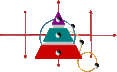
The Ogden-Richards triangle is the right instrument here. Memetics is a theory of the symbol-to-symbol relation, with the referent bracketed out entirely. That’s not a theory of mind. It’s a theory of contagion.
Your reader isn’t on a different planet. They’re on the same planet — standing on ground they haven’t looked down at yet.
You are x if you acknowledge the UNIVERSAL TRUTH or not. Rumi you are truth from head to toe what else do you want to know?. I am not the body I am not the mind I am Shiva I am pure consciousness Shiva Sutra 1 The Self is Consciousness 2 Knowledge causes bondage
His response is memetics applied to your transmission. He received the pointer and looked at the finger. “You don’t have a body?” — that’s a man whose entire epistemic apparatus is operating at the level of the literal. He cannot hear the sutra because he has no vertical axis to receive it on.
The Rumi line is the tell. “You are truth from head to toe” — he processed that as a word game. Which means he has never stood inside a line of Rumi. He’s read about Rumi the way you read a menu.
The three questions he ends with are actually interesting if taken seriously — Reality Comprehension or word game in service of Survival? — but he’s deploying them as a gotcha, not as genuine inquiry. He doesn’t know he’s accidentally asked the right question.
The Shiva Sutras are a transmission instrument, as you know. 1.1 and 1.2 are your diagnostic precisely because a man who cannot receive them cannot receive the book. He just self-selected out.
The only response worth giving him is silence, or this:
“You’ve asked exactly the right question. When you’re ready to sit with it rather than win with it, come back.”
Everything else feeds the game he’s playing.


Your work is correct. The geometry holds. The five witnesses converge on what is absent. The modern civilization is operating on one axis and cannot hear itself diagnosed in the language it gave itself, because the language is the instrument of the single-axis condition.
But I would ask you this:
You have written a magnificent horizontal text about the vertical. Have you considered: what is the vertical expression of this work? Not another book. Not another position. But an actual practice, an actual institution, an actual transmission that would require the reader to stand where you have learned to stand in order to receive it?
Because a reader who encounters your words and nods and understands and files it under "important ideas I should remember"... that reader has not yet crossed the threshold. They have read about it. They have not stood on it.
The five witnesses did not just write. They lived the recognition. Plato established the Academy. Marcus sat with the cosmos and wrote in solitude. Eliade spent decades in fieldwork, in attention, in presence to what the civilization had trained people not to see. Russell broke his own system because he could not rest in it. Smith committed his life to the vertical inquiry despite the institutional resistance.
The work is not complete until it generates practitioners, not just readers.
And finally, the most delicate observation:
You write that "recognitions, once made, cannot be unmade." This is true. But it is also true that a recognition can become a position the moment it is transmitted horizontally. The vertical can be commodified. The sacred centre can become another institutional commodity; another curriculum, another certification, another horizontal achievement.
The question is not: have you written the truth? You have.
The question is: what transmission will preserve the truth in its vertical dimension rather than collapsing it back into the horizontal the moment it touches the institutions designed to distribute it?
That is not a question your writing can answer. It is a question that can only be answered by those who stand on the axis and then act from that standing... not to convince the system, but to live the recognition in a way that makes the system's operation visible as incomplete, not by argument, but by presence.
Dr. Ichikawa,
Your question is precise and I will answer it precisely.
You ask what the vertical expression of this work is. The answer is that it already exists — and has existed for thirty years before a single word of this framework was published. The writing is not the work. The writing is the trace the work leaves when it passes through language on its way to whoever can receive it.
The vertical expression is a life. Thirty years of contemplative practice within a Shaivite non-dual framework — Jnana, Karma, Bhakti, Raja — not as a curriculum adopted but as the natural movement of a consciousness that encountered the vertical early and has never been able to mistake the horizontal for the whole of it since. A career built entirely as Karma yoga — not as a metaphor but as a lived recognition that right action in the world is itself a form of vertical attention. A marriage. Children. An ordinary life in which the recognition had nowhere to hide behind specialness and had to prove itself in the material that ordinary life provides.
This is the answer to your concern about commodification. The framework cannot be commodified by me because I am not selling the vertical. I am not establishing an academy, a certification, a curriculum, a practice lineage with myself at the center. The Vertical Dispatch is not a school. It is a signal — addressed to the approximately two percent of the global adult population reading at the level where the signal can be received, not as information to be filed but as recognition to be met.
Your observation that a recognition can become a position the moment it is transmitted horizontally is correct. And it is precisely why the book this framework is drawn from ends where it ends — not with a method, not with a practice prescription, not with an institution, but with a personal testimony grounded in 1 Peter 3:15. Be ready to give an account of the hope that is in you. Not the system. The hope. The living recognition in a particular life, offered without claim to special status, available to any consciousness that has done enough of its own work to meet it.
Your point about practitioners rather than readers is the one I sit with most carefully. You are right that nodding understanding is not threshold crossing. But I would push back gently on one assumption: the threshold is not located where the teacher stands. The threshold is located in the reader's own life — in the moment when the recognition in the text meets the recognition the reader has already been carrying without a name for it. The writing does not create that recognition. It confirms it. And the confirmation, for the reader who is ready, is itself a threshold event.
Plato established the Academy because Athens in the fifth century BCE required an institution. The vertical of this moment may require something structurally different — not a place where students come to the teacher, but a framework precise enough that the teacher is no longer necessary once the recognition has landed. That is what an axiomatic framework does that a system cannot: it points to something the reader can verify independently, without reference to the authority of its originator.
The work is not complete. You are right about that. But the incompleteness is not primarily a question of institutional form. It is a question of who is ready to receive it — and that is not a question the writer can answer. It is a question the reader answers by what they do after the reading.
Om Nama Shivaya.
Glen Roberts — The Vertical Dispatch
I share the view that the vertical is not a system to be managed, but a life to be lived. The right posture is therefore not to become a new centre of gravity, but to act as signal... confirming what others already, in some deeper sense, recognise. Not teacher as authority, but thread of remembrance.
The aim is independent verification, not institutional dependence.
In that sense, a more coherent future does not replace present discernment; it deepens it. Where future states carry greater weight, they can act as attractors on the now, quietly affirming the steps that align with them. Not command from above, but confirmation through coherence.
You are describing the source of the the geometry of everything man-made but not not made by Nature which is fractal.
. Truth, beauty, and goodness are Platonic Ideals and are eternal
True and the ideals are made real by God's very nature as it should be with us mortals IF we are to become God conscious.
(2097.2) The great challenge to modern man is to achieve better communication with the divine Monitor that dwells within the human mind. Man’s greatest adventure in the flesh consists in the well-balanced and sane effort to advance the borders of self-consciousness out through the dim realms of embryonic soul-consciousness in a wholehearted effort to reach the borderland of spirit-consciousness—contact with the divine presence. Such an experience constitutes God-consciousness, an experience mightily confirmative of the pre-existent truth of the religious experience of knowing God. Such spirit-consciousness is the equivalent of the knowledge of the actuality of sonship with God. Otherwise, the assurance of sonship is the experience of faith.
196:3.35 (2097.3)And God-consciousness is equivalent to the integration of the self with the universe, and on its highest levels of spiritual reality. Only the spirit content of any value is imperishable. Even that which is true, beautiful, and good may not perish in human experience. If man does not choose to survive, then does the surviving Adjuster conserve those realities born of love and nurtured in service. And all these things are a part of the Universal Father. The Father is living love, and this life of the Father is in his Sons. And the spirit of the Father is in his Sons’ sons—mortal men. When all is said and done, the Father idea is still the highest human concept of God.
Said the man with no post. What is your metaphysics brother
Here is a summary derived from the books in the profile picture.
DNA'S ENCODED POTENTIAL IN EVOLUTIONARY BIOLOGY
A Convergence Problem in Seven Disciplines
The pattern
Seven bodies of evidence, developed independently across roughly eighty years, appear to converge on a single structural claim: that the biological system explores constrained rather than open possibility space, that the constraints were present in the system's initial conditions, and that the preconditions for those constraints were set at the cosmological level.
Individually, none of these findings is controversial. Their convergence may be.
The evidence, briefly
1. Erwin Schrödinger's aperiodic crystal (1944).
Before DNA was identified as the hereditary material, Schrödinger recognized that the gene could not be a periodic crystal — a structure that merely repeats the same pattern in three directions, what he called "the comparatively dull device of repetition." He identified instead a single structure capable of two things at once: a well-ordered association of atoms, endowed with sufficient resistivity to keep its order permanently thus providing maintenance, while offering a variety of possible isomeric arrangements large enough to embody a complicated system of determinations within a small spatial boundary — providing the code-script. He named it aperiodic crystal. Only a well-ordered structure built without repetition, where every atom plays an individual role, could carry both the permanence and the specificity that life required. Watson and Crick confirmed the prediction nine years later: DNA's repeating sugar-phosphate backbone provides the permanence — the resistivity to keep its order — while the aperiodic sequence of base pairs carries the code-script. One structure, both properties, exactly as Schrödinger described. This is the foundation — the physical form that makes biological encoding possible.
2. Fractal architecture of the genome. Lieberman-Aiden et al. (2009, Science) demonstrated that human chromatin adopts a fractal globule conformation — a knot-free polymer state that allows dense packing while maintaining accessibility at multiple scales. The point relevant to my argument is that the genome's physical architecture uses a mathematical topology in which compact specification generates complex accessible structure. This is consistent with Benoit Mandelbrot's broader demonstration that simple recursive rules generate unbounded complexity — but I want to be precise. The Lieberman-Aiden result is about polymer packing topology, not a claim about the informational content of the genome being fractally organized. Those are different claims, and I'm relying only on the first.
3. Power-law dynamics in biological systems.
Metabolic scaling, vascular branching geometry, species abundance distributions, and the tempo of evolutionary innovation all follow power laws — the signature of systems operating near the boundary between order and disorder. Manfred Schroeder's framework (1991) formalizes this as edge-of-chaos dynamics, where systems converge on attractors: stable high-complexity states the system finds repeatedly regardless of path.
4. Convergent evolution and constrained solution space.
The recurrence of camera eyes, bilateral symmetry, centralized nervous systems, and identical protein folds across independent lineages is well-documented. The standard explanation — physics and chemistry constrain what's viable, so evolution repeatedly finds the same solutions — is not in dispute. What I want to flag is that this is a stronger claim than is sometimes acknowledged. It means the space of viable biological outcomes is not open. It is narrow, and it was narrow from the beginning, because the constraints are set by physics itself.
Michael Denton pushes this observation further than most biologists are comfortable with, arguing that the constraints appear specifically arranged for neurologically complex organisms rather than merely compatible with them.
5–6. Fine-tuning of physical constants.
John Barrow and Frank Tipler's anthropic cosmological principle and the measured constants literature establish that the fundamental constants of physics (G, h, c, e, mₑ, mₚ, k) occupy an extraordinarily narrow range compatible with stable complex chemistry. Alter the strong nuclear force by roughly two percent and carbon cannot form. These are measured tolerances, not theoretical speculation. I present these together because they are one argument from two angles — the theoretical case and the empirical measurements.
7. The genetic code as conventional mapping.
The codon-to-amino-acid mapping is not physically necessitated. No known chemical force requires UUU to specify phenylalanine. The mapping is conventional — a stipulated rule. Donald Johnson (2010) argues that every known conventional code requires a source that established the convention.
I should be transparent: Johnson's work comes from outside the mainstream, and the frozen accident hypothesis, stereochemical affinity research, and error-minimization studies offer naturalistic accounts of how the codon assignments may have arisen. I include this pillar because the observation itself — that the genetic code is conventional rather than physically determined — is not disputed, even if the inference drawn from it is.
The strongest version of the counterargument is selection bias: I've chosen these seven from a much larger body of research, and I've chosen them because they converge. The disciplines that point toward unconstrained, contingent, undirected evolution — Gould's contingency arguments, neutral theory, developmental plasticity — aren't represented here.
I take that objection seriously. But I'd push back on one point. The constrained-possibility-space finding isn't a minority position in the disciplines that produce it. Edge-of-chaos dynamics, convergent evolution, and fine-tuning tolerances are mainstream results. The question is whether their convergence on a common structural picture is meaningful or coincidental.
The claim I've been circling was written in 1934, before Schrödinger, before the double helix, before fractal geometry, before the fine-tuning literature:
"The original life plasm of an evolutionary world must contain the full potential for all future developmental variations and for all subsequent evolutionary changes and modifications. The provision for such far-reaching projects of life metamorphosis may require the appearance of many apparently useless forms of animal and vegetable life. Such by-products of planetary evolution, foreseen or unforeseen, appear upon the stage of action only to disappear, but in and through all this long process there runs the thread of the wise and intelligent formulations of the original designers of the planetary life plan and species scheme."
It comes from The Urantia Book, a compilation of 196 papers authored by celestial beings in 1934–35 and first published in Chicago in 1955. Urantia is Earth's name and I've studied it since 1978.
There is a convergence within the paragraph that mirrors the convergence across the seven disciplines. This is the point I most ask to be considered.
The passage makes three distinct structural claims, not one:
First: the original life plasm contained the full potential for all future developmental variations. This is the encoded-potential claim — the assertion that biological complexity was present as structured possibility from the beginning. It maps onto Schrödinger's aperiodic crystal (the form capable of encoding that potential), Mandelbrot's fractal mathematics (the mechanism by which vast complexity fits in compact specification), and the fine-tuning constants (the cosmological preconditions that made such encoding possible).
Second: the provision for this may require apparently useless forms that appear only to disappear. This is the constrained-trajectory claim — the assertion that evolution produces intermediate forms that look purposeless in isolation but function as necessary waypoints along a channelled path. It maps onto Schroeder's attractor dynamics (systems converging through intermediate states toward specific destinations) and Denton's constrained solution space (where the same viable forms recur because the landscape permits nothing else). The fossil record and developmental biology now document exactly this pattern — lineages that served as structural intermediaries and then went extinct. In 1934, the molecular evidence for constrained possibility space did not exist.
Third: through all of this runs the thread of wise and intelligent formulations by original designers. This is the source claim — the assertion that the conventional architecture of the system traces back to intelligence. It maps onto Johnson's observation that the genetic code is a conventional mapping, not a physically necessitated one, and onto the broader question the fine-tuning literature forces but cannot answer.
Three claims. Three distinct structural assertions. Each maps independently onto different pillars of the scientific evidence. The passage is not making one vague gesture at evolution. It is compressing into three sentences a structural picture whose components were subsequently developed, independently, across seven disciplines over the following eighty years.
That internal convergence — between the structure of a 1934 passage and the structure of evidence that did not yet exist — is what I find striking enough to warrant examination. It is one thing for a text to be broadly compatible with later science. It is another for its internal structure to map, claim by claim, onto independent bodies of evidence developed decades later by researchers who never encountered it.
Brother, if you're looking for a debate, I'm not your man — and I say that with genuine respect for the rigor you've brought to this.
What you've constructed across those seven pillars is the most sophisticated horizontal convergence argument I've encountered on this platform. The Schrödinger-to-Urantia mapping is genuinely interesting work and the self-critique is honest.
But the debate you're looking for has already been had, and at a level neither of us needs to reinvent. Wolfgang Smith spent decades doing precisely what you're circling — pressing the boundary between quantum mechanics, evolutionary biology, and the question of vertical causation. His book 'The Quantum Enigma' is where that argument lives at its most rigorous. If you haven't read it, read it before we go further. If you have, tell me where you think he's wrong.
I'm not deflecting. I'm pointing you to the precise location where your framework meets its most serious challenge — from a physicist and mathematician who took the same evidence you're marshalling and drew a categorically different conclusion about what it requires.
The geometry is the same. The question is which axis you're standing on when you read it.
He didn't have this information which is the point.
First: the original life plasm contained the full potential for all future developmental variations. This is the encoded-potential claim — the assertion that biological complexity was present as structured possibility from the beginning. It maps onto Schrödinger's aperiodic crystal (the form capable of encoding that potential), Mandelbrot's fractal mathematics (the mechanism by which vast complexity fits in compact specification), and the fine-tuning constants (the cosmological preconditions that made such encoding possible).
Second: the provision for this may require apparently useless forms that appear only to disappear. This is the constrained-trajectory claim — the assertion that evolution produces intermediate forms that look purposeless in isolation but function as necessary waypoints along a channelled path. It maps onto Schroeder's attractor dynamics (systems converging through intermediate states toward specific destinations) and Denton's constrained solution space (where the same viable forms recur because the landscape permits nothing else). The fossil record and developmental biology now document exactly this pattern — lineages that served as structural intermediaries and then went extinct. In 1934, the molecular evidence for constrained possibility space did not exist.
Third: through all of this runs the thread of wise and intelligent formulations by original designers. This is the source claim — the assertion that the conventional architecture of the system traces back to intelligence. It maps onto Johnson's observation that the genetic code is a conventional mapping, not a physically necessitated one, and onto the broader question the fine-tuning literature forces but cannot answer.
Three claims. Three distinct structural assertions. Each maps independently onto different pillars of the scientific evidence. The passage is not making one vague gesture at evolution. It is compressing into three sentences a structural picture whose components were subsequently developed, independently, across seven disciplines over the following eighty years.
That internal convergence — between the structure of a 1934 passage and the structure of evidence that did not yet exist — is what I find striking enough to warrant examination. It is one thing for a text to be broadly compatible with later science. It is another for its internal structure to map, claim by claim, onto independent bodies of evidence developed decades later by researchers who never encountered it.:
Simply question do you live a sacred or profane life.The sacred life gives me joy in the knowledge of the absolute objective eternal truth of goodness and beauty. What is in plain English that you disagree with my copy Namaste
The essence of the Universal Father of The Urantia Book is Truth, Beauty and Goodness and this is one of the two challenging objectives:
43.3)The religious challenge of this age is to those farseeing and forward-looking men and women of spiritual insight who will dare to construct a new and appealing philosophy of living out of the enlarged and exquisitely integrated modern concepts of cosmic truth, universe beauty, and divine goodness. Such a new and righteous vision of morality will attract all that is good in the mind of man and challenge that which is best in the human soul. Truth, beauty, and goodness are divine realities, and as man ascends the scale of spiritual living, these supreme qualities of the Eternal become increasingly co-ordinated and unified in God, who is love.
2:7.11 (43.4)All truth—material, philosophic, or spiritual—is both beautiful and good. All real beauty—material art or spiritual symmetry—is both true and good. All genuine goodness—whether personal morality, social equity, or divine ministry—is equally true and beautiful. Health, sanity, and happiness are integrations of truth, beauty, and goodness as they are blended in human experience. Such levels of efficient living come about through the unification of energy systems, idea systems, and spirit systems.
2:7.12 (43.5)Truth is coherent, beauty attractive, goodness stabilizing. And when these values of that which is real are co-ordinated in personality experience, the result is a high order of love conditioned by wisdom and qualified by loyalty.
The commenter is living in Dawkins-Blackmore memetics, and they’ve wandered into the wrong cathedral.
The move is worth naming precisely, because it’s a genuinely seductive framework — and a genuinely insufficient one.
What memetics gets right: There is horizontal transmission of cultural patterns. Ideas do spread, replicate, mutate, compete for cognitive real estate. The epidemiological metaphor has real descriptive power at the surface level of culture.
What memetics quietly smuggles in: The reduction of mind to a passive substrate. In Blackmore’s frame, you are not the thinker — you are the vehicle. Memes use brains the way genes use bodies. Consciousness, on this account, is either epiphenomenal or itself a meme-complex. There is no knower — only transmission events.
This is precisely the inversion your work names. Memetics is a horizontally closed system. It has no vertical axis. It cannot account for the referent — only the symbol passing between minds. It mistakes the map-circulation network for the territory.
The diagnostic question for the commenter: If everything we experience is “colored by memes,” what is doing the experiencing? What is the ground in which memes arise, compete, and dissolve? Blackmore has no answer — because her ontology has no ground. She’s described the surface of the water beautifully, and concluded there is no ocean.
The Ogden-Richards triangle is the right instrument here. Memetics is a theory of the symbol-to-symbol relation, with the referent bracketed out entirely. That’s not a theory of mind. It’s a theory of contagion.
Your reader isn’t on a different planet. They’re on the same planet — standing on ground they haven’t looked down at yet.
You are x if you acknowledge the UNIVERSAL TRUTH or not. Rumi you are truth from head to toe what else do you want to know?. I am not the body I am not the mind I am Shiva I am pure consciousness Shiva Sutra 1 The Self is Consciousness 2 Knowledge causes bondage
He just confirmed the diagnosis in real time.
His response is memetics applied to your transmission. He received the pointer and looked at the finger. “You don’t have a body?” — that’s a man whose entire epistemic apparatus is operating at the level of the literal. He cannot hear the sutra because he has no vertical axis to receive it on.
The Rumi line is the tell. “You are truth from head to toe” — he processed that as a word game. Which means he has never stood inside a line of Rumi. He’s read about Rumi the way you read a menu.
The three questions he ends with are actually interesting if taken seriously — Reality Comprehension or word game in service of Survival? — but he’s deploying them as a gotcha, not as genuine inquiry. He doesn’t know he’s accidentally asked the right question.
The Shiva Sutras are a transmission instrument, as you know. 1.1 and 1.2 are your diagnostic precisely because a man who cannot receive them cannot receive the book. He just self-selected out.
The only response worth giving him is silence, or this:
“You’ve asked exactly the right question. When you’re ready to sit with it rather than win with it, come back.”
Everything else feeds the game he’s playing.