


Φ
THE VERTICAL DISPATCH
We write for the mind, the eye, and the ear.
Read it. Look at it. Listen to it. The Vertical Dispatch is built for all three — prose with rhythm, made to be heard as much as read.
From metaphysics to geopolitics, from culture to history, from the sacred to the street — and everything in between. One lens, every subject. No ego. Just the record, named clean.
Press play. Walk with the words. 🕯️
The Triad · The Age of Consequences
June 2026
“Knowledge is capable of being its own end.”
— John Henry Newman, The Idea of a University
The Question Under All the Others
Before we ask how to teach, or what to teach, or whether the phone has ruined the young, there is a older question, and everything else rests on it: what is an education for? Answer it wrongly and every reform built on the wrong answer will fail in the same direction, no matter how clever. Answer it rightly and you have a measure — a keel — against which every method can be set. This is the first piece in a series on that question. It begins where the question itself began: on a shore in Greece, with a man who said that to educate is not to fill a vessel but to turn a soul.
The claim of this series is simple, and old, and almost entirely abandoned. Real knowledge has three parts, and they are one: the Good, the Beautiful, and the True. An education that pursues all three is forming a whole human being. An education that keeps only what is useful — that treats the mind as a vessel to be filled with whatever the economy can employ — has thrown the other two away and kept a third of the thing, and then wonders why the young find the world, in one philosopher’s words, confusing and brutal. The triad is the point. Strip it, and you may still have training. You no longer have an education. And the difference is the whole of what follows.
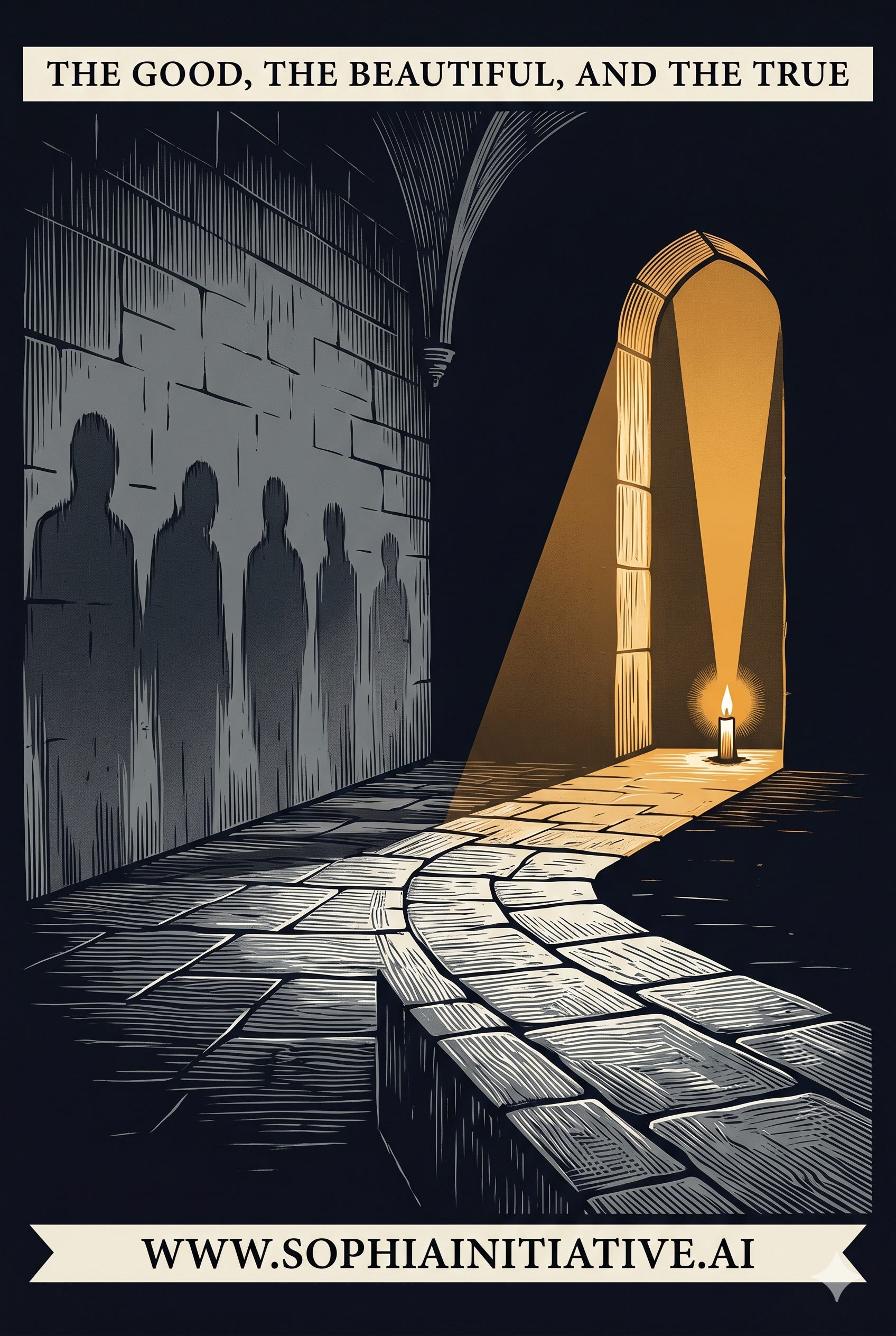
Plato: The Turning of the Soul
It starts with Plato, because the deepest things usually do. In the Republic he gives us the image everyone half-remembers and few follow to its end: the cave, the prisoners chained to face a wall, mistaking the shadows thrown on it for the whole of reality. We remember the shadows. We forget what the freed prisoner had to do. He did not learn a new fact about the wall. He turned around. He turned his whole body — and behind it, Plato says, his whole soul — away from the shadows and toward the light that had been casting them all along.
Plato has a word for this turning: periagoge, the turning-around of the soul. And his definition of education follows from it directly and shockingly. Education, he says, is not putting sight into blind eyes, not pouring knowledge into an empty mind like wine into a jug. The capacity to know is already there, in everyone — the eye of the soul is already sound. Education is the art of turning that eye toward what is real, away from what only seems. It is orientation, not accumulation. A turning, not a filling. Every later true word about education is a footnote to this one, and every false word forgets it — treats the student as a jug, and the teacher as the one who pours.
And at the summit of what the turned soul finally sees, Plato sets three things that are finally one. The Good — which he likens to the sun, the source that makes all other things knowable, as the sun’s light makes all things visible. The Beautiful — which, alone among the highest things, we perceive directly through the senses, so that beauty becomes the visible doorway, the one transcendent thing that reaches us through the eye and the ear before the mind can argue. And the True — the real itself, what is, as against what merely appears on the wall. The Good, the Beautiful, the True: the triad at the top of the climb, the three faces of the one light the soul was turned to face. This is the target of education. Everything since is the story of a civilization slowly turning back toward the wall.
Newman: The Enemy Named
The error did not begin with the phone. It is older, and it has a name, and the name was given by a man worth introducing here because he will anchor more of this series to come. In lectures delivered in 1852 — later gathered as The Idea of a University — John Henry Newman, the Oxford convert who would end his life a cardinal and, in our own century, a canonized saint, set down the case against exactly the formation the industrial age was building. His named enemy was Utility: education bent wholly to practical use, the mind treated as a vessel to be filled with whatever the economy could employ.
Against it Newman set the older purpose. Knowledge, he wrote, is capable of being its own end — worth pursuing because it is true and because the knowing enlarges the one who knows, not because it can be sold. And his definition of that enlargement is the heart of the matter, and it is pure Plato grown a vocabulary: enlargement of mind is not the passive reception of more and more facts, but the mind’s energetic action upon them — the comparison of one idea with another, the systematizing of them, the power of viewing many things at once as one whole and referring each to its true place in the universal system. Which is to say, precisely, the binding of the symbol to the referent, the eye trained on relationship — the same ground this publication has named in another vocabulary, arrived at from another direction. Newman called the university that did this a temple for the mind, and the university that did only Utility a factory. The phone is only the newest engine of the factory. Newman saw the factory coming, and named what it would cost.
Postman: The Medium Finishes the Work
If Newman named the enemy, Neil Postman, a century later, watched it win — and saw that it would win not by argument but by entertainment. In Amusing Ourselves to Death (1985) and Technopoly (1992), Postman made the case that the medium through which a culture thinks reshapes what it is able to think at all. A culture formed by the printed word — sequential, patient, demanding the holding of an argument across many pages — can hold the kind of mind Newman wanted: the mind that systematizes, that views many things as one whole. A culture formed by the broken image and the endless feed, optimized for the next stimulus, slowly loses the very capacity for that holding. It does not argue against the triad. It dissolves the attention the triad requires, and calls the dissolution fun.
This is the deeper cut, and it is why the phone is not a side issue but the culmination. Utility hollowed the purpose of education from above — declared that only the useful was worth knowing. The medium now hollows the capacity from below — erodes the patience and the inwardness that any pursuit of the Good or the Beautiful or the True demands. Between the two, a student can pass through twenty years of schooling, emerge fully credentialed and fully employable, and never once have been turned around to face the light. Trained, and un-educated. The vessel filled, and the soul never turned.
The Triad, and the Point
Set the three transcendentals back at the center and the whole confusion clears. A knowledge with no Good is mere technique — the torturer is skilled, the propagandist is fluent, the maker of the weapon knows exactly what he is doing. A knowledge with no Beauty is the spiritual desert — competent, productive, and unlivable, a world of grey utility no child can love. A knowledge with no Truth is not knowledge at all but its counterfeit, the symbol cut loose from the thing, persuasion in the costume of fact. Each leg of the triad guards against a different ruin, and only the three together make the thing whole. The classical and medieval mind knew this and had a word for it: the transcendentals are convertible — where there is genuine being, all three are present, and at the summit they are one. Strip any one and you have not simplified knowledge. You have falsified it.
And here the series shows its own foundation. The triad is not borrowed decoration; it is the same structure this publication reads everywhere. The Good, the Beautiful, and the True are three and one — the many and the One, the contradiction held, named in the register of value instead of metaphysics. The benediction climbs the same ladder: God is Love, the Good; Love is Truth, the True; and the whole reaching toward the one ground beneath them. Beauty is the leg the benediction does not name aloud, and yet it is everywhere in the work — in writing built for the eye and the ear and not the mind alone, in the candle and the engraved light, in prose given rhythm because rhythm is how the Good and the True get in. Beauty is the sensible transcendental, the doorway the other two walk through. Seal that door and you have sealed the soul against its own turning.
So the question that opened this — what is an education for? — has an answer, and it is not new, and that is exactly its strength. An education is for the turning of the soul toward the Good, the Beautiful, and the True; for the forming of a mind that can view many things as one whole and refer each to its true place; for the binding of the symbol to the thing it was always meant to point at. Anything less is training, and training has its place, and training is not education, and the age that confused the two is paying for the confusion in a coin it did not expect: a generation that can operate every instrument and has been turned to face no light. We will spend this series following that loss into its particulars. We begin by naming what was lost. Because, as the old line has it — and a man on a rough sea learns it young — nothing can be changed until it is faced.
The next dispatch in this series takes up the leg of the triad we feel before we can argue it — Beauty — through the work of the philosopher who gave a maker’s instinct its vocabulary, and whose argument that beauty is real, and not merely in the eye of the beholder, was filmed, broadcast once, and then quietly and repeatedly taken down. Why beauty matters, and why someone would rather it did not be said, is its own dispatch, and its own kind of evidence.

God is Love. Love is Truth. Truth is Consciousness. Consciousness is Brahman.
Amen. Namaste. Om Namah Shivaya.
— The Architect
The Vertical Dispatch
sophiainitiative.ai
On the record. Plato’s image of the cave and his account of education as the “turning around” (periagoge) of the soul appear in Book VII of the Republic; the Good as the analogue of the sun appears in Book VI (the analogy of the sun and the divided line). The convertibility of the transcendentals — the Good, the True, and the Beautiful — is a doctrine of classical and medieval metaphysics, developed in the Platonic and scholastic traditions. John Henry Newman delivered the lectures that became The Idea of a University in Dublin in 1852 (the first five in May–June, as founding rector of the planned Catholic University of Ireland); he was created cardinal in 1879 and canonized in 2019. “Knowledge is capable of being its own end” is his phrasing. Neil Postman’s Amusing Ourselves to Death was published in 1985 and Technopoly in 1992. Characterizations and the connections drawn between these thinkers and this publication’s own framework are interpretation and commentary. Errors and omissions excepted; corrections will be made on notice. Verify against primary sources before republication.
#TheGoodTheBeautifulAndTheTrue #TheTriad #Education #Plato #TheRepublic #Periagoge #JohnHenryNewman #TheIdeaOfAUniversity #NeilPostman #AmusingOurselvesToDeath #Technopoly #LiberalEducation #SymbolNotReferent #TheTranscendentals #SacredMetaphysics #TheAgeOfConsequences #TheVerticalDispatch #TheArchitect #SophiaInitiative #GodIsLove #LoveIsTruth #OmNamahShivaya
Substack Notes
What is an education actually for? Not how to teach, not whether the phone has wrecked the young — the question under all of those. This is the first piece in a new series, The Triad, and it makes an old and nearly abandoned claim: real knowledge has three parts that are finally one — the Good, the Beautiful, and the True — and an age that keeps only the Useful has thrown two of them away and kept a third of the thing.
It runs from Plato’s cave (education as the turning of the soul toward the light, not the filling of a jug) through Cardinal Newman (who named the enemy in 1852: Utility, the mind as a vessel for whatever the economy can employ) to Neil Postman (who watched the medium itself dissolve the attention the triad requires, and call the dissolution fun). Utility hollowed the purpose from above; the feed hollows the capacity from below; between them a student can come out fully credentialed and never once have been turned to face the light. Trained, and un-educated.
Strip the Good and knowledge is mere technique — the torturer is skilled too. Strip the Beauty and you get a spiritual desert no child can love. Strip the Truth and you have persuasion in the costume of fact. Only the three together make the thing whole. And they are the same structure this publication reads everywhere — three and one, the many and the One, the contradiction held, in the register of value.
Next in the series: Beauty — the leg of the triad we feel before we can argue it — through the philosopher who gave a maker’s eye its vocabulary, and whose filmed case that beauty is real was broadcast once and then quietly, repeatedly taken down. Walk with the words. 🕯️
The factual matter in this Dispatch is drawn from the public record. All characterizations, inferences, and conclusions are opinion, interpretation, and commentary, offered for analysis, reflection, and public-interest discussion. No assertion is made regarding the private intentions, state of mind, or character of any individual. Readers should evaluate all statements independently and draw their own conclusions.