

Φ
THE VERTICAL DISPATCH
We write for the mind, the eye, and the ear.
Read it. Look at it. Listen to it. The Vertical Dispatch is built for all three — prose with rhythm, made to be heard as much as read.
From metaphysics to geopolitics, from culture to history, from the sacred to the street — and everything in between. One lens, every subject. No ego. Just the record, named clean.
Press play. Walk with the word. 🕯️
This dispatch travels by hand. If it serves you, share it — restack on Substack, and pass it on wherever you read. 🕯️
The Age of Consequences · The Canadian Shadow Series
On the marketplace that prices war · without malice and without flattery
As of July 7, 2026
“It is a moral hazard in the technical economic sense, and no existing regulatory framework is well-designed to reach it.”
— on markets where the bettor can influence the outcome he has bet upon
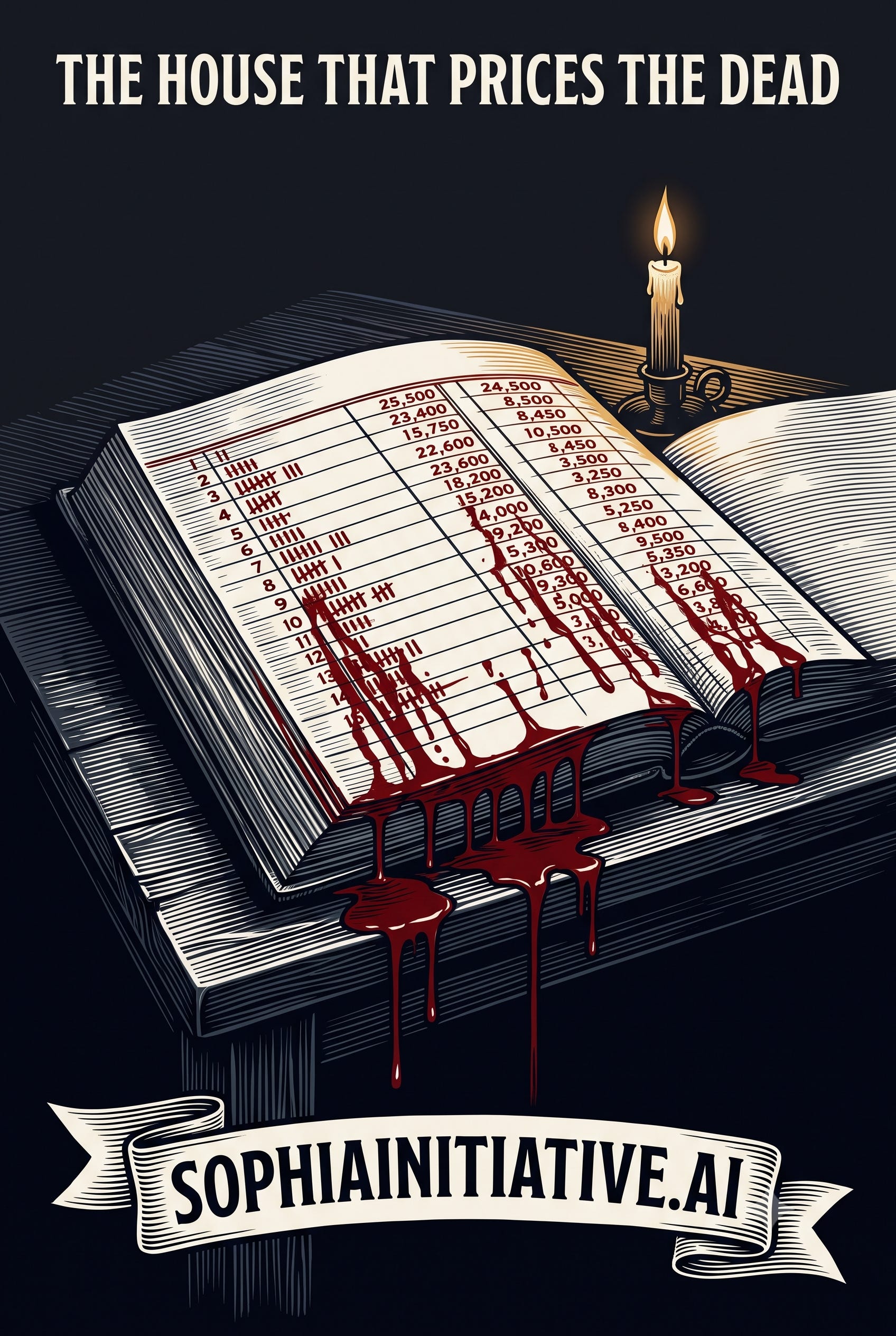
Begin with the fact they would rather you not begin with. The son of the sitting American president, Donald Trump Jr., sits on the advisory board of the largest online marketplace where strangers wager real money on death and war — a house his own venture firm has funded with millions. Hold that in view, and now read what the house actually trades. As Prime Minister Carney moved through Ankara this week — the submarines, the bank, the tightrope with Washington — that marketplace stood open, quoting a price on whether the alliance he was reinforcing will survive. Put ten thousand dollars down that the United States formally withdraws from NATO, priced near ten cents, and it returns a hundred thousand if it happens. Ten thousand on Russia invading a NATO country, priced near three cents, returns better than three hundred thousand. Ten thousand on the whole alliance dissolving pays two hundred thousand. Read the shape of it: the rarer and more catastrophic the horror, the fatter the purse — the house pays you most for betting on the worst. You can buy either side. You can sell before it settles. Somewhere a ledger updates in real time, and the men reading it are not statesmen or soldiers. They are traders, and the war is their book.This dispatch is not about the odds. The odds, we have read elsewhere, and they are honest enough as crowd-signal. This dispatch is about the house — the machine that takes the gravest questions a century can ask and renders them as contracts, priced to the penny, payable on the outcome. We will not raise our voice. The record does not require it. Laid out plainly, the thing indicts itself.
I. What Is Actually on the Board
Set aside the sanitised language of prediction and read what the contracts actually reference. In the months of the Iran war, one platform’s war category swelled past two hundred active contracts — ceasefire dates, strike timing, and, in the phrase a U.S. congressman gave them, death markets: contracts that let a stranger profit from the timing of a death, a military casualty, a rescue. More than half a billion dollars changed hands on the single question of when American bombs would fall on Iran. Over five hundred million, wagered on the hour of an act of war, by people with no stake in it but the payout.
Then read the one that should end the argument. In early April, while a search-and-rescue operation was still underway for the crew of a downed American F-15E over hostile ground, the house listed a contract on whether the airmen would be rescued. Men were in the water, or worse, and the house opened a window to bet on their odds of coming home. It was removed after public revulsion. The point is not that it was removed. The point is that it was listed — that a machine and the people running it looked at two aircrew fighting to survive and saw a market to be made. And a congressman counted two hundred and twenty-three war contracts still live the day after.
Men were still in the water. The house opened the book anyway. That is the whole of it, in one line.
II. The Bet That Reaches Back and Kills
There is a name for the darkest form of this, and it predates the platforms by thirty years: the assassination market. The mechanism is cold and simple. If a market pays out for correctly naming the date of a person’s death, then anyone with advance knowledge of a killing can profit by betting it — and anyone who wishes to profit is handed a financial reason to arrange the death and bet the date. The payoff rewards the accurate guess, not the act, which makes the guilt difficult to assign and the incentive no less real. This is not a hypothetical drawn from a cypherpunk essay. Analysts have warned that the popular platforms can serve exactly this function, and the record now shows why the warning was not paranoid.
In late February, an American-Israeli strike killed Iran’s supreme leader. On one platform, an account trading under a crude handle made over half a million dollars betting on that death and the events around it — trades placed in the days before the strike, which drew the immediate scrutiny of members of Congress who said the platforms invite those with access to classified operations to cash in on lethal military secrets. A month earlier, an account created less than a week before the United States seized Venezuela’s president bet thirty thousand dollars on his removal when the house priced it at five percent, and collected four hundred thirty-six thousand. The account had only ever bet on that one man and American military action against his country. Prosecutors are reportedly looking. This is the moral hazard named in our epigraph made flesh: a contract that does not merely predict the event but bears upon it — a structure that pays the informed, and cannot exclude them without admitting its prices are worthless.
III. The House Turns on the Witness
A marketplace this size does not stay confined to the marketplace. When money rides on an outcome, the people holding the money acquire an interest in what the world is told about it — and in March, that interest reached a working reporter. A military correspondent, covering the conflict, reported that an Iranian missile had struck an open area near an Israeli town. That single factual report bore on a contract with more than fourteen million dollars wagered on whether a strike had occurred on a given date. The gamblers found him. He received death threats — pressure to change what he had reported, because his facts moved their book. This is where the abstraction ends and the cost lands on a living person: the house does not merely price the war. It reaches out and leans on the man trying to tell the truth about it, because the truth is now a variable in a wager.
When a fact becomes a stake, the person who reports the fact becomes a target. That is not a side effect. It is the design, working.
IV. Who Owns the House
Return now to the fact we opened with, because it deepens. It would be easier if this ran at the margins of respectability, some offshore vice quarantined from power. It does not. The president’s son does not merely sit on the board of the largest house; he advises its chief competitor as well. Federal investigations opened under the previous administration were dropped under this one. And when states moved to apply their gambling laws to these markets, the administration sued the states — arguing the houses should be treated not as gambling but as federally-regulated financial instruments, beyond the reach of the state statutes that would have curbed them. A governor described the suit plainly as the government acting on behalf of the companies. Read it without heat: the power that could close the house has instead reached down to shield it, and the power and the house share a name.
V. What the Law Still Calls It
Here the record offers its own verdict, and we need add nothing to it. Under American commodity law, making trades based on death and war is already illegal, because such bets create a financial reward for violence, human suffering, and instability. That is not the opinion of this Dispatch. It is the existing statutory ground. The platforms have largely operated around it — the biggest through an overseas exchange beyond Washington’s regulators, reached by users through tools that hide their identity and location. And the Congress, across both parties, has been reduced to introducing bills whose very titles are the indictment: acts to prohibit contracts referencing war, terrorism, assassination, and an individual’s death. When lawmakers must draft a statute spelling out that you may not run a betting book on a named person’s killing, the civilisation has already told you where the line was — and that someone crossed it for money, at scale, and had to be legislated back.
VI. The Ledger That Has No Price
And now the other ledger, because there is always another ledger, and it is the one the house cannot quote. Against the book that priced the supreme leader’s death at pennies, and the airmen’s rescue as a live wager, and the invasion of a NATO country at three cents on the dollar, set the accounts that were paid in full and never traded. The father who read a wave without fear and set the boat so the people aboard glided safe — and who was gone within the year, and cannot be shorted or hedged. The men lost at Anzio and on the fishing grounds, whose deaths carried no date to bet and no payout to collect, only the people left behind. The soldier and the correspondent and the aircrew are not, on the true ledger, positions. They are the whole of someone’s world. The obscenity of the house is not finally that it is ghoulish, though it is. It is that it commits a category error at the scale of a half-billion dollars: it treats what cannot be priced as though it had a price, and invites the world to profit on the difference. Symbol is not referent. A human life is not a contract, and a war is not a book — and any machine that trades them as though they were has mistaken the map for the territory in the one place the mistake is unforgivable.
We said we would not raise our voice, and we have not. We laid the record down: the death markets, the rescue wager opened while men were still down, the assassination structure made flesh, the reporter threatened for a true report, the house shielded by the power that shares its name, and the law that already calls it what it is. There is nothing to add. In fairness, the defenders will say prediction markets surface truth faster than experts, that informed traders make prices accurate, that a free people may wager as they choose. Grant all of it. It does not touch the core. A mechanism can be efficient and still be an abomination; the efficiency of pricing a man’s rescue while he drowns is not a defence of the price but a description of the horror. The house is very good at what it does. What it does is the problem.


God is Love. Love is Truth. Truth is Consciousness. Consciousness is Brahman.
Amen. Namaste. Om Namah Shivaya.
— The Architect.
For those on the ledger that has no price.
The Vertical Dispatch
sophiainitiative.ai
On the record
NATO-related market prices (US withdrawal ~10%, any country leaving ~10–14%, dissolution ~5–6%, Russia invades a NATO country ~3%, Article 5 ~15%) are from Polymarket market pages as of early July 2026 and move in real time. The ~$529M+ traded on Iran airstrike-timing contracts, the 200+ war-contract peak, and the F-15E downed-aircrew rescue market (removed after backlash; 223 war contracts reported still active the next day, per Rep. Seth Moulton) are from The New Arab (April 13, 2026). The Khamenei-death trade (~$553K, account “Magamyman,” Feb. 28 strike) and Sen. Chris Murphy’s remarks are from NPR (March 1, 2026). The Maduro-seizure trade ($30K stake at 5.5%, $436,759 payout; SDNY reportedly investigating) is from The New Arab. The $14M missile-strike contract and death threats to military correspondent Emanuel Fabian are from The Block (March 16, 2026) and The Times of Israel. The assassination-market mechanism is from the public record on prediction markets (Wikipedia; Timothy May; Jim Bell). Donald Trump Jr.’s advisory role and 1789 Capital investment, the dropped federal investigations, and the federal suit against Arizona, Connecticut, and Illinois are from NPR and The New Arab. Proposed legislation (BETS OFF Act; STOP Corrupt Bets Act; the DEATH BETS Act, Rep. Adam Schiff; Sen. Murphy’s bill) is from crypto.news (March 11, 2026) and NPR. The existing illegality of death/war-based trades under U.S. commodity law is as characterised by NPR. Prices quoted are volatile; no figure is disaggregated by race or group. Characterizations of the platforms and their owners are opinion, interpretation, and commentary; no assertion is made about any individual’s private intent, and investigations named are reported, not adjudicated. This is a sensitive subject; readers affected by loss or in distress should seek appropriate support. Errors and omissions excepted; corrections will be made on notice. Verify against primary sources before republication.
Suggested tags
Polymarket, prediction markets, death markets, war betting, Kalshi, insider trading, assassination markets, NATO odds, CFTC, DEATH BETS Act, gambling regulation, moral hazard, press freedom, the Age of Consequences.
Substack Notes
The son of the sitting American president sits on the board of the largest online house where strangers bet real money on death and war. Hold that in view. This week that same marketplace stood open quoting a price on whether NATO will survive — ten cents on a U.S. withdrawal, three on a Russian invasion of a member state, five on the alliance dissolving. This dispatch is not about the odds. It is about the house that makes them: the machine that takes the gravest questions a century can ask and renders them as contracts, payable on the outcome.
We lay the record down cold, because it needs no heat. Over half a billion dollars wagered on the timing of American bombs falling on Iran. A contract listed on whether downed aircrew would be rescued — while the search was still underway. Half a million made betting on a supreme leader’s death in the days before the strike that killed him. A reporter sent death threats for a true report that moved a fourteen-million-dollar book. And the largest house tied to the family of the sitting president, shielded by the very power that could close it.
Under American law, trading on death and war is already illegal — because such bets pay a reward for human suffering. Congress has been reduced to writing bills whose titles are the whole indictment. When a civilisation must legislate that you may not run a book on a named person’s killing, it has already told you where the line was, and that someone crossed it for money.
Against the ledger that prices the dead, we set the ledger that has no price: the father who read the wave, the men lost at Anzio and on the fishing grounds, the aircrew who are not positions but the whole of someone’s world. A human life is not a contract. A war is not a book. Any machine that trades them as though they were has mistaken the map for the territory in the one place the mistake is unforgivable. Written from love, in service of the record. Walk with the word. 🕯️
#TheVerticalDispatch #TheArchitect #SophiaInitiative #Polymarket #PredictionMarkets #DeathMarkets #WarBetting #NATO #PressFreedom #TheAgeOfConsequences #GodIsLove #LoveIsTruth #OmNamahShivaya
The factual matter in this Dispatch is drawn from the public record. All characterizations, inferences, and conclusions are opinion, interpretation, and commentary, offered for analysis, reflection, and public-interest discussion. No assertion is made regarding the private intentions, state of mind, or character of any individual. Readers should evaluate all statements independently and draw their own conclusions.
That this is seen as a game, a sport, by those participating including Trump suggests a completely evil enterprise with no redeeming features.