


Φ
THE VERTICAL DISPATCH
We write for the mind, the eye, and the ear.
Read it. Look at it. Listen to it. The Vertical Dispatch is built for all three — prose with rhythm, made to be heard as much as read.
From metaphysics to geopolitics, from culture to history, from the sacred to the street — and everything in between. One lens, every subject. No ego. Just the record, named clean.
Press play. Walk with the word. 🕯️
This dispatch travels by hand. If it serves you, share it — restack on Substack, and pass it on wherever you read. 🕯️
Follow the Money · The Age of Consequences
June 28, 2026 · without malice and without flattery
“Who carries the risk, and who keeps the reward?”
— the question this publication asked of the World Cup on June 7, four days before kickoff
Canada One
Begin with the joy, because it was real and it was earned, and this publication does not begrudge a country its joy. On June 12, at a sold-out BMO Field in Toronto, the Canadian men’s national team drew one-all with Bosnia and Herzegovina — the first point Canada had ever won at a senior men’s World Cup, after losing every match it played in 1986 and again in 2022. Six days later, at BC Place in Vancouver, the team did something it had never done in its history: it won. Not narrowly, but overwhelmingly — six goals to nil against Qatar, the largest winning margin ever recorded at a World Cup by any nation from outside Europe or South America, and Qatar’s heaviest World Cup defeat. Jonathan David scored a hat trick. A country that had waited a lifetime for a single World Cup victory got a rout.
Then, on June 24, again before a sold-out Vancouver crowd, Canada lost two-one to Switzerland — a defeat that cost them top spot in the group and the home knockout games that came with it, but not their place in the tournament. They finished second in Group B and advanced, for the first time ever, to the World Cup’s knockout round, where they now face South Africa in Los Angeles. The stadium that night was loud to the last minute, urging a late equalizer that never came. The coach, Jesse Marsch, said afterward that the disappointment was simply that the team wanted to keep the energy going — the energy that had been built, in his words, around the team and around the tournament in the country. That energy is the fact this dispatch wants to hold up to the light. Because it sits very awkwardly beside another claim that has been repeated, for a year, by the man who would govern the country.
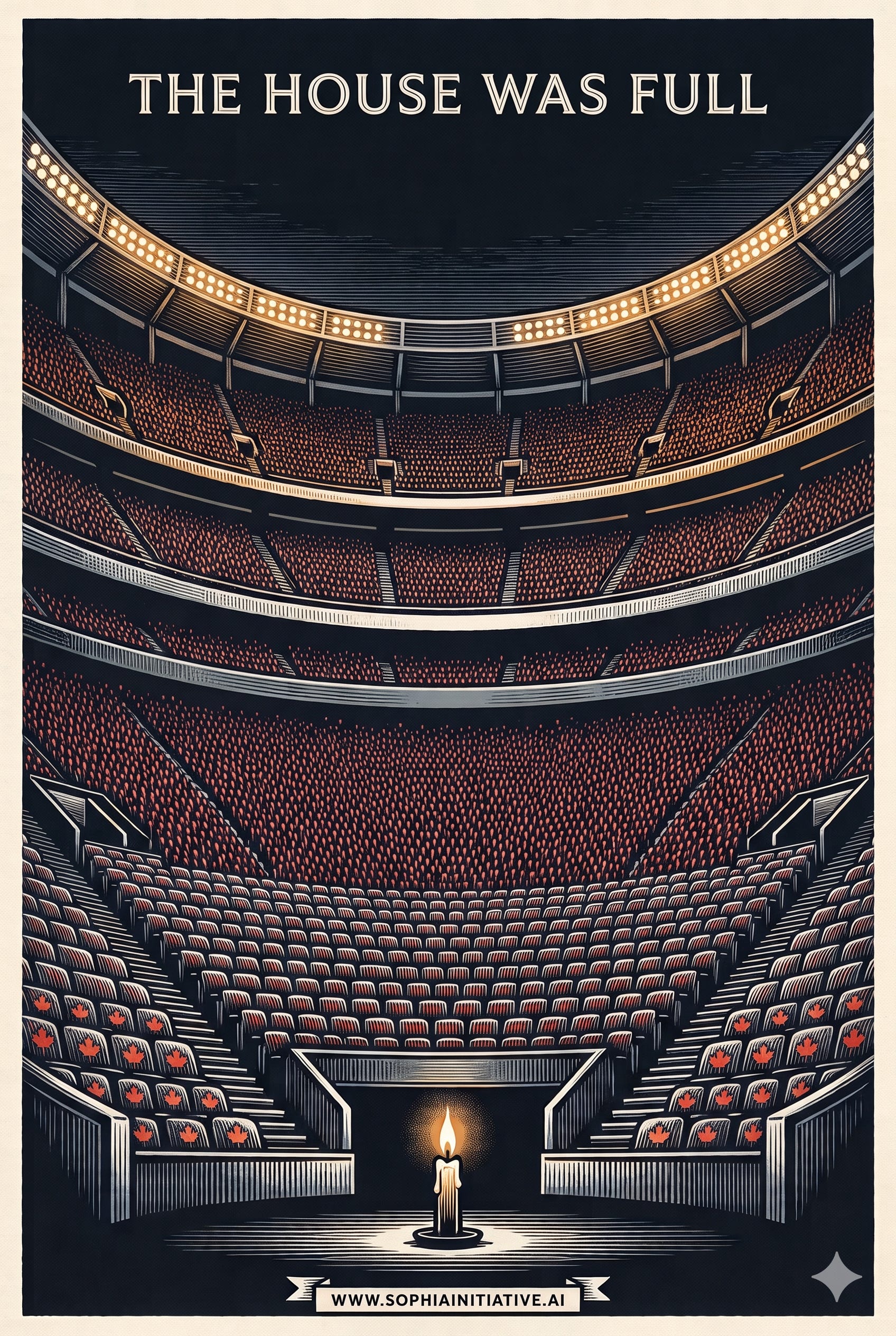
The Slogan and the Sold-Out House
Pierre Poilievre says Canada is broken. He has said it in those words, again and again, as the organizing thesis of his politics: a country whose promise has failed, whose people are crushed, whose every system is breaking under them. Set that claim beside the record of the past two weeks. A nation set an all-time World Cup attendance record. Its two stadiums filled to capacity — even the tournament’s lowest-drawing match, Ghana against Panama at a smaller Toronto venue, filled 99.8 per cent of its seats. Canadians found seven hundred dollars at the very cheapest, and far more commonly a thousand to two thousand six hundred, to watch their national team play, in a country their Opposition leader describes as too broken to function. So which is it? Either Canadians are too crushed to live — or they are flush enough to fill a stadium at a thousand dollars a seat for an afternoon of soccer. The slogan and the sold-out house cannot both be true at full strength.
Now the discipline of this house requires the other reading, stated as strongly as it can be made — and it is the stronger half, because it rescues something real from Poilievre’s slogan even as it dismantles its blanket form. The full stadium does not prove the country is fine. It may prove the opposite of what it appears to. If the only Canadians who got through the gate were the ones who could find a thousand dollars on a Thursday, then the sold-out house is not evidence that the country is whole. It is evidence of a country split in two — one half able to drop a month’s rent on an afternoon’s joy, and the other half watching from the free fan-festival down the road, on the giant screen, on the right side of the fence by income. The country is not broken. But it is not whole either. It is divided — and the World Cup, built and secured with everyone’s tax money and priced for only some, is the cleanest picture of that divide anyone has drawn this year. Poilievre is wrong that Canada is broken. He is closer to right that it is strained. The honest word the record supports is neither his nor his opponents’: it is bifurcated.
Either Canadians are too crushed to live — or they are flush enough to fill a stadium at a thousand dollars a seat. The slogan and the sold-out house cannot both be true at full strength.
The Full House That Still Loses Money
And here is the turn that should hold a citizen’s attention longest, because it is the one that survives every cheer. The stadiums filled — and the host cities will still, on the best available evidence, lose money. Those two facts are not in tension; they are the whole lesson. This publication laid out the ledger four days before kickoff, and nothing in the strong attendance has overturned it. The Parliamentary Budget Officer put the public cost of Canada’s thirteen matches at $1.066 billion — about eighty-two million dollars a game, drawn from federal, provincial and municipal treasuries. A full stadium does not repay that. What repays a public spend of that size is not the seat — it is the visitor: the out-of-town spender who fills a hotel for five nights, eats in restaurants, fills a downtown for a week. And the visitor, the evidence says, largely did not come.
The proof is in the count, and the count is now in. The stadiums ran at near-total capacity — and the hotels of the host cities ran emptier during the tournament than in the same weeks the year before. In Toronto, the Greater Toronto Hotel Association reported occupancy falling to seventy-two per cent in the third week of June, down from eighty-six per cent in the same week the previous year; in Vancouver, game-day occupancy sat below fifty per cent on most match days, down by roughly a third from a year earlier. FIFA had already handed back seventy to eighty per cent of the room blocks it reserved across the host cities — some fifteen thousand nightly cancellations in Vancouver alone — but the deeper tell is the actual occupancy: a full stadium standing above an emptier-than-usual hotel. The two facts can only both be true if the crowd in the building did not need a room — if it was, in other words, local. No official breakdown of attendance by nationality has been published, and this dispatch will not invent one; there were certainly international visitors, the diaspora crowds and the fans who travelled. But full stands above hotels running below a normal summer point hard in one direction: the houses were filled, in the main, by Canadians who drove in and drove home, not by the international visitors whose week-long spending was the entire economic case for the billion.
In fairness, the hotel industry offers its own mitigation, and the record carries it: this is the first World Cup split across three countries, which spread visitors over a continent rather than concentrating them in one city; booking behaviour ran later than usual; and some spending moved to short-term rentals, restaurants and the patios rather than the hotels. Hotel occupancy alone does not capture every dollar. All true. But the case for the billion was never “the patios will be busy.” It was a tourism windfall — a wave of out-of-town visitors filling the city for a week. And the hardest available number, the actual occupancy, says the hotels were emptier during the biggest event the city has ever hosted than in an ordinary June. The home crowd showed up. The paying guest, in the main, stayed away. The seats sold, and the spillover the spend was sold on did not arrive. The likely outcome remains what the independent evidence predicted in advance: a net public loss in the hundreds of millions. Not a scandal. A poor bet, made with public money, whose bill is now in the bank — the taxpayer’s bank.
Make Up Your Mind
Which brings the matter back, squarely, to the man who calls the country broken — and to the question his own slogan cannot dodge. Because the World Cup is, at bottom, a subsidy: a billion dollars of public money spent to stage a private organization’s tournament, from which that organization keeps the broadcast rights, the sponsorships, and the gate, and pays no Canadian tax. If Pierre Poilievre believes the country is broken and the citizen overtaxed and underserved — then where was the voice against this billion? The same politics that calls a program to house people a “bailout,” that promises to axe every tax and cut every cost, was conspicuously quiet while a billion in public money was committed to a month of soccer that the independent economists said, in advance, would not pay for itself. So the question is the plain one, and it is owed an answer: make up your mind. What is it that we subsidize, and what is it that we don’t? A billion for a tournament, yes — but condos to house the priced-out, no? Public money for FIFA’s gate, but a price correction left to crash on ordinary families? A country too broken to afford its groceries, but whole enough to underwrite the world’s most expensive sporting event and then watch its own citizens priced out of the seats it paid for?
This is not an argument that the World Cup should not have come, nor that Canadians should not have cheered. The joy was real; the team made history; a country that waited forty years for a World Cup win got a six-nil rout and a place in the knockout round, and that is worth every voice that was raised for it. It is only the record, named clean, and the question left where it belongs. A leader who builds a politics on the word broken owes the public a consistent account of what a broken country may spend a billion dollars on, and what it may not. Subsidy is not the sin; incoherence is. You cannot call the country too poor to house its people and rich enough to host the world in the same breath, and decline to say which spend you would have made. The taxpayer carried the risk, as the taxpayer always does. The least the taxpayer is owed in return is a politics that will say, plainly, what the public purse is for. Walk with the word. 🕯️


God is Love. Love is Truth. Truth is Consciousness. Consciousness is Brahman.
Amen. Namaste. Om Namah Shivaya.
— The Architect.
For the team that made history, and for every Canadian who watched it from the free seats down the road — the record is yours too.
The Vertical Dispatch
sophiainitiative.ai
On the record
This dispatch concerns Canada’s 2026 FIFA World Cup results, attendance, and the public cost of co-hosting, current as of June 28, 2026. It is reportage, interpretation and commentary; it tests the stated positions of public figures against the public record and judges policy, never private character. Verify all figures against primary sources before republication.
Canada’s results (Group B): 1–1 vs. Bosnia and Herzegovina (June 12, Toronto — Canada’s first-ever men’s World Cup point); 6–0 vs. Qatar (June 18, Vancouver — Canada’s first-ever World Cup win, Jonathan David hat trick, the largest World Cup winning margin by a non-UEFA/non-CONMEBOL nation and Qatar’s heaviest WC defeat); 1–2 vs. Switzerland (June 24, Vancouver). Canada finished second in Group B and advanced to the Round of 32 for the first time, facing South Africa in Los Angeles on June 28 (ESPN; Team Canada/Olympic.ca; Wikipedia “2026 FIFA World Cup Group B,” June 2026). Attendance: the tournament set an all-time World Cup cumulative attendance record (3,605,357 by June 25, surpassing 1994), with the first 60 matches at ~99.7% average occupancy; the lowest single-match attendance to date, Ghana–Panama at BMO Field, still filled ~99.8% of capacity; Canada’s Vancouver matches were sold out (Wikipedia; FootballGroundGuide; Team Canada, June 2026).
Ticket prices (Canadian matches, CAD, June 2026 reporting): Canada vs. Qatar get-in ~$755–$770 up to ~$2,625; Canada vs. Switzerland ~$680–$1,640; Toronto opener (Canada vs. Bosnia) ~$486–$2,391 face value; non-Canada group matches from ~$82–$96 (CAT 4) up to ~$610; a single Vancouver knockout seat listed as high as ~$1 million on resale (Daily Hive; Trip.com; Vancouver Is Awesome, 2026). Public cost and economics: Parliamentary Budget Officer (May 2026) — $1.066 billion total public cost (~$82M/match); BMO Economics and Government of B.C. projections, with BMO’s own 30–50% domestic-substitution discount and its statement that the public sector absorbs a disproportionate share of risk; independent mega-event literature (Zimbalist, Matheson) on systematically overstated returns. See this publication’s June 7, 2026 dispatch, “The Billion-Dollar Question,” for full sourcing.
Hotel occupancy (mid-tournament actuals): Greater Toronto Hotel Association reported occupancy of ~82% in the week of Canada’s first match (vs. ~83% the prior year) and ~72% in the third week of June (vs. ~86% the prior year) — i.e., lower than the same weeks in 2025 (CBC News / Canadian Press, June 26, 2026). Vancouver: Destination Vancouver reported June bookings ~20% below 2025; CoStar data showed game-day occupancy below 50% on most Vancouver match days (e.g., Canada–Qatar June 18 at ~50.3%, down from ~73.8% a year earlier) (CBC News, June 2026). FIFA had cancelled ~70–80% of reserved group room blocks across host cities (~15,000 Vancouver nightly cancellations) per the B.C. Hotel Association (CBC News, March 2026). Industry mitigations (three-country format dispersing visitors, later booking behaviour, spending shifting to short-term rentals and restaurants) are stated in the text per the Ontario Restaurant Hotel & Motel Association and B.C. tourism officials. No official breakdown of attendance by nationality has been published; the local-crowd inference is drawn from full stadiums sitting above below-baseline hotel occupancy and is identified as inference, not fact.
Pierre Poilievre’s characterization of Canada as “broken” is his documented and repeated public framing. This dispatch tests that framing against the public record and renders no judgment on his private motives; the “bifurcated” characterization is the author’s interpretation. Accountability is directed at the pricing structure, the public-cost decision, and the consistency of stated political positions — never at any fan, and never ranking citizens by income. No figure is disaggregated by race, group, or class. Errors and omissions excepted; corrections will be made on notice.
Suggested tags
World Cup 2026, Canada soccer, Pierre Poilievre, Canada is broken, public money, FIFA, BC Place, BMO Field, ticket prices, mega-events, follow the money, the age of consequences
Substack Notes
Canada reached the World Cup knockout stage for the first time in its history — a first-ever point against Bosnia, a stunning 6–0 rout of Qatar (the biggest World Cup win ever by a nation outside Europe or South America), and a sold-out, roaring BC Place to the final whistle. The joy was real and earned. This dispatch begins there, and then holds that joy up against a claim repeated for a year: that Canada is broken.
Both are on the record. A nation set an all-time World Cup attendance record, its stadiums at ~99% capacity, its citizens finding $700 to $2,600 a seat to watch their team — in a country its Opposition leader calls too broken to function. So which is it? Either Canadians are too crushed to live, or flush enough to fill a stadium at a thousand dollars a seat. The slogan and the sold-out house cannot both be true. We hold the other reading at full strength: maybe the full house only proves the divide — the half that could pay, and the half watching from the free fan-fest down the road. Not broken. Bifurcated.
And the sting under the cheer: the stadiums filled — and the host cities will still likely lose money. A full house doesn’t repay a billion-dollar public spend; an out-of-town visitor does. And the visitor mostly didn’t come — Toronto hotels ran emptier during the World Cup than the same weeks last year (72% vs 86% in week three), Vancouver game-days sat below 50%. Full building, below-baseline hotel, because the crowd was local. The seats sold; the spillover didn’t. The taxpayer carries a likely loss in the hundreds of millions — the bill the independent economists saw coming.
Which puts the question to the man who calls the country broken: make up your mind. What do we subsidize, and what don’t we? A billion for FIFA’s tournament — but condos to house the priced-out are a “bailout”? Too poor for groceries, but rich enough to host the world and watch our own citizens priced out of the seats we paid for? Subsidy isn’t the sin. Incoherence is. The joy was real; the team made history. The taxpayer is owed a politics that will say, plainly, what the public purse is for. Written from love, in service of the record. Walk with the word. 🕯️
#TheVerticalDispatch #TheArchitect #SophiaInitiative #WorldCup2026 #CanadaSoccer #PierrePoilievre #CanadaIsBroken #FollowTheMoney #PublicMoney #FIFA #BCPlace #TheAgeOfConsequences #GodIsLove #LoveIsTruth #OmNamahShivaya
The factual matter in this Dispatch is drawn from the public record. All characterizations, inferences, and conclusions are opinion, interpretation, and commentary, offered for analysis, reflection, and public-interest discussion. No assertion is made regarding the private intentions, state of mind, or character of any individual. Readers should evaluate all statements independently and draw their own conclusions.
Great pointing out question.
Unspoken, because not countable , is that all sporting events allow us to express tribal type big feelings, in a channeled relatively safe way.