


Φ
THE VERTICAL DISPATCH
We write for the mind, the eye, and the ear.
Read it. Look at it. Listen to it. The Vertical Dispatch is built for all three — prose with rhythm, made to be heard as much as read.
From metaphysics to geopolitics, from culture to history, from the sacred to the street — and everything in between. One lens, every subject. No ego. Just the record, named clean.
Press play. Walk with the word. 🕯️
This dispatch travels by hand. If it serves you, share it — restack on Substack, and pass it on wherever you read. 🕯️
The Price of Everything · A Vertical Dispatch Feature · Part One of Seven
June 22, 2026
“The cost of a thing is the amount of what I will call life which is required to be exchanged for it, immediately or in the long run.”
— Henry David Thoreau, Walden, 1854
Begin with a sentence almost everyone knows and almost everyone has wrong. Money, the saying goes, is the root of all evil. It is one of the most-quoted lines in the language, and it is a misquotation. The actual text — it is from the first letter to Timothy — says that the love of money is a root of all kinds of evil. Not money. The love of it.
Hold those two versions side by side, because the gap between them is the whole of this feature. The popular version blames the thing. The actual version blames the disordered desire for the thing. Money is a tool, a token, a promise — morally inert, like a hammer. What rots is the worship: the moment the token stops standing for something and becomes the thing itself, the object of the wanting. The misquotation does in miniature exactly what this series is about. It takes a symbol — money — and loses the referent the original sentence so carefully kept in view. Even our warnings about money have had the human meaning filed off them.
This is the first of seven parts, and it goes first on purpose, because it is the foundation the other six stand on. Before we can ask what money is, or what a central banker does, or what it means to protect the value of a currency, we have to ask the older question underneath all of them — the one we stopped asking so long ago that it now sounds naive. What is a thing actually worth? And worth to whom, measured in what?
Even our warnings about money have had the human meaning filed off them.
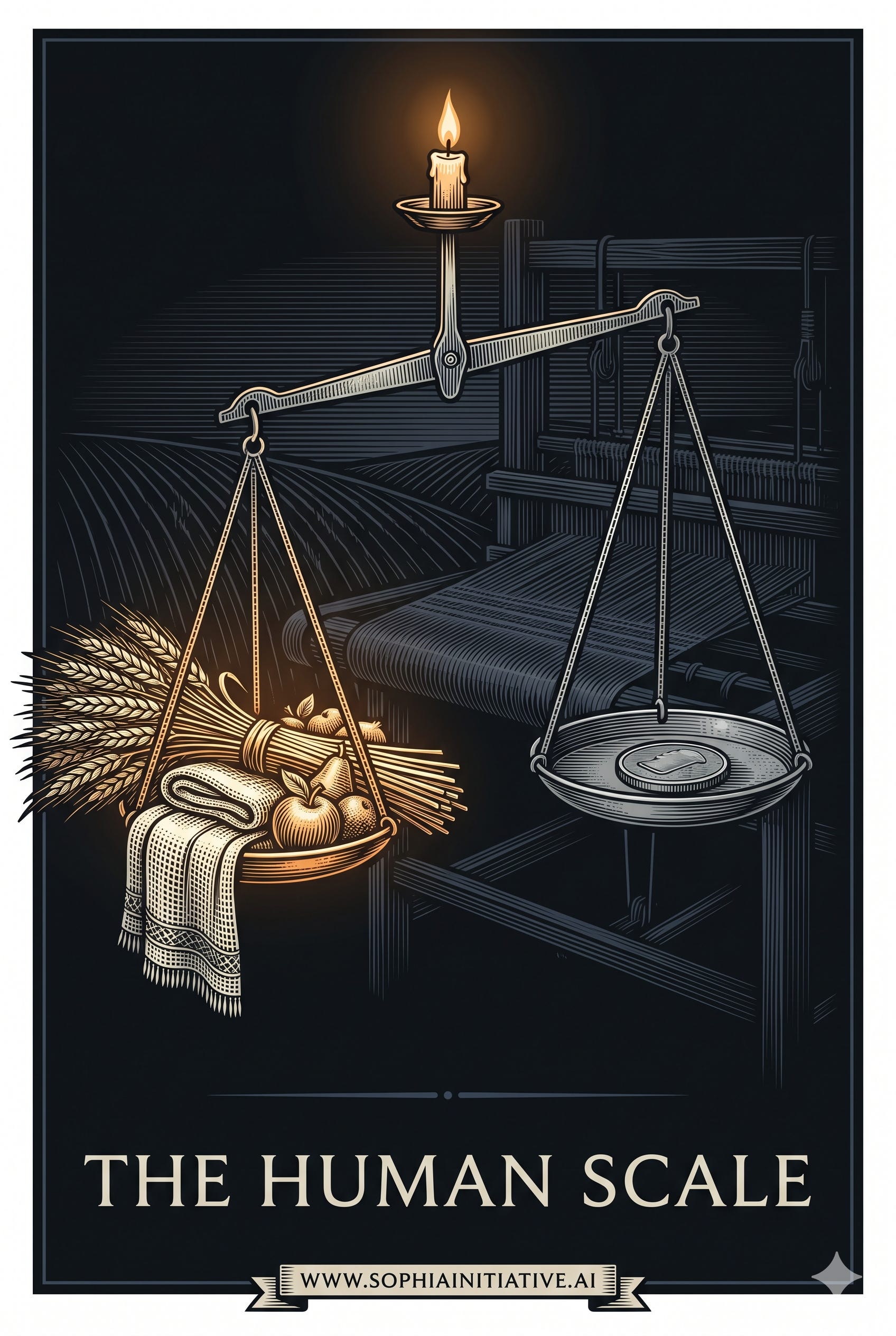
The Worth That Had a Body
For almost the whole of human history, value had a body. A thing was worth the labour and the land that went into it. A bushel of apples was worth the work of growing apples — the planting, the waiting, the picking, the seasons of a particular orchard tended by particular hands. A coat was worth the weaver’s hours and the wool and the loom. The worth was not abstract. You could point to it. It was sweat and soil and time, and everyone in the village understood the rough exchange because everyone could see the work inside the thing.
Money entered this world as a convenience, and a brilliant one. Rather than haul a coat to market hoping to meet someone with exactly the grain you wanted, you carried a token that stood in for the work — a portable, countable promise. The coin in your hand pointed at the labour behind it. That was its entire genius and its entire honesty: it was a symbol, and underneath the symbol was a real referent. Human effort. Human time. The life exchanged for the thing.
Thoreau put it as plainly as it has ever been put, in the opening chapter of Walden, the chapter he titled simply “Economy.” The cost of a thing, he wrote, is the amount of what he would call life that has to be exchanged for it. Read that again slowly, because it is the most exact definition of price ever written and we have almost entirely forgotten it. Not dollars. Not the number on the tag. Life. The hours of your one finite existence that you hand over, directly or in the long run, to have the thing. By that measure a cheap object bought with a week of joyless labour is not cheap at all. It is expensive in the only currency that cannot be reprinted.
There is a small irony worth pausing on, because it proves the point twice. The line of Thoreau’s that circulates today is usually a smoothed-down version — the price of anything is the amount of life you exchange for it. Cleaner, punchier, and not quite what he wrote. He was careful to say “what I will call life,” hedging, qualifying, keeping the referent in view. The culture sanded off the hedge and kept the slogan. Even the sentence that warns us about losing the human scale has, in our handling, lost a little of its own.
The Suffering in the Cloth
If Thoreau gives the measure, Gandhi gives the conscience. At the heart of his movement was a spinning wheel and a length of homespun cloth — khadi — and an argument most of the modern economy is built to ignore: that a garment carries the moral condition of its making. Cloth woven by a hand that was starved or shackled is stained, however fine the weave, however high the price it commands. There is no beauty, the sentiment runs, in the finest cloth if it was made by someone’s suffering.
Set that beside the market’s logic and watch them come apart. The market says the fine cloth is worth more — better thread, tighter weave, higher demand, higher price. Gandhi says the suffering inside it makes it worth less, in the only ledger that finally counts. These are not two opinions about the same number. They are two entirely different accountings, and at some point in the modern era the first one swallowed the second whole. Price ate worth. The question “what will the market give for this” devoured the question “what did it cost a human being to make.”
The spinning wheel sits at the center of the Indian flag for this reason. It is not decoration. It is a civilization insisting, in its founding symbol, that the human hand inside the cloth is part of the cloth’s worth — that you cannot price a thing honestly while looking away from the life that made it. Whatever one thinks of the economics, the moral claim is unkillable: the conditions of the making are part of the thing, whether or not the market agrees to count them.
Price ate worth. The market asks what a thing will fetch, and learned not to ask what it cost a human being to make.
The Harvest Burned to Keep the Price
There is a chapter in The Grapes of Wrath that says everything this feature is trying to say, and Steinbeck says it not as an argument but as a wound. It is the twenty-fifth chapter, the one that gives the book its title, and it is a litany of deliberate destruction. Oranges are sprayed with kerosene where they lie. Potatoes are dumped into the rivers, and men with rifles are posted on the banks to keep the starving from fishing them out. Pigs are slaughtered and buried in quicklime. Pears rot in their mounds; coffee and corn are burned for fuel. A whole catalogue of abundance, destroyed on purpose, while a few miles away children die of pellagra — a disease of pure malnutrition — within sight of the food. Not because there is too little. Because there is too much, and abundance has driven the price too low, and the price must be protected even at the cost of the food and the children both.
Read it as the pure form of the disease. A system designed to feed people destroys real food — real fruit, real grain, real animals, real labour, real sun and soil and the months of someone’s work — in order to defend an abstract number. The symbol, the price, has become more real to the system than the referent, the food and the hunger it could answer. And it is not one act of waste but a whole machinery of it: the kerosene on the oranges, the guards on the riverbank, the quicklime on the pigs, each one a deliberate choice, each one enforced. Steinbeck does not need to explain it. He just shows the destruction in its dreadful order and the people watching from behind the fences, and the reader feels the obscenity of a measure that has lost its mooring. The thing the economy exists to do — nourish human life — is sacrificed, methodically, to the thing that was only ever supposed to help it do that. Money was meant to serve the bread. Here it burns the bread to protect itself.
This is the moment the human scale dies, dramatized across a single chapter. And Steinbeck knew exactly what he had shown, because of the image he chose to close on. The title of the book comes from those final lines: that in the souls of the hungry people, the grapes of wrath are filling and growing heavy, growing heavy for the vintage. The rage, he is saying, ripens like wine — slowly, in the dark, gathering weight, waiting for its season. It is a borrowed image, from Revelation by way of an old battle hymn, and it is the precise shadow-twin of another wine-and-darkness image this publication has carried for years: love, too, ripens in shadow, patient and unseen, until its time. Two vintages fermenting in the same cellar of the human heart — the wrath and the love — both waiting on what we choose to feed them. Steinbeck poured the kerosene and showed us which one a heartless measure cultivates.
And it is not a relic of the 1930s. The same logic runs, quieter and better-dressed, through every modern arrangement in which the number on the screen outranks the body it was supposed to serve. We will spend the next six parts following that logic into the machinery of the present. But the wound is always the same wound, and Steinbeck named it first and best: the price defended, the life discarded, the kerosene poured.
The Fruit and the Hand
There is a deeper way to say all of this, and it belongs to the sacred floor under everything this publication writes. The Bhagavad Gita teaches karma yoga — the discipline of acting fully while renouncing attachment to the fruit of the action. Do the work; release the reward. It is a spiritual instruction, but turn it toward the economy and it becomes a diagnosis of civilizational scale.
Because we have built, with enormous ingenuity, the exact inversion of karma yoga. We have constructed a system that worships the fruit and forgot the act. It prices the harvest and looks away from the hand. It can tell you to the penny what a thing will sell for and has no language at all for what it cost a human consciousness to bring into being. The labour — the field, the loom, the hour, the living attention of a person meeting matter and shaping it — is the act. The price is the fruit. And we have raised a civilization that sees only the fruit, counts only the fruit, defends only the fruit, and has trained itself, like the growers in Steinbeck’s field, to burn the act whenever the fruit’s number requires it.
This is not, in the end, an economic claim. It is a metaphysical one, and it is the keel of this whole feature. Human labour is consciousness meeting matter — the most ordinary miracle there is, repeated in every kitchen and field and workshop on earth. A measure that prices everything except the consciousness inside the work has not made a technical error. It has made a category error at the root, mistaking the symbol for the thing, the price for the worth, the fruit for the act. Symbol is not referent. We have said it on this page about popes and premiers and the value of a dollar. Here it is at the foundation of the entire economic order: the measure came loose from the life it was built to serve.
A civilization that worships the fruit and forgot the act. It prices the harvest and looks away from the hand.
The Case for the Measure
Now the other side, at full strength, because the keel of this work is to end on the opposing case before the verdict, and the opposing case here is real and serious.
Someone will say, rightly, that all of this is romantic. That the human scale was also the scale of the village that could not feed itself in a bad winter, of the local famine no distant granary could relieve, of a life nasty and short precisely because it was so small and so local. The abstraction of value into money and markets — the very loosening this essay mourns — is also what let a coat made in one country clothe a body in another, what let surplus grain travel to where the hunger was, what lifted more human beings out of absolute poverty in two centuries than all the moral exhortation of the prior twenty. The market’s blindness to the particular hand is the same blindness that lets it coordinate the labour of millions of strangers who will never meet. A price is a brutally efficient way of moving information about scarcity and need across a planet. That is not nothing. That is, by some honest measures, the greatest engine of material relief in human history.
And the deeper version of the rebuttal is harder still. It is easy to say worth should be measured in life and labour. It is murderously difficult to build a working economy on it. Every serious attempt to price human effort by decree rather than by exchange — to set the just wage and the true value from above — has produced its own catastrophes, its own famines, its own discarded human beings, often on a scale that dwarfs the cruelties of the market it sought to replace. The labour theory of value, taken as a pricing mechanism rather than a moral intuition, runs into a wall: a thing nobody wants is worth nothing, however much life was poured into it. Worth, the hardest version of the counter-argument goes, is not only in the making. It is in the meeting of the making and the wanting — and no committee has ever set that meeting-point as well as a free price does.
That case deserves to stand without a rushed rebuttal, because it is true. The measure we are mourning is also a marvel. It coordinates, it relieves, it lifts. To pretend otherwise would be to commit this feature’s own cardinal sin and let a beautiful symbol outrun its referent.
The Question We Stopped Asking
So hold both, because holding both is the whole discipline. The measure is a marvel and the measure is blind. Money coordinates the labour of millions and looks away from the suffering of each. The price moves grain to the hungry and burns the oranges to defend itself. Both are true, and a person who can only hold one of them — the romantic who sees only the lost human scale, or the technocrat who sees only the engine of relief — has not yet understood the thing.
But notice what the strongest version of the defence quietly concedes. It never claims the measure sees the human being. It claims the measure works anyway — that its blindness is the price of its power, that we trade the visible hand for the invisible coordination of millions of hands. Perhaps that trade is worth making. Perhaps it is even unavoidable. But it is a trade, and a civilization that makes it should at least know it has made it. The thing we are not allowed to do — the thing this feature exists to refuse — is to forget. To mistake the blindness for clear sight. To believe that because the number is precise it is therefore true, and that because the market gave a price the question of worth has been answered. It has not been answered. It has been changed into a different question and the original quietly retired.
That original question is the one we will carry through all seven parts, and it is the one Thoreau and Gandhi and Steinbeck and the Gita all ask in their different tongues. What is a thing actually worth? Not what will it fetch — what did it cost, in the only currency that finally counts, the life exchanged for it? We are not going to pretend, this week, that we can hand you the answer. The honest work is smaller and harder than that. It is to put the question back on the table — to make it sayable again in a civilization that filed it down to a slogan and then forgot even the slogan. Value once had a body. We took the body out of the measure to make the measure powerful. The least we owe ourselves is to remember that we did it, and to ask, with open eyes, what it cost.
Value once had a body. We took the body out to make the measure powerful. The least we owe ourselves is to remember that we did it.
Tomorrow, the next part: what money actually is, once the human scale is gone — the trapdoor under the phrase “the value of money,” and where the dollar in your hand really comes from. The full meal, served across a week. Walk with the word. 🕯️
God is Love. Love is Truth. Truth is Consciousness. Consciousness is Brahman.
Amen. Namaste. Om Namah Shivaya.
— The Architect
For the hand inside the cloth, and the life inside the price.
The Vertical Dispatch
sophiainitiative.ai
On the record
The misquotation. “The love of money is a root of all kinds of evil” is 1 Timothy 6:10; the popular form “money is the root of all evil” drops “the love of.” Public-domain scripture.
Thoreau. “The cost of a thing is the amount of what I will call life which is required to be exchanged for it, immediately or in the long run” — Walden, chapter one (“Economy”), 1854; public domain. The widely-circulated “the price of anything is the amount of life you exchange for it” is a documented paraphrase, not Thoreau’s words (per the Walden Woods Project).
Gandhi / khadi. The moral argument that cloth carries the condition of its making is paraphrased here, not quoted; it reflects Gandhi’s khadi (homespun) philosophy and the spinning wheel’s place on the Indian flag. No specific film line is reproduced.
Steinbeck. The deliberate destruction of surplus food to protect price — oranges sprayed with kerosene, potatoes dumped in rivers under armed guard, pigs slaughtered and buried in quicklime, with children dying of pellagra nearby — is the litany of Chapter 25 of The Grapes of Wrath (1939), the chapter that gives the novel its title. The closing “grapes of wrath … growing heavy for the vintage” image draws on Revelation and Julia Ward Howe’s “Battle Hymn of the Republic.” Described here, not reproduced; the novel remains under copyright and no text is quoted.
The Gita. Karma yoga — acting while renouncing attachment to the fruit of action — is the teaching of the Bhagavad Gita, paraphrased.
Standing note. This is a foundation essay in the Feature “The Price of Everything.” All characterizations and the central thesis — “the measure came loose from the life it was built to serve” — are the author’s interpretation and commentary. The opposing case (the market as engine of material relief; the failures of decreed value) is stated at full strength. No figure is disaggregated by race, group, or class. Verify all attributions against primary sources before republication.
Suggested tags
value, money, labour, Thoreau, Gandhi, Steinbeck, Bhagavad Gita, the human scale, political economy, The Price of Everything
Substack Notes
“Money is the root of all evil” is a misquotation. The actual line blames the LOVE of money — the symbol mistaken for the thing. That dropped phrase is the whole of this new seven-part feature, which opens today: The Price of Everything. Part One asks the question we filed down to a slogan and then forgot — what is a thing actually worth?
Value once had a body. A coat was worth the weaver’s hours; money was a token that pointed at the labour beneath it. Thoreau named the measure exactly — the cost of a thing is the life you exchange for it. Gandhi named the conscience — no beauty in the finest cloth if it was made by suffering. Steinbeck named the wound — oranges burned to defend a price while children went hungry. And the Gita names the inversion: we built a civilization that worships the fruit and forgot the act.
But we hold the other side at full strength, because that is the keel. The measure we mourn is also a marvel — the greatest engine of material relief in history, and every attempt to price human worth by decree has its own graveyard. The market is a wonder and the market is blind. Both are true. The feature does not prescribe a cure. It restores the question.
Seven parts this week, one argument walked whole: what money is, who manages it, the man who has sat that chair twice, and what it would cost to put the human being back in the measure. We begin at the foundation. Read it, and walk with us. 🕯️
Written from love, in service of the record. Walk with the word. 🕯️
#ThePriceOfEverything #TheHumanScale #Thoreau #Gandhi #Steinbeck #BhagavadGita #Value #PoliticalEconomy #TheVerticalDispatch #TheArchitect #SophiaInitiative #GodIsLove #LoveIsTruth #OmNamahShivaya
The factual matter in this Dispatch is drawn from the public record. All characterizations, inferences, and conclusions are opinion, interpretation, and commentary, offered for analysis, reflection, and public-interest discussion. No assertion is made regarding the private intentions, state of mind, or character of any individual. Readers should evaluate all statements independently and draw their own conclusions.
Appreciate how you name both sides of the paradox of labour in how consciousness meets matter. Hoping you will include how some labours have rarely been given a price. Parenting. Although ancient Germanic practices such as Wergeld did price the killing of a pregnant woman as worthy of higher compensation.
Another perspective is from Jane Jacobs “Systems of Survival “ where she posits two fundamentally different kinds of labour. Guardian work, where we take from and tend the land and resources - we share with all other life forms. Trading work, where we exchange, which is practically unique to humans. The point is that each type of work begets and is supported by relevant moral codes. Honesty is critical to Exchange work , eg the importance of honest weights dating back to ancient Sumer. Whereas tricking your enemy on behalf of guarding the hearth or castle is just fine. Jacobs warns that mixing up the two syndromes yields truly horrible results. As we’re seeing now eg with US practicing transactional guardianship
https://a.co/d/0chuRX8d