


Φ
THE VERTICAL DISPATCH
We write for the mind, the eye, and the ear.
Read it. Look at it. Listen to it. The Vertical Dispatch is built for all three — prose with rhythm, made to be heard as much as read.
From metaphysics to geopolitics, from culture to history, from the sacred to the street — and everything in between. One lens, every subject. No ego. Just the record, named clean.
Press play. Walk with the word. 🕯️
This dispatch travels by hand. If it serves you, share it — restack on Substack, and pass it on wherever you read. 🕯️
The Age of Consequences · Building Canada Strong
As of the evening of July 2, 2026 — the sequel to the test we set on June 20, before the day
“Take your time. Don’t be in a rush to declare a north or south route.”
— Mark Maki, Trans Mountain Corp., May 2026 — the company that would build it, counselling patience
On June 20, before Alberta filed a single page, we set down a test in public and on purpose. A proposal prepared with public money, on a matter of declared national interest, crossing Indigenous jurisdiction, must be released in full — the options analysis, the cost basis, the stage-gate plan, the risk register, and the one answer that finally matters: who will build it, and with whose money. If the plan appeared and showed real rigour, it was a plan, and we would say so. If it was withheld, the withholding was itself the answer. Transparency would prove the pipeline. Secrecy would prove the politics. There was no third reading. That full test is reprinted at the foot of this page.
July 2 has come. The record has answered. But the sharpest answer is not in what was released or withheld. It is in a single date that did not move — and should have.
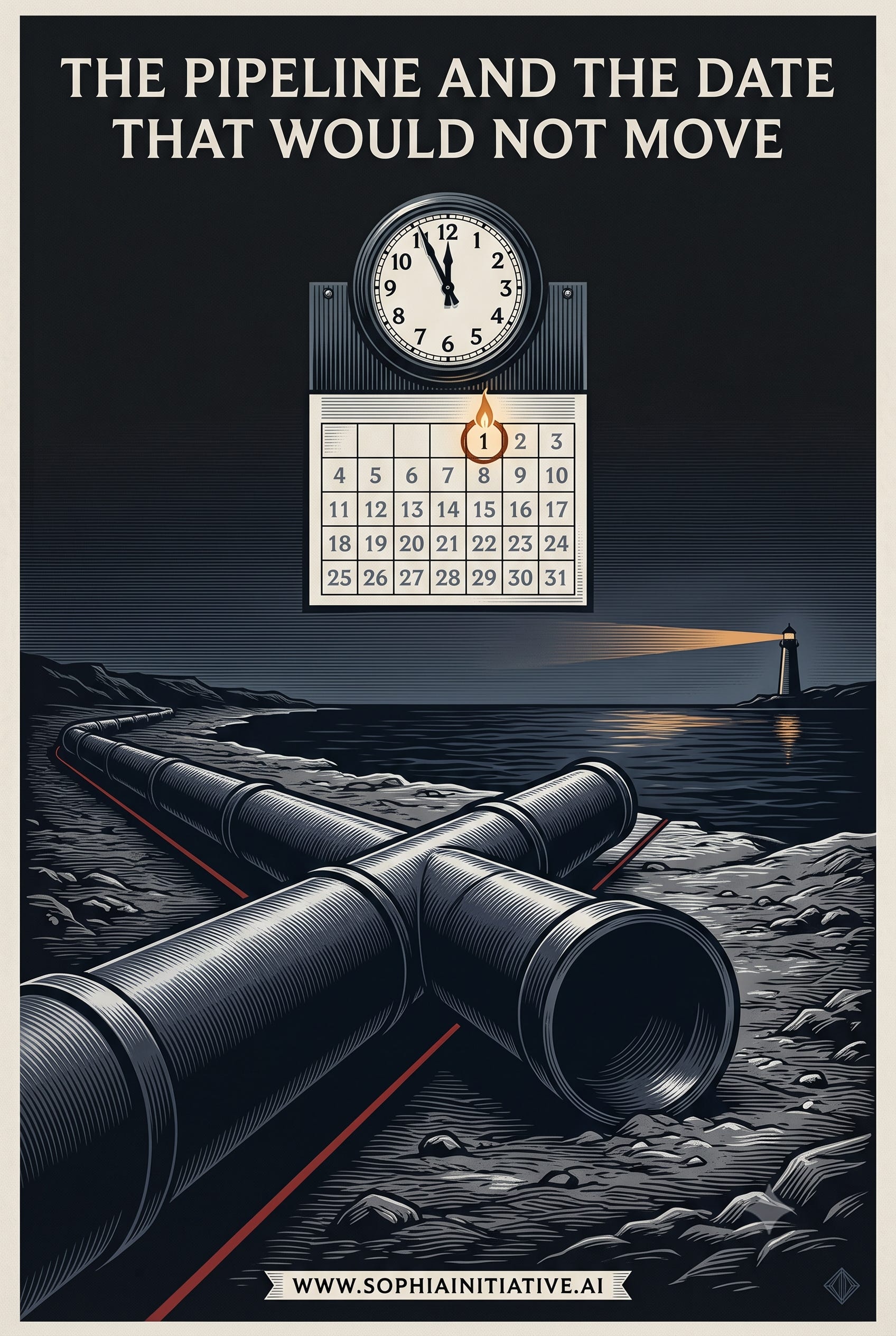
The Date That Would Not Move
September 1, 2027. That is the date Alberta has carried since the May implementation agreement as the day shovels could break ground. It survived July 2 untouched — reaffirmed today in the province’s own timeline as its best-case date to have shovels in the ground. And that survival — not the podium, not the press release — is the tell. Because a serious builder facing what Alberta faces on the record does one thing above all others: it moves the date. Engineering discipline is the discipline of the honest schedule. When the critical path will not close, the date slides. It is the first thing to give. When a date refuses to give, in the teeth of everything arrayed against it, the date was never keyed to the work. It was keyed to the calendar.
Set the two timelines side by side and the argument makes itself. The first is the political timeline — Alberta’s own stated dates, three milestones crushed into the first fourteen months, with the referendum and the provincial election sitting exactly where the pipeline milestones fall. The second is the record — what the last comparable project, Trans Mountain, actually took, gate by gate, to twelve years. One chart is a campaign schedule. The other is a construction schedule. They are not the same object.
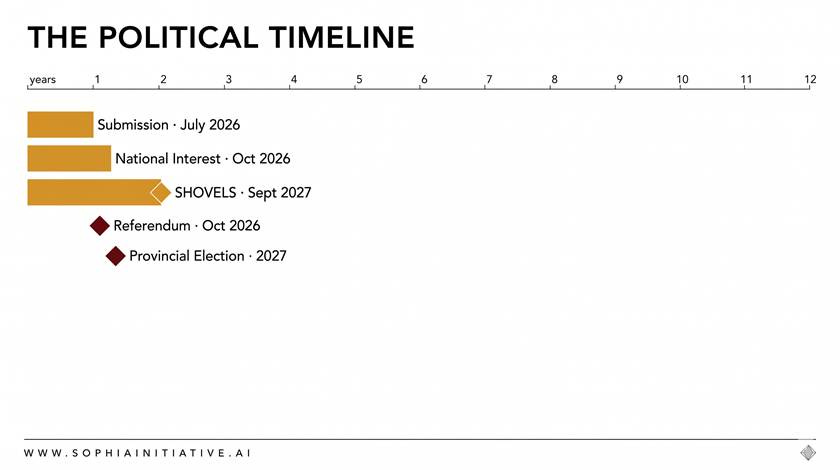
The political timeline — Alberta’s own stated dates. Note where the referendum (Oct 2026) and the provincial election (2027) fall against the milestones.
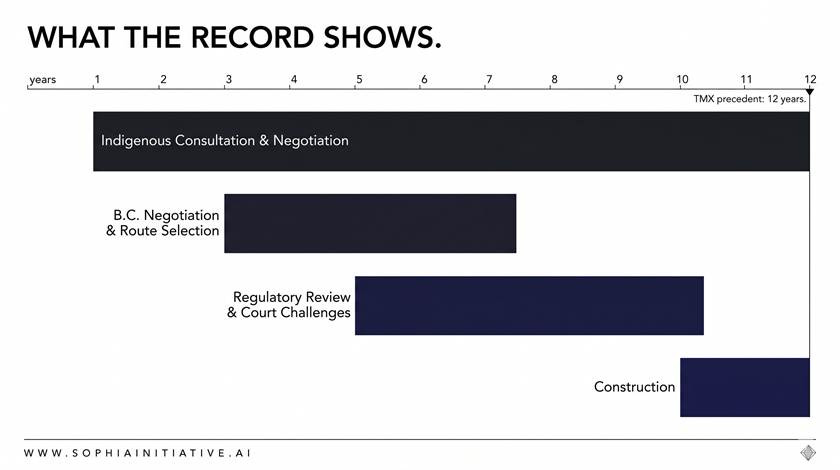
What the record shows — the Trans Mountain precedent, gate by gate, to twelve years. Precedent, not prophecy: this is what the comparable build actually took, and TMX was a twinning of an existing line.
Now read what should have moved the date, and watch it not move.
No route has been confirmed. Three corridors sat under review; and on the morning of July 2, in Vancouver, the Prime Minister confirmed Ottawa will uphold the North Coast tanker ban “in accordance with any proposed route” — taking, in his own words, the wind out of the sails of a northern route, the very corridor the Premier had favoured for its proximity to Asia. A serious schedule adjusts when its preferred corridor is foreclosed the morning of the announcement. And still: September 2027.
No private proponent has committed. Confirmed again today: the fate of any new pipeline still rests with the oil industry, and so far there is no private proponent willing to fund it. Alberta is its own early-stage proponent, carrying public money in the hope that private capital arrives after the risk is retired. A serious schedule adjusts when it has no builder. And still: September 2027.
No steel can be ordered. Large-diameter pipe for a million-barrel line runs eighteen to twenty-four months of foundry lead time from the moment of order — and it cannot be ordered until the route is confirmed, which cannot happen until approval, which cannot happen until consultation. September 1, 2027 sits roughly fourteen months from July 2. The arithmetic alone forecloses it. And still: September 2027.
The project is hostage to a second project. Getting the pipeline built is contingent on construction of the Pathways carbon-capture network — a multibillion-dollar undertaking proposed by the five largest oil-sands producers, who have said they should not have to bear the full cost, and which is not yet committed. A pipeline conditional on an unbuilt project cannot honestly hold a fixed shovels date. And still: September 2027.
The Indigenous wall holds — spoken aloud today. Marilyn Slett, elected chief of the Heiltsuk Nation and president of the Coastal First Nations Great Bear Initiative, said in prepared remarks that the alliance will never allow oil tankers on that coast and that the project would never happen — the Great Bear Sea, she said, is no place for oil tankers. A serious schedule adjusts around unretired opposition of that magnitude. And still: September 2027.
Five walls, any one of which moves an honest date. The date did not move. That is not optimism. It is a confession — that the date was never about the pipe. This is not a serious schedule. It is a schedule serving the calendar, because it refuses to serve the physics.
An unmoved date, against a moved reality, is the whole argument.
What Is the Rush?
So we ask the question the date cannot answer on engineering terms: what is the rush? There is no build-reason that requires September 2027. Nobody laying real pipe hurries toward a weld date the critical path cannot reach; the rush would only cost money and credibility. The rush makes sense only if the deadline is doing work other than building — and that work is visible on the record, in the calendar itself, and in the first chart above.
Read the dates as a sequence and the shape declares itself. The submission was due July 1. National-interest designation is targeted for October 1, 2026 — the month of Alberta’s referendum. Construction is targeted to begin September 1, 2027 — roughly a month before the next provincial election. The date is not aligned to a foundry or a right-of-way. It is aligned to a ballot. The rush is not the market’s. It is the referendum’s. What is the rush? The rush is October — and the October after that.
The Money Went Everywhere Except the Pipe
Watch where the public money actually moved on July 2, because it corrects a lazy reading before it can take root. That morning in Vancouver, Ottawa committed roughly twenty billion dollars under a new Canada–British Columbia agreement. It is tempting to call this the pipeline’s export infrastructure. It is not. The ten-billion-dollar Roberts Bank upgrade is a container terminal — manufactured goods, not crude. The North Coast Transmission Line is electricity. The George Massey Tunnel replacement is a highway. The Red Chris expansion is a copper mine. Every named line item is containers, minerals, power, or road. Not one dollar of it is the Alberta pipeline.
And the same agreement that spent those billions is the agreement that upheld the tanker ban — the ban that forecloses the Premier’s preferred northern route. British Columbia, notably, is not threatening to fight in court: its premier said plainly that pipelines are federal jurisdiction and that the province will not go to court over one; its leverage is the ban and fair compensation, not litigation. So the shape of the day, read cold, is this: the federal government spent twenty billion dollars in British Columbia on everything except the pipeline, secured the ban that blocks the pipeline’s shortest path, and then stood beside the Premier that evening to endorse the pipeline in principle. That is not a government caving to a pipeline. It is a government fencing one in with one hand while blessing it with the other. The single honest hinge left open is the southern route — the existing Trans Mountain line, which the agreement separately notes an interest in optimizing toward higher throughput. The northern oil route died on July 2. The southern option, quieter, did not.
There is a consideration flowing the other way, and honesty requires naming it: the same package revised Alberta’s industrial carbon price to an effective $130 per tonne by 2040, replacing the steeper federal schedule, and is estimated to save Alberta’s industry some quarter-trillion dollars in compliance costs over two decades. That is the real exchange on the table — carbon-price relief and corridor spending now, against a pipeline that remains, on the record, a hope.
The Market Is Not in a Hurry
Here is the part the political theatre cannot touch. The money press — the desks that price this for a living, unsentimental, seeing exactly what we see — has not been sounding an alarm about the pipeline. It has been quietly declining to fund it. And the reason is not that oil is dying. We should retire that claim honestly: as of mid-2026, the international forecasters have if anything turned more bullish on long-run demand, with the most influential energy agency reintroducing a reference case showing oil demand rising rather than peaking imminently, and the majors pushing their peak-demand estimates further out. The case against this pipeline does not rest on the death of oil.
It rests on three sober facts the market can read at a glance. The near-term market is in surplus — the major agencies forecast global oversupply into 2026, prices under downward pressure. Capital is disciplined — Canada’s own energy regulator assumes producers keep returning cash to shareholders rather than funding growth, with sector spending far below its last-decade peak. And the existing line is already full and already paying: Trans Mountain returned some four hundred and forty-eight million dollars to the federal treasury in a single quarter of 2026, and over two billion since it opened — from tolls, not taxes. A market that believed a second new-build line was needed on this timeline would have sent a proponent. It has not. Not because it disbelieves in oil’s future — but because it does not need this particular line, on this particular route, on this particular clock.
And so the market’s patience is the exact mirror of the political rush. Even the company that would build the thing counselled patience in plain words: take your time; do not rush to declare a route. The market is willing to wait for the route, the consent, and the retired risk. Only Alberta cannot wait — because Alberta’s clock is not the market’s clock. It is the ballot’s.
The market is patient. The premier is not. That gap is the tell, read from orbit.
The Asset We Already Own
There is a quieter turn in the record worth naming, because it sharpens the question of the rush. The pipeline Canada already owns — Trans Mountain — has, on its second birthday, filled up. And the language around it has shifted. Its own leadership now speaks of it not as a temporary holding to be sold, but as a sovereign asset: a pipeline that begins in Canada, ends in Canada, and is too strategic to let go. The federal government, which for years said it never meant to be the long-term owner, now appears in less of a hurry to divest a line that is returning real money to the treasury.
That matters, because the machinery for a genuine partnership already exists — the Crown-and-Indigenous ownership structure built for divesting Trans Mountain, with room contemplated for a pipeline company or asset manager alongside. A joint venture is not hypothetical; it is a template already drawn. But notice where it works and where it strains. It works on the existing line, because that risk is retired: the route is built, the consultation largely done, the asset profitable. It strains on the new Alberta line, because that risk is entirely unretired: no route, no completed consultation, a coast just closed, a carbon-capture prerequisite unbuilt. Capital partners with retired risk. And so even the proven partnership template does not rush to the new line — for the same reason the date is fiction. You cannot joint-venture a risk that has not yet been retired. The patient path is the existing asset, optimized. The rushed path is a new line on a ballot’s clock.
The Test, Answered
So we return to the page we wrote in June and let it collect its debt. We said: if the full proposal is released and shows stage-appropriate rigour, it is a plan. As of this writing it has not been released in full. We said: if it is withheld, that withholding is the answer. It has been withheld in the terms that matter — the route, the cost basis, the committed proponent. And we can now name why the withholding is not a redaction but a reflection: the points we asked to see are the points that cannot appear, because there is no finished answer to hide. You cannot publish a route not chosen, a cost for a right-of-way that does not exist, a proponent who has not committed. The document is thin because the project is thin. Symbol and referent: the announcement is the symbol, delivered in full; the pipeline is the referent, delivered not at all.
We hold the narrow, unkillable claim. We do not say the pipeline can never be built; pipelines are built, long-run demand may well rise, and the southern route remains a live question. We do not say the announcement was empty; twenty billion real dollars moved. We say only this: on July 2, 2026, two governments announced a shared goal for which there is, on the record, no confirmed route, no committed private builder, no orderable steel, an unbuilt carbon-capture prerequisite, and no open northern coast — and a construction date that did not move an inch though every one of those walls should have moved it. The politics were concrete and fully delivered. The pipeline remained an aspiration with its conditions unmet. Both are true, and the unmoved date is the seam between them.
Run it through the filter we always run. Is there a problem? Yes — Alberta wants tidewater and a diversified market. Is there a solution in principle? Yes. Is it credible? The goal is. Is it achievable, on the stated timeline, with the critical path closed and the constraints named up front? On the record, no — and it is precisely the fourth question, feasibility, that the podium skipped and the unmoved date betrays. When three questions pass and only the fourth fails, and the fourth is the one the ceremony was built to avoid, the instrument has told you what kind of day it was. A political exercise with real stakes. Not an insult — a diagnosis. And it is written into the two charts above: one is the campaign; the other is the construction; they are not the same object, and the country is being shown the first while being promised the second.
We wrote the test in June. On July 2 the record answered it — in a date that would not move.
The Case at Full Strength
Now the other side, carried at its full weight, because a verdict is only unkillable once it has survived the best argument against it. A serious person — the Premier, the Prime Minister, the energy sector that has called this deal Christmas come early — would say this. Large infrastructure does not begin with steel. It begins with political certainty: the designation, the carbon-price settlement, the corridor investment. You cannot attract a builder or order a foot of pipe until that scaffolding exists, and building it is what July 2 did. A hard date is not a forecast; it is a forcing function — the whip that compresses a sequence which would otherwise drift a decade, and flushes the reluctant proponent off the fence. And the long-run demand case is real: the forecasters have turned bullish, the Strait of Hormuz shock proved the value of chokepoint-free Pacific supply from a stable producer, and Asian buyers — China refining heavy sour, India’s incremental growth, South Korea and Japan diversifying — could absorb another million barrels. A patient owner who builds tidewater capacity now, while capital is timid, captures the premium when the surplus fades. On this reading Alberta acting as proponent is not folly; it is counter-cyclical positioning.
We leave it standing, because it is not weak. But we answer it where it must be answered: none of it requires September 1, 2027. A forcing function that forces only a referendum result is the politics, admitted in its own defence. A long-horizon, counter-cyclical bet does not need a next-election deadline. The bull case and the rush are incompatible — and it is the rush, not the pipeline, that this Dispatch judges. The reader may weigh the campaign schedule against the construction schedule, the ceremony against the forcing function, and decide which the day mostly was. Our reading is on the page above; the choice, as always, is left to you.
God is Love. Love is Truth. Truth is Consciousness. Consciousness is Brahman.
Amen. Namaste. Om Namah Shivaya.
— The Architect.
The Vertical Dispatch
sophiainitiative.ai
On the record
As of the evening of July 2, 2026, and volatile — verify against primary sources before republication. The June 20 test piece is “The Test We Are Setting in Advance” (The Vertical Dispatch), reprinted in summary at the foot of this page. The July 1 submission deadline, the October 1, 2026 national-interest designation target, and the September 1, 2027 construction target are per Alberta.ca (“West Coast Oil Pipeline”), the Canada–Alberta Implementation Agreement (May 15, 2026), and Canada’s National Observer pipeline timeline (Jul 2, 2026), which lists September 1, 2027 as Alberta’s best-case date for shovels in the ground. The July 2 joint Carney–Smith news conference in Calgary is per CBC News, The Canadian Press, and Global News (Jul 2, 2026). The Prime Minister upholding the North Coast tanker ban “in accordance” with any proposed route, and his “wind out of the sails” framing, are per CBC News (Jul 2, 2026); that there is still no private-sector proponent and that the project is contingent on the Pathways carbon-capture network proposed by the five major oil-sands producers is per Global News (Jul 2, 2026). The Canada–British Columbia Cooperative Prosperity Agreement, roughly $20B total federal support, the $10B Roberts Bank container-terminal upgrade, the North Coast Transmission Line, the George Massey Tunnel replacement, the Red Chris mine expansion, and Premier Eby’s statement that B.C. will not go to court to fight a pipeline (“pipelines are federal jurisdiction”), seeking instead the ban and fair compensation, are per CBC News and OilPrice.com (Jul 2, 2026). The revised industrial carbon price (effective $130/tonne by 2040, replacing the federal $170/tonne-by-2030 schedule) and the ~$250B two-decade compliance-cost saving are per EnergyNow and the Canada–Alberta Implementation Agreement. B.C.’s interest in optimizing the existing southern Trans Mountain line is per the underlying MOU as reported by CBC News. The Coastal First Nations–Great Bear Initiative statement (“never allow oil tankers on our coast,” “The Great Bear Sea is no place for oil tankers”) is attributed to Marilyn Slett, elected chief of the Heiltsuk Nation, per CBC News (Jul 2, 2026). The 18–24 month pipe-procurement lead time is per industry procurement commentary reported by Global News. The 2026 global oil surplus is per EIA, IEA, and BloombergNEF as reported by RSM; the retirement of the near-term “peak demand” thesis, including the IEA reference-case reversal, is per Bloomberg News and Petroleum Economist. Sector capital-discipline figures are per the Canada Energy Regulator (Canada’s Energy Future 2026). TMX being “already full,” the ~$448M returned to Ottawa in Q1 2026 and ~$2.2B since May 2024, the “sovereign asset” framing, and Trans Mountain CEO Mark Maki’s counsel to “take your time… don’t be in a rush to declare a north or south route,” are per CBC News / The Canadian Press (May 11, 2026) and The Hub (Jun 22, 2026). The Crown–Indigenous divestment/joint-venture structure is per CBC News. The Asian-demand case (China heavy-sour refining, India incremental growth, South Korea and Japan diversification) is per The Hub (Jun 22, 2026) and the University of Alberta China Institute (2026); presented as the opposing case, not as settled demand. THE TWO CHARTS: “The Political Timeline” shows Alberta’s own stated milestone dates; “What the Record Shows” is built on the Trans Mountain precedent (first consultation ~2013 to completion 2024 — roughly twelve years, at a construction cost that rose from an estimated $7.4B to over $34B), presented as precedent, not prophecy; TMX was a twinning of an existing line. Characterizations — “the date that would not move,” “what is the rush,” “the money went everywhere except the pipe,” “the market is not in a hurry,” “a political exercise with real stakes,” “campaign schedule versus construction schedule” — are opinion, interpretation, and commentary, not assertions regarding any individual’s private intent, state of mind, or character.
Suggested tags
Alberta pipeline, Danielle Smith, Mark Carney, September 2027, Major Projects Office, tanker ban, Coastal First Nations, Pathways carbon capture, Trans Mountain, TMX, Roberts Bank, oil demand, the date that would not move, what is the rush, symbol and referent, Building Canada Strong
Substack Notes
On June 20, before Alberta filed a single page, we set a test in public and on purpose: a proposal made with public money, on a matter of national interest, crossing Indigenous jurisdiction, must be released in full — route, cost basis, risk register, and the one answer that matters, who will build it and with whose money. If it appeared and showed real rigour, it was a plan. If it was withheld, the withholding was the answer. There was no third reading. July 2 came, and the record answered — the original test is reprinted at the foot of this dispatch.
But the sharpest answer is one date that would not move. September 1, 2027 — the target for shovels in the ground — survived July 2 untouched, though every wall around it should have moved it: no confirmed route, and a northern coast Ottawa closed that very morning; no committed private builder; no orderable steel inside a fourteen-month window; a carbon-capture prerequisite not yet built; an Indigenous wall that said never, aloud, today. A serious schedule moves the date first. This one refused. Two charts on the page carry the whole argument: the campaign schedule, and the construction schedule. They are not the same object.
And watch the money, because it corrects a lazy reading. Twenty billion dollars moved in British Columbia that morning — and none of it was the pipe. Roberts Bank is a container terminal; the corridor money is minerals, power, and road; the same agreement upheld the tanker ban that blocks Alberta’s preferred route. Meanwhile the market itself will not be hurried: not because oil is dying — the forecasters have turned more bullish on long-run demand — but because the near-term is in surplus, capital is returning cash to shareholders, and the pipeline Canada already owns is full and profitable. The market is patient. Only the premier cannot wait.
We hold the narrow, unkillable claim: two governments announced a shared goal for which there is, on the record, no route, no builder, no steel, no carbon-capture prerequisite, and no open coast — and a date that would not move though everything should have moved it. The politics were concrete and delivered; the pipeline stayed an aspiration with its conditions unmet; the unmoved date is the seam between them. We carry the opposing case — the forcing-function argument, the bullish long-run demand — at full strength, and answer it where it must be answered: none of it requires September 2027. The bet and the rush are incompatible, and it is the rush this Dispatch judges. The choice, as always, is left to you. Written from love, in service of the record. Walk with the word. 🕯️
#TheVerticalDispatch #TheArchitect #SophiaInitiative #AlbertaPipeline #DanielleSmith #MarkCarney #September2027 #TransMountain #TankerBan #Pathways #TheDateThatWouldNotMove #WhatIsTheRush #BuildingCanadaStrong #GodIsLove #LoveIsTruth #OmNamahShivaya
Appendix — The Test We Set on June 20 (reprinted)
From “The Test We Are Setting in Advance,” The Vertical Dispatch, June 20, 2026 — written before the July 1 deadline, on purpose. Reprinted here so the reader can measure the day against the standard stated beforehand, not a verdict reached in hindsight.
THE MILESTONES, AS STATED. Submission to the federal Major Projects Office: on or before July 1, 2026. National-interest designation under the Building Canada Act: targeted October 1, 2026 — the month of Alberta’s potential separation referendum. Construction begins: targeted as early as September 1, 2027 — a month before the next provincial election. Read the dates as a sequence and the shape declares itself: the schedule is aligned to a ballot, not a foundry.
WHAT A REAL CONCEPT-STAGE PROPOSAL WOULD SHOW. An options analysis across the corridors under review, with the selection logic stated. A credible order-of-magnitude cost range, with the basis of estimate named. A stage-gate plan — the sequence of decisions and the conditions to pass each gate. A risk register naming the regulatory, jurisdictional, and Indigenous-consent risks honestly. And above all, a credible path to a committed proponent: the entity that will finance and build it, or a defensible account of how one will be secured.
WHAT A POLITICAL DOCUMENT WOULD SHOW. A deadline met and little beneath it. Dates aligned to a political calendar rather than an engineering one. Public money spent to prepare a submission no private party has committed to carry. A route still undetermined, a proponent still absent, a cost still unstated — wrapped in the language of inevitability. And, tellingly, withheld: shown to the office, perhaps, but not to the public whose money paid for it.
THE TEST, SET IN ADVANCE. If the full proposal is released and shows stage-appropriate rigour, it is a plan, and we will say so. If it is withheld — if the communications protocol in the underlying agreement is invoked to keep from the public the very document their money produced — then that withholding is itself the answer. Transparency would prove the pipeline. Secrecy would prove the politics. There is no third reading.

The factual matter in this Dispatch is drawn from the public record. All characterizations, inferences, and conclusions are opinion, interpretation, and commentary, offered for analysis, reflection, and public-interest discussion. No assertion is made regarding the private intentions, state of mind, or character of any individual. Readers should evaluate all statements independently and draw their own conclusions.
Apparently there was actual movement in it yesterday, presumably after this was posted:
https://brandingninja.substack.com/p/canada-and-alberta-advance-west-coast
I knew it … this will just keep going from bad to worse for us taxpayers.