


Φ
THE VERTICAL DISPATCH
We write for the mind, the eye, and the ear.
Read it. Look at it. Listen to it. The Vertical Dispatch is built for all three — prose with rhythm, made to be heard as much as read.
From metaphysics to geopolitics, from culture to history, from the sacred to the street — and everything in between. One lens, every subject. No ego. Just the record, named clean.
Press play. Walk with the word. 🕯️
This dispatch travels by hand. If it serves you, share it — restack on Substack, and pass it on wherever you read. 🕯️
The Age of Consequences · Building Canada Strong
As of June 20, 2026 — written before the July 1 deadline, on purpose
“It’s a plan for a plan for a plan.”
— Alberta Counsel, on the Smith–Carney pipeline agreement
A word about standing, first, because the discipline of this Dispatch requires it. I am not a Primavera project scheduler. I have worked with project management at the concept level — enough to know the difference between a plan and a promise, between a document that resolves to real artifacts and one that resolves to a press release. That is the standing from which this is written: not the expert’s, but the informed citizen’s, asking the question any informed citizen may ask. Where is the work?
On or before July 1, 2026, Alberta will submit its proposal for a one-million-barrel-a-day bitumen pipeline to British Columbia’s northwest coast to the federal Major Projects Office. We are writing this before that date, deliberately. The purpose is to set down, in public and in advance, the standard against which July 1 should be measured — so that whatever is released on that day is read against a test stated beforehand, not against a verdict reached in hindsight. This is how the Dispatch reads any stated commitment: name the test first, then let the record answer.
What a Real Concept-Stage Proposal Would Show
Let us be fair to the stage. A proposal submitted to a major projects office is not an execution plan; no one expects a fully loaded construction schedule at the concept gate. The parties themselves describe Alberta as acting “as proponent in the initial stages.” So the test is not whether they produce a detailed critical-path schedule — it is whether they produce the rigour that genuinely belongs at this stage. That is a knowable list, and it is the right one to measure against.
A serious concept-stage submission would show: an options analysis across the corridors actually under review, with the selection logic stated. A credible order-of-magnitude cost range, with the basis of estimate named. A stage-gate plan — the sequence of decisions, and the conditions that must be met to pass each gate. A risk register that names the regulatory, jurisdictional, and Indigenous-consent risks honestly. And above all, a credible path to a committed proponent: the entity that will actually finance and build the thing, or a defensible account of how and when one will be secured. These are not exotic demands. They are the ordinary contents of a real plan.
What a Political Document Would Show
A political document, by contrast, would show a deadline met and little beneath it. It would show dates that align suspiciously well with a political calendar rather than an engineering one. It would show public money spent to prepare a submission that no private party has committed to carry. It would show a route still undetermined, a proponent still absent, and a cost still unstated — wrapped in the language of inevitability. And it would, tellingly, be withheld: shown to the office, perhaps, but not to the public whose money paid for it and whose coast it crosses.
We do not assert which of these July 1 will be. We are setting down, before the day, what each would look like — so the reader can judge for themselves when the day comes.
What the Record Already Shows
Some of the answer is already on the public record, and it is worth stating plainly, because it shapes what July 1 can credibly contain.
Alberta is the proponent. Not a private company — the province itself, “acting as proponent in the initial stages,” spending roughly fourteen million dollars of public money to flesh out the project, in the stated hope that private and Indigenous backers will step forward once it has cleared regulatory approval. That sequence is the tell: the capital is expected to arrive after the risk has been retired by the public, not before.
No private proponent has committed. Three companies — South Bow, Enbridge, and Trans Mountain — sit on a technical advisory group. That is real, and it should be stated precisely: they are advising. None has signed on as the principal proponent, and none has committed to finance or build the line. Advisory is not proponent; proponent is not committed capital. The distinction is the whole matter. And the industry has said why, on the record: a former chief executive of one of the country’s largest producers has stated plainly that, given the regulatory, political, and legal risks and the history of write-downs, no chief executive would presently take such a proposal to their board. That is not this Dispatch’s opinion. It is the industry’s own assessment of the capital question.
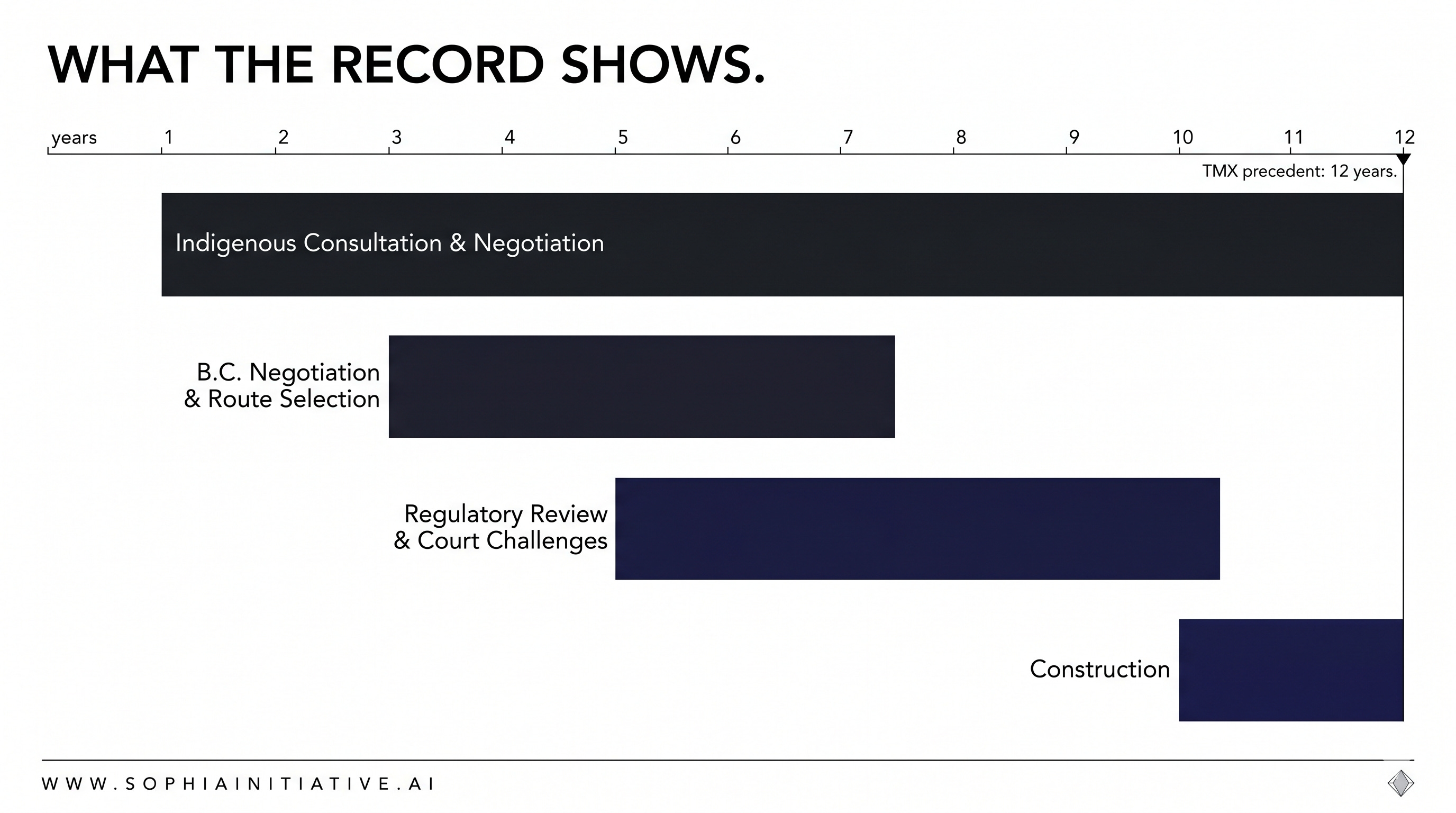
No route has been selected. Three corridors through northern British Columbia remain under review. Without a route there is no right-of-way, no civil profile, no permitting universe, and therefore no firm cost. B.C.’s premier, a coalition of coastal First Nations, and environmental groups have reiterated their opposition; the northern-coast tanker ban remains unresolved; and Ottawa’s own Indigenous advisory council to the Major Projects Office was, by its account, not given advance notice of the underlying agreement. Independent analysts have called the timeline a best-case scenario, and the 2027 construction target wildly ambitious.
The Calendar Is the Argument
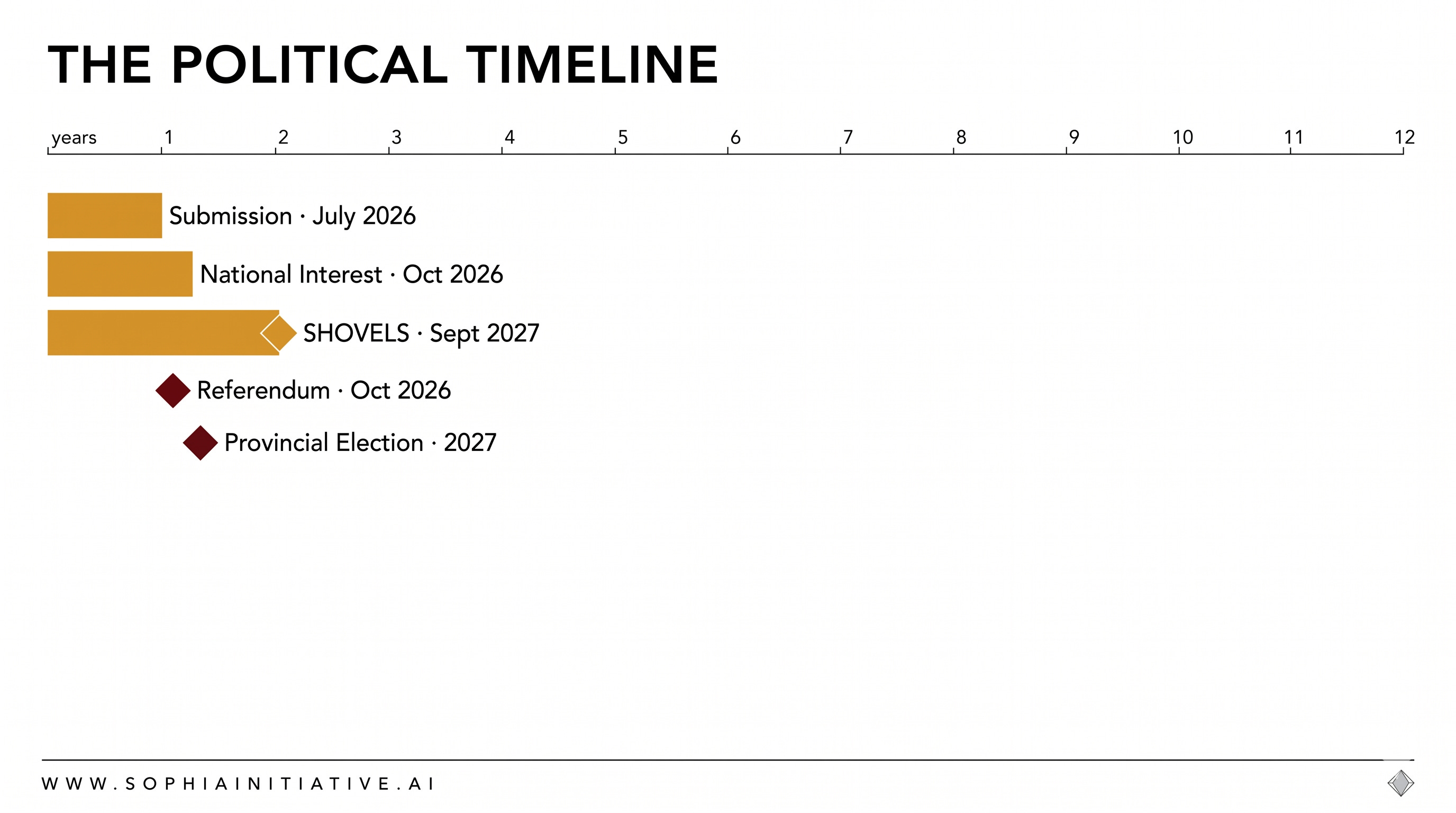
Read the dates as a sequence and the shape declares itself. The submission is due July 1. National-interest designation is targeted for October 1, 2026 — the month of Alberta’s potential separation referendum. Construction is targeted to begin as early as September 1, 2027 — a month before the next provincial election. As one Alberta legal analyst observed, for the governing party the dates matter almost as much as the project itself.
This is where the Go board replaces the chessboard. A chess player attacks one position. A Go player places a single stone that exerts influence across two regions at once. The July 1 submission is such a stone. It speaks to the provincial base — I am fighting for our resources, against an indifferent Ottawa — and it speaks to the national board — deal with me, or face the pressure building toward October. Whether it ever becomes a pipeline is almost a separate question from what it accomplishes on the board the day it is placed. We judge the move, not the heart behind it. The record shows a player keeping a seat on the national board while holding the threat of leaving it in reserve. That is skilled positional play. It is also, on the public record, a political function, whatever the private intent.
The Demand: Make It Public
Which brings us to the one demand this Dispatch will make, and the test it sets. The memorandum underlying this project contains a communications protocol: each party — federal and provincial — must agree before its content is released publicly. Both governments hold a veto over what the public is permitted to see.
We say plainly: a proposal prepared with public money, submitted on a matter of declared national interest, crossing Indigenous jurisdiction and bearing on the national-unity question, must be made public in full. Not summarized. Not briefed. Released. The options analysis, the cost basis, the stage-gate plan, the risk register, and the answer to the only question that finally matters — who will build it, and with whose money — belong to the citizens who paid for the work.
And here is the test, set in advance. If, on or about July 1, the full proposal is released and shows the stage-appropriate rigour named above, then it is a plan, and we will say so, and measure it fairly against this standard. If it is withheld — if the communications protocol is invoked to keep from the public the very document their money produced — then that withholding is itself the answer. A government that will not show its citizens the plan it made in their name has told them what the plan is for. Transparency would prove the pipeline. Secrecy would prove the politics. There is no third reading.
We have written down, before the day, exactly what we are watching for. On July 1, the record will answer. We will be reading it against this page.
The Corner Stones Were Already Placed

On May 13, 2026, an Alberta Court of King’s Bench justice quashed the Elections Alberta approval of the Stay Free Alberta separation petition. Justice Shaina Leonard ruled, without ambiguity, that the petition should never have been issued. Three hundred and two thousand signatures. A provincial government that argued in court for the process to proceed…
God is Love. Love is Truth. Truth is Consciousness. Consciousness is Brahman.
Amen. Namaste. Om Namah Shivaya.
Written from love, in service of the record. Walk with the word. 🕯️
— The Architect
The Vertical Dispatch
sophiainitiative.ai
On the record
As of June 20, 2026. The July 1, 2026 submission deadline to the federal Major Projects Office, the October 1, 2026 national-interest designation target, and the September 1, 2027 construction target are per Alberta.ca (“West Coast Oil Pipeline”) and the Canada–Alberta Memorandum of Understanding (Prime Minister of Canada, Nov 27 2025). Alberta acting “as proponent in the initial stages” and the ~$14M figure are per Alberta.ca and The Globe and Mail (Oct 4 2025). The technical advisory group of South Bow, Enbridge, and Trans Mountain is per BOE Report (Jan 6 2026); none is identified as the principal proponent or as committed to finance or construction. The industry assessment that no chief executive would presently take such a proposal to their board is attributed to former Cenovus CEO Alex Pourbaix as reported by The Globe and Mail. “A plan for a plan for a plan” and “no private-sector proponent attached… no final route selected” are per Alberta Counsel News. The three corridors under review, the chicken-and-egg consultation problem, and the “wildly ambitious” characterization are per CBC News (Jun 1 2026); B.C. opposition and the unresolved tanker ban per CBC (May 19 2026); the October referendum context per Alberta Counsel; the CIBC “best-case scenario” assessment per CBC. The Major Projects Office Indigenous advisory council’s statement that it was not given advance notice of the MOU is per Global News (Dec 12 2025). The communications-protocol clause requiring mutual agreement before public release is drawn from the underlying MOU. Characterizations — the “test,” the “Go board,” the “political function” — are commentary and interpretation, not assertions of any individual’s private intent. Date-stamped because this file is volatile; verify against primary sources before republication.
Suggested tags
Alberta pipeline, Danielle Smith, Mark Carney, Major Projects Office, July 1 deadline, bitumen, West Coast pipeline, the test stated in advance, transparency, Indigenous consent, Alberta referendum, project management, the record
Substack Notes
Alberta’s pipeline proposal is due at the federal Major Projects Office on July 1. We are writing before that date, on purpose — to set down, in public and in advance, the standard against which the day should be measured. Name the test first; then let the record answer. This is how the Dispatch reads any stated commitment.
A fair test respects the stage. No one expects a construction schedule at the concept gate. But a serious concept-stage submission would show an options analysis across the corridors, a credible cost basis, a stage-gate plan, an honest risk register — and above all a credible path to a committed proponent: the entity that will actually finance and build it. The record so far shows none of these. Alberta is its own proponent, spending public money; three companies advise but none has committed; no route is chosen; and an industry chief executive has said plainly that no board would presently approve it.
Read the dates as a sequence and the shape declares itself. Submission July 1. National-interest designation targeted for October — the month of a potential separation referendum. Construction targeted for the month before the next provincial election. This is the Go board, not the chessboard: a single stone placed to influence two regions at once. We judge the move on the record, not the heart behind it.
So we make one demand and set one test. A proposal made with public money, on a matter of national interest, crossing Indigenous jurisdiction, must be released in full — not summarized, released. The underlying agreement lets both governments veto disclosure. If the full plan appears and shows real rigour, it is a plan, and we will say so. If it is withheld, that withholding is the answer. Transparency would prove the pipeline; secrecy would prove the politics. Written from love, in service of the record. Walk with the word. 🕯️
#TheVerticalDispatch #TheArchitect #SophiaInitiative #AlbertaPipeline #DanielleSmith #MarkCarney #MajorProjectsOffice #July1 #Transparency #BuildingCanadaStrong #TheTestStatedInAdvance #GodIsLove #LoveIsTruth #OmNamahShivaya
The factual matter in this Dispatch is drawn from the public record. All characterizations, inferences, and conclusions are opinion, interpretation, and commentary, offered for analysis, reflection, and public-interest discussion. No assertion is made regarding the private intentions, state of mind, or character of any individual. Readers should evaluate all statements independently and draw their own conclusions.