


Φ
THE VERTICAL DISPATCH
We write for the mind, the eye, and the ear.
Read it. Look at it. Listen to it. The Vertical Dispatch is built for all three — prose with rhythm, made to be heard as much as read.
From metaphysics to geopolitics, from culture to history, from the sacred to the street — and everything in between. One lens, every subject. No ego. Just the record, named clean.
Press play. Walk with the words. 🕯️
The Age of Consequences · A Profile in Conduct
As of 7 June 2026
without malice and without flattery
“I really don’t care. I couldn’t care less.”
— Donald Trump, on whether the Iran peace talks collapse, CNBC, 1 June 2026
This dispatch travels by hand. If it serves you, share it — restack on Substack, pass it on wherever you read. 🕯️
A Note on Method
This is a profile, and a profile is interpretation. What follows reads the documented public record of a public figure through a single lens: the gap between the role a person performs and the conduct the record shows. Carl Jung gave us a useful word for the role — the archetype, the figure we step into and play before the world. A man may perform the Builder: the name in stone, the ribbon cut, the grand hall. Whether he is, in conduct, a builder is a separate question, and only the record can answer it. This dispatch makes no claim about what is inside the man — not his mind, not his motives, not his private knowledge. It claims only what the public record establishes about what he has done, and it sets that beside the role he performs. The reader draws the rest. That is the whole of the method, and its discipline is its honesty.
The Role: The Builder
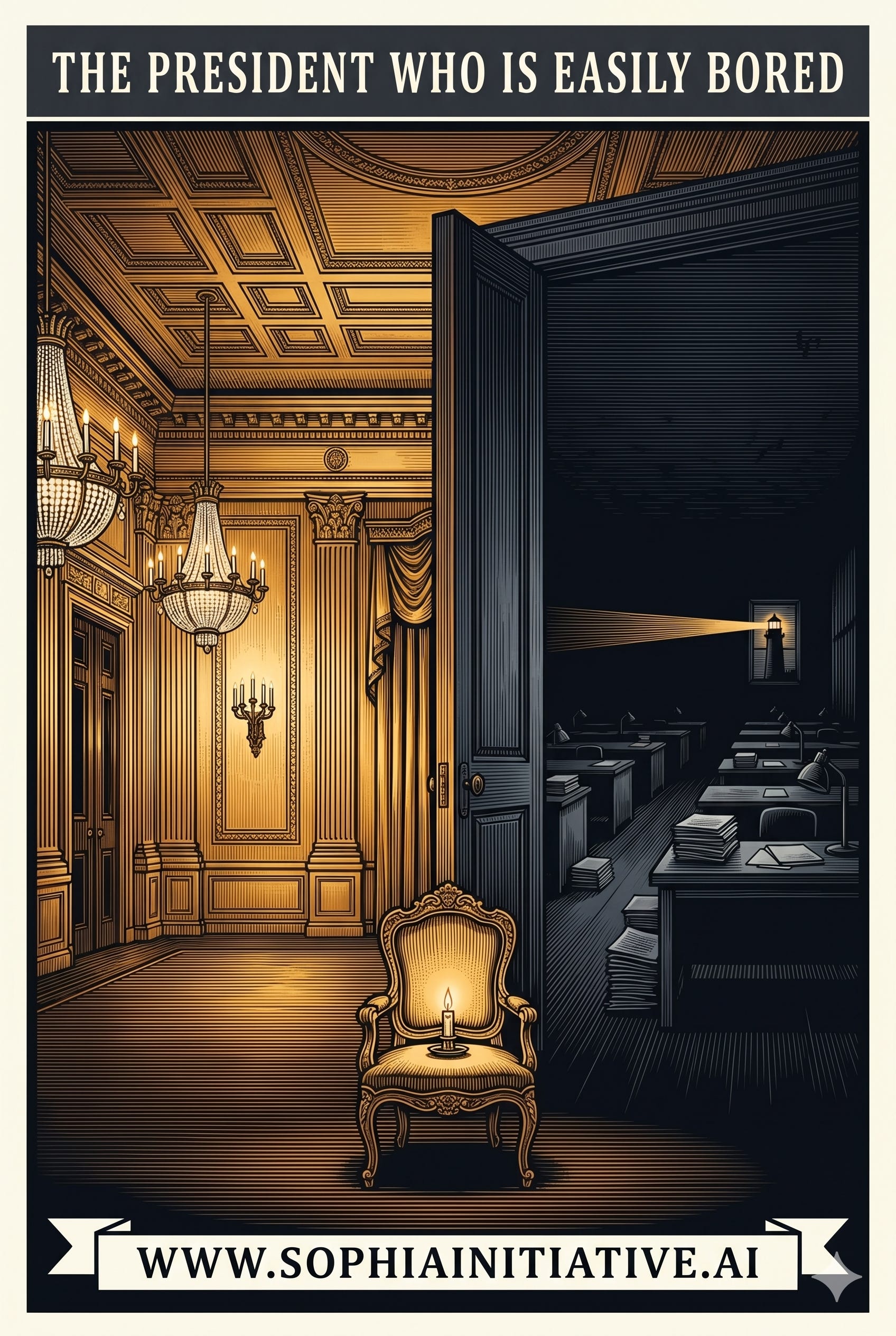
No one in modern public life has performed the Builder more completely. The name itself became the product — set in gold letters across towers on several continents, a brand sold as a synonym for having built. The performance is genuine in its detail: building his flagship tower, he flew to a quarry in Italy to choose the lobby marble personally, marking the best slabs with tape and scrapping the rest. Decades later he could still stand in a ballroom and point out the details of a ceiling he oversaw. This is real engagement — but mark where it falls. The lobby. The ballroom ceiling. The marble. These are the surfaces a camera sees. The performance of the Builder is, before anything else, an aesthetic performance, and its intensity tracks the photograph.
The Record: The Brander
Now the conduct, set beside the role. Of the dozens of towers that have worn his name across the world, the record shows that the great majority were licensing arrangements — his name leased to other developers who carried the cost, the construction, and the risk, in exchange for a fee. His own company routinely placed disclaimers on its property listings noting that the buildings were owned by separate companies and the name merely leased. A review of public records found that a large share of the buildings bearing his name in his own home city were not owned by him at all. Strip the leased name from the towers that merely wear it, and what he built from the ground up and still holds comes down, in the main, to the flagship — and even that he owns only in part, mortgaged. The empire, by the record, is largely a name. The Builder, in conduct, is mainly a Brander — and a brander does not stay for the daily operation, because the operation is someone else’s to run.
The record carries the cost of that distance, too. A review of public filings documented hundreds of liens and dozens of lawsuits over the decades from contractors and workers — painters, a dishwasher, electrical and construction firms — claiming they were not paid for work performed; on a single Atlantic City casino project, public records showed hundreds of subcontractors not paid in full or on time. His companies were cited for two dozen federal labour-standards violations since 2005, resolved by paying back wages. He has not disputed the practice; he defended it in his own words, saying he would deduct from the bill of anyone whose work he judged poor. These are filings and adjudicated findings — the record, not a characterization of it. They are consistent with a principal engaged with the picture and absent from the ledger.
Where the Camera Does Not Go
Hold the pattern up against the largest decision of the present moment, and it holds its shape. On the twenty-eighth of February, he launched a war on Iran — decisive, announced, photographed: the strikes, the address to the nation, the declaration of objectives. That is the opening of a war, and it is intensely photographable. What followed is the part no camera frames as triumph: the grinding diplomacy, the shifting timelines — four weeks, then five, then six, then “as long as we want” — the casualties, the stalemate. Public records and human-rights monitors documented more than a thousand civilian deaths, including hundreds of children, in the opening weeks. The Strait of Hormuz was choked; oil surged; the price of gasoline rose roughly fifty per cent from where it stood before the war, from about $2.98 a gallon to $4.48, with analysts warning it will not return for many months. The citizen pays that at the pump while the war’s middle grinds on, unphotographed.
And on the first of June, asked whether the talks to end it were collapsing, he answered, in his own words to CNBC: “I don’t care if they’re over, honestly. I really don’t care. I couldn’t care less,” adding that he thought the negotiations “started to get very boring.” Set that beside a single earlier line, also his, from March, when someone predicted he would tire of the war: “There’s nothing boring about this.” Nothing boring, in March, at the launch. Very boring, in June, at the grind. The word the record supplies is his own, at both ends. We do not say what it means inside him. We say only that the talks that would stop the dying and ease the pump he calls boring — and that the part of any war that is boring, by his own measure, is the part with no photograph in it.
Are We Surprised?
So to the question a reader is owed at the end of a profile: is this a surprise? On the conduct, no. The pattern is not hidden and it is not new. It runs from the marble to the ballroom ceiling to the gold name on other people’s buildings to a war opened with a flourish and abandoned, in word, at its hardest passage. There is a second instance the record offers without our reaching for it: a healthcare promise carried for the better part of a decade — the replacement always coming, the plan always nearly here, the detail never arriving — a concept performed and never built, until it too became something he seemed to prefer not to discuss. Concept, announcement, attention; then the long unglamorous middle, and the attention gone. That is the documented arc. A figure whose engagement is governed by the lens will be engaged where the lens is — and absent where it is not. The work of building, of governing, of ending a war, is overwhelmingly the part the lens never frames. No one who has read the record should be surprised that he finds it boring. The surprise would be if he did not.
This is not a verdict on the man’s worth, which is not ours to weigh, and it is not a claim about his mind, which is not ours to see. It is a profile of conduct against the role performed, and it ends where honesty requires: with the gap laid open and the meaning left to you. The Builder cut the ribbon. The building, in the main, was someone else’s. The war was opened with an address and called boring at the cost of the dead and the price at the pump. Whether that is the figure a moment of consequence requires is not a question this publication will answer for you. It is the question this publication exists to set, cleanly, before you.

God is Love. Love is Truth. Truth is Consciousness. Consciousness is Brahman.
Amen. Namaste. Om Namah Shivaya.
— The Architect
The Vertical Dispatch
sophiainitiative.ai
On the record — sources (as of 7 June 2026). Real estate: Trump licensed his name at least ~50 times; the majority of international Trump-branded developments are licensing deals in which other developers carry cost and construction (Washington Post; CREW). The Trump Organization places disclaimers on listings noting properties are owned by separate companies and the name is leased (Washington Post). CBS/NPR: a large share of buildings bearing his name are not owned by him; of buildings in his home city bearing the name, he owns a handful. Trump Tower (Fifth Avenue) is the building he developed ground-up and still holds in part; Forbes (2026) values his commercial/retail stake at ~$196M against ~$100M mortgage debt (companieshistory/Forbes). Contractors/labour: USA TODAY Network review of public records found at least ~60 lawsuits and 200+ mechanic’s liens alleging non-payment since the 1980s; ~253 subcontractors not paid in full/on time on the Taj Mahal casino (NJ Casino Control Commission records, 1990); 24 Fair Labor Standards Act violations since 2005, resolved by paying back wages (US DOL). Trump on record: he would “deduct” from contractors whose work he judged poor (USA TODAY). War/Iran: US–Israel strikes on Iran began 28 Feb 2026; shifting public timelines documented (PolitiFact; AP; ABC). Civilian deaths: human-rights monitors recorded at least ~1,443 civilian deaths including ~217 children through 23 March 2026 (PolitiFact compilation). Gasoline: U.S. average ~$2.98/gal just before the war; ~$4.48/gal as of early May 2026, ~50% higher, per AAA, with analysts (OPIS, GasBuddy) warning of a prolonged elevation tied to the Strait of Hormuz (Al Jazeera; Newsweek). Quotes: “There’s nothing boring about this” (March 2026, reported by CNN); “I don’t care if they’re over... I couldn’t care less... started to get very boring” (CNBC/Eamon Javers, 1 June 2026; corroborated by MSNBC transcript). Healthcare: a long-promised replacement plan repeatedly announced as forthcoming over roughly a decade without an enacted comprehensive plan (contemporaneous reporting). This is a profile: an interpretation of documented public conduct read through the lens of role-versus-record. It asserts nothing about any individual’s private mental state, cognition, motives, or knowledge, offers no clinical or psychological diagnosis, and makes no claim of unlawful conduct beyond the adjudicated findings cited. The Jungian “archetype” is used as a literary lens for public performance, not as a diagnosis of a person. The same method would be applied to any public figure of any party. No figure is disaggregated by race, group, or class. Figures are date-stamped and subject to revision. Errors and omissions excepted; corrections will be made on notice. Verify against primary sources before republication.
#ThePresidentWhoIsEasilyBored #DonaldTrump #IranWar #GasPrices #ProfileInConduct #FollowTheRecord #ConceptVsBuilder #StraitOfHormuz #TheAgeOfConsequences #TheVerticalDispatch #TheArchitect #SophiaInitiative #GodIsLove #LoveIsTruth #OmNamahShivaya
Substack Notes
A profile, read through one lens: the gap between the role a man performs and the conduct the record shows. He performs the Builder — the name in gold across towers on several continents, the lobby marble he flew to Italy to choose, the ballroom ceiling he still points to. But the record shows the Brander: the great majority of those towers were his name leased to other developers who carried the cost and the risk. Strip the leased name away and what he built ground-up and still holds comes down, in the main, to one flagship — owned in part, mortgaged. His own company’s listings carried disclaimers saying so.
The record carries the cost of that distance: hundreds of liens and dozens of suits from contractors and workers alleging non-payment over decades; 253 subcontractors unpaid on one casino; two dozen federal labour violations. He didn’t deny it — he defended it. A man engaged with the picture, the record suggests, and absent from the ledger. Engagement that tracks the photograph: intense where the camera looks, gone where it doesn’t.
Hold it against the war. He launched the strikes on Iran February 28 — decisive, announced, photographed. Then the unphotographed middle: shifting timelines, more than a thousand civilians dead including hundreds of children, the Strait choked, gas up ~50% from $2.98 to $4.48 a gallon and not coming back soon. And June 1, on CNBC: the talks to end it are “very boring” and “I couldn’t care less” if they collapse. In March, at the launch, he’d said “there’s nothing boring about this.” His own word at both ends — nothing boring at the flourish, very boring at the grind.
Are we surprised? On the conduct, no. The same arc shows in a healthcare plan promised for a decade and never built — the concept performed, the detail never arriving, until he seemed to prefer not to discuss it. Concept, announcement, attention — then the long unglamorous middle, and the attention gone. We make no claim about his mind; we read the record against the role. The Builder cut the ribbon; the building was mostly someone else’s; the war was opened with an address and called boring at the cost of the dead and the pump. Whether that’s the figure a moment of consequence requires — that question we set before you, and leave with you. Without malice and without flattery. Written from love, for a sacred humanity, in the full light of consciousness, toward the greater good. 🕯️
The factual matter in this Dispatch is drawn from the public record. All characterizations, inferences, and conclusions are opinion, interpretation, and commentary, offered for analysis, reflection, and public-interest discussion. This is a profile read through an interpretive lens; no assertion is made regarding the private intentions, state of mind, cognition, or character of any individual, and nothing herein is a psychological or clinical diagnosis. Readers should evaluate all statements independently and draw their own conclusions.