


Φ
THE VERTICAL DISPATCH
We write for the mind, the eye, and the ear.
Read it. Look at it. Listen to it. The Vertical Dispatch is built for all three — prose with rhythm, made to be heard as much as read.
From metaphysics to geopolitics, from culture to history, from the sacred to the street — and everything in between. One lens, every subject. No ego. Just the record, named clean.
Press play. Walk with the word. 🕯️
This dispatch travels by hand. If it serves you, share it — restack on Substack, and pass it on wherever you read. 🕯️
The Age of Consequences · Canadian Geopolitical Analysis · Part Two of Two
As of June 30, 2026
“You’re basically throwing up your hands and saying Canadians aren’t sophisticated enough to understand that the roof getting fixed is not money going into my personal pocket.”
— Rick Mercer, on the decades-long refusal to repair the Prime Minister’s residence
The Plastic and the Hair Dryer
In 2005, the comedian Rick Mercer visited Twenty-four Sussex Drive to interview the Prime Minister of Canada. What the two men did on camera has become a small national legend: they drove to Canadian Tire, bought rolls of plastic sheeting, and taped it over the drafty doors of the official residence of the head of government of a G7 nation, sealing it against the winter wind with a hair dryer. “It gets a little drafty here in the wintertime,” the Prime Minister quipped. It was played for laughs, and it was funny. It was also, in hindsight, a documentary. The most powerful office in the country was being weatherproofed like a student apartment, on television, because no one would spend the money to do it properly.
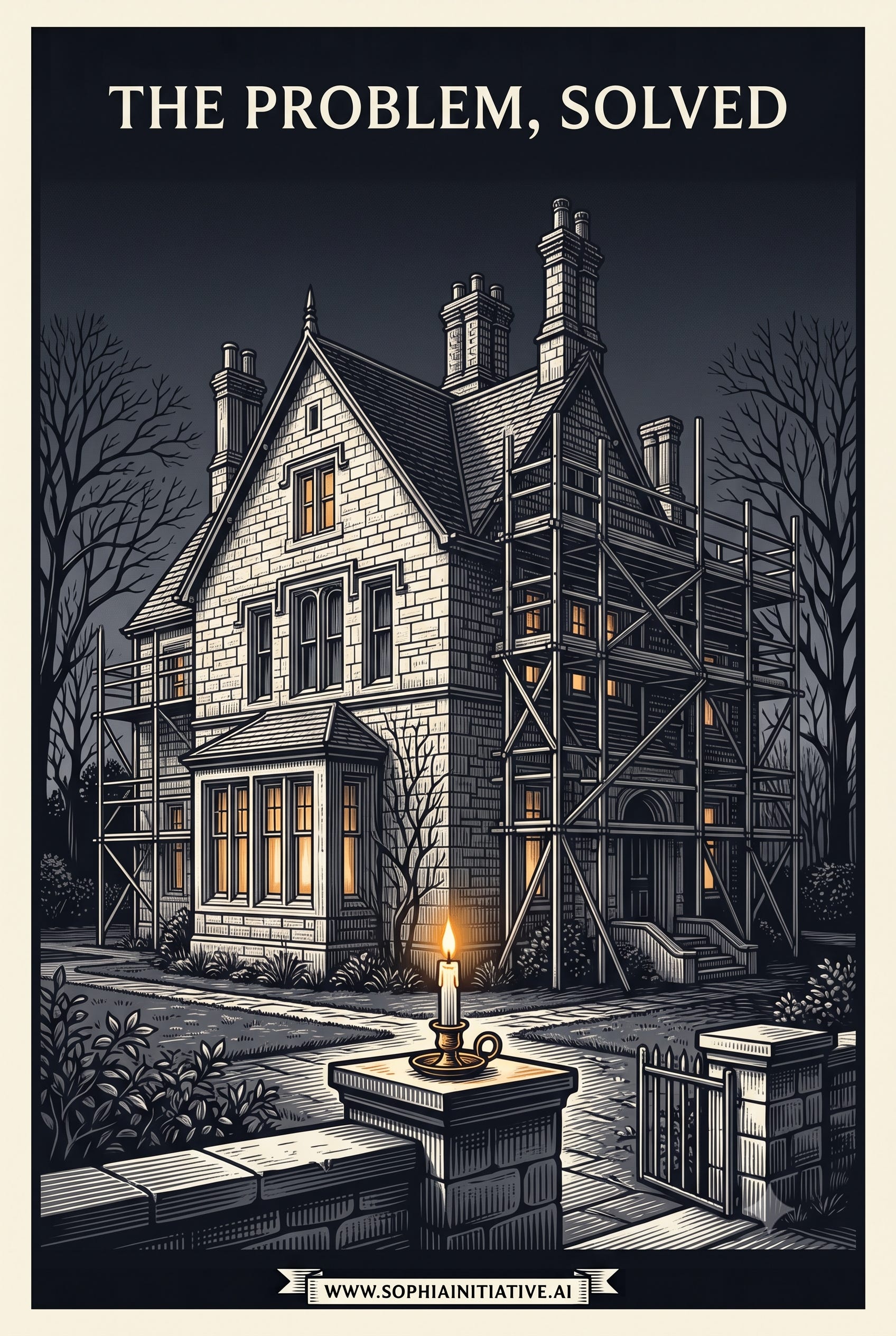
Part One of this series set out the trap: a house left to rot not because the money was absent or the law forbade the fix, but because ending the embarrassment paid no votes and cost political skin, while keeping it made a useful weapon. Part One ended on a test — a decision the current Prime Minister had promised for Friday, June 26. That Friday has come. The decision is on the record. And the record is worth reading closely, because it does something rare in this file: it solves the problem, and it solves it in the one way that takes the weapon out of everyone’s hand at once.
Let the Publisher Be Plain: The Rot Was Bipartisan
Before we credit any solution, let the record of the failure be stated without partisan favour, because the honesty is what makes the rest unkillable — and because this Dispatch will not let one party carry a blame that belongs to a whole political class. The house was called in “advanced disrepair” as far back as 1984. Jean Chrétien, a Liberal, refused the repairs. Paul Martin, a Liberal, taped plastic over the windows rather than fix them. Stephen Harper, a Conservative, lived in the house for a decade and, in the words of the record, simply ignored any and all advice to repair it — the years in which the building was best known as a shelter for the family cats. Justin Trudeau, a Liberal, declined to occupy or restore it for nine years, saying plainly that no prime minister wants to spend a penny of taxpayer money on the place. The law — the Official Residences Act — obligates the government to spend four percent of the building’s value on upkeep every year. It has essentially never been done, through governments of every stripe, for sixty years.
So when the house finally had to be gutted — asbestos, mould, rodents stripped out at public expense — the ruin was not one leader’s and not one party’s. It was the whole class’s, Liberal and Conservative alike, each preferring the small safety of doing nothing to the political risk of doing right. That is the trap Part One named, and the naming holds: the problem was worth more to everyone, unsolved, than the solved problem would have been to anyone. Which is exactly what makes the way out of it worth studying.
The Move That Played the Whole Board
Here is what was announced on Friday. Not a cheque from the treasury — which would have handed every opponent the oldest attack in the file, the image of a leader lavishing millions on his own mansion while citizens cannot pay rent. Instead: an independent national design-and-build competition, open to Canadian firms, to restore the house — paired with a national fundraising campaign run not by the government but by the Rideau Hall Foundation, a non-partisan charity, with no government influence on its decisions. The donations are capped, so no single donor can buy influence — no more than ten percent of the total from any one giver. Corporations are barred; anonymous gifts are barred; only individual Canadians, permanent residents, and philanthropic organizations may give. And the donor list will be made public. The Prime Minister will not live in the restored house himself. It is, in his words, for his successors, and for Canadians.
Set that beside the trap and the design becomes visible. Every attack that froze a decade of predecessors was closed off in advance. Spending public millions on the PM’s mansion? No public millions are being spent on the restoration. Buying influence through the residence? Capped, non-corporate, published. A partisan vanity project? Run by a non-partisan charity, endorsed by every living former prime minister, for a house the sitting PM will never occupy. Whatever the intent behind it — and this Dispatch does not read intent — the shape of the move on the board is unmistakable. Where a decade of leaders played checkers, taking the safe piece in front of them and losing the larger game while the house rotted, this was a move that looked several turns ahead and left the opposing replies weak. It did not win an exchange. It changed the board.
Where a decade of leaders played checkers — taking the safe piece in front of them while the house rotted — this was a move that looked several turns ahead and left the opposing replies weak. It did not win an exchange. It changed the board.
The Nation Named the Brand
Part One made a claim that some readers may have taken as the writer’s own flourish: that Twenty-four Sussex is not merely a building but the Canadian brand — a statement of the country’s standing, its sovereignty, its self-respect. That claim no longer rests on this Dispatch. In the days after the announcement, the nation named it in the same words. The President of the Rideau Hall Foundation said that for many Canadians the house is “a symbol of pride in the country… a symbol of our sovereignty… a symbol of our identity” — and added the telling observation that a campaign like this would not have drawn broad support five or ten years ago, “but we’re in a different time now.” The Foundation’s board chair called the house “a national institution and a symbol of Canada’s democratic continuity.” The Prime Minister called it “a symbol of the nation” that must again reflect “our ambition, excellence, and national pride.”
And then the citizens answered, which is the part no press release can manufacture. In the first weekend, more than two hundred Canadians gave from their own pockets — over fifty thousand dollars, an average gift of more than two hundred and fifty, climbing past a hundred thousand within days, against a goal the Foundation set at fifty million. The Foundation’s president said she was “floored.” These are not lobbyists or corporations; corporations are forbidden. They are ordinary people, in a season of renewed talk about Canadian sovereignty, choosing to pay to restore the house where their country receives the world. The brand Part One argued was being spent as ammunition turns out to be real, and shared, and — given the chance to invest in it rather than merely argue about it — backed with money by the people who own it. That is the referent catching up to the symbol. The claim is no longer ours. It is theirs.
The Case Against, at Full Strength
The discipline of this publication requires the opposing case put as strongly as its makers put it, and here it is real. First, and most principled: some Canadians object to the private-funding model itself — they hold that a public residence should be paid for by the public purse, plainly and fully, and that inviting private donors into a national institution, however capped and transparent, sets a precedent worth resisting. That is a serious argument and it does not go away because the safeguards are strong. Second: Twenty-four Sussex is contested symbolic terrain. For many Canadians — in the West, among Indigenous peoples, among those who read the federal symbols as central-Canadian or elite — the house does not command unambiguous pride, and a nationwide campaign around it can feel like a Laurentian story asking the whole country to salute. Third, and sharpest, and aimed at everyone including the man who solved it: it is easy for the former prime ministers to line up behind the restoration now, when none of them must wear the political cost. It would have been better had any one of them spent a dime of political capital on it when the house was theirs to fix. All three objections are true, and none of them is dissolved by Friday’s plan. The reader should weigh them.
The Reply From Stornoway
And the opposition’s reply is also on the record, and this Dispatch will do with it what it does with all conduct: lay it beside the facts and step back. Offered a plan engineered to spend no public money on the restoration, to bar corporations, to cap and publish every gift, to restore a house the Prime Minister will not live in — a plan, in short, stripped of every feature that could fairly be attacked — the Leader of the Opposition’s response, by the reporting, was that restoring the residence should be nowhere near the government’s priorities given the housing crisis facing young Canadians. He offered this, as Part One noted, while himself resident at Stornoway, the sound and fully-staffed official home of the Leader of the Opposition.
There is a real argument inside that reply, and it deserves its due: the housing crisis is real, young Canadians are genuinely squeezed, and a leader is entitled to name his priorities. But note what the reply is not. It is not a competing plan. It is not an amendment, a condition, an offer of cover, or a better idea. It is, once more, the posture Part One identified — indignation where a bill was never tabled, dismissal where the terrain was more useful than the repair. The Dispatch draws no verdict on the man; the keel forbids it. It draws the reader’s eye only to the shape of the thing. A matter the Foundation, the Prime Minister, and thousands of paying citizens have named a symbol of national sovereignty is, to the Leader of the Opposition, not worth thinking about — said from the one functional official residence in the story. The record asks only that you look.
A matter the nation named a symbol of its sovereignty is, to the Leader of the Opposition, not worth thinking about — said from the one functional official residence in the story. The record asks only that you look.
What Friday Revealed
So the test Part One posed has been answered, and the answer is the whole point of the Age of Consequences: given a matter of national standing, one man treated it as a problem to solve, and found the single path that solved it without handing anyone a weapon — and the nation, offered the chance, paid to prove the standing was real. Given the same matter, the opposition treated it, once more, as terrain to find a problem on, and found one. This Dispatch does not tell you to admire the first or condemn the second. It tells you what each did, on the record, in the same week, before the same house. The casualty in Part One was the Canadian brand, spent as ammunition. The recovery, in Part Two, is that the brand turned out to belong to the Canadians, who — handed the chance — chose to restore it themselves. The house will be set right. What Friday revealed is who, in this country, treats its standing as something to build, and who treats it as something to shoot with. Walk with the word. 🕯️

God is Love. Love is Truth. Truth is Consciousness. Consciousness is Brahman.
Amen. Namaste. Om Namah Shivaya.
— The Architect.
For the Canadians who paid, from their own pockets, to set the nation’s house right.
The Vertical Dispatch
sophiainitiative.ai
On the record — Part Two of two
As of June 30, 2026. Load-bearing facts verified against primary and authoritative sources. FRIDAY ANNOUNCEMENT (June 26, 2026): PM Carney announced a national design-and-build competition (open to Canadian firms; winning design by July 1, 2027) plus a national fundraising campaign run by the Rideau Hall Foundation (non-partisan charity) to cover “all or most” of the cost; government covers security costs; Carney will not live at 24 Sussex (remains at Rideau Cottage), restoration is for future PMs — source: Prime Minister of Canada (pm.gc.ca, June 26, 2026) and CBC. DONATION RULES: donor list published; cap of 10% of total (~$5M) per donor; only individual Canadians/PRs/philanthropic organizations; NO corporations, NO anonymous gifts — source: CBC, Rideau Hall Foundation. FUNDRAISING: $50M goal (Foundation CEO Teresa Marques, called it “a moonshot”); first weekend 200+ donors, ~$54,000, avg ~$257; over $100,000 within days — source: CBC (June 29, 2026), Canadian Press. SOVEREIGNTY/PRIDE FRAMING: Marques — “a symbol of pride in the country… sovereignty… identity,” “we’re in a different time now” (CBC); board chair (Rob Prichard) — “a national institution and a symbol of Canada’s democratic continuity”; Carney — “symbol of the nation,” “ambition, excellence, and national pride” (pm.gc.ca). BIPARTISAN DISREPAIR: “advanced disrepair” noted by 1984; Chrétien refused repairs; Martin’s 2005 Rick Mercer skit (Canadian Tire plastic sheeting, hair dryer, “gets a little drafty”) — note: Rick Mercer Report, 2005, Paul Martin PM; Harper “ignored any and all advice” over ~a decade (2006–15); Trudeau declined to occupy/restore 2015–24, “no prime minister wants to spend a penny of taxpayer dollars” (2018); Official Residences Act 4%/year maintenance obligation essentially never met in ~60 years — sources: CBC, Maclean’s, Globe and Mail, Canadian Press. RICK MERCER QUOTE (“throwing up your hands… not money going into my personal pocket”) — Maclean’s (2015). OPPOSITION REPLY: per reporting (Build Canada analysis citing Poilievre outside Parliament), Poilievre said restoring 24 Sussex should be nowhere near priorities given the housing crisis, while resident at Stornoway — VERIFY exact Poilievre quote and House Leader Andrew Scheer’s Friday remarks against a PRIMARY news source (CBC/CTV/clip) before publication. §11 (opposing case) is carried in the text at full strength. No verdict is drawn on any individual; conduct only. Verify all against primary sources before republication.
No figure in this dispatch is disaggregated by race, group, or class. All characterizations are commentary on conduct in the public record. No assertion is made regarding the private intentions, state of mind, or character of any individual. Errors and omissions excepted; corrections will be made on notice. Verify against primary sources before republication.
Suggested tags
24 Sussex Drive · Rideau Hall Foundation · Carney · Rick Mercer · Stornoway · official residences · Canadian sovereignty · Canadian brand · Canadian politics · Age of Consequences
Substack Notes
Part One left a decade-old embarrassment and a test: the Prime Minister had promised a decision on 24 Sussex for Friday, June 26. Friday came. This is what it revealed — and it completes the story. First, the honesty the keel demands: the rot was bipartisan. Chrétien refused repairs; Martin taped plastic over the windows with Rick Mercer and a hair dryer; Harper ignored every warning for a decade; Trudeau declined for nine years. Every stripe. The whole political class preferred the small safety of nothing to the risk of doing right.
Then the move that broke the trap. Not public millions — which would have handed every opponent the oldest attack in the file. Instead: a non-partisan charity runs a capped, corporation-free, fully-published national fundraiser, for a house the PM will not live in, endorsed by every living former PM. Every attack that froze a decade of predecessors was closed off in advance. Whatever the intent — and we don’t read intent — the shape on the board is a chess move where everyone before played checkers. It didn’t win an exchange. It changed the board.
And the nation named the brand Part One named. The Foundation, the board chair, and the Prime Minister all called the house a symbol of Canada’s sovereignty, identity, and democratic continuity — and then 200+ ordinary Canadians paid from their own pockets, past $100,000 in days, toward a $50M goal. The claim is no longer the writer’s. It’s theirs. The §11 is carried in full: some object to private funding on principle; the house is contested symbolic terrain for many; and it’s cheap for former PMs to cheer now. Weigh them.
The opposition’s reply, on the record: offered a plan stripped of every fair line of attack, the Leader of the Opposition called restoring the residence not a priority — from Stornoway, the one functional official home in the story. There’s a real argument in it (the housing crisis is real). But it’s not a plan, an amendment, or an offer of cover. It’s the posture Part One named. We draw no verdict on the man. We lay the record beside the conduct and ask only that you look. Written from love, in service of the record. Walk with the word. 🕯️
#TheVerticalDispatch #TheArchitect #SophiaInitiative #AgeOfConsequences #24Sussex #RideauHallFoundation #Carney #Stornoway #CanadianSovereignty #CanadianBrand #GodIsLove #LoveIsTruth #OmNamahShivaya
The factual matter in this Dispatch is drawn from the public record and is current as of June 30, 2026. Donation figures and the fundraising campaign are ongoing and will change. All characterizations, inferences, and conclusions are opinion, interpretation, and commentary, offered for analysis, reflection, and public-interest discussion. No assertion is made regarding the private intentions, state of mind, or character of any individual. Readers should evaluate all statements independently and draw their own conclusions.
I am one of those that believes that the Nation Capital Commission should have done their job properly and maintained 24 Sussex in good form, as they have apparently done for Stornoway. Nevertheless, I will be contributing to the fund because Canada's PM deserves a decent place to live and receive visitors.
Thanks for the Rick Mercer and Martin bit! Their discussion of trade deals sounded strangely relevant today.