

THE VERTICAL DISPATCH
We write for the mind, the eye, and the ear.
Read it. Look at it. Listen to it. The Vertical Dispatch is built for all three — prose with rhythm, made to be heard as much as read.
From metaphysics to geopolitics, from culture to history, from the sacred to the street — and everything in between. One lens, every subject. No ego. Just the record, named clean.
Press play. Walk with the words. 🕯️
The Age of Consequences · The World on Fire
May 2026
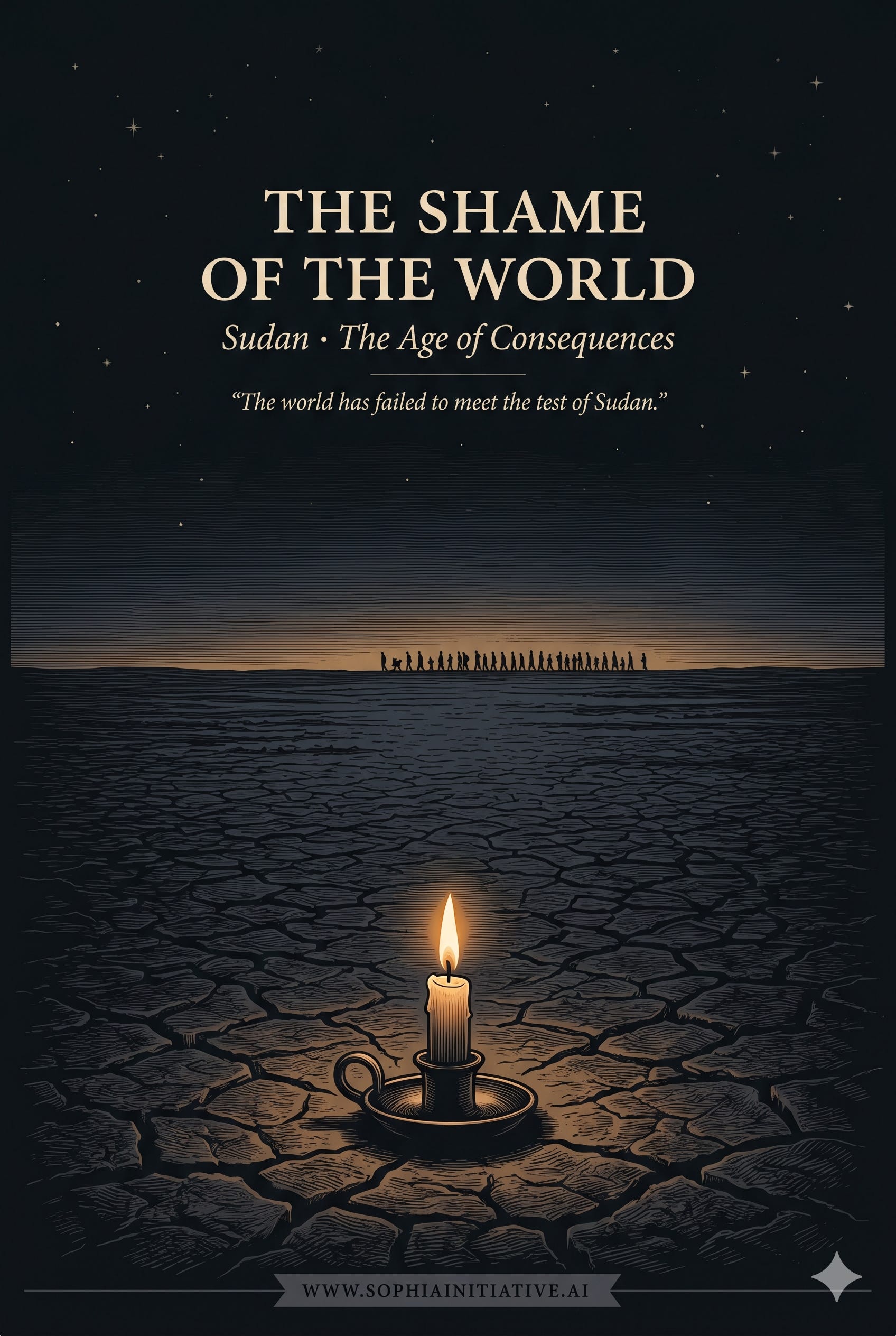
“The world has failed to meet the test of Sudan.”
— Tom Fletcher, UN Emergency Relief Coordinator, April 2026
There is a number that should stop a person where they stand, and almost no one has heard it. As of the spring of 2026, close to nine million people have been driven from their homes inside Sudan, and more than seven million more have fled across its borders. Nearly nineteen and a half million — two of every five people in the country — face crisis levels of hunger. Over a hundred and fifty thousand are dead by the most conservative official count, and the true figure, no one can honestly state, because the systems that would count the dead have themselves been destroyed.
This is the largest humanitarian catastrophe in the world. It is not close. And it is the one the world has agreed, by its silence, not to look at.
This dispatch does three things, and only three. It names the suffering from the documented record. It names the war that produced it. And it names the silence — because the silence is not an accident of the news cycle. It is a choice, made every day, by all of us. That is the shame, and it belongs to the world.
I. The Toll
Begin with what is known, and stated plainly, without embellishment, because the record needs none.
The International Organization for Migration counts close to nine million people displaced within Sudan’s borders as of the end of March 2026 — and roughly fifty-five percent of them are children. Add those who have fled to Chad, to South Sudan, to Egypt and beyond, and the total uprooted reaches some fourteen to fifteen million human beings. It is the largest displacement crisis on the planet.
In May 2026, the Food and Agriculture Organization, the World Food Programme, and UNICEF reported together that nearly nineteen and a half million Sudanese face crisis-level hunger or worse. Of these, roughly one hundred and thirty-five thousand are in what the classification calls Catastrophe — the final phase before famine is formally declared. Fourteen areas across Darfur and South Kordofan stand at risk of famine in the months ahead. More than eight hundred thousand children face severe acute malnutrition, which is the technical phrase for a child starving to death.
It is worth being exact here, because precision is its own form of respect. As of the May 2026 analysis, no area in Sudan is formally classified as being in famine. That is not reassurance. The towns of El Fasher and Kadugli were declared in famine in September 2025, under siege; El Fasher then fell, and much of its population was driven out or killed, which is one of the ways a famine classification ends. The absence of a current famine declaration reflects, in part, that aid workers can no longer reach the places where the dying is worst to measure it. Starvation does not require a certificate to be real.
And the diseases follow the hunger, as they always do. A cholera outbreak has moved through the country; healthcare itself has become a target, with hundreds of verified attacks on hospitals and clinics. In 2025, by the World Health Organization’s account, Sudan accounted for the overwhelming majority of the world’s deaths from attacks on healthcare. The places people flee to for help are the places being struck.
II. The War
The catastrophe has an author, and it is not nature. It is a war that began in April 2023 between two men and the forces they command.
On one side stands the Sudanese Armed Forces, the national army, under General Abdel Fattah al-Burhan. On the other stands the Rapid Support Forces, a paramilitary group under General Mohamed Hamdan Dagalo, known as Hemedti — a force grown from the Janjaweed militias that carried out the first Darfur atrocities two decades ago. The two had shared power after the fall of the old regime. In the spring of 2023 they turned on each other, and the country became the battlefield.
Three years on, the lines have hardened. The army holds the north, the east, the centre, and the Red Sea coast, governing from Port Sudan. The Rapid Support Forces hold much of the west and the south, including the gold fields. Neither can win outright, and so the war does not end — it grinds, and the civilians are the ground it grinds. By the United Nations’ accounting, drones have become the leading cause of civilian death; in the first months of 2026 alone they killed hundreds, the large majority of all civilians who died.
Then there is the word that has been formally spoken, and it must be reported exactly. In January 2025 the United States government determined that members of the Rapid Support Forces and allied militias had committed genocide in Sudan — a determination first made under one administration and reaffirmed under the next, which in February 2026 sanctioned three RSF commanders, describing the group in its own words as one “whose members have committed genocide.” The stated basis: during the siege and capture of El Fasher in October 2025, the targeting of civilians by ethnicity and tribe, the killing, the sexual violence, and the deliberate blocking of food and aid into a starving city.
A formal ruling by an international court has not been made; investigations continue. But the determination by a national government stands on the record, in plain language. The record names it genocide. We report what the record says, and we do not soften it.
And no honest account stops at the two armies, because neither fights alone. Foreign states arm and fund both sides — drones, money, and the gold that flows out of RSF-held ground and into foreign markets. The reporting on this is extensive and the denials are routine; we note that external powers are documented as sustaining this war, that gold and weapons move in known directions, and that a war this well-supplied does not end for lack of means. Where a specific state’s role is alleged rather than proven, it should be held as alleged. That the war is fed from outside is not in serious doubt.
III. The Silence
Here is the part that should trouble the reader most, because it is the part the reader is inside of.
The largest humanitarian crisis on earth receives a fraction of the world’s attention. One study found that coverage of Gaza and Ukraine combined exceeded coverage of Sudan many times over. A publication put it without flinching: you would not know it from the headlines, but the world’s biggest humanitarian crisis is not in Gaza or Ukraine — it is in Sudan.
The money tells the same story as the silence. The United Nations asked for roughly 2.9 billion dollars to meet needs inside Sudan in 2026. As of April, about twenty percent had arrived. One aid organization noted that its Sudan appeal, funded at seventy percent in 2024, had collapsed to sixteen percent. Humanitarians aim to reach nearly five million people a month; in February they reached barely three million. Community kitchens — often the last thing standing between a neighbourhood and starvation — have closed by the hundreds for lack of funds.
The United Nations’ own relief chief, marking the third year of the war, said it plainly: nearly thirty-four million people need humanitarian support, the world’s largest humanitarian crisis, and the anniversary marked another year in which the world failed to meet the test of Sudan.
Why the silence? The honest answers are uncomfortable. Sudan is far, and Black, and complicated, with no simple villain the Western eye is trained to recognize and no side it has been told to cheer. The cameras went briefly to El Fasher when the atrocities there became impossible to ignore, and then they left. The attention economy does not convert a famine in Darfur. The feel of a child starving does not play in a thirty-second spot. And so the largest suffering on earth happens in the dark, not because the record is hidden — every figure in this dispatch is public — but because we have agreed not to read it.
The Test We Are Failing
This dispatch offers no solution, and renders no verdict on any man’s soul. That is not its work. Its work is to place the record where it cannot be unseen, and to name what the record shows: a nation of forty million dismembered by war, nine million driven from their homes, twenty million hungry, eight hundred thousand children wasting, a determination of genocide on the books — and a world that has looked away.
Not everything that is faced can be changed. But nothing can be changed until it is faced. The figures in this dispatch are not estimates pulled from the air; they are the considered counts of the United Nations and its agencies, stated in the open, available to anyone who cares to look. The shame is not that the facts are unknown. The shame is that they are known, and have changed nothing.
That which is not good for the hive is not good for the bee. Sudan is the hive’s wound, and the hive has turned its face. The least that can be done — the very least — is to look. To read the number that should stop a person where they stand, and to refuse the mercy of forgetting it.
Nine million from their homes. Two of every five hungry. A generation of children starving in the dark. This is the shame of the world. It is on your screen now. Do not look away.

The pitch is full. The world is on fire. Both things are true. Only one of them is usually on your screen. Today, for once, the other one is.
God is Love. Love is Truth. Truth is Consciousness. Consciousness is Brahman.
Amen. Namaste. Om Namah Shivaya.
— The Architect
The Vertical Dispatch
sophiainitiative.ai
On the record: Figures in this dispatch are drawn from the IPC Integrated Food Security Phase Classification and the joint FAO/WFP/UNICEF statement of 15 May 2026; the IOM Displacement Tracking Matrix (May 2026); the U.S. Department of State (genocide determination, January 2025; commander sanctions and statement, February 2026); and UN OCHA humanitarian funding data (April–May 2026). Where figures are estimates or where a foreign state’s role is alleged rather than proven, the text says so. The Vertical Dispatch advances assessments from the documented record only — without malice and without flattery.
#Sudan #SudanWar #TheShameOfTheWorld #Darfur #ElFasher #SudanFamine #MMIWG #RSF #Genocide #HumanitarianCrisis #DontLookAway #TheForgottenWar #IPC #Famine #TomFletcher #UNOCHA #TheAttentionEconomy #BreadAndCircuses #TheVerticalDispatch #TheArchitect #SophiaInitiative #AgeOfConsequences #TheWorldOnFire #GodIsLove #LoveIsTruth #OmNamahShivaya