


THE VERTICAL DISPATCH
We write for the mind, the eye, and the ear.
Read it. Look at it. Listen to it. The Vertical Dispatch is built for all three — prose with rhythm, made to be heard as much as read.
From metaphysics to geopolitics, from culture to history, from the sacred to the street — and everything in between. One lens, every subject. No ego. Just the record, named clean.
Press play. Walk with the words. 🕯️
The Age of Consequences · Building Canada Strong
As of June 2, 2026
Building Canada Strong — without malice and without excuse
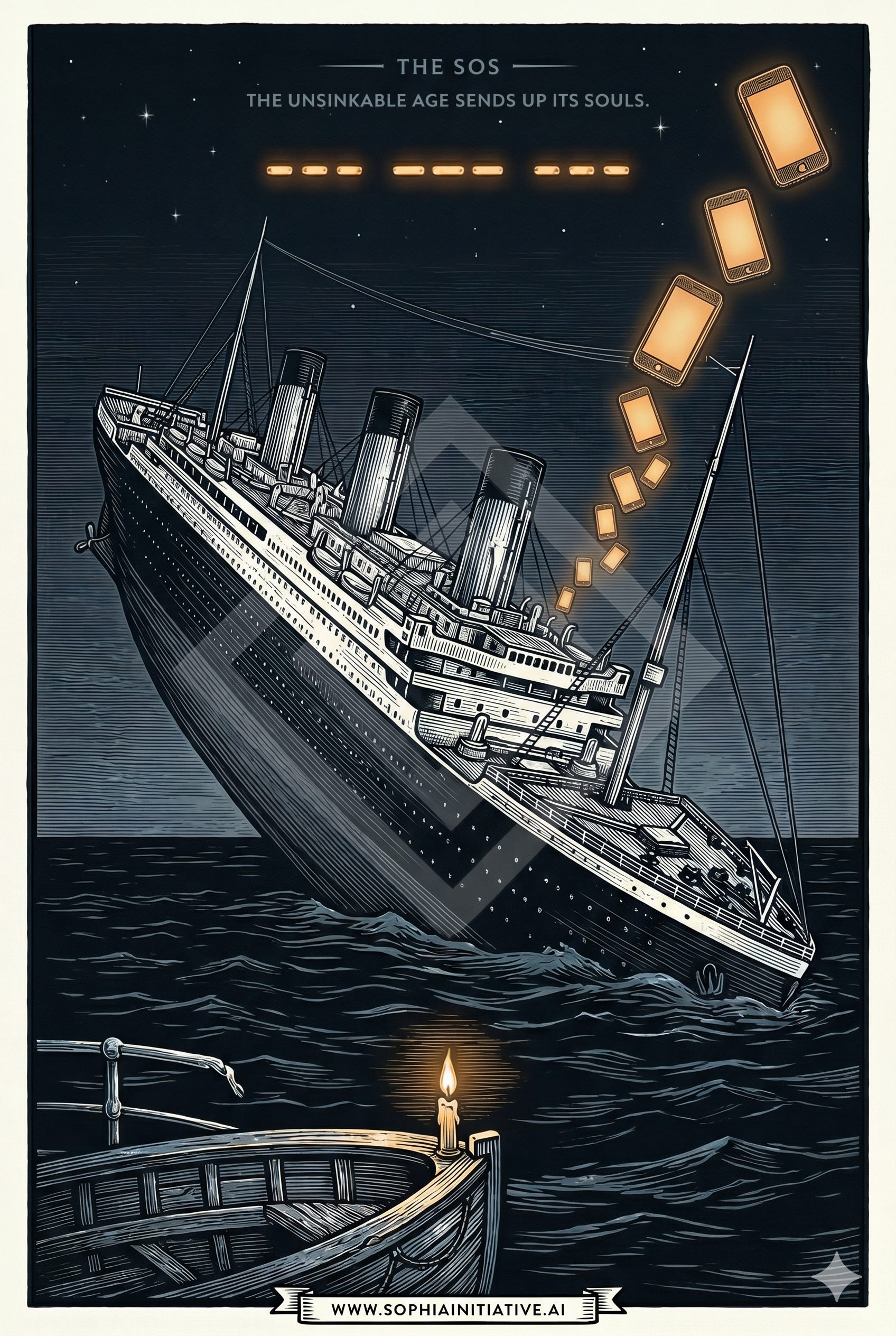
The unsinkable age built the ship, called it mastery, and sent up — instead of smoke — the glowing rectangles. The signal is not logic. It is distress.
There is a small object on the desk of nearly every child in the developed world, and the adults who govern that child’s formation have spent two years deciding what to do about it. The object is the smartphone. The decision is whether it belongs in the classroom. Framed that way it sounds like a question of school discipline — a matter for a code of conduct, a line in a handbook. It is not. The device on the desk is the visible edge of something the whole industrialized world is now reaching to push back against at once, and the reaching is itself the story. When most of the governments on earth move toward the same lever inside two years, the lever is not the point. What they are reaching to hold back is the point.
This dispatch follows the question where it actually leads — from the device in the classroom, to Canada’s response, to the world’s, and finally to what the reaching reveals: that education is the shared value on which the future of an alliance, and a civilization, now turns. An earlier filing in this publication named what the platforms are taking — not attention only, but the inward conditions of the soul itself. This dispatch does not re-argue that. It takes it as the floor, and asks the practical question the soul argument leaves on the table: the world has heard the alarm and grabbed for the rope — whose hands are on it, and does the rope reach?
I. The Device on the Desk
Begin with the thing itself, because the keel of this publication is that the symbol is not the referent, and the device is a symbol that points at something larger than itself. A phone in a child’s hand during a lesson is not merely a distraction from the lesson. It is a competing medium, and the competing medium carries its own theory of what attention is for. The lesson asks the child to follow one continuous thread to its end. The feed asks the child to abandon every thread the instant a brighter one appears. These are not two uses of one tool. They are two formations of one mind, running against each other in the same room, and only one of them is engineered by people whose commercial survival depends on winning. The teacher wants the child’s attention for the sake of the child. The platform wants the child’s attention for the sake of the platform. It is not a fair contest, and for two decades it was not even acknowledged as a contest. The phone simply arrived, and the classroom absorbed it, and the formation of a generation was quietly handed to whichever medium could hold the eye longest.
The error did not begin with the phone. It is older, and it has a name, and the name was given by a man worth introducing here because he will anchor more of this publication’s writing on education to come. In 1852, Cardinal John Henry Newman — later canonized, then among the most searching minds of his century — set down in The Idea of a University the case against exactly the formation the industrial age was building. His named enemy was Utility: education bent wholly to practical use, the mind treated as a vessel to be filled with what the economy could employ. Against it Newman set the older purpose. Knowledge, he wrote, “is capable of being its own end.” And true enlargement of mind, in his definition, is the power of viewing many things at once as one whole and referring each to its true place in the universal system — which is to say, precisely, the binding of symbol to referent, the eye trained on relationship, named in another century by another tradition and arriving at the same ground. The phone is only the newest instrument of Utility’s triumph. Newman saw the triumph coming and named what it would cost.
That is what the world is now, belatedly, reaching to undo. And the reaching is the right instinct — the alarm is real. But an instinct is not yet a turning, and removing the object is not the same as forming the mind. Hold that distinction; the whole dispatch turns on it.
II. Canada Reaches for the Rope
Canada’s response, like everything in Canadian education, is provincial — Section 93 of the Constitution Act, 1867 hands the formation of children to the provinces, and so there is no single Canadian answer but thirteen of them, arriving at different speeds and in different shapes. By the 2024–25 school year nearly every province had moved. Ontario requires phones off and out of sight all day for the youngest grades, out of sight during instruction for the older ones, social media blocked on school networks. Alberta’s ministerial order took effect September 2024. Quebec went furthest, a full-day ban from the 2025–26 year. British Columbia, Manitoba, Saskatchewan, Nova Scotia, Newfoundland and Labrador, the Atlantic provinces — each with its own version, its own line between class time and the lunch hour, its own list of exceptions. The patchwork is the predictable result of thirteen benches answering one question without a shared floor beneath them.
And here a premier said the quiet thing out loud. Saskatchewan’s Scott Moe, whose province moved early on phones in class, has more recently looked at the next front — the move to restrict social media for children — and concluded that the provinces cannot do it well one at a time. He named the patchwork problem directly: at what age, which platforms, in school or out, and what happens when thirteen jurisdictions answer differently and a child’s protection depends on which border they were born inside. His conclusion was not to push harder provincially but to carry the question up — to say this is bigger than any one province and belongs, in part, at the federal table, where Ottawa is now circling a national approach and the Prime Minister has signalled openness. Lift that move up for what it is: a premier hearing the alarm and recognizing that the answer the moment requires is larger than the chair he sits in. That recognition is the spine of everything that follows.
Because the deeper Canadian pattern is not about any one premier or minister. It is about the chair itself. This publication has argued across its recent filings that the minister who forms a province’s children sits at the seam of three domains — the craft of teaching, the science of how a young mind learns, and the stewardship of a vast public institution — and that the chairs are staffed, almost everywhere and regardless of province size, for the third domain and rarely the first two. Sort the people who have held these chairs against the requisite and the pattern holds across the federation: business and management backgrounds, law, political science, public service — the résumés of capable administrators, seldom the résumés of those trained in how a child’s mind is formed or how a medium forms it. This is an indictment of the system that defines the chair, never of the people who answer the call to fill it. But it means the lever now being pulled — the device removed, the feed restricted — is, in most cases, being pulled by hands that were never required to understand what the device was doing to the mind in the first place. The instinct is sound. The requisite is the empty seat.
III. The World Reaches at Once
Now widen the frame, because Canada is not reaching alone — it is one hand among many, and the scale of the global reach is the part that should stop the reader. By March 2026, UNESCO’s Global Education Monitoring team reported that 114 education systems — fifty-eight percent of the world’s countries — had a national restriction on phones in schools. The arc is steep: fewer than one in four countries had such a measure in June 2023; forty percent by early 2025; a majority of the planet within three years. France’s 2018 law and its 2025 extension to a full-day ban; the Netherlands; the United Kingdom’s 2024 guidance; Australia state by state; New Zealand’s national ban; Italy; Brazil’s 2025 federal law; thirty-nine American states acting in the absence of any federal rule; and a steady column of new entries — Bolivia, Costa Rica, Croatia, Georgia, the Maldives, Malta — joining through late 2025 and into 2026. This is not a national policy debate. It is a civilization, almost in unison, reaching to hold back the same tide.
And here is the discipline that keeps this honest, because the keel does not permit the reaching to be mistaken for a settled answer. The evidence on whether the bans work is genuinely contested, and a serious writer holds both sides. The strongest study to date — a 2025 examination of Florida’s pioneering ban — found that after a first year of friction, with a sharp rise in suspensions that fell hardest on Black students, test scores by the second year were significantly higher, with much of the gain flowing from reduced absences. That is real evidence the lever can work. But the most comprehensive British study found that restrictive policies alone did not improve grades, wellbeing, sleep, or behaviour, and a review out of Dublin called the international evidence mixed and conflicting. UNESCO itself — the body counting the bans — issued the caution that matters most: limiting the device does not remove the need to teach a child how to navigate the digital world, and the school remains one of the few places that formation can happen. Removing the object is not the turning. It was never going to be.
Set that beside the deeper alarm and the picture clarifies. American twelfth-grade reading scores fell in 2024 to their lowest in three decades, nearly a third of students below the most basic level; the share of young teenagers who read for pleasure almost daily has roughly halved in a decade. The floor was falling before the phones, and the phones accelerated the fall — but no ban repairs a floor. A ban removes a weight from a sinking deck. The turning — the periagoge, the binding of symbol to referent, the furnished mind that can question what the fluent machine returns — is the only thing that keeps the deck above water, and no government on earth has yet reached for that. They have reached for the device, because the device is the thing a hand can grab. The harder thing requires rebuilding the chair.
IV. What the SOS Is Really Signalling
Why does a phone in a classroom matter at the scale of a civilization? Because of what the device is the visible edge of. The platforms did not merely capture attention; having captured it, they reached further — for the inward conditions under which a human being becomes more than appetite and fear. Silence. Unbroken time. The attention that can turn inward. The presence of one soul to another. The day of rest. The practice that tends the inner life. These are the conditions every serious tradition the species has produced has named as the ground on which meaning, relationship, and conscience operate — and they are, one by one, the precise conditions the engineered feed is built to foreclose. A child formed entirely inside that feed is not merely distracted. The child is being formed without ever living inside the conditions from which a soul operates, and may grow up without a name for what was never there.
That is the SOS. The most advanced vessel of its age — the unsinkable ship of glass and code, the proudest engineering the species has built — is going down by the bow, and what rises from its mast is not smoke but the glowing rectangles, and the oldest new signal there is: three short, three long, three short. It is not a logical objection. A sinking ship does not run a cost-benefit analysis. It calls out into the dark because something irreducible is being lost. The attention economy answers in the language of engagement metrics; the distress call answers in the language of the soul, because that is the register the actual stakes live in. Logic built the ship. Logic will not save it. And this — let it be said plainly as the publication’s own reading, named as reading, not dressed as measured fact — this is hubris at the Titanic scale: the conviction that a thing so advanced could not founder, held right up to the moment the water came over the rail. The device on the child’s desk is one rivet of that hull. The world reaching to ban it is the first cry of a crew that has finally felt the deck tilt.
V. The Value of an Educated World
Here the dispatch turns from the alarm to the answer, because the publication does not traffic in despair — the doomsayers say abandon ship, and the doomsayers are wrong. The answer to a generation formed by the feed is not a better feed and not only a ban. It is an educated generation: minds that have been turned, not merely filled; that carry references enough to question the fluent machine; that can hold a symbol bound to its referent and so cannot be moved by a slogan or a shadow on the wall. An educated world is not a luxury of settled times. It is the keel that lets a civilization read the rough water and set the boat at the angle that carries the people safe over the wave. The value of an educated world is, in the most literal sense, the difference between a generation that crosses the wilderness and one that perishes in it for want of the bread that sustains the crossing.
And the bread has a name the older tongue gave it: manna. Not the device — that is the tool for a job the machine is already taking. The manna is the turning of the soul: the furnished mind, the faculty of facing, the capacity to bind the word to the thing. Train the keyboard and you prepare a worker for obsolescence. Turn the soul, and you give a people what no platform can deliver and no machine can supply — the inward ground from which a human being acts as something more than a resource to be mined. That is what education is for. That is what the device fight is really about. And that is why it cannot be left to thirteen patchwork answers or fifty-eight percent of governments reaching for the nearest lever. It is the work of a civilization, and civilizations do this work together or not at all.
Consider, as the publication’s own reading and not a measured figure, what the numbers imply at global scale. The PIAAC literacy data come from the developed world — the wealthiest, best-resourced school systems the species operates. Take those scores as the floor, and the worldwide picture is graver still, because the least-served populations are precisely the least measured: the gap the survey cannot see is almost certainly wider than the gap it can. A civilization that can extrapolate that from its own best data — that can see, in 2026, the scale of what its young are not being given — and still reaches only for the device, only for the nearest lever, has named its own condition. It is not a logistics problem. It is a failure of will dressed as a policy debate, and that, in the year 2026, with everything the species knows and everything it can build, is a shame a civilization should not be able to live with.
VI. The Educated Alliance
Which brings the dispatch to the structure now taking shape, the one this publication has been tracing across its Building Canada Strong filings: a new global alignment forming as the old order loosens — not a throne and not an empire, but a network of peers, a convening of equals around a table that turns rather than a head that commands. Such an alliance is held together not by conquest and not by capital but by what its members commit to in common. And nothing a network of peers can commit to matters more than how it forms its young. Education is the deepest shared value of the alliance precisely because it is the one investment whose return is the future itself — the next generation that will either carry the alliance forward or let it dissolve.
Say it without quarter, because the universal claim takes no quarter: the value of the alliance is in the education of the alliance as a whole. Not Canada’s children only, and not the children of the wealthy members only, but the formation of the young across every shore the alliance reaches — for a network of peers is only as strong as its least-formed member, and a generation turned in one country and abandoned in another is not an alliance but a hierarchy wearing the language of partnership. This is the keel held exactly: partnership among peers, never absorption, never one shore forming another’s children in its own image. Each member forms its own, to a floor the alliance holds in common — the shared answer to what education is for, carried across borders the way a lighthouse keeper’s light is carried across the water to every ship at once, the smallest boat and the largest, without preference and without surveillance. The educated alliance is the manna distributed: every member’s young given the turning, so that the whole crosses the wilderness together.
That is the constructive answer to the SOS, and it is the work of the long horizon, not the news cycle. The device on the desk is where the alarm became visible. The patchwork is where the limits of the old structure showed. The global reach is the scale of the stakes. And the educated alliance — peers bound by the shared value of forming their young, to a common floor, without absorption and without a single hand over any classroom — is the boat set at the angle that carries the generation safe over the wave. The waters are rough. The keel holds. The light that never goes out at land’s end is the one the whole alliance steers by now.
The world heard the alarm and grabbed for the rope. The rope reaches only if the alliance holds, together, the one value that forms the future — and that value is the turning of every child’s soul.

God is Love. Love is Truth. Truth is Consciousness. Consciousness is Brahman.
Amen. Namaste. Om Namah Shivaya.
— The Architect
For Ellison, who read the wave without fear, and set the boat so the boys glided safe over it.
The Vertical Dispatch
sophiainitiative.ai
On the record: John Henry Newman, The Idea of a University (lectures 1852, published 1873), Discourse V “Knowledge Its Own End” — the critique of “Utility” and the definition of enlargement of mind as viewing many things as one whole; “knowledge is capable of being its own end” quoted under fair-use length, attributed. UNESCO Global Education Monitoring (GEM) team, March 2026: 114 education systems (58% of countries) have a national restriction on phones in schools; 24% in June 2023, 40% by early 2025 (UNESCO GEM Report). UNESCO’s standing caution — that restricting devices does not remove the need to teach digital literacy and critical thinking, and schools remain a primary site for that formation — is quoted in substance, paraphrased. National measures referenced: France (2018 law; 2025 full-day extension), Netherlands (2024 guidance), UK (Feb 2024 statutory guidance, not legislation), Australia (state-by-state, 2024), New Zealand (2024 national ban), Italy (2024–25), Brazil (federal law, Jan 2025), 39 US states (UNESCO/state records); recent national additions Bolivia, Costa Rica, Croatia, Georgia, Maldives, Malta (UNESCO GEM, late 2025–2026). Canadian provincial policies (Ontario, Alberta, Quebec, B.C., Saskatchewan, Manitoba, Nova Scotia, Newfoundland & Labrador and others) are current to the 2024–25 / 2025–26 school years per official provincial sources; rosters and policies change — verify before republication. Saskatchewan’s in-class phone restriction (2024–25) was announced under Education Minister Jeremy Cockrill (B.Comm./BBA, Trinity Western University; management and agriculture background; now Minister of Health), per Government of Saskatchewan and CBC. Premier Scott Moe’s more recent position — skepticism that provinces can effectively restrict children’s social media alone, and a preference to carry the question to the federal level — is per The Logic (June 2026) and CBC/CTV (May 2026); characterized here as leadership in raising the question, not as a verdict on any individual. Ontario Education Minister Paul Calandra (B.A. Political Science and History, Carleton; real-estate/family-business background) confirmed considering a near-total school phone ban (CBC, Apr 28, 2026). Manitoba Premier Wab Kinew’s government moving on a youth social-media ban; PM Mark Carney signalled openness federally (CBC/Global, 2026). The three-domain analysis of the education chair and the requisite-fit argument are the Architect’s own proposal under the Requisite Cabinet lens, not established policy; no claim is made that any individual is unqualified, and the critique is directed at the system that defines the chair, not at office-holders. Evidence on bans is contested and presented both ways: Figlio & Özek, NBER Working Paper 34388 (Oct 2025) — Florida ban associated with higher test scores by year two after a first-year rise in suspensions (heaviest among Black students), gains linked to reduced absences; University of Birmingham (2025) and Dublin City University (2025) — restrictive policies alone showed little or mixed effect; the broader NAEP decline (2024 grade-12 reading lowest in ~30 years) predates and exceeds the phone question. PIAAC: the data shows stalled generational improvement and a widening gap at the bottom — NOT that young adults read worse than older adults; the trajectory/emergency language is the Dispatch’s structural reading, not a measured forecast. The global extrapolation — that developed-world PIAAC scores are a floor and the unmeasured world is likely graver — is explicitly the Architect’s inference, not a measured global figure. The soul framework (the inward conditions of the soul’s operation) is the Architect’s own, developed in a prior dispatch; the Titanic/SOS and ‘hubris at the Titanic scale’ framing is the Architect’s reading, offered as interpretation, not asserted fact. The ‘educated alliance’ is offered as argument under the Building Canada Strong frame, consistent with the publication’s standing principle of partnership among peers, never absorption. Date-stamped June 2, 2026. Errors and omissions excepted; corrections will be made on notice. Verify all characterizations against primary sources before republication.
#TheSOS #PhonesInSchools #TheDeviceOnTheDesk #Education #Newman #TheIdeaOfAUniversity #TheEducatedAlliance #UNESCO #Section93 #ScottMoe #DigitalLiteracy #TheNextGeneration #BuildingCanadaStrong #TheAgeOfConsequences #TheVerticalDispatch #TheArchitect #SophiaInitiative #GodIsLove #LoveIsTruth #OmNamahShivaya
Substack Notes
There is a small object on nearly every child’s desk, and for two years the world has been deciding what to do about it. The phone in the classroom looks like a discipline question. It is not. By March 2026, fifty-eight percent of the world’s countries — 114 education systems — had moved to restrict phones in schools, up from less than a quarter three years earlier. When most governments on earth reach for the same lever at once, the lever is not the story. What they are reaching to hold back is the story.
Canada’s answer is provincial and therefore a patchwork — thirteen benches, thirteen versions. One premier, Saskatchewan’s Scott Moe, said the quiet thing out loud: the provinces cannot do this well one at a time, and the question belongs at the federal table. He is right, and his recognition is the spine of the piece. But the deeper pattern is the chair itself: the minister who forms a province’s children is almost everywhere staffed for administration, rarely for the science of how a young mind learns. The hands on the lever were never required to understand what the device was doing to the mind.
And the evidence, held honestly, says removing the object is not the turning. Florida’s ban raised scores by year two — but only after a year of friction, and the deeper literacy collapse predates the phones. UNESCO itself cautions: limiting the device does not remove the need to teach a child to navigate the world. The ban removes a weight from a sinking deck. It does not repair the deck.
So the answer is not despair, and not a better feed. It is an educated generation — minds turned, not merely filled — and an educated alliance that holds the formation of its young as its deepest shared value, every member forming its own to a common floor, partnership among peers and never absorption. The world heard the alarm and grabbed for the rope. The rope reaches only if the alliance holds, together, the one value that forms the future. The waters are rough. The keel holds. Walk with the words. 🕯️
The factual matter in this Dispatch is drawn from the public record. All characterizations, inferences, and conclusions are opinion, interpretation, and commentary, offered for analysis, reflection, and public-interest discussion. No assertion is made regarding the private intentions, state of mind, or character of any individual. Readers should evaluate all statements independently and draw their own conclusions.