


Φ
THE VERTICAL DISPATCH
We write for the mind, the eye, and the ear.
Read it. Look at it. Listen to it. The Vertical Dispatch is built for all three — prose with rhythm, made to be heard as much as read.
From metaphysics to geopolitics, from culture to history, from the sacred to the street — and everything in between. One lens, every subject. No ego. Just the record, named clean.
Press play. Walk with the words. 🕯️
The Foundation Series · The Age of Consequences
As of 4 June 2026
“Knowledge is capable of being its own end.”
— John Henry Newman, The Idea of a University
This dispatch travels by hand. If it serves you, share it — restack on Substack, pass it on wherever you read. 🕯️
The Document of the Day
On the fourth of June, 2026, at Toronto General Hospital, the Prime Minister and the country’s first Minister of Artificial Intelligence unveiled “AI for All” — Canada’s national AI strategy, two and a third billion dollars over five years, three guiding principles, six pillars, and a set of numbers built to be quoted: up to two hundred and fifty thousand new jobs, sixty percent business adoption by 2034, two hundred billion dollars of added economic growth. It is a serious document produced by serious people after wide consultation, and it deserves a serious reading — which means, first, a fair one.
So begin with what is right in it, at full strength, because a critic who will not concede the strong parts has not earned the right to name the weak ones.
What the Strategy Gets Right
The sovereignty diagnosis is muscular and, by the record, correct. The strategy states plainly that Canada is over-exposed to foreign-controlled infrastructure — that its AI data centres and cloud are largely foreign-owned, its sovereign compute “nascent,” its ecosystem at risk of falling under foreign control. This is the same wound this publication named in the national electricity grid: a country wired more firmly to others than to itself, in the one kind of infrastructure that now decides whether a nation governs its own future. The remedy — a “build-partner-buy” approach, a public supercomputer, a Sovereign Technology Alliance signed with Germany at Munich in February, a middle-power bid for a third path between American dominance and Chinese control — is a real answer to a real problem. Asked directly whether the goal is a genuine alternative to American big tech, the Prime Minister said yes. On sovereignty, the strategy names the problem true and the solution fits. Credit where it is due.
And the government’s defense of the rest is not frivolous, so let it stand at full strength before it is tested. The Minister calls the strategy a framework, not a finished code — “we are not pretending you can handle AI in one document and chip it in stone” — built to adjust as new risks emerge. That is a defensible philosophy for governing a fast-moving technology, and a reader should weigh it honestly. The question is not whether the government is acting. It plainly is. The question is the older one this publication is bound to ask of any solution: what, precisely, is the problem it is built to solve — and does the solution reach it?
The Foundation They Named
Here the strategy does something unusual and admirable: it names its own foundation. Low AI literacy and low public trust, it says, are the “binding constraints” on the technology’s growth in Canada — the thing on which everything else depends. The Prime Minister put the wound in a sentence: Canada ranks near the bottom of countries in AI training, literacy, and trust. The strategy’s logic follows cleanly from there. If literacy and trust are the binding constraints, then build literacy and build trust, and the rest becomes possible. A National AI Literacy Initiative: one million entry-level post-secondary students reached, more than three thousand educators trained with AI learning kits, free courses in libraries and seniors’ centres, a “trusted AI agent” promised to every student in the country.
It is the right instinct aimed at a foundation the strategy correctly identifies. And it is here, precisely at the foundation, that the architecture begins to sag — because the strategy names literacy as the thing on which everything depends, and then never says what it means by the word.
The Word They Never Defined
Press on the benchmark and it gives way. The “near the bottom” ranking — forty-fourth of forty-seven countries — comes from a single source: a 2025 KPMG and University of Melbourne survey of roughly forty-eight thousand people worldwide, about a thousand of them Canadian. And that study defines “AI literacy” as three self-reported things: whether you have received AI training, how knowledgeable you feel about AI, and how confident you are using it. That is the entire foundation. Not a tested competency. Not an examination. A poll of how many people have taken a course and feel comfortable with the tool.
Watch what that does. The problem is measured as “too few Canadians have had AI training.” The solution is “provide AI training to a million Canadians.” The benchmark and the remedy are the same variable. Train more people, and by definition the literacy number rises, and the constraint is declared eased — whether or not a single mind was changed in any way that matters. The strategy borrowed the word “literacy,” which carries the whole weight of human formation, of learning to read and think, and attached it to a measure of tool-familiarity. The word is doing work the measure cannot cash. This is not literacy as anyone who loves the word would mean it. It is not the literacy of a child meeting Great Expectations and building, from black marks on a white page, an entire world behind the eyes. It is knowing where the knobs are on a machine.
The Paradox in Their Own Numbers
And the same study contains a finding the strategy notes but does not resolve, and it is the most revealing thing in the whole document. Canadians trust AI less than the global average — thirty-four percent willing to trust what it tells them, against forty-six percent worldwide — and nearly half believe its risks outweigh its benefits, against under a third globally. Yet fewer Canadians than the global average have actually experienced a bad outcome from AI: thirty-nine percent against forty-three. Read that slowly. Canadians are more wary of the machine while having been harmed by it less.
The strategy reads that wariness as a deficit — low trust, a constraint to be trained away. But there is another reading, and it is at least as likely: that the wariness is not ignorance but discernment. That a population holding back from a fluent, confident, unproven machine — declining to trust it on its word, judging its risks soberly before its rewards — is displaying exactly the caution a furnished mind should display toward any instrument that answers everything instantly and is wrong without blushing. The strategy proposes to train that caution away and call the result trust. It is worth asking whether the caution was the wisest thing the survey found, and whether “building trust” in a thing not yet proven trustworthy is a foundation or a flattery.
What a Foundation Actually Is
If the strategy will make literacy the foundation, then it is fair to ask what a foundation in the forming of a mind actually consists of — because it is not the tool, and it is older than any tool. It is the architecture of the sentence: subject, predicate, object — which is nothing less than the structure of thought made visible, a thing said about a thing, the first act of binding a word to the world. It is the older architecture beneath that one, which Aristotle gave the West in his Categories: the kinds of being, substance and the ways a thing can be qualified — quantity, quality, relation, and the rest — the classification by which a mind sorts what is said to it into definition and accident, claim and quality, the real and the merely asserted. It is the furnished shelf of references — the way a lawyer carries not the whole law in his head but the trained knowledge of which book, which statute, where the binding precedent lives. It is geometry, studied not for its images but for relationship: the eye trained to see the invisible relation that generates the visible form, because the relation is always prior to the form. And over all of it, the thing Plato named: the turning of the soul, the periagoge, the redirection of an eye already there toward what is real.
These are the foundation priors, and they have one defining property the strategy never reckons with: they must become automatic. Like breathing. A child who has them does not think “subject, predicate, object” any more than a reader thinks “inhale, exhale” — they run underneath, and they free the conscious mind to do the higher work that stands on them. That is what a foundation is: the thing you no longer have to think about, that lets you think about everything else. And there is an age for laying it, a window when the young mind is still plastic enough to take it as breath. The science of exactly when, and exactly how, is a real discipline — and it is the one this publication has named, across these dispatches, as the empty chair: the seat for the developmental knowledge of how a mind is formed, which the ministries that form our children almost never fill.
How the Performer Is Made
Now the hard mechanism, named carefully, because the fault is in the system and never in the child. When the foundation is not laid — when a young person is passed forward past an unmade floor, advanced by age and grade and bell whether or not the priors ever became breath — something specific and terrible happens. They do not stop. They are carried onward into work that has no floor beneath it, and from that point on, the real learning that requires the foundation cannot happen, because the foundation is not there. What is left to them is performance: the reading of the room, the detection of the expected answer, the delivery of it on cue. A system that advances a child past an unmade foundation has not failed that child once. It has condemned everything after to performance, and called the performance an education.
This is not the child’s failing. The child chained from the start to a wall they did not build is the prisoner in Plato’s cave, owed a turning that never came. The accountability points up — at a model of schooling built to move vessels through on a schedule, to measure throughput rather than whether the floor was poured — and never down at the young person standing on the empty floor doing the only thing left to them. But it is worth saying plainly what that mechanism produces, because the culture has already told us its name. Ask a child today what they want to be, and at or near the top of the answer, in survey after survey, is a single word: influencer. Which is to say, a performer. A whole generation taught, by the medium and by a schooling built for throughput, that the goal of a human life is to be watched — and now told that what they need is to be trained to use a machine.
The Boat Everyone Is Missing
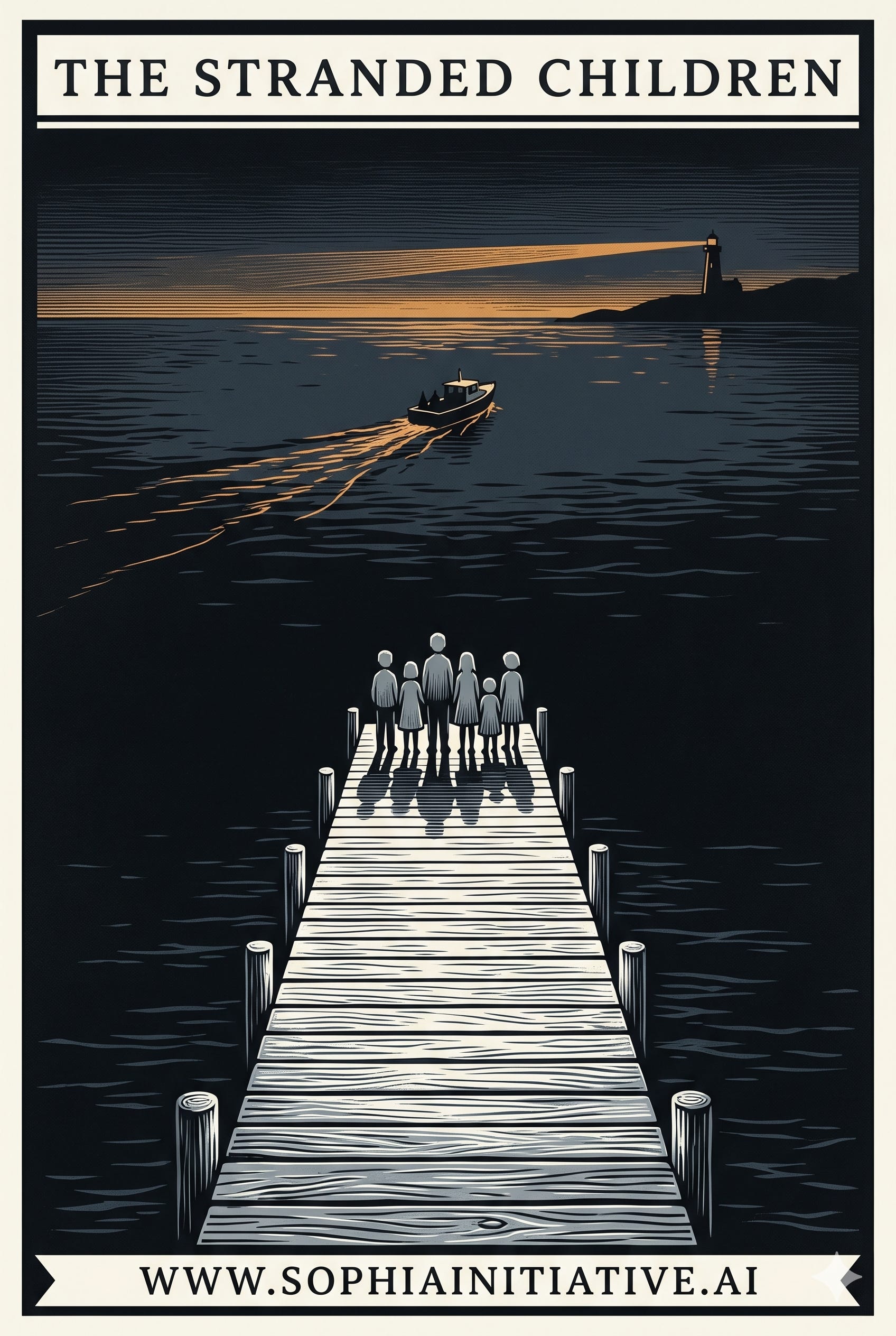
And so the strategy, for all that is right in it, misses the boat — and the cruelty of it is that everyone can see the children left on the pier. The Prime Minister named them himself: near the bottom in literacy. The consultations heard them. The numbers are not in dispute. The strategy reaches, with real money and real intent, for the device and the tool — AI literacy training, a trusted agent for every student, a million reached — because the tool is the thing a hand can grab. But the boat that would actually carry these children across is the foundation: the sentence, the categories, the references, the turning, laid as breath at the right age by a chair built to know how. That boat the strategy does not board. It trains the use of the instrument and calls the result literate, while the foundation that would let a mind wield any instrument goes unbuilt, and the children who were never given it stand on the pier, in plain sight, performing.
This publication wrote the prior on this question before the strategy was released. It argued, across three dispatches, that education is not the filling of a vessel but the turning of the soul; that the chair which forms a province’s children sits empty of the science of how a mind learns; and that the world reaching to ban the device in the classroom had grabbed the rope but not the rope that reaches. The strategy released this week is the proof of those dispatches, dated days after them: a national plan that names literacy the binding constraint and then funds tool-familiarity; that names trust the foundation and then proposes to train away the wariness that may be wisdom; that reaches for the instrument and misses the formation. The record named the wound before the bandage was unveiled.
There is a language for the thing the strategy will not build — the language of the universal and the particular, the philosopher’s tongue, the register in which a mind moves between the pattern and the case as naturally as breath. It has become so rare in public life that an ordinary person may go a lifetime and hear it spoken aloud only once, from a king on a broadcast, and conclude it is not a language for them. That conclusion is the whole tragedy in a sentence — because the tongue is not hard, and it is not a monarch’s affectation. It is the natural speech of any soul that has been turned, and it was once the birthright of the educated and could be the birthright of every child. The proof is ordinary and everywhere: people who came to it late, by their own hand, against the schooling they were given, and speak it true. If it can be reached late and alone, it can be given early and by right. That is the boat. And a national strategy that trains a generation to operate a machine, while leaving the foundation of their own minds unbuilt, has rowed past the pier where the children are standing — in full view, named in the strategy’s own opening pages — and called the trip a crossing.

God is Love. Love is Truth. Truth is Consciousness. Consciousness is Brahman.
Amen. Namaste. Om Namah Shivaya.
— The Architect
For Ellison, who read the wave without fear, and set the boat so the boys glided safe over it.
The Vertical Dispatch
sophiainitiative.ai
On the record. Canada’s “AI for All” national AI strategy was launched by PM Mark Carney and AI Minister Evan Solomon at Toronto General Hospital on 4 June 2026: $2.3 billion over five years; three guiding principles (building trust, creating opportunity, reinforcing sovereignty) and six pillars first outlined in the April 2026 spring economic update (PMO release, pm.gc.ca, 4 June 2026). Stated targets include up to 250,000 new jobs and up to 90,000 youth jobs/placements by 2031, business AI adoption from ~12% to 60% by 2034, and ~$200 billion in added economic growth (PMO; CBC; Canadian Press; The Logic, 4 June 2026). Named funding components reported include a ~$500M Canadian Tech Growth Fund, a ~$700M Compute Access Fund for SMEs, and up to ~$1B for public supercomputing, plus ~$50M to expand the Canadian AI Safety Institute; the public record does not provide a reconciled line-by-line breakdown of the full $2.3B and the named components do not cleanly sum, so figures are reported as stated, not as a verified total. The strategy describes low AI literacy and trust as “binding constraints” and Canada as over-exposed to foreign-controlled cloud/compute, with sovereign capacity “nascent”; it commits to a “build-partner-buy” approach, a public supercomputer, and a Sovereign Technology Alliance signed with Germany at the Munich Security Conference, Feb 2026 (strategy document; CBC; HR Reporter; Politico). The “near the bottom / 44th of 47” ranking is from KPMG International & University of Melbourne, “Trust, attitudes and use of AI: A global study 2025” (≈48,000 respondents across 47 countries, ≈1,025 in Canada, fielded Nov 2024–Jan 2025), which defines AI literacy via self-reported training, knowledge, and efficacy. Trust figures: 34% of Canadians willing to trust information from AI vs 46% globally; 46% say risks outweigh benefits vs 32% globally; 39% of Canadians report experiencing a negative AI outcome vs 43% globally (KPMG/Melbourne 2025). The strategy does not provide an operational definition of “AI literacy” nor a benchmark for assessing the one million students (gap noted in the public record). Critics including Michael Geist, and opposition figures, characterize the strategy as lacking concrete safety timelines and AI-specific regulation; the government (Solomon, Carney, 4 June 2026) defends it as an intentionally flexible “framework” with privacy and online-safety legislation to follow — both positions are represented, and the record does not resolve them. Plato, Republic Book VII (education as periagoge). Aristotle, Categories (the kinds of predication/being). John Henry Newman, The Idea of a University (1852; “knowledge is capable of being its own end,” Discourse V), quoted under fair-use length, attributed. The reading of subject-predicate-object, the categories, the “furnished references,” geometry-as-relationship, the “foundation priors as breath,” the sequence-failure-produces-performance argument, and the “influencer/performer” reading are the Architect’s own interpretation, developed across the prior Foundation Series dispatches (What Is Education For?; The Three Empty Chairs; The Sandbox; The SOS), offered as commentary, not as measured fact. Surveys on children’s aspiration to “influencer/content creator” careers are widely reported across multiple polls; cited here directionally. No figure in this dispatch is disaggregated by race, group, or class. This dispatch judges systems and institutions, never individuals, and makes no assertion about any person’s private character or intentions. Errors and omissions excepted; corrections will be made on notice. Verify against primary sources before republication.
#TheStrandedChildren #AIforAll #AIStrategy #AILiteracy #WhatIsEducationFor #Plato #Aristotle #Newman #Periagoge #MarkCarney #EvanSolomon #TheNextGeneration #TheFoundationSeries #TheAgeOfConsequences #TheVerticalDispatch #TheArchitect #SophiaInitiative #GodIsLove #LoveIsTruth #OmNamahShivaya
Substack Notes
This week Ottawa unveiled “AI for All,” a $2.3-billion national AI strategy. Give it its due: the sovereignty diagnosis is real and correct — Canada is over-exposed to a foreign-controlled AI stack, the same wound as the national grid, and the plan to build sovereign compute is a serious answer. But the strategy names its own foundation, in its own words: low literacy and low trust are “binding constraints,” the thing on which everything depends. And then it never says what “literacy” means.
Press the benchmark and it gives way. The “near the bottom” ranking comes from a single survey that defines AI literacy as three self-reported things — have you had training, do you feel knowledgeable, are you confident with the tool. So the problem is “too few have had training” and the solution is “train a million people,” and the benchmark and the remedy are the same variable. The word “literacy” is doing work the measure cannot cash. This is not the literacy of a child meeting Great Expectations and building a world behind the eyes. It is knowing where the knobs are.
And the same survey holds a paradox the strategy notes but does not resolve: Canadians trust AI less than the global average while having been harmed by it less. The strategy reads that as a deficit to train away. Read it again: it may be discernment — the wariness a furnished mind should have toward a fluent machine that is wrong without blushing. A real foundation is older than any tool: the architecture of the sentence, Aristotle’s categories, the furnished shelf of references, geometry studied for relationship, Plato’s turning of the soul — laid as breath, at the right age, by a chair built to know how. Pass a child past that unmade foundation and what is left to them is performance. Ask a child today what they want to be, and the answer, at the top, is: influencer. A performer. We taught them to be watched, and now we offer to train them on a machine.
This publication wrote the prior before the strategy dropped — three dispatches arguing education is the turning of the soul, not the filling of a vessel, and that the device is not the boat. The strategy is the proof, dated days later: it reaches for the instrument and misses the formation, while the children it named in its own opening pages stand on the pier in plain sight. They missed the boat. And everyone can see the children who were left on it.
Written from love, for a sacred humanity, in the full light of consciousness, toward the greater good. 🕯️
The factual matter in this Dispatch is drawn from the public record. All characterizations, inferences, and conclusions are opinion, interpretation, and commentary, offered for analysis, reflection, and public-interest discussion. No assertion is made regarding the private intentions, state of mind, or character of any individual. Readers should evaluate all statements independently and draw their own conclusions.
Many things about the way AI is being pushed on us cause me concern. It is largely hegemonic, has been “trained” on material that belongs to others without their consent, it is being implemented without personal choice anytime we use most search engines, it is weakening the free press, and it gets things wrong with confidence. The commercial versions feed back flattery. There is the environmental impact and all foregone alternatives. In short, it reflects everything Canadians have had to manage in our relationship with the USA for years. We are right to be slow to warm up to it. What we need are an articulation of the values and principles it must follow, along with articulation of the strategies humans must use to prevent it from making errors that harm us. Our experience with past technologies hint that this one has potential for great impacts, both helpful and harmful. It is processing information according to algorithms. That is not true intelligence. Thank you for helping to shape the discussion of AI.