


Φ
THE VERTICAL DISPATCH
We write for the mind, the eye, and the ear.
Read it. Look at it. Listen to it. The Vertical Dispatch is built for all three — prose with rhythm, made to be heard as much as read.
From metaphysics to geopolitics, from culture to history, from the sacred to the street — and everything in between. One lens, every subject. No ego. Just the record, named clean.
Press play. Walk with the word. 🕯️
This dispatch travels by hand. If it serves you, share it — restack on Substack, and pass it on wherever you read. 🕯️
The Age of Consequences · Part One of Three
June 16, 2026
“We don’t see the economics in building in certain areas.”
— Tony Staffieri, President and CEO, Rogers Communications, on cancelling network builds, April 2026
All Along the Watchtower
There is an old song — two riders, a watchtower, the wind starting to howl — about the hour a thing built for watching becomes the thing that hems you in. We have hummed it for sixty years without quite hearing it. Because we did this to ourselves, and gladly. We signed for the convenience the way we sign a credit-card slip, barely reading the line — and then waved the flag for freedom and privacy once the walls were already up around us.
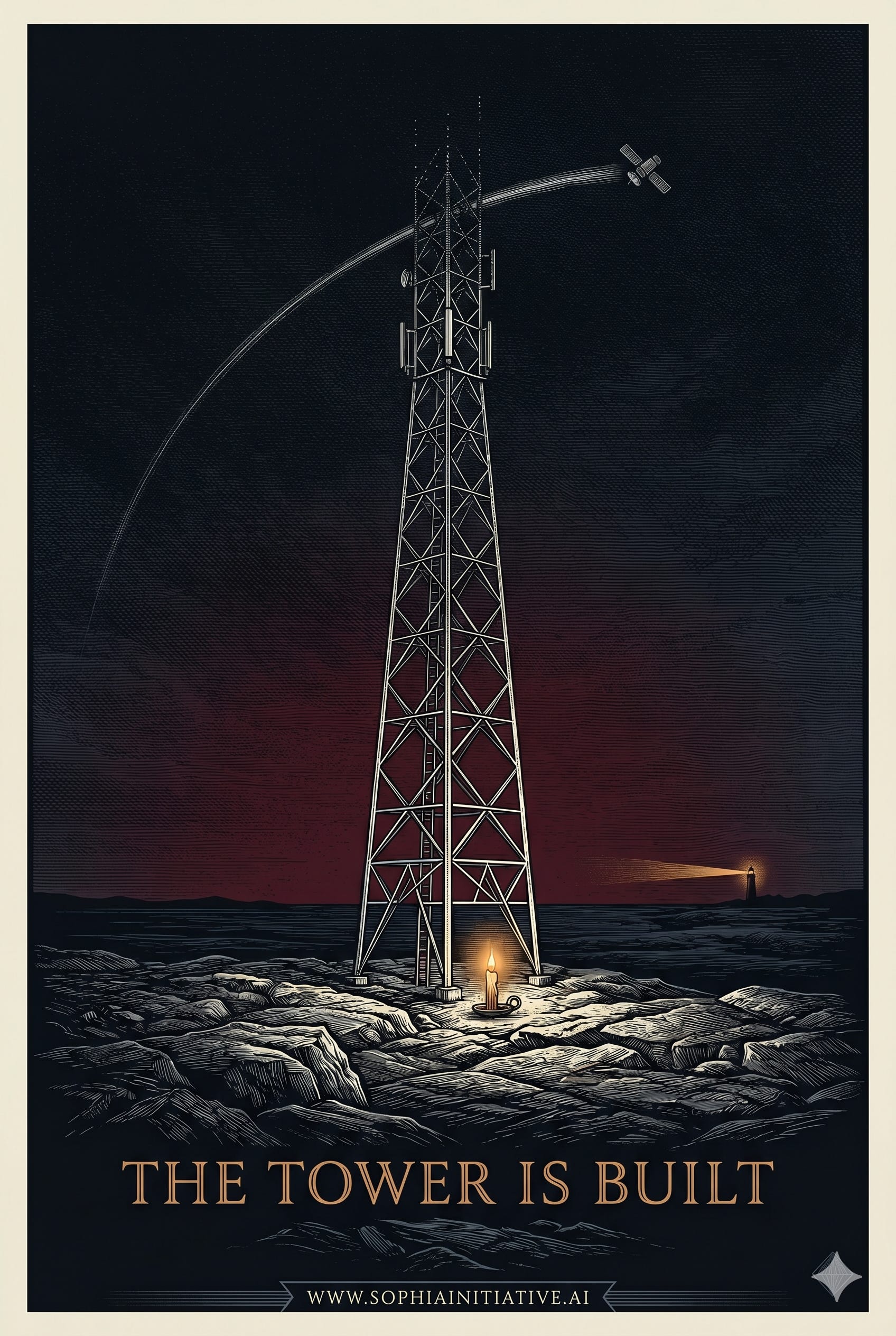
The tower on the hill was raised to carry our voices to one another. Somewhere along the way it became the structure we pay a toll to pass through, and a watcher we never quite chose. That is a longer reckoning — what we traded, and what we clicked “agree” to without reading — and it is a Pandora’s box that deserves its own dispatch, on its own day. This one stays on the smaller, harder ground: not what the tower costs the soul, but what it costs the wallet — and whether the bill we are handed is an honest one.
The Fee That Came Back
On Friday, June 12, 2026, a new rule took effect in Canada. Under Telecom Regulatory Policy CRTC 2026-43, and the amendment to section 27.04 of the Telecommunications Act that came into force last October, a carrier may no longer charge a fee tied to activating or modifying a wireless plan, or any fee whose main purpose is to discourage a subscriber from switching or cancelling. The ban was meant to remove the small frictions that keep a customer from walking to a cheaper rival. The wall between you and a better price was supposed to come down.
Within seventy-two hours, two of the three national carriers rebuilt it under a new name.
Bell had carried an $80 connection fee. Ahead of the deadline it removed that fee — and introduced a $40 “device handling fee” for customers who buy a phone with their plan. Telus had its own connection charge; it removed it, and on June 11 introduced a mandatory $15 SIM fee, applied even to an eSIM, which is a line of software with no physical card at all, and which its dealers were told they could not waive.
The regulator moved the same day the rules took effect. On June 12, the CRTC’s Director of Social and Consumer Policy, Nanao Kachi, sent letters to Philippe Gauvin at Bell and Stephen Schmidt at Telus. The letters were blunt: confirm that you have ceased charging these fees, or explain why they comply. The reasoning was that a SIM, or a phone, is required to deliver the service the customer is buying — so a charge for it may simply be the prohibited activation fee wearing a different coat. Both companies were given until June 17 to answer. If they do not, CRTC staff will, in the regulator’s words, consider all available compliance options.
As of this writing, on the morning of June 16 — one day before the deadline — neither carrier has blinked. Bell says that because buying a phone is optional, the fee attached to it is exempt; it called the charge fully compliant with the Telecommunications Act and the Wireless Code. Telus is in the same standoff over its $15. The fees were still live on both companies’ websites. By the time you read this, the answers may be in. The shape of the thing will not have changed.
Strike the eighty-dollar fee, and forty reappears. Strike the forty, and fifteen appears. The number falls; the reflex does not.
This is the door. Behind it is a larger question, and it is the one worth your morning: if a fee can be rebuilt the instant it is banned, what is the real cost the fee was standing in for? The carriers have an answer ready, and it is the oldest answer in Canadian telecom. It is geography.
The Geography, Granted in Full
Let us give the argument its full strength first, because it is partly true and a fair reading begins by conceding what is real.
Canada is the second-largest country on earth and one of the most thinly settled. The land runs to more than nine million square kilometres, and the population — about forty million — works out to roughly four people per square kilometre, among the lowest densities in the world. And those people are not spread across the land. Two in three Canadians live within a hundred kilometres of the United States border; the great majority live within three hundred. The map is mostly empty, and the empty part is cold, rocky, and far from anything.
Stringing a network across that is genuinely expensive in a way it is not in France or Italy or the dense cities of Japan. Telus alone reports capital investment of more than fifty-nine billion dollars in its networks since the year 2000. That number is real, the geography is in it, and the leeway you are inclined to extend is, at the level of building the thing, honestly earned. We will not pretend otherwise.
But leeway earned at the building stage is not the same as leeway owed on the price forever. To test whether the geography explains the price, you need a country shaped like Canada that sells the same service. There is one.
The Country That Covers a Harder Land for Less
Australia is the control case. It is vast, it is empty in the middle, its people cling to a coastal rim, and it must cover enormous distances to reach them. If geography were the engine of the Canadian price, Australia should cost roughly the same.
It does not, and the gap is not small. Across years of the federal government’s own commissioned price studies, comparable Australian plans have come in at a fraction of the Canadian price — in some service tiers less than a third. Independent cost-per-gigabyte analyses have put Canada at several times the Australian figure, and many multiples of France, Ireland, and Finland. The direction never reverses. A harder country, covered for less.
And the leeway has been measured directly. A Montreal Economic Institute analysis some years ago adjusted for the cost of network coverage in each country and found that Australia’s geographic challenge was, if anything, slightly greater than Canada’s — and that Australia still came out cheaper across the board. Its conclusion was the one that matters: the size of the country and the thinness of its population do not, by themselves, explain Canada’s prices. The geography is real. It is not the binding constraint.
It must be said plainly that the carriers do not concede this, and there is a federal study they will cite. Innovation, Science and Economic Development Canada’s most recent price comparison reports that most Canadian mobile plans now sit below the benchmark prices its seven comparator countries would charge — a real finding, and the honest reader should hold it. Prices have fallen. But the same study keeps Canada in the upper rank of its peer set, and the fall it records is not an act of geography lifting. It is the arrival of a fourth competitor. Which is the next fact.
The Map Did Not Change. The Price Did.
Canada has only four physical wireless networks: Rogers, Bell, Telus, and Quebecor’s Videotron and Freedom. Almost everything else a Canadian can buy — Fido, Chatr, Virgin, Lucky, Koodo, Public Mobile, Fizz — is a discount flanker brand riding on one of those four. The three incumbents together hold about 87 per cent of subscribers and on the order of 90 per cent of wireless revenue.
For years that was a stable three. Then, as a condition of approving the Rogers takeover of Shaw, Ottawa forced the sale of Freedom Mobile to Quebecor, which closed on April 3, 2023, creating a genuine fourth national carrier bound by a federal commitment to price at least twenty per cent below the incumbents for ten years.
Here is what happened to the price. According to Statistics Canada, wireless service prices fell 31.6 per cent between March 2023, just before the deal, and early 2026 — while over the same span the general Consumer Price Index rose 7.8 per cent. Prices for the service dropped by nearly a third while prices for everything else went up. Quebecor, which added nearly 287,000 lines in a single year while the incumbents lost ground, is happy to take the credit, and on the numbers it has earned it.
If geography set the price, a fourth competitor could not have moved it. The land did not shrink. The price fell a third anyway.
This is the keel of the whole matter, and it is the master discipline of this publication: a symbol is not its referent. The carriers point at the map — the empty, expensive kilometres — as the thing that sets the price. But the map did not change between 2023 and 2026. The number of competitors did. And the price followed the competitor, not the country. The geography was the symbol. The market structure was the referent all along.
What a Two-Thirds Margin Tells You
If covering the country were truly crushing the carriers, it would show in the operating economics of the network. It does not. In the third quarter of 2025, Rogers reported a wireless operating margin — adjusted earnings before interest, tax, depreciation, and amortization — of 67 per cent. Two dollars in three, before the capital bill, kept as operating profit.
That figure deserves an honest caveat, and here it is at full strength: a margin measured before depreciation and interest flatters the picture, because the enormous, one-time cost of building a national network in a near-empty country lands precisely in the depreciation and interest lines that the margin skips. The carriers will say, fairly, that you are looking at the profit before the geography bill arrives. The answer is that even after that bill — even at the level of net income, after every tower is depreciated and every dollar of debt serviced — the companies remain solidly profitable, raise dividends, and return billions to shareholders. The geography is a heavy cost. It is not a wound.
They Are Cutting the Thing They Say Is the Cost
The clearest evidence is what the carriers chose to do with their building budgets in 2026 — and they said it themselves, on the record, within weeks of each other.
Rogers cut its 2026 capital guidance from a range of $3.3 to $3.5 billion down to $2.5 to $2.7 billion — close to a thirty per cent reduction. Its CEO did not hide the reasoning: there are projects, he said, that Rogers is simply cancelling, because it does not see the economics of building in certain areas. Telus moved its capital spending down about ten per cent for the year. And Bell, in its own year-end regulatory filing, wrote in plain language that it had planned a reduction in capital spending, attributable in part to regulatory decisions that discourage network investment.
Sit with the contradiction. For years the story was that the network is a vast and unending cost, and the price reflects it. Now, in the same breath, all three are spending less on that network while their free cash flow rises. You cannot call a cost crushing and cut it at will in pursuit of more cash. A cost that bends to the regulatory return on investment, rather than to the physical demands of the land, was never really about the land. The geography does not negotiate with the CRTC. The capital budget does.
What the Network Is Actually Made Of
To see why the running of a network is cheap once it exists, you have to know what the thing is built from. It comes in three layers.
First, the access layer — the tower and the gear bolted to it: the steel mast, the antennas, the radios. The mast is the thirty-year asset; once it stands, it stands. The radios are swapped each generation, and that is the smaller cost. Upgrading an existing site from 4G to 5G runs a fraction of building a new one, precisely because it reuses the structure already there. Second, the transport layer — backhaul, the fibre or microwave that carries each tower’s traffic back to the core. This is the heaviest cost after the towers, and it is a one-time build: lay the fibre once, and it carries an effectively unlimited number of bits for decades. Third, the core — the switching and software, increasingly housed in data centres, where the cost is electricity and code, not steel.
Above all of it sits spectrum: the licensed airwaves, bought from Ottawa at auction for billions. A real cost, but a payment to government, not a build — and one that does not recur with use.
The pattern that matters is the crossover. The era of building — the towers, the fibre, the thirty-year steel — is winding down. The era of running — power, software, the radio refresh — is what remains. And the cost of running does not scale with the size of the country. It scales with traffic and electricity, both cheap per bit and getting cheaper. The kilometres were a building problem. Building is the thing they are now cutting.
The Steel Is Shared — and Now It Is Sold
There is a second reason the standing network is cheap to run: the carriers increasingly do not bear it alone. Multiple networks hang their gear on one structure, a practice called colocation — one mast, several tenants, the cost of the steel split among them. In the United States, independent tower companies own the great majority of the towers and rent space to all comers; in Canada the carriers have historically owned roughly 95 per cent of their own steel, a thinner sharing market than the American one. That is a fair qualifier, and it weakens the sharing argument here somewhat. It does not survive 2025.
Because in 2025, Telus did the thing the argument predicts. It carved its passive tower assets — the steel itself — into a separate company called Terrion, built explicitly to enable wholesale access and colocation, and on September 10 sold a 49.9 per cent stake in it to the Caisse de dépôt for $1.26 billion, while keeping the active network gear. A carrier does not finance half its tower fleet to an outside pension investor unless those towers are a stable, sweatable, shareable asset throwing off predictable returns. Telus turned its geography into an investment product. That is the clearest possible statement that the standing network, once built, is not a burden. It is a yield.
And the Empty Kilometres Now Come From Orbit
The single most expensive part of the geography story is the remote, empty land — the wilderness, the parks, the long rural highways. It is the territory the premium was always justified by. And as of December 9, 2025, Rogers covers it without building a single new rural tower.
Rogers Satellite, running on SpaceX’s Starlink Direct-to-Cell network and Rogers’ own spectrum, launched to consumers at $15 a month. It reaches 5.4 million square kilometres — more remote ground than any terrestrial network in the country touches — and Rogers’ own CEO framed it as extending coverage to the most remote areas, coast to coast, including access to 911. The honest limit must be stated: this is texting, emergency contact, and light apps today, not full voice and data — those are promised for the next phase, not delivered. It is a thin safety layer over the gaps, not a replacement for the network that carries real traffic.
But notice what it does to the argument. The hardest, emptiest, most expensive-to-reach part of Canada — the exact ground the premium pointed at — is now coverable by renting capacity on someone else’s satellites for fifteen dollars. And Rogers is lighting up that 5.4 million square kilometres in the very same year it cancels terrestrial builds it does not see the economics in. The expensive land is now the cheap, leased, in-orbit part. The costly network serves the cities and the corridors — which is exactly where geography is not the problem.
The Canada Post Argument, Bound to Its Referent
There is one more form of the geography defence, and it is the noblest: that city users pay a small premium so that remote Canada is not left dark — the cross-subsidy principle, the same one that lets a stamp cost the same to the Arctic as to downtown. It is real. The CRTC set a Universal Service Objective in 2016, and there is a formal machine behind it: large carriers must remit a percentage of revenue, and the money funds connectivity in rural, remote, and Indigenous communities, with a requirement of reasonable rural pricing.
But bind the claim to its referent. The fund is not the carriers nobly tithing; it is a compelled, revenue-based levy administered by an independent third party. And it is small. The Broadband Fund is capped at $150 million a year — across the entire national industry. Set that beside a single carrier’s wireless operating earnings, measured in billions per quarter, and the remote-connectivity fund is a rounding error. It also mostly pays for building, not running, and that building is nearly complete — with the remote operational gap increasingly filled, as we have seen, by satellite at fifteen dollars.
So grant the small true thing: a portion of revenue is levied to extend service to remote Canada, and that is good. But do not let it carry the big floating thing. A capped, compelled, winding-down construction levy cannot justify a price premium measured in billions, in a market a fourth competitor just cut by a third. The solidarity is real and small. The premium that invokes it is neither.
Who Holds the Wall
Walk back through it. The fee returns the moment it is banned. The price falls a third the moment a competitor arrives. The margin sits at two-thirds. The carriers cut the network they call their burden, sell half their towers to a pension fund, and cover the empty land from orbit for the price of a sandwich. Every layer says the same thing in a different voice: the geography was a capital cost, the capital is built or leased or in orbit, and the cost that remains does not scale with the size of Canada.
Which leaves one actor standing in the middle of the whole story — the one that banned the fee, sent the letters, set tomorrow’s deadline, and forced the fourth carrier into being in the first place. The regulator. For years it was mocked as toothless. In telecom, in 2026, it is suddenly biting — picking fights with the largest carriers in the country and winning price cuts the market could not deliver on its own.
So the next question writes itself. Who is this regulator? Where did it come from, who fills its chairs, and how is it bound to the government that appoints them? And here is the strange part, the part that turns the page: the same body finding its teeth in telecom may be losing them somewhere else entirely — in the older half of its job, where the infinite channels of the internet have overrun a referee built for a world of scarcity. That is the companion to this dispatch, and it is where we go next.
This is Part One of three dispatches reading one moment from three angles. Read Part Two — The Referee (who watches the carriers and the streamers), and Part Three — Who Holds the Pen? (whether Canada can make the giants pay the country at all):


God is Love. Love is Truth. Truth is Consciousness. Consciousness is Brahman.
Amen. Namaste. Om Namah Shivaya.
— The Architect.
Written from love, for a sacred humanity, in the full light of consciousness, toward the greater good. 🕯️
The Vertical Dispatch
sophiainitiative.ai
On the record
Fee ban: Telecom Regulatory Policy CRTC 2026-43, on the prohibition of fees that are a barrier to switching cellphone and Internet plans; s. 27.04 of the Telecommunications Act, amendment in force October 30, 2025; ban effective June 12, 2026. Warning letters dated June 12, 2026, signed by Nanao Kachi, CRTC Director of Social and Consumer Policy, to Philippe Gauvin (Bell) and Stephen Schmidt (Telus); response deadline June 17, 2026. Bell $40 device handling fee; Telus $15 SIM/eSIM fee introduced June 11, 2026. Status of carrier responses as of June 16, 2026; positions may have changed by the deadline. Verify the live status before republication.
Market structure and prices: Four physical networks (Rogers, Bell, Telus, Quebecor/Videotron-Freedom). Big Three roughly 86.9% of subscribers and about 90% of wireless revenue, per the CRTC 2025 market report. Freedom Mobile acquisition by Quebecor closed April 3, 2023. Wireless service prices down 31.6% from March 2023 to early 2026 while CPI rose 7.8%, per Statistics Canada as cited in Quebecor Q1 2026 results (May 14, 2026). Quebecor added about 287,000 lines in the trailing year. ISED 17th annual price comparison (data Fall 2024) reports most Canadian mobile plans below benchmark prices; Montreal Economic Institute coverage-adjusted analysis argues geography does not explain the gap (figure-level claims not individually re-verified here).
Economics and infrastructure: Rogers Q3 2025 wireless adjusted-EBITDA margin 67%. Rogers 2026 capex guidance cut from $3.3-3.5B to $2.5-2.7B; Telus 2026 capex down about 10%; BCE 2025 capex $3.7B (from $3.9B), with Bell Q4 2025 filing citing regulatory decisions that discourage network investment. Telus capital investment over $59B since 2000 (operating spend since 2000 is a separate, larger figure and should not be conflated with capital). Telus Terrion tower entity: 49.9% sold to La Caisse for $1.26B, closed September 10, 2025. Colocation: Canadian carriers own roughly 95% of their towers vs. independent ownership dominant in the US. Telus 5G covered about 32.4M Canadians (about 87% of population) as at March 31, 2025.
Satellite and cross-subsidy: Rogers Satellite (Starlink Direct-to-Cell) launched December 9, 2025 at $15/month, covering 5.4M square km; text and apps today, voice and data promised for a later phase. Universal Service Objective established 2016 (Telecom Regulatory Policy 2016-496); revenue-based contribution regime; CRTC Broadband Fund capped at $150M/year, primarily funding capital builds. All figures current to June 16, 2026; verify against primary sources before republication.
Suggested tags
CRTC fee ban; Canadian wireless prices; Rogers Bell Telus; Quebecor Freedom Mobile; Rogers Satellite Starlink; telecom geography; Broadband Fund; network infrastructure
Substack Notes
The new rule was supposed to tear down the wall between you and a cheaper phone plan. It took effect Friday. By Monday, two of Canada’s three giant carriers had rebuilt it under a new name — an $80 fee struck, a $40 fee raised; a connection charge gone, a $15 SIM fee in its place. The regulator has given them until Wednesday to explain. But the fee fight is just the door. Behind it is the question that actually matters: if a charge can be rebuilt the instant it’s banned, what was it ever standing in for?
The carriers’ answer is always geography — Canada is vast, empty, expensive to cover. This dispatch grants that argument its full strength, then walks it down to the bone. Australia covers a harder country for a third of the price. The one time Canada added a fourth competitor, prices fell 31.6 per cent while everything else got more expensive — and the map never changed. The carriers run two-thirds margins, are cutting the very network they call their burden, sold half their towers to a pension fund, and now cover the empty wilderness from orbit for fifteen dollars a month.
The geography was a capital cost. The capital is built, leased, and in orbit. The cost that remains does not scale with the size of Canada. That is the whole story, named clean — and it points straight at the one actor standing in the middle of it: the regulator now biting the giants in telecom, even as it may be losing its teeth in broadcasting. That’s the companion piece.
Written from love, in service of the record. Walk with the word. 🕯️
#TheVerticalDispatch #TheArchitect #SophiaInitiative #CRTC #CanadianTelecom #Rogers #Bell #Telus #Quebecor #FreedomMobile #Starlink #WirelessPrices #BuildingCanadaStrong #GodIsLove #LoveIsTruth #OmNamahShivaya
The factual matter in this Dispatch is drawn from the public record. All characterizations, inferences, and conclusions are opinion, interpretation, and commentary, offered for analysis, reflection, and public-interest discussion. No assertion is made regarding the private intentions, state of mind, or character of any individual. Readers should evaluate all statements independently and draw their own conclusions.