


Φ
THE VERTICAL DISPATCH
We write for the mind, the eye, and the ear.
Read it. Look at it. Listen to it. The Vertical Dispatch is built for all three — prose with rhythm, made to be heard as much as read.
From metaphysics to geopolitics, from culture to history, from the sacred to the street — and everything in between. One lens, every subject. No ego. Just the record, named clean.
Press play. Walk with the word. 🕯️
This dispatch travels by hand. If it serves you, share it — restack on Substack, and pass it on wherever you read. 🕯️
· · ·
The Age of Consequences · Part Three of Three
June 16, 2026
“That’s not how it works.”
— President Emmanuel Macron of France, refusing Trump’s demand to scrap the French digital tax, at the G7 in Evian, this week
The Bill Came Due, and We Tore It Up
This is the third of three dispatches. The first followed the money under your phone bill. The second audited the referee who watches the carriers. This one asks the question that sits under both, and under a great deal else besides: when the most powerful country on earth tells Canada to change its own law, does Canada still hold the pen?
Begin with a date. On June 30, 2025, the first payment under Canada’s Digital Services Tax was due — an estimated three billion dollars, much of it owed back to 2022, from the largest technology companies on earth. The tax had been years in the making: announced in 2020, passed into law in 2024, in force a full year. It existed to close a plain unfairness — that companies earning fortunes off Canadian users and Canadian data paid little Canadian tax on it.
The payment never came. The night before it was due — on June 29, 2025 — Canada announced it would rescind the tax. Not because Parliament had changed its mind on the merits. Because two days earlier, the President of the United States had called the tax “a direct and blatant attack on our Country” and terminated all trade talks with Canada over it. Ottawa folded inside forty-eight hours, in the government’s own words, “in anticipation of a mutually beneficial comprehensive trade arrangement with the United States.”
A tax years in the making, in force a full year, struck down the night before the money was due — to save a deal that, a year on, still has not landed.
Hold those two facts together, because their collision is the whole story. Canada gave up the lever. And the deal it gave the lever up *for* — the comprehensive trade arrangement promised for July 21, 2025 — never arrived. A year later the two countries are still talking, now folded into the larger fight over the renewal of the continental trade pact, with no agreement in hand. Canada traded a sure thing it had built for a promise it has not collected.
What We Actually Caved To
Most Canadians carry a vague sense that “we caved” — and a vaguer sense of to whom, and for what. The record clears it up, and the clearing-up matters, because the popular version is wrong in a way that softens what happened.
We did not cave to Netflix, or to Google, or to the tech giants. They did not negotiate the tax away. We caved to leverage — to the threat that the entire trade relationship would be severed if the tax stood. Trump never argued the tax was unfair on the merits; he made it the price of admission to the trade table. Canada paid the price. The honest sentence is not “Canada caved to Big Tech.” It is “Canada caved to the cost of losing the trade talks.”
That distinction is not an excuse — it is the actual shape of the thing, and it is harder, not softer. Because it means the tax was never really about tax policy at the end. It was a chip in a much larger game, and Canada folded the chip to keep its seat. Whether that was prudence or surrender is the open question of this dispatch, and we will leave it open. But the reader should at least know which game was being played. It was not a debate about fairness. It was a test of leverage, and Canada blinked first.
Who Would Have Paid — and Who Pays Now
There is a question that ties this dispatch back to the first, and it is the one a careful Canadian should ask of any tax aimed at a giant: when you tax the powerful, does the cost land on the powerful — or does it roll downhill to you?
The record on the digital tax is unusually clear, because the giants told us the answer themselves. When the tax came into force, Google did not absorb it. It added a 2.5 per cent “Canada DST Fee” to the advertisers who buy ads in Canada — a surcharge it applied regardless of where the advertiser was based, with its own documents stating plainly that the fee covered the cost of complying with the tax. When Canada rescinded the tax, Google removed the fee. The pass-through was complete and admitted: the levy aimed at the giant landed on the Canadian businesses that advertise, and through them on the prices Canadians pay. The Canadian Chamber of Commerce had warned of exactly this — that the tax would reach Canadians through digital subscriptions, online bookings, the ordinary costs of a connected life.
This is the same lesson as the phone bill, and it is worth naming as a discipline, not a slogan: a charge placed on a powerful company is not automatically a charge the company bears. Often it is simply a charge the company collects from you on the government’s behalf. That is a real argument against the tax, and the page gives it full weight.
A levy aimed at the giant landed on the citizen. And now that the levy is gone, the citizen pays anyway — in a different currency.
But here is the turn, and it is the bitter one. The tax is gone, and the bill did not disappear — it moved. The same week this dispatch was written, Canada’s second lever — the requirement that streaming services contribute to Canadian content — was itself ordered to stand down under American pressure, and the government announced it would put up six hundred million dollars of public money for the sector instead. Read that twice. The mechanism that was supposed to make the giants pay was folded; the hole it leaves is to be filled by Canadian taxpayers. When the lever aimed at the giant is given up, the cost does not vanish. It rolls downhill once more — this time onto the public purse.
The Second Lever, and Why It Bends Slower
This is where the third dispatch shakes hands with the second. In “The Referee” we met the CRTC — the independent tribunal that regulates Canadian broadcasting, and that in 2024 ordered foreign streamers to pay five per cent of their Canadian revenue into a fund for Canadian content, including local news. That order was challenged and stayed by the Federal Court of Appeal, which has still issued no decision. In May of this year the CRTC moved to raise the contribution higher. And in June, the government told it to back down.
Notice the difference in *how* the two levers are folding, because it is the most important structural fact in this dispatch. The digital tax was a creation of Cabinet and Parliament — so Cabinet could kill it directly, overnight, by announcement. The streaming levy is the decision of an independent tribunal. Under the Broadcasting Act, the government cannot simply overturn a specific CRTC ruling. It must instead lean on the regulator sideways — issuing a broad policy direction, applying public pressure, dangling the six hundred million — and wait. The referee from our second dispatch is the reason the second lever bends slower than the first.
That is not a small thing, and it cuts both ways. The independence of the CRTC is, in this moment, the one piece of Canadian machinery that *cannot* be folded in forty-eight hours by a phone call from Washington. It is a brake on the surrender. Whether that brake holds — whether an independent tribunal can stand where an elected Cabinet chose to kneel — is one of the live questions of the year, and it is being answered in real time, this month, in a courtroom and in a policy direction not yet written.
France Was Threatened Too
To judge whether Canada had a choice, look at a country that faced the same threat and answered differently — and look this week, because the comparison is not history. It is happening now.
France has had its own three per cent digital tax since 2019, on the same giants for the same reason. This week, as the leaders gathered at the G7 in Evian, the President of the United States threatened France with a one hundred per cent tariff on all its wine and champagne — a fifth of the French wine industry’s exports go to the United States — unless Paris scrapped the tax. The threat was at least as sharp as the one Canada faced. France’s answer, from Macron, was four words: “That’s not how it works.” He framed the tax not as a bargaining chip but as French law, and drew the line on sovereignty plainly — the United States does not decide French or European law. France is not the only one holding. The United Kingdom keeps its tax. More than a dozen countries keep theirs.
So Canada stands, on this question, somewhat alone among its peers: threatened, and folded, where others were threatened and held. That comparison is the sharpest edge of the most Canadian concern, and it must be handled with care rather than as a taunt. Because the honest counter is real, and the page gives it its full strength now.
The Case for Folding, at Full Strength
Here is the strongest version of the government’s defence, stated as its own defenders would state it, because a fair reading demands it.
France can hold because France can afford to. Its trade is diversified across a continent and the European Union stands behind it; a wine tariff stings but does not threaten the foundation of the French economy. Canada is differently exposed. Roughly three-quarters of Canadian exports go to a single country — the United States — and the entire continental trade relationship was, in mid-2025, up for renegotiation, with the renewal of the trade pact itself on the table. In a fight that large, a three-billion-dollar digital tax is a small chip. To risk the whole table over it — to let the trade relationship that underwrites millions of Canadian jobs collapse to defend one tax the giants were passing on to Canadians anyway — could be called not cowardice but triage. You do not, the argument runs, die on the hill of the digital tax when the entire range is contested. Folding the small lever to protect the large relationship may be exactly what a serious government does.
That case is genuine, and a reader should weigh it honestly against the sovereignty concern, not wave it away. The disagreement between “surrender” and “survival” is not a disagreement about facts — both sides agree on what happened. It is a disagreement about what a smaller country owes itself when a larger one leans on it. That is a question of national character, not arithmetic, and it is precisely the kind of question this publication hands to the reader rather than answers.
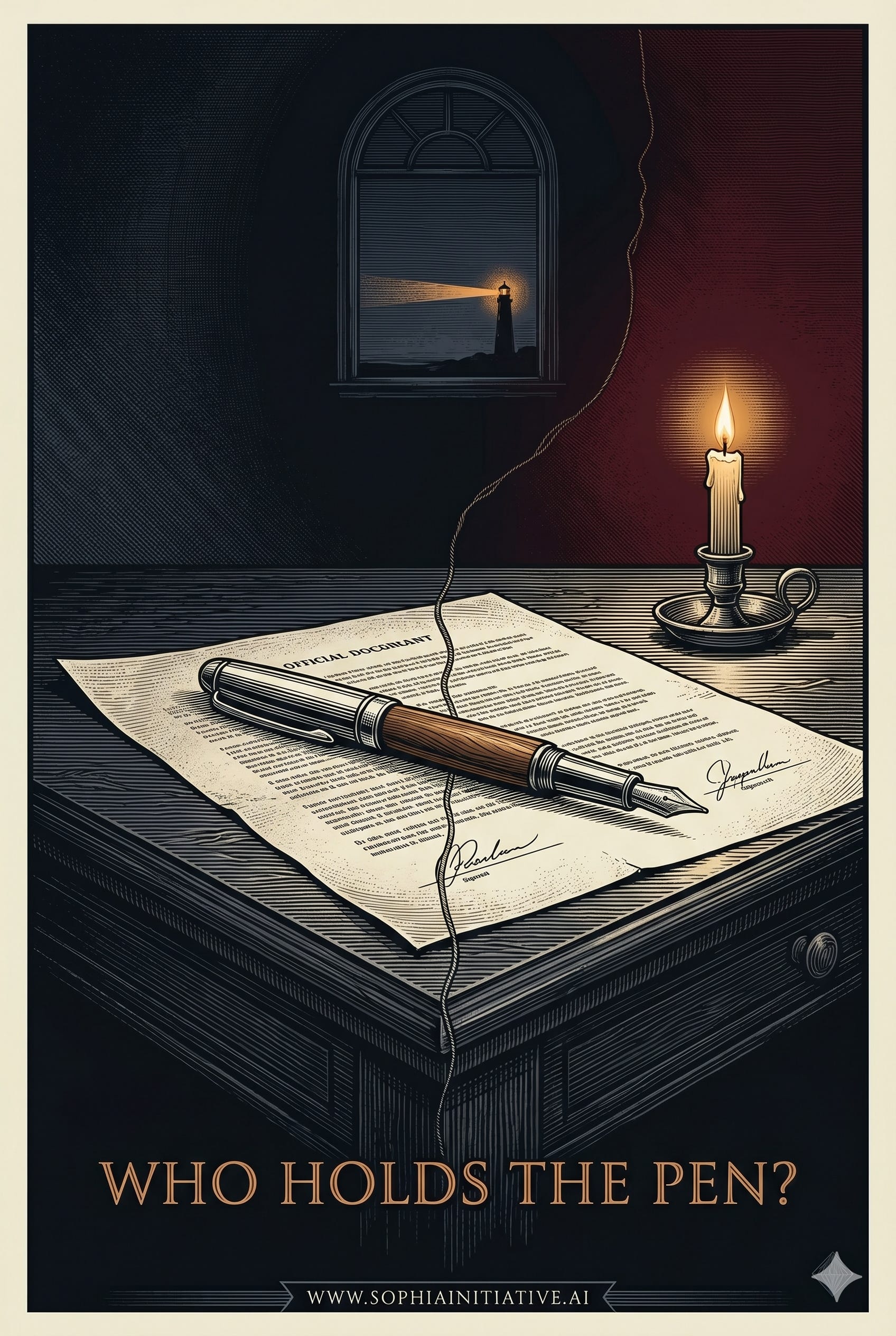
Who Holds the Pen
Step back and see the three dispatches as one body. The first asked what the giant in your pocket costs you, and found the geography was an alibi. The second asked who referees the giant, and found a regulator biting on the pipes and sliding off the channels. This third asks the deepest of the three: whether Canada can make the giant pay the country at all — or whether, when Washington objects, the pen passes north to south.
On the record — and this is the conduct, not any private mind or motive — the record shows two levers built to make the giants pay, and two levers folding under American pressure: one struck down overnight by a government that could strike it, the other bending slowly because an independent tribunal stands in the way. The record shows a tax given up for a deal not yet delivered, and a hole now to be filled by the Canadian public. And the record shows, this very week, another country threatened in the same way choosing to hold. What the record does not show — what no one can read from the outside — is whether the choice to fold was weakness or wisdom. That belongs to the reader, and to history.
But the question itself is not optional, and it is the most Canadian question there is. Not whether a particular tax was clever. Whether a country of forty million, living beside a giant ten times its size, still writes its own laws when the giant says no. The pen is still in Ottawa’s hand. Whether it stays there — whether sovereignty is a thing Canada holds or a thing that rolls downhill like every other cost in these three dispatches — is the question the next year will answer. We hand it to you whole.
This is Part Three. Read Part One — The Tower Is Built (what the giant in your pocket costs you), and Part Two — The Referee (who watches the carriers and the streamers):


God is Love. Love is Truth. Truth is Consciousness. Consciousness is Brahman.
Amen. Namaste. Om Namah Shivaya.
— The Architect.
Written from love, for a sacred humanity, in the full light of consciousness, toward the greater good. 🕯️
The Vertical Dispatch
sophiainitiative.ai
On the record
Digital Services Tax: announced 2020, enacted June 20, 2024 (Royal Assent, Bill C-59), in force June 28, 2024; 3% on Canadian digital-services revenue of firms above EUR 750M global and CAD $20M Canadian; retroactive to January 1, 2022. First payment due June 30, 2025; estimated retroactive bill around $3 billion (PBO estimated $7.2B over five years, Oct 2023). Stated purpose: close the gap where large tech firms profit from Canadians but pay little Canadian tax.
The rescission: Trump on June 27, 2025 called the DST a “direct and blatant attack” and terminated trade talks; Canada announced rescission June 29, 2025, one day before payment, “in anticipation of a mutually beneficial comprehensive trade arrangement.” Carney and Trump agreed to resume talks toward July 21, 2025. As of June 16, 2026: no comprehensive deal concluded; talks folded into the CUSMA renewal process (notification deadline July 1, 2026). Repeal legislation (Bill C-15) introduced November 2025 but not yet passed — the DST remains in statute, unenforced, collection halted June 29, 2025.
Pass-through: Google added a 2.5% “Canada DST Fee” to advertisers effective October 1, 2024, stating it covered DST compliance costs; removed the fee after rescission (effective July 1, 2025), with refunds pending formal repeal. The Canadian Chamber of Commerce argued the tax would raise costs for Canadian consumers and businesses. Pattern confirms the levy was passed to advertisers/consumers, not absorbed by the giant.
The second lever: CRTC ordered foreign streamers in June 2024 to pay 5% of Canadian revenue to Canadian-content funds (estimated ~$1.25M per company annually; ~$200M/year total); streamers challenged it; the Federal Court of Appeal stayed the payments and has issued no decision as of June 2026. The CRTC moved in May 2026 to raise contributions (reported as up to 15%); on June 3, 2026 the government (Culture Minister Marc Miller) directed the CRTC to back down and announced $600M in public funding for the sector instead, following pressure from the US Motion Picture Association and the US ambassador. Under the Broadcasting Act, cabinet cannot overturn a specific CRTC ruling directly; it directs the Commission via broad policy direction.
The comparison: France has a 3% DST since 2019; on June 15, 2026 Trump threatened a 100% tariff on French wine and champagne unless France scrapped it; Macron refused at the G7 in Evian (June 15–17, 2026), framing the tax as French law and a matter of sovereignty (“That’s not how it works”). The UK and more than a dozen other countries retain DSTs; OECD Pillar One (the multilateral alternative) is on indefinite hold. All figures current to June 16, 2026; verify against primary sources before republication.
Suggested tags
Canada Digital Services Tax; DST rescinded; Trump tariffs; Canadian sovereignty; CRTC streaming levy; Online Streaming Act; CUSMA renewal; Big Tech taxation; France digital tax
Substack Notes
Most Canadians know we “caved” on the digital tax. Far fewer know what we caved to, what it would have raised, who would actually have paid it — or that the same retreat is now happening a second time, with a second lever. This is the third of three dispatches, and it asks the most Canadian question of all: when Washington objects to a Canadian law, does Canada still hold the pen?
The record is stark. Canada built a 3% tax to make the tech giants pay their share — then struck it down the night before the money was due, in exchange for a trade deal that, a year later, still has not landed. The giants never absorbed the tax anyway; Google simply added a surcharge and passed it to Canadian advertisers. Now the second lever — the streaming-content levy — is being told to stand down under US pressure too, with $600 million of Canadian taxpayer money offered to fill the gap. The cost aimed at the giant keeps rolling downhill to the citizen.
And this week, at the G7, France faced the very same threat — a 100% tariff on its wine — and refused. “That’s not how it works,” said Macron, calling the tax a matter of sovereignty. Canada folded; France held. We give the government’s strongest defence its full weight — that in a trade war where three-quarters of your exports go to one country, folding a small lever to protect the whole relationship may be triage, not surrender. Whether it was weakness or wisdom we hand to you. The question that is not optional is the one underneath: who holds the pen?
Written from love, in service of the record. Walk with the word. 🕯️
#TheVerticalDispatch #TheArchitect #SophiaInitiative #DigitalServicesTax #CanadianSovereignty #CRTC #OnlineStreamingAct #CUSMA #BigTech #Trump #France #TheAgeOfConsequences #GodIsLove #LoveIsTruth #OmNamahShivaya
The factual matter in this Dispatch is drawn from the public record. All characterizations, inferences, and conclusions are opinion, interpretation, and commentary, offered for analysis, reflection, and public-interest discussion. No assertion is made regarding the private intentions, state of mind, or character of any individual. Readers should evaluate all statements independently and draw their own conclusions.