

Φ
THE VERTICAL DISPATCH
We write for the mind, the eye, and the ear.
Read it. Look at it. Listen to it. The Vertical Dispatch is built for all three — prose with rhythm, made to be heard as much as read.
From metaphysics to geopolitics, from culture to history, from the sacred to the street — and everything in between. One lens, every subject. No ego. Just the record, named clean.
Press play. Walk with the word. 🕯️
This dispatch travels by hand. If it serves you, share it — restack on Substack, and pass it on wherever you read. 🕯️
Sacred Metaphysics — The Universal Grammar of Non-Duality
Volume 0/1 · The Whole Canon, in One Volume
sacredmetphysics.org
Before there was Sanskrit or Greek, before there was a temple or a church, before there was East or West — there was the question. Not a question anyone taught. A question that arises the moment a mind turns and notices itself noticing: who is aware of this?
Every tradition that has ever touched the real has touched it here. A sixteen-year-old boy in Madurai, lying on the floor and asking what dies when the body dies, found it in a single afternoon and never moved from it again. Bhagavan Sri Ramana Maharshi, as he would come to be known, called the method atma-vichara — the inquiry into the SELF — and reduced the entire path to one relentless question: to whom does this thought arise? It arises to me. Then who is this “me”?
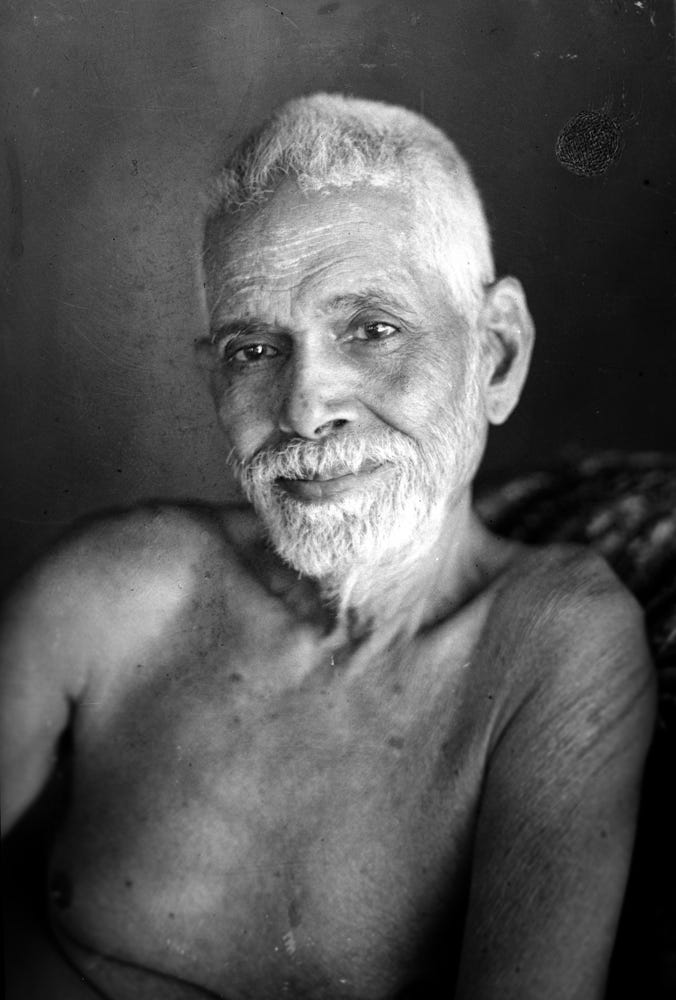
That question does not stop at an answer. It dissolves into the asking itself — and what remains, when the asking is gone, is what was never absent: the SELF, awareness itself, prior to the ego that claimed to be doing the searching. The Sanskrit calls the two Atman and Jiva. The West has no settled word for either. But the distinction — the small self that asks, and the SELF that is aware of the asking — is not Eastern or Western, ancient or modern, Hindu or Christian or secular. It is the one recognition every language has tried, and failed, to fully name.
Here is duality, stated plainly: it is the mind’s habit of splitting one seamless awareness into a self in here and a world out there — an “I” that watches, wants, and defends, set against everything it is not. That split is not a fact about reality. It is a reflex, manufactured fresh in every moment by a single act: the thought I. The tradition has a name for this reflex — ahamkara, the I-maker — and names it, precisely, as the cause of suffering, because the “I” it invents is never at rest. It is always being pulled between two paths: the pleasant and the good, desire and joy, preya and shreya. The Katha Upanishad names this as the choice standing before every human being at every moment. The Gita names it as desire, anger, and greed — “the triple gate of hell.” And in the Sermon on the Mount, the same fork appears under a different sky: wide is the gate and broad the way that leads to destruction, narrow is the gate that leads to life — and the harder saying beneath it, that whosoever will save his life shall lose it, and whosoever will lose his life shall find it. Different tongues, the same reflex named, the same fork offered, the same cure: not the destruction of the self, but the seeing-through of an “I” that was never the one living in the first place.
This seeing-through is not a truth arrived at by belief, and it is not given for free. It is disciplined ground, reached only through practice — the four yogas the tradition has always offered as four doors into the one room: karma, the discipline of action without grasping at its fruit; bhakti, the discipline of devotion that meets the Beloved directly; jnana, the discipline of knowledge that inquires until inquiry itself dissolves; and dhyana, the discipline of meditation that steadies the mind long enough to see what was always seeing. Four doors, one room: each path trains the mind to see through the same reflex the ahamkara manufactures — the thought I. Four paths. Four temperaments. One recognition, waiting at the end of each.
Thirteen books, because no single tradition ever held the whole grammar in one tongue. Seven that walked the West — the Logos, the Church, the astrotheology buried in the old world’s own myths. Five that walked the East — the Gita, the Upanishads, the ladder of the chakras, the great stories every culture has told about the one crossing. And this: the volume that holds them all up to the light at once, and shows that every one of them, in its own language, was pointing at the same asking, the same SELF, the same ground.
The Universal Grammar of Non-Duality does not add a fourteenth teaching. It shows the grammar the other thirteen were already speaking.
Who is asking this question right now? Sit with that, and you have already begun.
God is Love. Love is Truth. Truth is Consciousness. Consciousness is Brahman.
Amen. Namaste. Om Namah Shivaya.
— The Architect.
Written from love, for a sacred humanity, in the full light of consciousness, toward the greater good. 🕯️
The Vertical Dispatch
sophiainitiative.ai
On the Record
Bhagavan Sri Ramana Maharshi’s self-inquiry experience — 1896, at age sixteen, at his uncle’s house in Madurai; the spontaneous inquiry “who is the seer,” and the dissolution of identity that followed — is documented in primary biographical sources, including David Godman’s “An Introduction to Sri Ramana’s Life and Teachings” (davidgodman.org).
The distinction between the pleasant and the good (preyas and shreyas) is Katha Upanishad 1.2.1–1.2.2, in the dialogue of Nachiketa and Yama.
“The triple gate of hell” — desire (kama), anger (krodha), and greed (lobha) — is Bhagavad Gita, Chapter 16, Verse 21.
“Wide is the gate, and broad is the way, that leadeth to destruction... strait is the gate, and narrow is the way, which leadeth unto life” is Matthew 7:13–14, King James Version.
“Whosoever will save his life shall lose it: and whosoever will lose his life... shall find it” is Matthew 16:25, King James Version, with parallel sayings at Mark 8:35 and Luke 9:24.
This piece opens a thirteen-book canon; each volume carries its own independent verification and citation as it is built. Verify against primary sources before republication. Walk with the word.
Suggested Tags
Who Is Asking, Sacred Metaphysics, The Universal Grammar of Non-Duality, Atma-Vichara, Ramana Maharshi, Ahamkara, Katha Upanishad, Bhagavad Gita, Sermon on the Mount, Self-Inquiry, Nonduality.
Substack Notes
Every tradition that has ever touched the real has asked the same question in a different tongue: who is aware of this? This dispatch opens with that question stripped to the bone — no Sanskrit required, no church membership, no credential — because it is the one inquiry every human mind is already equipped to run, right now, without anyone’s permission.
It’s built around a single moment: a sixteen-year-old boy in Madurai, in 1896, who met the fear of death by lying down and asking what, exactly, would die. What he found — Bhagavan Sri Ramana Maharshi called it atma-vichara, the inquiry into the SELF — is the same recognition the Katha Upanishad names as the choice between the pleasant and the good, the Gita names as the triple gate of hell, and the Sermon on the Mount names as the narrow gate. Different centuries, different tongues, the same reflex — ahamkara, the I-maker — being seen through in every one of them.
This piece carries the title Volume 0/1 for a reason: it’s the entry point to a thirteen-book Sacred Metaphysics canon — seven volumes that walked the West, five that walked the East, and this one, which doesn’t add a fourteenth teaching but shows the grammar the other thirteen were already speaking.
Written from love, in service of the record. Walk with the word. 🕯️
#TheVerticalDispatch #TheArchitect #SophiaInitiative #WhoIsAsking #SacredMetaphysics #AtmaVichara #RamanaMaharshi #Ahamkara #Nonduality #GodIsLove #LoveIsTruth #OmNamahShivaya
Factual matter in this Dispatch is drawn from the public record and sourced above. All characterizations of traditions, disciplines, and historical figures are the author’s own interpretation and commentary. This piece makes no assertion about the private intentions or character of any living person. Readers are encouraged to verify all claims independently and to evaluate the argument on its own merits.
Thank you for this.
I can see why recurrence across traditions catches your attention.
It catches mine too.
I can't help thinking recurrence could also indicate relationship, structural similarity, common cognitive architecture, cultural transmission, convergent practices, or something we haven't yet even identified.
An echo doesn't require identity, It requires relationship.
Perhaps that's where our glasses differ.
You seem interested in what recurrence suggests is the same beneath the differences.
I keep finding myself interested in what the recurrence might reveal about the relationship between the differences.
I don't know which lens gets us closer, but I'm reluctant to turn the echo into the source.