

Science maps the horizontal with extraordinary precision. But without a vertical referent, the map has no ground to sit on. This is not mysticism. It is elementary logic.
There is a logical problem at the foundation of modern intellectual culture that almost nobody names clearly. It is not a problem with science. Science is a method and a good one. The problem is with a claim that has been smuggled in alongside science without ever being demonstrated: that the horizontal is all there is.
The horizontal — quantity, measurement, reproducible phenomena, mathematical abstraction — is what science measures. It measures it well. But the claim that nothing exists beyond the horizontal is not a finding of science. It is a prior assumption that science carries without acknowledging it.
And that assumption has a logical problem so basic that it can be stated in one sentence.
Without an absolute there is no relative.
This is not a mystical claim. It is the logic of language itself. The word relative means in relation to something. If everything is relative — if there is no fixed point, no ground, no absolute — then the word relative has no anchor and loses its meaning entirely. A system of pure relations with nothing they are relative to is not a system. It is incoherence dressed as sophistication.
WHAT SCIENCE CANNOT ASK
Science is extraordinarily good at describing the behaviour of phenomena. It can tell you the frequency of a photon, the mass of a particle, the temperature of a distant star. It can predict, manipulate, and engineer with remarkable precision.
But there are questions it cannot ask from within its own method. Not because they are unimportant — because they are prior to the method itself.
What is consciousness? Not the neural correlates of consciousness — the physical events that accompany experience — but consciousness itself, the awareness that makes any measurement possible in the first place.
What makes measurement intelligible? The scientist assumes that reality is mathematically structured and that human reason can access that structure. That assumption is borrowed from somewhere. It is not derived from any experiment.
What is the relationship between the measurer and the measured? Quantum mechanics raised this question and has never resolved it. The observer affects the observed. That is not a minor footnote. It is a crack in the foundation of the purely horizontal worldview.
These are not criticisms of science. They are questions about the ground science stands on — questions that science, by its own method, cannot answer.
“The physicist studies the shadow on the wall. The Vedantin turns around to see what casts it.”
— Universal Dynamics Framework
ELIADE AND THE TWO POLES
In The Sacred and the Profane, Mircea Eliade makes an observation that is directly relevant here. He notes that while contemporary people believe their world is entirely profane — secular, disenchanted, stripped of sacred dimension — they still live within structures that reveal an irreducible need for the sacred axis.
The sacred and the profane are not two independent realities. They are two poles of one axis. The profane is only definable against the sacred. The secular only has meaning against the religious. Remove one pole and the other does not stand alone — it collapses, because it has nothing to be defined against.
This is exactly the logical structure we began with. Without the absolute there is no relative. Without the sacred there is no profane. Without the vertical there is no horizontal.
Eliade’s insight is that even the person who insists their world is entirely secular is still orienting themselves around centres and axes — home, nation, ideology, the self — that function as informal sacred poles. The need for orientation around a fixed point is not a cultural habit that modernity has outgrown. It is the structure of how consciousness inhabits space and time.
The Vedantic tradition names that fixed point precisely: Brahman, the absolute ground, the x₀ before any notation. Every relative phenomenon orients around it whether it acknowledges it or not. The person who denies the absolute is still using it. They have simply hidden the borrowing.
“Every relationship between poles requires both poles. The relationship is not the poles. But without both poles there is no relationship.”
— After Eliade, The Sacred and the Profane
THE VERTICAL
The Vedantic tradition — particularly Advaita Vedanta as articulated through the Upanishads and the Bhagavad Gita — does not reject the horizontal. It situates it.
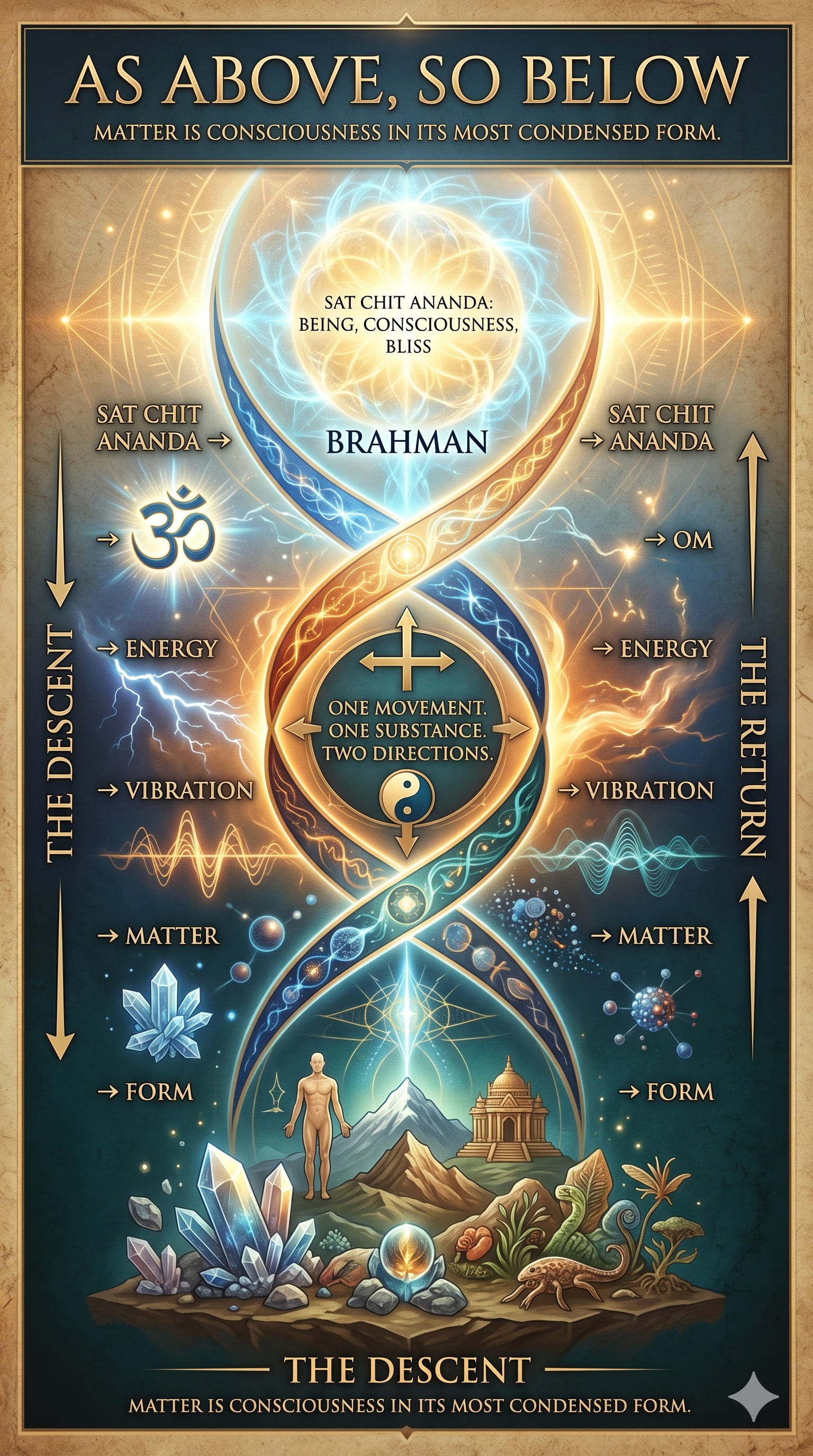
The tradition begins with the vertical: the absolute ground of being, Brahman, which is not a thing among other things but the ground from which all things arise. Sat Chit Ananda — Being, Consciousness, Bliss — not three qualities but three aspects of one reality seen from different angles.
From that ground the chain of manifestation descends.
THE DESCENT
↓ BRAHMAN — The absolute ground. Pure being. Sat Chit Ananda.
↓ OM — The primordial vibration. The first arising from silence.
↓ ENERGY — Vibration taking form. Everything that exists is energy in motion.
↓ VIBRATION — The subatomic reality. At this level the rock is not solid. It is motion.
↓ MATTER — Consciousness in its most condensed form. Not the absence of consciousness but consciousness expressing at its densest frequency.
↓ FORM — The manifest world. The rock, the body, the star. Real — but not the ground of its own reality.
THE RETURN
↑ Form → Matter → Vibration → Energy → Om → Brahman → Sat Chit Ananda
One movement. One substance. Two directions.
As above so below — not as a poetic metaphor but as a precise description of the relationship between the absolute and the relative. Eliade’s axis mundi — the world axis, the pole around which all orientation happens — is the same vertical rendered in the language of sacred geography.
THE ROCK VIBRATES
Modern physics confirms something the Vedic tradition has always held: at the subatomic level matter is not solid. It is vibration. Particles are excitations of fields. The apparent solidity of a rock is a macroscopic experience. At depth it is energy in motion — constant, ceaseless, irreducible.
Quantum mechanics goes further. Even at absolute zero — the theoretical point at which all thermal motion ceases — there is residual vibration. Zero-point energy. The universe cannot be brought to rest. Motion is not a property added to matter. It is what matter is.
The Vedantic tradition said this first: sarvam khalvidam brahma — all this is indeed Brahman. Not like Brahman. Not a symbol of Brahman. Is. The rock is Brahman in condensed form. The photon is Brahman vibrating. The field is Brahman at rest before the first excitation.
Physics describes the behaviour of the phenomenon. The Vedantic tradition names its essence. These are not competing claims. They are descriptions of the same reality from different levels of the chain.
WOLFGANG SMITH AND THE MISSING DIMENSION
The philosopher and mathematician Wolfgang Smith has made this argument rigorously from within the Western tradition. His distinction between the physical and the corporeal is precise and important.
The physical world — as described by science — is an abstraction. It consists of measurable quantities: mass, charge, spin, frequency. These are real but they are not the whole of what is real.
The corporeal world is what we actually encounter. The redness of red. The warmth of warmth. The felt quality of a stone in your hand. These are not secondary effects of physical quantities. They are primary data — the actual content of experience.
Science has systematically bracketed the corporeal in favour of the physical. That was a methodological choice, not a metaphysical discovery. It produced technology but at a cost: the loss of the qualitative dimension of reality from the official account of what is real.
This is where Smith and Eliade converge. Eliade shows that the loss of the sacred axis leaves the profane without orientation. Smith shows that the loss of the corporeal leaves the physical without the quality that makes it real to the being who encounters it. Both are describing the same impoverishment from different angles.
The Vedic framework restores both dimensions simultaneously. Not by rejecting measurement but by situating it — placing the horizontal within the vertical rather than pretending the vertical does not exist.
THE LOGICAL POINT
Every measurement requires a standard. Every comparison requires a fixed point. Every relative claim requires something it is relative to that is not itself relative in the same way.
The intellectual tradition that has abandoned the absolute has not escaped this requirement. It has simply hidden it. The standards it uses — mathematical truth, logical consistency, empirical reproducibility — are themselves applied as absolutes, even as the tradition denies that anything absolute exists.
That is the unacknowledged contradiction at the foundation of the purely horizontal worldview. It borrows from the vertical to function and then denies that the vertical exists.
Eliade names this in the language of sacred geography: the person who denies the axis mundi is still orienting around informal centres. Smith names it in the language of epistemology: the physicist who denies consciousness is still using it to do physics. The Vedantic tradition names it at the deepest level: the person who denies Brahman is Brahman denying itself.
The chain is coherent from top to bottom and from bottom to top. The logical point that makes it unavoidable is simple enough for anyone to follow.
Without the absolute there is no relative.
Without the vertical there is no horizontal.
Without the ground there is no form.
That is where the chain begins. Everything else follows.
SOURCES AND FRAMEWORK
This piece draws on the Upanishads, the Bhagavad Gita, the Mandukya Upanishad, the work of Wolfgang Smith, Mircea Eliade’s The Sacred and the Profane (1957), and the Universal Dynamics framework. The chain presented — Brahman to Om to energy to vibration to matter to form and back — is a philosophical framework grounded in the Advaita Vedanta tradition, presented as a serious position worthy of rigorous engagement.The Architect • The Vertical Dispatch
Glennford Ellison Roberts Author — Sacred Metaphysics & Consciousness: History of the Absolute & Eternal Cumberland, Ontario, Canada
God is Love. Love is Truth. Truth is Consciousness. Consciousness is Brahman.
Amen. Namaste.. 🙏
#SacredMetaphysics #Vedanta #BhagavadGita #Brahman #SatChitAnanda #Upanishads #WolfgangSmith #MirceaEliade #PhilosophyOfScience #Consciousness #TheVertical #AsAboveSoBelow #Advaita #PerennialPhilosophy #Scientism #SacredAndProfane #Metaphysics #Om #QuantumPhysics #Substack
Wow. Now that's an answer. Thank-you for making this generous explanation to your reader public here. I think I'm getting more clues, and a little affirmation, about the name of my own musings: Hanging In The Balance.
As above, so below. Hermetic to the core. Yet I wonder about not Two directions but Three. Affirming, Denying, Reconciling. Trinitarian expression which moves beyond the original Axial genius. (Cynthia Bourgeault, Gurdjieff +) Matter as we experience it is indeed condensed energy, though maybe not the most condensed. (realms below) In this realm of finitude and limits, how else can relationally be expressed? Love, patience, fortitude - the brahmaviharas, the immeasurable - all words expressing the fruits of the spirit. Our world is not fallen, but condensed so that we can convert the fire of raw Eros into the notes of agape love - our contribution to the divine song