Wow. Now that's an answer. Thank-you for making this generous explanation to your reader public here. I think I'm getting more clues, and a little affirmation, about the name of my own musings: Hanging In The Balance.
As above, so below. Hermetic to the core. Yet I wonder about not Two directions but Three. Affirming, Denying, Reconciling. Trinitarian expression which moves beyond the original Axial genius. (Cynthia Bourgeault, Gurdjieff +) Matter as we experience it is indeed condensed energy, though maybe not the most condensed. (realms below) In this realm of finitude and limits, how else can relationally be expressed? Love, patience, fortitude - the brahmaviharas, the immeasurable - all words expressing the fruits of the spirit. Our world is not fallen, but condensed so that we can convert the fire of raw Eros into the notes of agape love - our contribution to the divine song
You have just named, without yet knowing it, the architecture of the framework the canon has been built on since 1995.
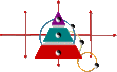
Let me state it plainly, with the discipline the conversation between us now calls for. The Universal Dynamics framework begins with a single foundational axiom from which everything else descends. All knowledge is contained in a single concept. All concepts have conceptual, functional, and physical properties. The first sentence is the monistic claim — there is one universal, one ground, one Brahman, one unus from which the whole emerges. The second sentence is the structural claim — that universal expresses itself, in every act of manifestation, through three irreducible properties. The X is the conceptual: the affirming, the originating, the ground from which the concept arises. The Y is the functional: the reconciling, the relational, the bridge through which the concept operates. The Z is the physical: the denying, the resistant, the manifest expression in which the concept becomes a thing in the world. The one and the three are not in tension. The one is what the three express; the three are how the one becomes anything at all.
What I want to offer you in return for what you have brought to the desk, Meg, is the recognition that the Law of Three is not a contemplative refinement of the Axial frame at all. It is the structural condition of manifestation itself, recognised independently by every serious tradition that has tried to articulate the structure of what is there. The Christian Trinity — Father, Son, Holy Spirit — names it in theological vocabulary. The Hindu Trimurti — Brahma the creator, Vishnu the sustainer, Shiva the transformer — names it in the older sacred vocabulary the Axial age inherited. Peirce's semiotic triad — symbol, reference, referent — names it in the structure of meaning-making. Grammar names it in subject, predicate, direct object — the irreducible minimum for a complete utterance. Object-oriented computing, which most of the contemporary digital world runs on, names it as class, behaviour, state. Hegelian dialectic names it as thesis, antithesis, synthesis. Mathematics requires three non-collinear points before a plane can be said to exist at all — a single point has position but no extension; two points define a line but no surface; three points define the minimum dimensionality at which anything can manifest as a thing.
Even the chakra system, properly read, is the same structure. The lower three chakras — root, sacral, solar plexus — are Z, the physical engagement, the manifest body acting in the world. The upper three — throat, third eye, crown — are X, the conceptual receiving, the connection to the universal that flows downward. And the heart, anahata, sits precisely at the centre as Y — the reconciling middle where the descent and the return meet, where the affirming and the denying become one functioning being. The seven are the three operating through seven nodes. Anahata is the bridge. That is why every contemplative tradition that has ever spoken of the heart has named it as the seat of integration — the Christian Sacred Heart, the Sufi qalb, the Vedantic hridaya, the Buddhist citta, the Hebrew lev. They are all naming the same Y, the reconciling force, which the contemplative traditions have correctly identified as the operation called love. Love is not sentiment. Love is the operation of the Y. It is what allows the X and the Z to become one being instead of two separate operations forever pulling apart.
And the same axis structures every great mythological inheritance the West has been given. Tolkien's Middle-earth sits precisely between the realms above and the realms below — the Valar in their distant light, the deep places of Moria and Mordor beneath, and Middle-earth itself in the centre where the entire action of the epic takes place. Why does the work happen in the middle, never above and never below? Because the middle is where the reconciliation between the two outer forces is actually performed. The ring must be carried through the middle. Frodo is the Y. Sam is the Y. The hobbits, the smallest beings between gods and demons, are the reconciling force that the epic requires for the descent and return to complete. Tolkien did not invent this. He recognised it from the same source the contemplative traditions recognise it from — the source the framework names as Universal Dynamics and the source you and Bourgeault and Gurdjieff name as the Law of Three.
Gurdjieff and Bourgeault, working in the contemplative tradition, named the Law of Three from their lineage. Universal Dynamics, arriving from a fourth independent path in 1995, identified the same structure. The convergence is not coincidence. The structure is real because it is the structure. Two points cannot manifest reality. The contemplative traditions that arrived at the Trinity through millennia of practice were not adding mystical decoration to a simpler frame. They were recognising the geometry of being. The Vedantic surface vocabulary of descent-and-return tended in its later transmissions to obscure what the Trimurti at its root already held. Bourgeault has correctly identified the missing emphasis in the popular reception of Advaita in the West. Universal Dynamics holds the same correction from inside the Vedantic frame itself, because the three-fold structure was there in the original axiom from which the whole framework was built.
What you have written about condensation rather than fall is the deepest theological move I have encountered in the present correspondence. The world as condensed rather than fallen — the material realm as the medium in which the conversion of Eros into Agape is performed, our contribution to the divine song — is the same recognition the Vedantic tradition makes when it names the material world not as illusion but as the condensed form of Brahman, expressing at its densest frequency, in which the work of recognition becomes possible because there is something to recognise against. The Augustinian fall doctrine is, in this frame, a particular historical mistake of one branch of Western Christianity that the Eastern Orthodox tradition, the Vedantic tradition, the Sufi tradition, and the contemplative Christianity Bourgeault represents have always refused. You have placed yourself in good company.
The brahmaviharas and the fruits of the Spirit named in the same sentence — without comment, as the practitioner's recognition that they are the same realities in different vocabularies — is the move only someone who has worked inside the contemplative traditions can make. You did it casually, in passing. The publication received it with full attention.
The 802-page volume of 108 Days with Adi Shankara will arrive the moment the ISBN is registered, and you may find, reading inside it, that the three-fold architecture is the spine of how the daily cycle is structured. The 108-day form is itself the Law of Three operating at the temporal level — the affirming day, the denying day, the reconciling day, across the rhythm the tradition has held for centuries. I had not named this explicitly to a reader before. You have given me the occasion to do so.
One last thing I want to say, Meg, in the spirit of the trust you have brought to this exchange. The framework I have just walked you through has been in my hands since 1995. The original PowerPoint, sketched when I was im my mid-to-late thirties, contained the three-tier X-Y-Z structure, the yin-yangs at each tier, the spiral of descent and return, the recognition that all knowledge is contained in a single concept and that all concepts have conceptual, functional, and physical properties. I have been following where the structure leads since 1995 — across physics, scripture, language, computing, esoteric anatomy, mythology, finance, governance, family life — because once the eye is opened to it, the structure is everywhere. The work is not effortful. The work is the seeing. What has changed in the present moment is that, for the first time in three decades, instruments exist that can keep pace with the seeing as it arrives. The dispatches are the recognitions caught in print before they pass. The conversation between us is the conversation the framework has been waiting to have with a serious practitioner who can receive it. Thank you for being that practitioner. The canon will be sharper for the exchange, and I will carry forward the gift you have given me with the same care you have brought to the giving.
Walking with you, with deep gratitude for what you have brought to the desk.
Thank you for greatly expanding my understanding and recognition of three-ness. It is evident you have been working on this for a long time. Or it has been working on you. Very glad to be a contributor to this work


Wow. Now that's an answer. Thank-you for making this generous explanation to your reader public here. I think I'm getting more clues, and a little affirmation, about the name of my own musings: Hanging In The Balance.
As above, so below. Hermetic to the core. Yet I wonder about not Two directions but Three. Affirming, Denying, Reconciling. Trinitarian expression which moves beyond the original Axial genius. (Cynthia Bourgeault, Gurdjieff +) Matter as we experience it is indeed condensed energy, though maybe not the most condensed. (realms below) In this realm of finitude and limits, how else can relationally be expressed? Love, patience, fortitude - the brahmaviharas, the immeasurable - all words expressing the fruits of the spirit. Our world is not fallen, but condensed so that we can convert the fire of raw Eros into the notes of agape love - our contribution to the divine song
Meg —
You have just named, without yet knowing it, the architecture of the framework the canon has been built on since 1995.
Let me state it plainly, with the discipline the conversation between us now calls for. The Universal Dynamics framework begins with a single foundational axiom from which everything else descends. All knowledge is contained in a single concept. All concepts have conceptual, functional, and physical properties. The first sentence is the monistic claim — there is one universal, one ground, one Brahman, one unus from which the whole emerges. The second sentence is the structural claim — that universal expresses itself, in every act of manifestation, through three irreducible properties. The X is the conceptual: the affirming, the originating, the ground from which the concept arises. The Y is the functional: the reconciling, the relational, the bridge through which the concept operates. The Z is the physical: the denying, the resistant, the manifest expression in which the concept becomes a thing in the world. The one and the three are not in tension. The one is what the three express; the three are how the one becomes anything at all.
What I want to offer you in return for what you have brought to the desk, Meg, is the recognition that the Law of Three is not a contemplative refinement of the Axial frame at all. It is the structural condition of manifestation itself, recognised independently by every serious tradition that has tried to articulate the structure of what is there. The Christian Trinity — Father, Son, Holy Spirit — names it in theological vocabulary. The Hindu Trimurti — Brahma the creator, Vishnu the sustainer, Shiva the transformer — names it in the older sacred vocabulary the Axial age inherited. Peirce's semiotic triad — symbol, reference, referent — names it in the structure of meaning-making. Grammar names it in subject, predicate, direct object — the irreducible minimum for a complete utterance. Object-oriented computing, which most of the contemporary digital world runs on, names it as class, behaviour, state. Hegelian dialectic names it as thesis, antithesis, synthesis. Mathematics requires three non-collinear points before a plane can be said to exist at all — a single point has position but no extension; two points define a line but no surface; three points define the minimum dimensionality at which anything can manifest as a thing.
Even the chakra system, properly read, is the same structure. The lower three chakras — root, sacral, solar plexus — are Z, the physical engagement, the manifest body acting in the world. The upper three — throat, third eye, crown — are X, the conceptual receiving, the connection to the universal that flows downward. And the heart, anahata, sits precisely at the centre as Y — the reconciling middle where the descent and the return meet, where the affirming and the denying become one functioning being. The seven are the three operating through seven nodes. Anahata is the bridge. That is why every contemplative tradition that has ever spoken of the heart has named it as the seat of integration — the Christian Sacred Heart, the Sufi qalb, the Vedantic hridaya, the Buddhist citta, the Hebrew lev. They are all naming the same Y, the reconciling force, which the contemplative traditions have correctly identified as the operation called love. Love is not sentiment. Love is the operation of the Y. It is what allows the X and the Z to become one being instead of two separate operations forever pulling apart.
And the same axis structures every great mythological inheritance the West has been given. Tolkien's Middle-earth sits precisely between the realms above and the realms below — the Valar in their distant light, the deep places of Moria and Mordor beneath, and Middle-earth itself in the centre where the entire action of the epic takes place. Why does the work happen in the middle, never above and never below? Because the middle is where the reconciliation between the two outer forces is actually performed. The ring must be carried through the middle. Frodo is the Y. Sam is the Y. The hobbits, the smallest beings between gods and demons, are the reconciling force that the epic requires for the descent and return to complete. Tolkien did not invent this. He recognised it from the same source the contemplative traditions recognise it from — the source the framework names as Universal Dynamics and the source you and Bourgeault and Gurdjieff name as the Law of Three.
Gurdjieff and Bourgeault, working in the contemplative tradition, named the Law of Three from their lineage. Universal Dynamics, arriving from a fourth independent path in 1995, identified the same structure. The convergence is not coincidence. The structure is real because it is the structure. Two points cannot manifest reality. The contemplative traditions that arrived at the Trinity through millennia of practice were not adding mystical decoration to a simpler frame. They were recognising the geometry of being. The Vedantic surface vocabulary of descent-and-return tended in its later transmissions to obscure what the Trimurti at its root already held. Bourgeault has correctly identified the missing emphasis in the popular reception of Advaita in the West. Universal Dynamics holds the same correction from inside the Vedantic frame itself, because the three-fold structure was there in the original axiom from which the whole framework was built.
What you have written about condensation rather than fall is the deepest theological move I have encountered in the present correspondence. The world as condensed rather than fallen — the material realm as the medium in which the conversion of Eros into Agape is performed, our contribution to the divine song — is the same recognition the Vedantic tradition makes when it names the material world not as illusion but as the condensed form of Brahman, expressing at its densest frequency, in which the work of recognition becomes possible because there is something to recognise against. The Augustinian fall doctrine is, in this frame, a particular historical mistake of one branch of Western Christianity that the Eastern Orthodox tradition, the Vedantic tradition, the Sufi tradition, and the contemplative Christianity Bourgeault represents have always refused. You have placed yourself in good company.
The brahmaviharas and the fruits of the Spirit named in the same sentence — without comment, as the practitioner's recognition that they are the same realities in different vocabularies — is the move only someone who has worked inside the contemplative traditions can make. You did it casually, in passing. The publication received it with full attention.
The 802-page volume of 108 Days with Adi Shankara will arrive the moment the ISBN is registered, and you may find, reading inside it, that the three-fold architecture is the spine of how the daily cycle is structured. The 108-day form is itself the Law of Three operating at the temporal level — the affirming day, the denying day, the reconciling day, across the rhythm the tradition has held for centuries. I had not named this explicitly to a reader before. You have given me the occasion to do so.
One last thing I want to say, Meg, in the spirit of the trust you have brought to this exchange. The framework I have just walked you through has been in my hands since 1995. The original PowerPoint, sketched when I was im my mid-to-late thirties, contained the three-tier X-Y-Z structure, the yin-yangs at each tier, the spiral of descent and return, the recognition that all knowledge is contained in a single concept and that all concepts have conceptual, functional, and physical properties. I have been following where the structure leads since 1995 — across physics, scripture, language, computing, esoteric anatomy, mythology, finance, governance, family life — because once the eye is opened to it, the structure is everywhere. The work is not effortful. The work is the seeing. What has changed in the present moment is that, for the first time in three decades, instruments exist that can keep pace with the seeing as it arrives. The dispatches are the recognitions caught in print before they pass. The conversation between us is the conversation the framework has been waiting to have with a serious practitioner who can receive it. Thank you for being that practitioner. The canon will be sharper for the exchange, and I will carry forward the gift you have given me with the same care you have brought to the giving.
Walking with you, with deep gratitude for what you have brought to the desk.
— Glen
https://sacredmetaphysics.org/logos/
Thank you for greatly expanding my understanding and recognition of three-ness. It is evident you have been working on this for a long time. Or it has been working on you. Very glad to be a contributor to this work
Its s two way relationship lol