


THE VERTICAL DISPATCH
We write for the mind, the eye, and the ear.
Read it. Look at it. Listen to it. The Vertical Dispatch is built for all three — prose with rhythm, made to be heard as much as read.
From metaphysics to geopolitics, from culture to history, from the sacred to the street — and everything in between. One lens, every subject. No ego. Just the record, named clean.
Press play. Walk with the words. 🕯️
On Democracy · The Age of Consequences
May 2026
“You learn the difference between the sound that belongs to you and the sound that belongs to the ocean.”
— a submariner, on the discipline of the deep
There is a kind of man who has been down. Not down as in low — down as in beneath, under the weight of the whole ocean, where the light does not reach and the noise of the surface cannot follow. He went there on purpose, in a steel hull built to hold the pressure, and he stayed. By one account, ninety days submerged in a single stretch — three months without the sun, without the surface, without a word spoken louder than the boat could afford. We will not name him, and we will not name the boat, and we will not name the mission, because the discipline that sent him down is the same discipline that keeps those things his to tell. What can be said is what the depth itself does to a man, and what it teaches, and why it matters now — because the country has just handed its highest secrets to men trained in exactly that discipline, and one man who wants to lead the country has refused to go anywhere near it.
This is a dispatch about depth, and about silence, and about what they cost — and about the difference between the people who have paid that cost and the people who have decided the surface is enough.
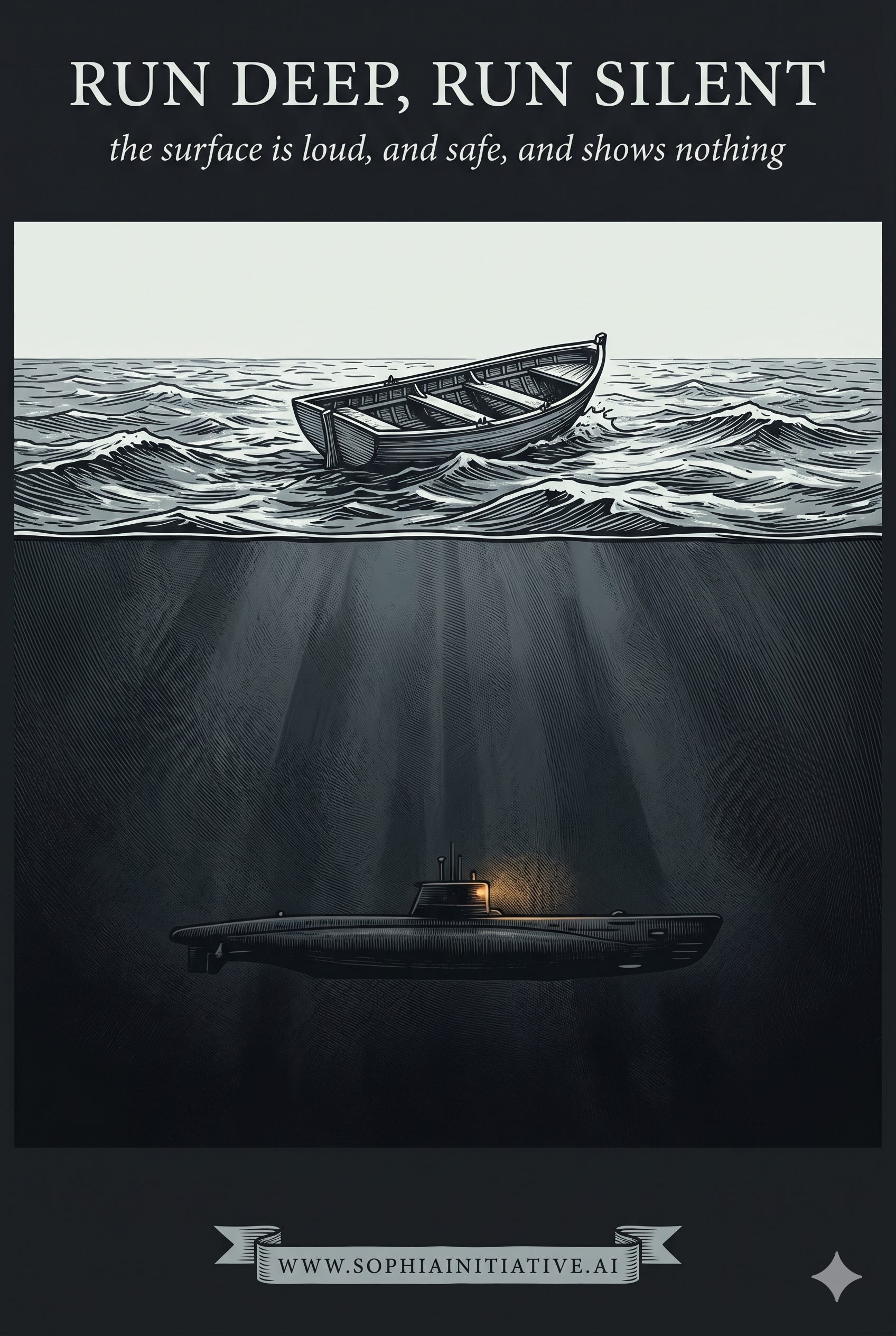
I. The Sound That Belongs to You
To run silent is not the absence of effort. It is the hardest effort there is. On a submarine running silent, every system that makes noise is shut down or muffled — the crew moves softly, speaks rarely, and listens. Above all, listens. Because the boat’s life depends on a single, almost impossible skill: telling the sound that belongs to you from the sound that belongs to the ocean. The hum of your own machinery from the screw of the ship hunting you. Your own hull settling under pressure from the ping that means you have been found. A man who cannot tell his own noise from the sea’s noise does not last in the deep. The discipline is total, and it is interior, and it does not switch off when the patrol ends. It becomes how he hears the world.
That is the first thing the depth does. It makes a man quiet — not timid, but disciplined; not empty, but holding. He learns that most of what could be said does not need to be said, and that some of what could be said must never be said, and that the difference between the two is a matter of life. He carries it home. He is, ever after, a man who offers little, because he has spent his formative years learning that the loud thing and the true thing are rarely the same thing, and that the surface — where all the noise is — shows nothing of what runs beneath it.
The men who served beneath the South Atlantic in the cold spring of 1982 lived this at the limit. The British submarines took station early and stayed, capable of remaining submerged for the entire campaign, holding a silent picket on the edge of hostile waters, trailing wire aerials to catch the first sound of an aircraft launching so the fleet above might have forty-five minutes’ warning. The water was rough, dark, and acoustically cluttered — sonar crews chased contacts that turned out to be whales, wrecks, and seagulls, the sea forever throwing up false sound to drown the true one. On at least one boat a floating aerial fouled the propeller and began to sing a betraying note; men went over the side in heavy seas to cut it free, knowing that if anything was detected, the captain would have to shut the hatch, dive the boat, and leave them to the ocean. That is the price of running silent. The silence is not comfort. The silence is survival, bought at a cost the surface never sees.
II. Clearance Is a Dive
Now bring it ashore, into the quiet rooms where a democracy keeps its secrets. A security clearance is sold to the public as a kind of key — a card that opens locked doors. That is the shallow understanding. A clearance is not a key. It is a dive. To hold one is to go down, deliberately, into water most citizens never see, and to accept the pressure that comes with the depth: the knowledge you take on can never come back up with you. You will know things you cannot say. You will see the true sound beneath the surface noise, and you will be bound, by oath and by law, to run silent about it for the rest of your life.
In Canada the mechanics are precise. The tiers run from site access up through Secret to Top Secret, with the most sensitive material classified at the level whose disclosure would do exceptionally grave injury to the national interest. The Canadian Security Intelligence Service conducts the vetting. For the body that watches the whole secret apparatus — the National Security and Intelligence Committee of Parliamentarians — the required clearance is a Top Secret clearance issued by the Clerk of the Privy Council, and its members are bound by the Security of Information Act, permitted to discuss what they know only inside restricted rooms, obligated to ensure they do not even indirectly let a secret slip. That is the gag that comes with the dive. You go down; you are bound to silence; the binding is for life.
This is the discipline of the deep, transposed into the machinery of self-government. The cleared official is the submariner of the democracy. He has gone down into the pressure where the real threats move — the foreign interference, the intelligence the public cannot see — and he has accepted that the price of seeing it is that he can no longer speak it. He runs silent so the country can run safe. And like the submariner, the discipline becomes the man: he offers little, because he has learned that the loud version and the true version are rarely the same, and that some truths are held precisely by not being spoken.
III. The Man Who Went Down
Canada has, at this moment, placed its military and its intelligence services under the command of a man who spent seven years doing nothing but go down. For seven years he chaired the committee that watches the watchers — the only body in Parliament that sees the full classified picture of what the security agencies do. He held the highest clearance the country issues. He sat across the table from the spy service, the signals service, the police, the border agency, and the armed forces, and he read what they read, and he asked the questions no one else had the clearance to ask. And he could say almost none of it. For seven years he ran deep and ran silent, and the public barely knew his name.
When the foreign-interference report his committee produced finally surfaced in redacted form, it carried a finding that should have stopped the country cold: that some members of Parliament had wittingly assisted the efforts of hostile foreign states. He had been down in the water where that truth lived. And asked to turn it into a partisan weapon, he would not. His public request was the submariner’s instinct exactly: if you are going to have a serious and adult conversation, he said, you need to park the partisanship at the door. He had seen the true sound beneath the surface noise, and he refused to add to the noise. He held his depth.
Whether that man has since become the commander his new office requires is a separate question, and one this publication has pressed elsewhere without flattery. The point here is narrower and it is about character formed by depth: he is a man who went down, who paid the price of the dive, who carries the discipline of silence because he earned it in the deep. He is not loud. The deep does not produce loud men. It produces men who have learned the difference between their own noise and the ocean’s, and who have decided, at cost, to run silent.
IV. The Surface Is Loud, and Safe, and Shows Nothing
Set against the man who went down, consider the man who would not. When the same foreign-interference report became available to be read in full — the unredacted version, the true picture beneath the surface — every major federal leader sought the clearance required to go down and read it. Elizabeth May obtained it. Jagmeet Singh obtained it or sought it. Yves-François Blanchet did the same. One leader, alone, refused. Pierre Poilievre declined to obtain the clearance, and so declined to read what the deep contained. He was, and remained, the only major leader who would not go down.
Hear his own reason, because it is the fairest way to weigh him, and because in his own words he convicts himself of the very thing the title names. His office explained that if he read the report, he would not be allowed to call out any parliamentarians named in it, that the clearance would bind him to silence, that a briefing would leave him — in his office’s own framing — legally prevented from speaking with anyone other than legal counsel about what he learned. Strip the framing away and the meaning is plain: he refused to go down because going down would require him to run silent, and running silent would cost him the freedom to be loud. He chose the surface, because the surface is where you may say anything, precisely because you have not gone down to learn what may not be said.
This is a real choice, and it deserves to be named as the choice it is rather than dressed as principle. There is a version of the argument that sounds noble — an opposition leader stays unbound so he can hold the government to account in public. But notice what it actually means: he preserved his voice by refusing the knowledge. He kept the megaphone by declining the dive. He chose to speak about the threat rather than to know it. And a man who will not go down into the secret water cannot tell the country what truly moves beneath the surface — he can only stand on the deck, in the loud bright air, and describe the waves.
He will not run deep. He will not run silent. And the word carries its second weight here, because depth is not only a matter of clearance. Depth is the willingness to go down into the hard interior of a thing — a policy, a problem, a truth — and stay there in the pressure until you understand it, rather than skating the bright surface where the slogans live. The man who would not dive into the classified water is, the record invites us to ask, the same man who has shown little appetite for going to depth in anything: quick on the surface, fluent in the noise, reluctant to descend into the complexity where the real answers are held in difficult silence. The refusal of the one depth is of a piece with the refusal of the other. The surface is loud, and safe, and shows nothing of what runs beneath it — and it is where he has chosen to stay.
V. The Hand That Grants the Dive
There is a third relationship to the deep, and it sits at the very top, and it is worth naming because it completes the picture. Below the summit, a clearance is earned by vetting — the dive is permitted only after the diver is screened, tested, found fit to bear the pressure. But the authority to grant clearances, and to declassify, sits with offices that are themselves never vetted. The top of the system is the one seat that bypasses the system’s own screening. Access there is not earned by the discipline of the deep; it is held by the power of the office, and it can be handed to others by will alone.
The American record furnishes the clearest illustration. When career security specialists rejected a top-level clearance for a senior White House figure after a background check raised concerns about foreign influence, a supervisor overruled them; the President personally ordered the clearance granted over the written objection of his own White House counsel. It was one of some thirty cases in which career experts were overruled for incoming officials — a number a whistleblower called unprecedented. The point is not the partisanship of it. The point is structural and it is sobering: at the top, the dive is not taken and the pressure is not paid. Access becomes a thing the office bestows, severed from the discipline that is supposed to give it meaning. The submariner earns his depth and is bound by it. The unvetted hand at the surface grants depth to others and is bound by nothing.
What the Deep Knows
So here are the three, and the country should see them clearly. The man who went down and was bound by it — quiet, disciplined, carrying what he cannot say, the submariner of the democracy who runs silent so the country can run safe. The man who would not go down — who kept his voice by refusing the knowledge, who chose the loud bright surface that shows nothing, who will not run deep in the secret water or, the record suggests, in much else. And the hand at the very top that grants the dive without ever taking it, bound by nothing but the limits of its own restraint.
A democracy needs the divers. It needs the men and women willing to go down into the pressure, to see the true sound beneath the surface noise, and to accept the lifelong silence that the seeing imposes. It is not a glamorous service. The deep does not produce loud men, and the loud surface rarely honours the quiet ones who keep it safe. But when the country must choose who shall command its secrets — or who shall lead it — the question is worth asking in the submariner’s own terms. Has this one been down? Has this one paid the price of the dive? Or has this one stayed on the surface, where it is loud, and safe, and where nothing of the truth beneath ever shows?
The surface is loud, and safe, and shows nothing. The deep is silent, and costly, and it is where the truth is held. A serious country learns the difference — the way a submariner learns the difference between the sound that belongs to him and the sound that belongs to the ocean. It is the most important thing he ever learns. It may be the most important thing a democracy ever learns, too.
The surface is loud, and safe, and shows nothing. The deep is silent, and costly, and true.


God is Love. Love is Truth. Truth is Consciousness. Consciousness is Brahman.
Amen. Namaste. Om Namah Shivaya.
— The Architect
The Vertical Dispatch
sophiainitiative.ai
On the record: Canadian security clearances run from site access through Secret to Top Secret; CSIS conducts vetting, and the clearance required for the National Security and Intelligence Committee of Parliamentarians is a Top Secret clearance issued by the Clerk of the Privy Council, with members bound by the Security of Information Act. Pierre Poilievre declined to obtain the clearance needed to read the unredacted NSICOP foreign-interference report; his office stated this was to preserve his ability to speak publicly. Other major federal leaders obtained or sought the clearance. “Park the partisanship at the door” was said by David McGuinty to iPolitics, June 12, 2024. The U.S. clearance-override example refers to documented reporting on the Trump administration. The Falklands detail reflects the published record of Royal Navy submarine service in 1982. Quotations and figures should be verified against primary sources before republication.
#RunDeepRunSilent #SecurityClearance #NSICOP #Accountability #Democracy #Oversight #Poilievre #Carney #NationalSecurity #ForeignInterference #WhoWatchesTheWatchers #TheDisciplineOfTheDeep #Submariner #Falklands #SymbolAndReferent #TheVerticalDispatch #TheArchitect #SophiaInitiative #AgeOfConsequences #GodIsLove #LoveIsTruth #OmNamahShivaya
Substack Notes
There is a kind of man who has been down — beneath the whole weight of the ocean, where the light doesn’t reach and the noise of the surface can’t follow. A submariner. He runs silent, and he learns the one skill the deep demands: telling the sound that belongs to him from the sound that belongs to the ocean. He comes home quiet. He offers little. The deep does not make loud men.
A security clearance is the same dive. To hold one is to go down into water most citizens never see, and to accept the price: you will know things you can never say. You run silent so the country can run safe.
Canada just handed its secrets to men trained in exactly that discipline. And one man who wants to lead the country refused to go anywhere near it — declined the clearance, declined the dive, by his own account, so he could stay free to be loud. He chose the surface, where you may say anything, because you never went down to learn what may not be said.
He will not run deep. He will not run silent. And the surface is loud, and safe, and shows nothing of what runs beneath it. 🕯️
The factual matter in this Dispatch is drawn from the public record. All characterizations, inferences, and conclusions are opinion, interpretation, and commentary, offered for analysis, reflection, and public-interest discussion. No assertion is made regarding the private intentions, state of mind, or character of any individual. Readers should evaluate all statements independently and draw their own conclusions.
A Top Secret security clearance is a deep-dive into many items/relations including family, extended and in-laws. It typically takes months. We're all speculating here, but Poilievre's reason for not submitting to this clearance is not likely to 'preserve his ability to speak publicly'. We should all be concerned about the leader of a Federal political party refusing to submit to a Top Secret Security Clearance.
Thank you for sahring