

THE VERTICAL DISPATCH
We write for the mind, the eye, and the ear.
Read it. Look at it. Listen to it. The Vertical Dispatch is built for all three — prose with rhythm, made to be heard as much as read.
From metaphysics to geopolitics, from culture to history, from the sacred to the street — and everything in between. One lens, every subject. No ego. Just the record, named clean.
Press play. Walk with the words. 🕯️
On Geopolitics · The Age of Consequences
May 2026
How Canada’s submarine decision became a sovereignty signal
The United States was not at the table. Not because it was uninvited. Because it had nothing to offer.
Canada is weeks away from one of the most consequential military procurement decisions in its modern history — the selection of up to twelve new submarines under the Canadian Patrol Submarine Project, a program valued in the range of C$60 billion. Two bidders remain: Germany’s ThyssenKrupp Marine Systems with the Type 212CD, backed by the governments of Germany and Norway; and South Korea’s Hanwha Ocean with the KSS-III Batch II. Washington is nowhere in the conversation. The reason is elementary: the United States does not build conventional diesel-electric submarines. Its entire fleet runs on nuclear propulsion. Canada needs under-ice capable, conventionally powered boats. America has none to sell.
But the absence is more than industrial. It is geopolitical. And it is the opening frame of everything that follows.
I. The Field
The competition was narrowed to two qualified suppliers in August 2025, from a field that had included France’s Naval Group, Spain’s Navantia, and Sweden’s Saab. The geometry of the contest is straightforward on the surface. Germany and Norway offer NATO interoperability — Canada would enter a Type 212CD community with two trusted Atlantic allies, with Berlin projecting tens of billions in Canadian economic impact and hundreds of thousands of job-years. South Korea’s Hanwha offers speed — four KSS-III boats before 2035, and a full fleet of twelve by 2043 — the fastest credible delivery timeline in the competition, with Ottawa having set a 2035 deadline to avoid a capability gap.
Both platforms meet Canada’s technical requirements for three-ocean patrol: Atlantic, Pacific, and Arctic. Both offer industrial offset packages designed to embed deeply into Canada’s defence manufacturing base. On raw capability, the choice is genuinely competitive — which is precisely why the decision is not fundamentally about capability.
At the end of May 2026, Germany and Norway escalated their bid dramatically. At the CANSEC defence exhibition in Ottawa, Berlin and Oslo offered to reallocate production slots from their own procurement schedules — surrendering boats they had already ordered — to accelerate Canadian delivery. German Defence Minister Boris Pistorius and Norwegian Prime Minister Jonas Gahr Støre presented the offer jointly. The message was not merely commercial. It was a declaration of strategic intent.
“It is about reliability among partners and allies.”
— Boris Pistorius, German Defence Minister (CANSEC, Ottawa, May 2026)
II. The Jaques Axiom Applied
Elliott Jaques’ theory of stratified systems gives us the instrument for reading what is actually at stake. Stratum I actors execute. Stratum IV actors manage complexity across systems. Stratum VI and VII actors operate at the level of civilizational time — decades, generations, the architecture of order itself.
The submarine decision operates at Stratum VI at minimum. It will define Canada’s undersea posture for thirty to forty years. The platform chosen determines not just what Canada can do beneath the water, but who Canada trains with, who maintains its boats, whose doctrine it absorbs, whose industrial base it sustains, and whose strategic communications it integrates into. These are not procurement variables. They are identity variables.
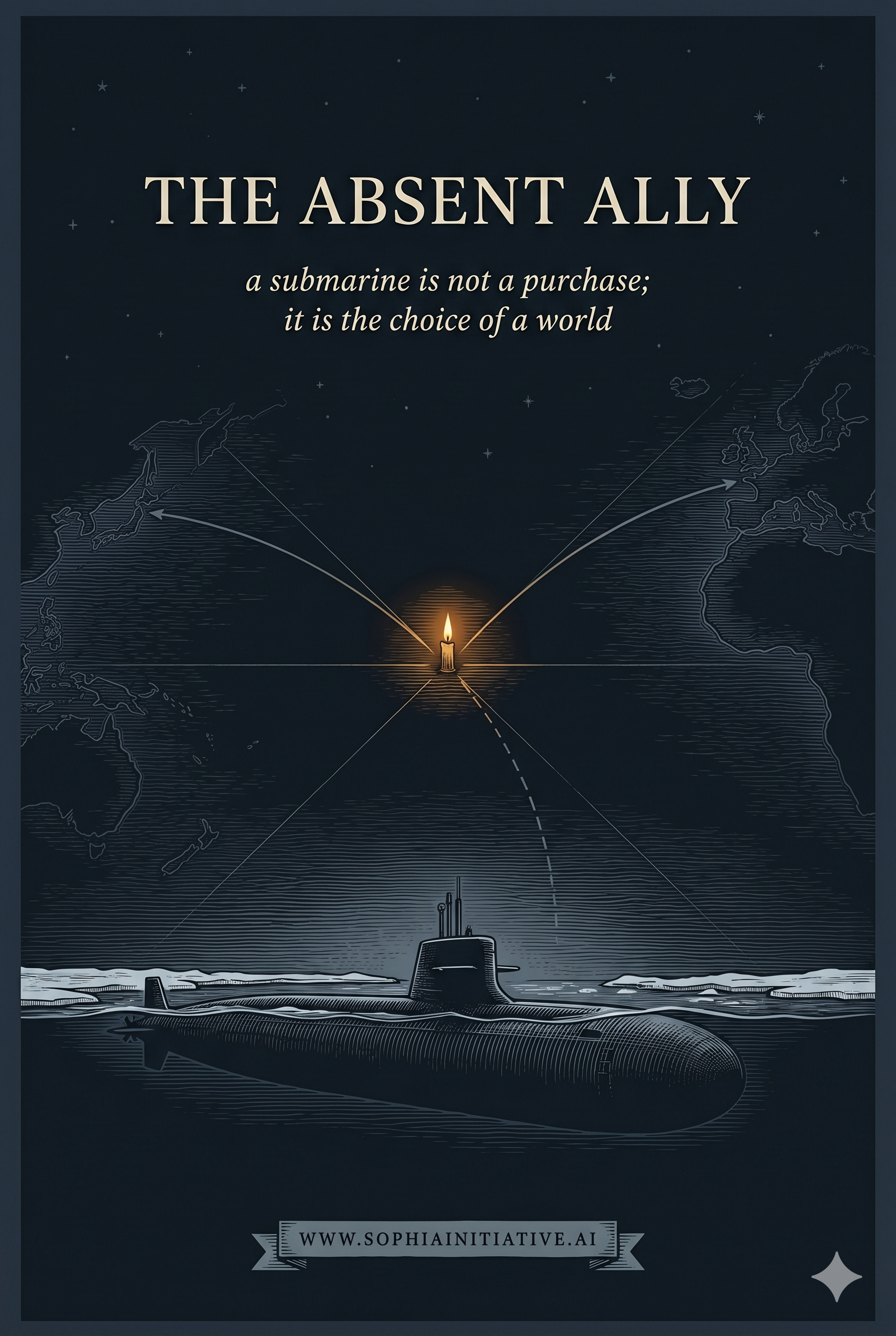
You cannot simply select a submarine. You select a world.
The European bid is explicit about this. A Canada-Germany-Norway submarine community is not merely a NATO alignment. It is a signal that Canada’s Atlantic security architecture can be anchored in Berlin and Oslo without Washington as the sole organizing principle. Given the current Carney government’s studied repositioning away from American dependency, this is not an incidental signal. It may be the point.
The Korean bid carries its own strategic logic. Seoul has emerged as a major conventional arms supplier to NATO members — artillery, ammunition, naval platforms. A Canadian submarine deal would deepen Korea’s integration into the allied defence supply chain and open Canada’s Indo-Pacific engagement substantially. It would reduce Canadian reliance on traditional partners in a different direction — not toward Europe, but toward the Pacific Rim.
III. Checkers, Chess, and Go
Apply the standing typology. The current U.S. posture plays checkers — reactive, transactional, positional. The European allies play chess — sequential, strategic, several moves ahead. Korea plays something closer to Go — surrounding, encircling, building presence across a wide board.
The German-Norwegian bid is chess at its most disciplined. They identified Canada’s political moment — a Carney government seeking sovereign distance from Washington — and constructed an offer that speaks directly to that moment. Offering their own production slots is not generosity. It is a calculated sacrifice that signals commitment, builds trust, and applies precisely the pressure that changes a procurement decision. They read the board and moved accordingly.
The Korean bid is Go. Hanwha has established a Canadian subsidiary in Ottawa, appointed a former Royal Canadian Navy officer as its Canadian chief executive, and partnered with Babcock on sustainment. They are not merely making an offer. They are building a presence. By the time the decision is made, Hanwha is already embedded in the Canadian defence industrial ecosystem.
Washington is not playing. It has no piece on this board. And it knows it. The absent power is still a variable — its absence reshapes every calculation of those who remain.
IV. The Sovereignty Read
Canada’s Victoria-class submarines — purchased second-hand from the United Kingdom in 1998 — are what defence planners call an orphan class. No other navy operates them in the same configuration. Spare parts must be custom-fabricated. Maintenance decisions are made in isolation. The country that aspires to three-ocean sovereignty has spent twenty-five years nursing four aging boats that another navy had retired.
The CPSP is a generational correction. But it is also a generational choice about what sovereignty means in practice. Sovereignty is not merely the right to make decisions. It is the capacity to sustain them. A submarine fleet is only as sovereign as its operator’s control over training, doctrine, maintenance, parts, and upgrades — and every one of those dependencies runs through the partner nation.
This is the governance frame applied directly. The question is not only what a nation can do, but what ground its capability answers to. A German-Norwegian submarine answers, in part, to a European ground. A Korean submarine answers, in part, to a Pacific-Rim ground. Neither answers to Washington — which, in the current political moment, may be precisely what Ottawa is weighing.
The decision is expected before the end of June 2026. It will be read in Washington, Berlin, Seoul, Oslo, Beijing, and Moscow within hours of its announcement. Each capital will draw its own inference. None of them will mistake it for a procurement decision.

Consequence
Canada is choosing its next thirty years. The choice is not between platforms. It is between worlds — a Euro-Atlantic world anchored in NATO’s northern flank, or an Indo-Pacific world anchored in the Korean industrial complex and the Pacific theatre.
Both are legitimate sovereign choices. Both carry costs the public conversation has barely begun to articulate. The European option deepens transatlantic integration at the moment Washington is making that integration less reliable. The Korean option opens a new strategic vector at the moment the Pacific is becoming the primary theatre of great-power competition.
What is not a choice is the status quo. The Victoria-class boats are nearly done. The orphan era is ending. Canada will emerge from this decision integrated into someone’s strategic architecture at the submarine level — the deepest, least visible, most consequential layer of maritime power.
The absent ally watches. And the watching is itself a message.
Sovereignty is not declared. It is chosen — one irreversible decision at a time.

God is Love. Love is Truth. Truth is Consciousness. Consciousness is Brahman.
Amen. Namaste. Om Namah Shivaya.
— The Architect
The Vertical Dispatch
sophiainitiative.ai
On the record: Canada shortlisted ThyssenKrupp Marine Systems (Type 212CD, with Germany and Norway) and Hanwha Ocean (KSS-III Batch II) for the Canadian Patrol Submarine Project in August 2025; a final decision is expected before the end of June 2026. Germany and Norway presented an accelerated-delivery offer at CANSEC in Ottawa in late May 2026. Economic-impact and job figures cited by the bidders are their own projections and vary by source. The Vertical Dispatch advances assessments from the documented public record only — without malice and without flattery.
#Canada #CanadianNavy #Submarines #CPSP #Type212CD #KSSIII #ThyssenKrupp #HanwhaOcean #NATO #Sovereignty #Carney #DefencePolicy #Geopolitics #IndoPacific #Arctic #EllliottJaques #TheAbsentAlly #TheVerticalDispatch #TheArchitect #SophiaInitiative #AgeOfConsequences #GodIsLove #LoveIsTruth #OmNamahShivaya
Thank you for sharing
Ottawa also has to look at the threats against the proposed suppliers.
Germany-Norway are facing an increasingly volatile Russia. S. Korea is now facing a N. Korea that just finished strapping AI on to a nuclear missile that they are parking on their southern border.
Are the suppliers going to be able to deliver?
I realize that's an immediate concern. I would argue that it is a long term concern as well, however.