

Φ
THE VERTICAL DISPATCH
We write for the mind, the eye, and the ear.
Read it. Look at it. Listen to it. The Vertical Dispatch is built for all three — prose with rhythm, made to be heard as much as read.
From metaphysics to geopolitics, from culture to history, from the sacred to the street — and everything in between. One lens, every subject. No ego. Just the record, named clean.
Press play. Walk with the word. 🕯️
This dispatch travels by hand. If it serves you, share it — restack on Substack, and pass it on wherever you read. 🕯️

THE DOOR IS OPEN
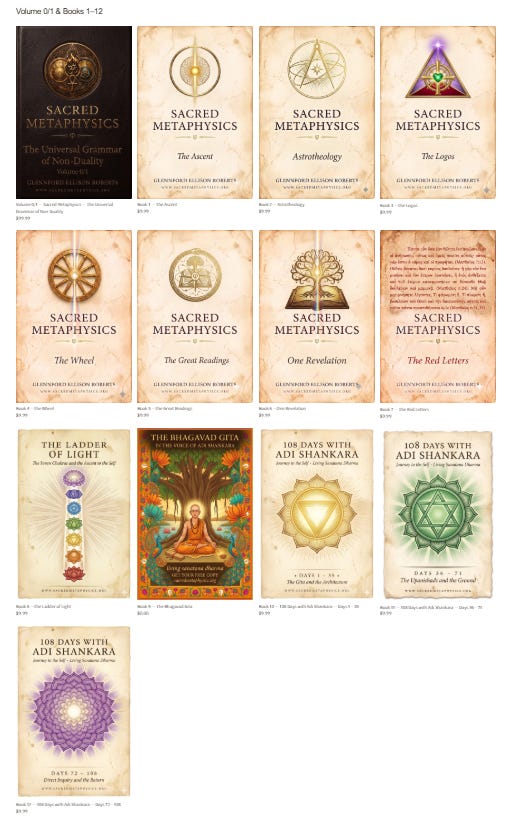
Twelve books. Two hundred and forty-four chapters. Seven hundred and seventy-eight thousand, eight hundred and twenty-seven words — and that count doesn’t even reach the thirteenth, which hasn’t been written yet. What follows is not a marketing description. It’s an honest map of what’s actually inside each of these books, so that you can find the door that’s yours.
Sacred Metaphysics
The Universal Grammar of Non-Duality — The Metaphysics of ZERO and the Physics of ONE
Every language has a grammar — a small set of rules underneath an infinite number of sentences. Sacred Metaphysics claims reality has one too, and that non-duality is its name.
Start at ZERO. Before subject and object, before self and world, before even the first distinction, there is the unmanifest fullness the traditions have called by many names — Brahman, the Godhead, the Tao. Not nothing. The fullness prior to form. That is the metaphysics of ZERO.
Then comes ONE. The instant the ZERO moves — the instant it becomes a source of something — the world of form begins: the first “I am,” the first distinction, the first physics. Everything after that step is the physics of ONE: cause and effect, self and other, the entire visible universe of things in relation. Non-duality does not deny the physics of ONE. It denies that the ONE ever separated from the ZERO it rose out of. The wave was never apart from the ocean.
Truth has its own logic, and the history of philosophy — East and West alike — keeps arriving at the same requirement: to be truth at all, and not mere opinion, truth must be absolute, objective, and eternal. Not absolute because we insist on it, but because a truth that changes with the age or the observer was never truth to begin with, only a passing agreement. That absolute — Satyam Shivam Sundaram (सत्यं शिवं सुन्दरम्), the True, the Good, the Beautiful — is what the ZERO holds, whole and undivided. The ONE is its copy: a form, and every form is a copy, measured not by what it is in itself but by how far it falls short of the original it copies. This is why the relative is relative, why the subjective is subjective, why the temporal passes — not because reality is unstable at its root, but because a copy is, by its nature, a deficient thing, judged against an eternal it was never going to equal.
This is where the ego enters, and where the danger Jung spent a lifetime naming begins. The ego is the physics of ONE mistaking itself for the whole of reality — the wave convinced it is not water. And Maslow showed us we are born straight into it: the whole climb of human need, from survival to esteem, is a ladder built inside the ONE, a self trying to secure itself against a world it believes stands apart from it. That is not a flaw. It is the necessary first half of the grammar. But a life spent entirely there, that never asks what the ONE rose out of, has read half a sentence and mistaken it for the whole book.
The turn is the question Ramana Maharshi asked, and the question the thirteenth book of this canon will be built around: Who is asking? Not who you are named, or employed, or afraid, or proud to be — who is asking the question at all? Follow the “I” far enough back and it turns out to be the ZERO, wearing the mask of the ONE. That is the turn to the eternal, to the Good — and it is the one turn that is not first a turn away from the world, but a turn into what the world was standing on the whole time.
This is why Sacred Metaphysics changes a life before it changes anything else. Turn one person past the ego and toward the eternal, and you have changed a life. Enough changed lives change a family, a town, a nation. There is no other route to a changed world. The world does not turn until the people in it do — one “who is asking” at a time.
Om Namah Shivaya.
The Shape of the Canon
The twelve books split into two halves, and the split isn’t arbitrary — it’s the whole method.
Seven books make up the Western Canon. These are the books that state the argument directly: the structure underneath all things, named plainly, then found again and again in every field of human knowledge, then walked back through the scriptures of the West — the Hebrew Bible, the words of Jesus — to show that the same structure was there all along, half-forgotten under centuries of literal reading.
Five books make up the Eastern Canon. These don’t argue the structure — they walk it. The body, the breath, the Gita itself in the voice of the man who has taught it longest, and finally the hundred and eight days that carry a reader the whole distance, from the first collapse on the battlefield to the door that was never closed.
Read in either order. But know that they’re reading the same country from two sides of the world, and confirming each other the whole way.
The Western Canon
Book One — The Ascent — The ascent to our eternal life
This is the last book chronologically in how it was conceived, but it opens the canon because it names the reason all the others exist. Every other book in this series is a base camp — a place to rest and gain the altitude the next stretch demands. This book is the last leg: the direct, unflinching approach to death, which the modern world will discuss in every language except the one that matters. It doesn’t sell you an afterlife. It holds the question at fifty-fifty, the way it holds the name of God, and shows that the great traditions are most trustworthy exactly where they claim the least. The wager it lays out cannot lose: live toward the eternal, and even if there is nothing after, you will have lived a good and true and beautiful life. If there is something after, you arrive having already begun the climb.
Book Two — Astrotheology — Written in the Stars
Before anyone could write, everyone read the sky. This book recovers that reading — not fortune-telling, but the oldest scripture there is, the wheel of the twelve turning through the ages. It’s placed early in the canon on purpose: the sky is the frame everything else sits inside. Once you’ve read the great wheel here, the Hebrew scriptures — Eden as the golden age, the flood as the waters, the calf and the ram as one age turning into the next — open on their own. It’s also the first place a reader meets the canon’s rule of type: the casing of the letters carries the metaphysics itself — lowercase for the manifest, capitals for the transcendent, full capitals for the ZERO and the SELF, the source and the summit of everything.
Book Three — The Logos — Universal Dynamics
The shortest book in the canon, and the spine of all the others. It states one argument, plainly, without story or ornament, and climbs it to the end: that all knowledge is contained in a single concept, and every concept carries three properties — conceptual, functional, physical — and that this triad is the Logos itself, the ordering reason the Greeks first heard and named, running through the sentence and the atom, the soul and its ascent. Read it as a ladder, in order, rung by rung. Everything else in the canon is this same structure given flesh, narrative, song, and scripture.
Book Four — The Wheel of the Domains — Universal Dynamics
The companion to The Logos, and best read after it. Where that book stated the structure once, this one shows it everywhere — walking field after field of human knowledge (physics, biology, the divided brain, language, alchemy, psychology, history, love, philosophy) and finding the same triad standing in each, named by the two thinkers who saw furthest into it. Twelve domains on the rim of a wheel, and at the hub, the thirteenth: not a field but the single discovery every field was turning around and mostly forgot. Different maps, drawn by hands that never met, all showing the same country.
Book Five — Universal Readings — The Great Stories
Every people that ever lived told a story about a soul that left home, crossed a great danger, and came back changed. This book gathers those stories — Gilgamesh, the Odyssey, the Descent of Inanna, Osiris, Quetzalcoatl, the Conference of the Birds, and more — from continents and centuries that never touched each other, and reads each one the same way: through the surface to what it was always pointing at. The test for admission is narrow and has nothing to do with fame or age: does the story end with the seeker discovering he was the sought? The first five stories climb the old ladder of the elements — earth, water, fire, air, ether — to teach the reading. What follows isn’t a second ladder. It’s the whole earth, and the proof becomes overwhelming precisely because none of these tellings could have copied each other.
Book Six — The One Revelation — The Bible and the Vedic Mirror
We weren’t cast out of a garden in the East — we were cast out of a way of seeing. This book restores the lost art of reading a symbol straight through to what it names, and does it with the oldest book of symbols the West has: the Hebrew scriptures. The garden, the flood, the tower, the ladder, the burning bush — read not as a chronicle to defend or dismiss, but as the soul’s own story in the oldest signs there are. Beside each reading stands the Vedic mirror, confirming from the other side of the world that what’s being pointed at is one, and real, and belongs to no single people.
Book Seven — The Church and the Red Letters — The Words of Jesus, and the Un-Veiling
Before the languages and the councils, before the Sermon and the Turn, this book asks you to hold one small story: the prodigal son. A son who took his portion, wasted it, and came home rehearsing a servant’s speech — only to find his father already running down the road to meet him, before the confession was even finished. That is the whole book, told before the book begins: the son was always the son, the greatness was never far off, and the seeker and the sought are not, in the end, two. From there the book walks the actual history — how the voice became an empire, how a council fixed a word, how the house became houses — toward the un-veiling in Jesus’s own words.
The Eastern Canon
The Ladder of Light — The Seven Chakras and the Ascent to the Self
Not a book to read start to finish in one sitting — a map that only proves itself walked. Seven centers, root to crown, each a precise teaching in how consciousness narrows into matter on the way down and remembers itself on the way back up. No wellness-chart softening here: the descent, the coiled serpent of kundalini, and the caduceus that has carried this same knowledge half-forgotten into the West are all given their full weight. Read a section, close your eyes, and let your own body do the confirming.
The Bhagavad Gita — In the Voice of Adi Shankara — Living Sanatana Dharma
The complete eighteen chapters, all seven hundred verses, given directly — no commentary standing between the reader and Krishna’s voice. But spoken as if Shankara himself is handing it to you, one chapter a week for eighteen weeks, because a chapter read once is information and a chapter carried for seven days begins to read you back. The battlefield, he tells you before you begin, was never in the past and never outside you — dharmakshetra is the field of your own body and mind, right now. Three movements of six: action, devotion, knowledge. One song. And at the end, a door to the longer walk waiting for anyone whose appetite has grown rather than been satisfied.
108 Days with Adi Shankara — Three volumes: Days 1–35, Days 36–71, Days 72–108
The longer walk itself. A hundred and eight days, one at a time, because this book was built to be walked, not read in a sitting — bound as one volume it would ask more weight than a book like this should ask of anyone.
Volume One (Days 1–35, The Gita and the Architecture) is the door: the Gita again, more slowly, and the opening days of the Brahma Sutras.
Volume Two (Days 36–71, The Upanishads and the Ground) is the deep water: the Upanishads themselves, the ground everything else stands on.
Volume Three (Days 72–108, Direct Inquiry and the Return) closes the walk — the rest of the Upanishads, then Shankara’s own independent works in his own first-person voice (the Vivekachudamani, the Atma Bodha, the Tattva Bodha), his devotional hymns, the lineage that carried the teaching forward through Gaudapada and the four Maths — the four monasteries Shankara himself founded at India’s four cardinal points, Sringeri, Dwarka, Puri, and Jyotirmath, so the teaching would survive him — and into living memory with Ramana Maharshi and Anandamayi Ma, and finally the two closing days that gather everything the hundred and eight days have carried.
Each volume is fully illustrated, chapter by chapter, in the same devotional plate style throughout — and each carries the same search, read-aloud, and note-taking tools as the rest of the interactive editions, so all three volumes can be loaded together in one browser tab and searched as a single walk.
Book Thirteen
Still ahead. The working name is Who Is Asking? The Most Important Question Ever Asked, grounded in Ramana Maharshi’s own practice of self-inquiry. No manuscript yet — the twelve above are the whole store for now, and the thirteenth will complete the canon when it’s ready.
How to Get Them
The Bhagavad Gita is free, in full — the one open door into the canon, no account, no catch. Every other book is $9.99 on its own. The complete set — all twelve, with the thirteenth added the day it’s finished — is $99.99. And for anyone who wants to walk the whole canon as it’s being read and discussed, a year’s subscription on Substack is $80.00.
Four ways in. One canon.
The store is open. Come in.
A Preview of Book Thirteen
Sacred Metaphysics — The Universal Grammar of Non-Duality · Volume 0/1
WHO IS ASKING?
The Most Important Question Ever Asked

God is Love. Love is Truth. Truth is Consciousness. Consciousness is Brahman.
Amen. Namaste. Om Namah Shivaya.
— The Architect.
Written from love, for a sacred humanity, in the full light of consciousness, toward the greater good. 🕯️
The Vertical Dispatch
sophiainitiative.ai
On the Record
All figures in this piece — book count, chapter count, total word count, chapter/day structure of each volume, and pricing — are the publisher’s own figures for the Sacred Metaphysics canon and Universal Dynamics Publishing store, current as of publication date. They are self-reported catalog data, not third-party-audited claims.
Dharmakshetra kurukshetra — “the field of dharma, the field of the Kurus” — is the opening phrase of the Bhagavad Gita, Chapter 1, Verse 1.
Satyam Shivam Sundaram (सत्यं शिवं सुन्दरम्) is a classical Sanskrit formulation, rendered variously as “Truth, Goodness/Auspiciousness, Beauty” across Vedantic commentary.
Bhagavan Sri Ramana Maharshi’s self-inquiry experience — 1896, at age sixteen, at his uncle’s house in Madurai; the spontaneous inquiry “who is the seer,” and the dissolution of identity that followed — is documented in primary biographical sources, including David Godman’s “An Introduction to Sri Ramana’s Life and Teachings” (davidgodman.org).
The distinction between the pleasant and the good (preyas and shreyas) is Katha Upanishad 1.2.1–1.2.2, in the dialogue of Nachiketa and Yama.
“The triple gate of hell” — desire (kama), anger (krodha), and greed (lobha) — is Bhagavad Gita, Chapter 16, Verse 21.
“Wide is the gate, and broad is the way, that leadeth to destruction... strait is the gate, and narrow is the way, which leadeth unto life” is Matthew 7:13–14, King James Version.
“Whosoever will save his life shall lose it: and whosoever will lose his life... shall find it” is Matthew 16:25, King James Version, with parallel sayings at Mark 8:35 and Luke 9:24.
Verify against primary sources before republication. Walk with the word.
Suggested Tags
Sacred Metaphysics, The Store Is Open, Universal Dynamics Publishing, Non-Duality, The Logos, The Bhagavad Gita, 108 Days with Adi Shankara, The Ladder of Light, Astrotheology, Universal Readings, Who Is Asking, Atma-Vichara, Ramana Maharshi, Ahamkara, Self-Inquiry.
Substack Notes
Twelve books. Two hundred and forty-four chapters. Seven hundred and seventy-eight thousand, eight hundred and twenty-seven words. The Sacred Metaphysics canon is open for the first time as a complete store — and this dispatch is the honest map of what’s actually inside each door, not a sales pitch.
The shape of it is the whole method: seven books making up a Western Canon that states the argument directly — one structure, found again in every field of knowledge, then walked back through the Hebrew scriptures and the words of Jesus — and five books making up an Eastern Canon that doesn’t argue the structure but walks it, body and breath and the Gita itself, all the way to the hundred and eight days that carry a reader from the first collapse on the battlefield to the door that was never closed.
The Gita is free, in full, no account and no catch — the one open door into the whole canon. Everything else is $9.99 a book, $99.99 for the complete set with the thirteenth added the day it’s finished, or $80 a year to walk it on Substack as it’s read and discussed.
And below the catalog itself, a preview of the thirteenth book, not yet written: Who Is Asking? — the question every one of the other twelve, East and West, was already speaking in its own tongue.
Written from love, in service of the record. Walk with the word. 🕯️
#TheVerticalDispatch #TheArchitect #SophiaInitiative #SacredMetaphysics #UniversalDynamicsPublishing #TheStoreIsOpen #WhoIsAsking #AtmaVichara #RamanaMaharshi #Nonduality #GodIsLove #LoveIsTruth #OmNamahShivaya
Factual matter in this Dispatch is drawn from the publisher’s own record and sourced above. All characterizations are the author’s own interpretation and commentary. Readers are encouraged to verify all claims independently and to evaluate the argument on its own merits.