

Φ
THE VERTICAL DISPATCH
We write for the mind, the eye, and the ear.
Read it. Look at it. Listen to it. The Vertical Dispatch is built for all three — prose with rhythm, made to be heard as much as read.
From metaphysics to geopolitics, from culture to history, from the sacred to the street — and everything in between. One lens, every subject. No ego. Just the record, named clean.
Press play. Walk with the word. 🕯️
This dispatch travels by hand. If it serves you, share it — restack on Substack, and pass it on wherever you read. 🕯️
The Age of Consequences · Media Criticism · Building Canada Strong
June 15, 2026 — day one at Évian, filed in the evening. Volatile facts date-stamped as of this hour.
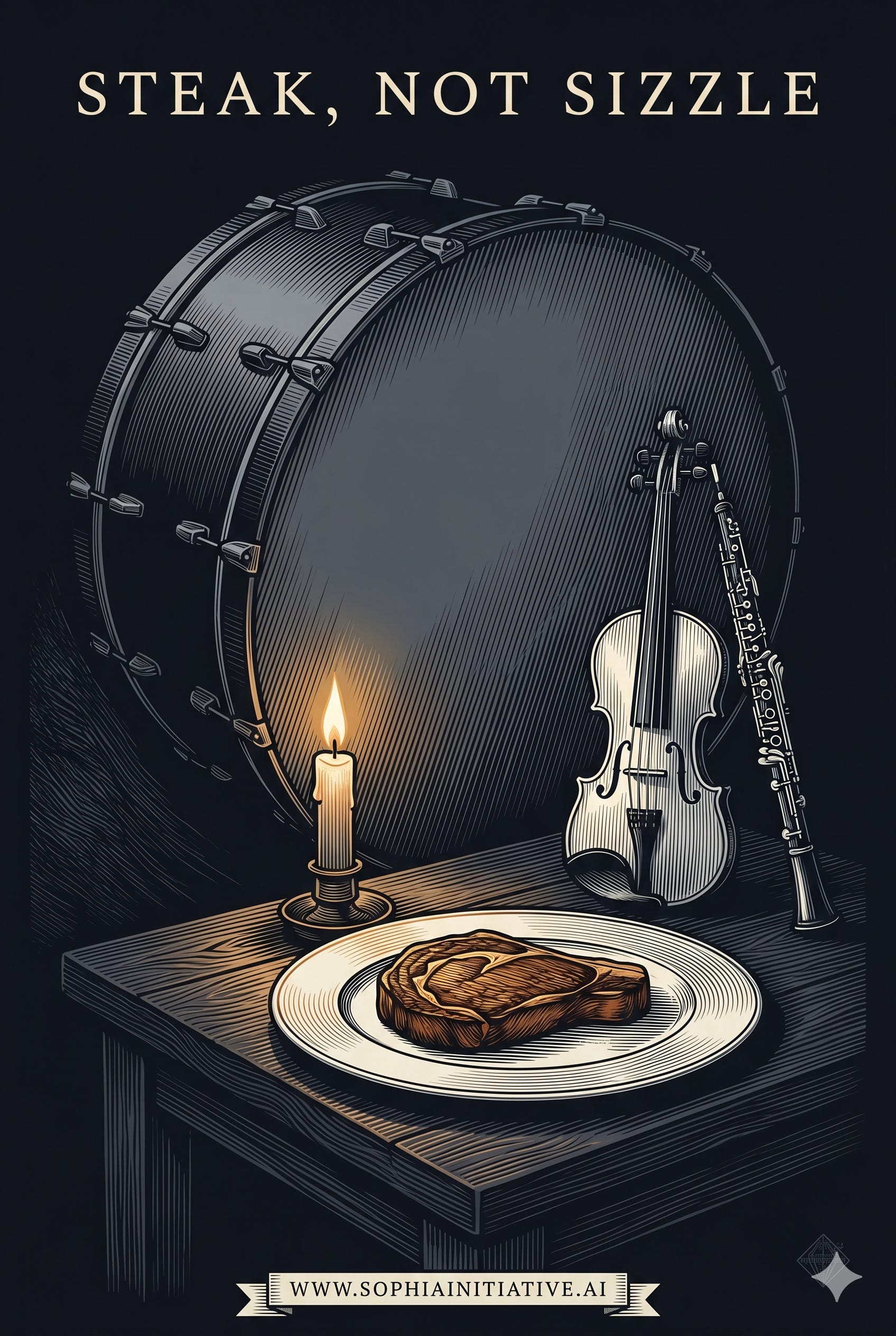
Sit at the table for the whole meal, because the first day of a G7 is a banquet, and the trained palate does not fill up on the appetizer the waiter pushes hardest. There is sizzle on every menu — the loud arrival, the camera scrum, the four-word social-media boast — and there is steak, the substance a country actually came to eat. The Canadian feed today, in the main, served the sizzle: the American president stepping onto the tarmac, the spectacle, the question shouted across a rope line. This dispatch is here for the steak. And the steak today was Canadian, sourced, signed, and almost entirely missed in the noise of the room next door.
We came for the violins and the oboes. The drum is only the loudest thing in the room — it is not the melody.
So a word on method before the courses, because it governs the whole meal. This publication does not read the loudest voice as the most important one — it reads the gap between what a voice says and what its hand actually does, and it lets the volume be a finding rather than a verdict. There is one instrument in that room playing fortissimo over everyone, every year, by design. We will name it for what it is on the page — the loudest instrument — and then we will do the thing a listener who came for the music does: turn the ear past the percussion, toward the strings and the reeds carrying the actual line. No claim is made here about any leader’s inner state. The claim is about the score, and who is playing the melody when you stop letting the drum set the volume of your attention.
First Course — The Steak: A Canadian Contract the World Will Notice
Begin where the Canadian feed should have begun. Today at Évian, before he sat down with the two presidents of the European Union, Prime Minister Carney announced that a Montreal firm, Marconi Technologies, had won a contract worth more than ten million dollars to supply Canadian-made tactical radios to Poland’s military, partnering with the Polish company Enamor International, with deliveries running from this year through 2030. It is the first contract any Canadian company has landed under SAFE — the European Union’s 150-billion-euro defence-procurement instrument, the one Canada became the only non-European country to join. Carney named it for exactly what it is: the first concrete example, he said, and there will be many more.
Hold that against what this publication built only this morning. The argument of “The Standing Appointment” was that Carney and the EU’s two-headed leadership keep a standing meeting, and that every time the chairs are filled, a piece of machinery advances. Here is the machinery advancing, on the record, within hours: the trio met, and the first SAFE contract in Canadian history was announced in the same breath. This is not a photograph of a handshake. It is the handshake producing a deliverable — a Canadian factory, a Canadian export, a European ally supplied, all flowing through the architecture Canada joined precisely to reduce its dependence on a single neighbour. That is the steak. It is small in dollars and enormous in vector: it proves the door the trio built actually opens, and that Canadian goods walk through it. The feed that led with the tarmac gave the country the noise and skipped the thing the noise was standing in front of.
Second Course — The Strings: Europe Plays the Melody
Now turn the ear to the European players, because the substantive line of the day was carried by them, and the big European press reported it as substance rather than spectacle. France’s Macron, hosting his final G7 before leaving office, did not merely react to the Iran announcement — he attached a deployable instrument to it. France and Britain, he said, are ready to lead a defensive maritime mission to reopen the Strait of Hormuz; the Charles de Gaulle aircraft carrier and everything around it can be in position within two or three days of the agreement holding, with Italy, the Netherlands and others prepared to send frigates and mine-clearance vessels. Whatever one makes of the politics, note the shape of the statement: a named asset, a named timeline, a named coalition. That is a string section playing an actual line — a claim bound to a referent you can check against a carrier’s sailing date.
Beside him, the Commission president carried the energy theme with the same discipline. The lesson of this war, von der Leyen told the European press, is that energy dependencies have been weaponised; Europe must diversify its supply routes and build alternative corridors away from the bottleneck of Hormuz, and that conversation belongs at Évian. On the Iran sanctions question she set a conditional that is the opposite of a boast: if behaviour changes credibly and verifiably, sanctions can be lifted — and, she added, the reverse is equally true. These are oboes and violins: quieter than the percussion, carrying the melody. And underneath them runs the deeper European theme the wire services flagged for those still listening — the widening rift over artificial-intelligence sovereignty, von der Leyen’s warning that Europe cannot depend on others for the technologies that run its hospitals and grids, the same sovereignty note this publication graded in its education coverage, now sounding at the summit table.
A named asset, a named timeline, a named coalition. That is a string section playing an actual line — a claim you can check against a carrier’s sailing date.
Third Course — The Drum: The Loudest Instrument in the Room
And now the percussion, named on the page for precisely what the record shows it to be: the loudest instrument at the table. The American president arrived having announced, the night before, that his Iran deal was complete, and spent the day touting it and signalling he would turn next to ending the wars in Ukraine and Lebanon. The volume was total; the verifiable content lagged behind it. He said the memorandum had already been signed but could not say when its text would be released; the formal signing was variously reported as already done and as set for later in the week in Switzerland; the Strait, he said, would be “completely opened” on a day named as Friday. Around the boast, the substance the European press recorded was the unease it generated — fresh tariff threats aimed at the host nation, France, and the standing fear that the loudest guest might, as he did at last year’s summit in Canada, leave before the music ended; the host has reportedly arranged a Versailles gala to keep him in his seat.
The discipline of this house forbids the easy line — that the words mean nothing, that the man knows they are empty. We cannot read that, and we do not try. What we can do is measure the gap, and the gap today was wide: the loudest announcement in the room was also the one whose text no one could produce, whose signing date no one could fix, whose terms remained, in the reporting, undisclosed. That is not a verdict on a soul. It is a reading of a score. The drum was the loudest thing at Évian, and the loudest thing at Évian was not, on today’s evidence, the thing carrying the most verifiable substance. A listener is free to be thrilled by the percussion. A listener who came for the music keeps one ear on the strings, where the melody was actually being played — and where, today, a Canadian contract and a European naval timeline were quietly, checkably, real.
Fourth Course — The Feed That Sold the Sizzle
Which returns us to the lesson under the meal, the same one this publication named in “The Mark of the X.” The facts of this day were available to every outlet equally. The Canadian broadcaster reported the summit, the arrival, the Iran announcement, all of it accurately. What it largely did not do — what the European wires did by instinct — was lead with the steak: a Canadian firm’s first contract under a European defence pact, announced by the Canadian Prime Minister, on a European stage, as the founding proof of a strategy to rebuild the country’s place in the world. The meaning of a Canadian win at the G7 was, once again, easier to read off Reuters and the Irish Times and the European Council’s own readout than off the national feed, which gave the country the loud arrival and let the quiet contract pass. It is the vectorlessness this house keeps naming: the facts delivered without the through-line that makes them matter, the sizzle plated and the steak left in the kitchen.
This is not a complaint about effort or a charge of malice. It is a description of a habit — the reflex to cover the loudest instrument because it is the loudest, and to mistake volume for significance. A country that learns its news this way learns to hear only the drum. It will know, tonight, that the American president made noise at Évian. It is less likely to know that its own Prime Minister shipped the first Canadian goods through the door he spent a year building — which is the larger fact, the one with a future attached, the steak the feed forgot to serve. And the cost is not abstract: a nation that cannot hear its own victories cannot build on them.
The Open Question
So the question goes to the reader, not settled here. In a room with one drummer and a full orchestra, which sound is a nation’s press training its citizens to hear — and what does a people lose when it learns to listen only for the loudest instrument? The percussion will always be loudest; that is what percussion is for. The melody will always be quieter; that is what a melody is. A free citizen’s ear is not the one that hears the drum — everyone hears the drum. It is the one that can still find the violins underneath, where the actual score is being played: a contract signed, a carrier ready to sail, a sovereignty being built one quiet, checkable deliverable at a time. The deal may sign Friday or it may not; that is the sizzle, and it will age by the weekend. The steak — the first Canadian contract through the European door — is already on the plate, and it will still be there when the noise has gone quiet. We came for the violins and the oboes. We always will.


God is Love. Love is Truth. Truth is Consciousness. Consciousness is Brahman.
Amen. Namaste. Om Namah Shivaya.
— The Architect.
The Vertical Dispatch
sophiainitiative.ai
On the record. The 52nd G7 Leaders’ Summit opened June 15, 2026 at Évian-les-Bains, France (June 15–17), hosted by President Emmanuel Macron, with Geneva as the arrival gateway, per the European Council (Consilium), the Élysée, and Reuters. The Marconi Technologies contract — Montreal-based firm, more than $10 million, Canadian-made tactical radios to Poland’s military, partnered with Enamor International, deliveries 2026 through 2030, the first Canadian contract under SAFE — and Carney’s remark (“the first concrete example… there will be many more”) per the Office of the Prime Minister via CBC News / The Canadian Press, BNN Bloomberg, and Castanet; announced before Carney’s meeting with European Commission President Ursula von der Leyen and European Council President António Costa. SAFE: the EU’s €150-billion (~$174B CAD) defence-procurement instrument, Canada the only non-European member, European Parliament consent May 2026, per Consilium and the European Parliament; the next Canada–EU Summit is reported for Canada at the end of October 2026. Von der Leyen’s remarks on “never been closer,” a digital trade agreement, and critical raw materials, and Costa’s “closer with every visit,” per The Canadian Press. Macron’s Strait of Hormuz statement (France and Britain ready to lead a defensive maritime mission; the Charles de Gaulle deployable “within two or three days” of the agreement holding; Italy, the Netherlands and others to contribute) per The National, Le Figaro, TF1, and CBS News. Von der Leyen on energy diversification away from the Hormuz “bottleneck” per The Irish Times; her sanctions conditional (“if behavior is changing credibly and verifiably… the other way around is also true”) per Euronews; her AI/tech-sovereignty remarks per TechPolicy.Press. U.S. President Trump’s Iran-deal claims, the unresolved signing status and timing, the reported Friday Strait reopening, the tariff threats toward France, and the Versailles gala per Reuters, The Times of Israel, CBS News, and The National; the U.S.-Iran deal’s signed status was being reported as it developed through the evening of June 15 and remains volatile. No assertion is made regarding the private intentions, sincerity, or state of mind of any leader or editor; this dispatch reads documented statements, documented deeds, and the framing choices of the named outlets. The musical and culinary figures are interpretation. Volatile facts date-stamped June 15, 2026, evening. Errors and omissions excepted; verify against primary sources before republication.
Suggested tags: G7, Évian, Mark Carney, SAFE, Marconi Technologies, Canada defence, European Union, von der Leyen, Costa, Macron, Strait of Hormuz, Iran deal, media criticism, the Canadian press, steak not sizzle, symbol and referent, AI sovereignty, The Standing Appointment, Building Canada Strong, The Age of Consequences, AIG
Substack Notes
The first day of a G7 is a banquet, and the trained palate does not fill up on the appetizer the waiter pushes hardest. Today at Évian, the Canadian feed served the sizzle — the loud American arrival, the camera scrum, the four-word boast. The steak went almost unserved: before Carney sat down with the EU’s two presidents, he announced the first Canadian contract ever signed under SAFE — a Montreal firm, Marconi, supplying more than $10 million in Canadian-made tactical radios to Poland’s military through the European defence door Canada joined to reduce its reliance on one neighbour. “The first concrete example,” Carney said. “There will be many more.”
This dispatch reads the day as an orchestra. There is one instrument that plays fortissimo over everyone every year by design — the loudest is not the melody. So we turn the ear past the percussion to the strings: Macron attaching a named asset and a two-or-three-day timeline to a Hormuz naval mission; von der Leyen on diversifying energy away from the bottleneck, on sanctions that lift only if behaviour changes “credibly and verifiably,” on Europe’s tech sovereignty. Claims bound to referents you can check. We name the drum as the drum — the announced-but-unsigned deal, the undisclosed text, the tariff threats — by measuring the gap between word and deed, never by reading a mind.
And the lesson under the meal is the one this house keeps naming: the meaning of a Canadian win at the G7 was easier to read off the European wires than off the national feed. A country that learns its news by always covering the loudest instrument learns to hear only the drum. The steak — the first Canadian contract through the European door — is already on the plate, and it will still be there when the noise has gone quiet. We came for the violins and the oboes. We always will. Walk with the word. 🕯️
Written from love, in service of the record. Walk with the word. 🕯️
#SteakNotSizzle #G7 #Evian #Carney #SAFE #Marconi #CanadaDefence #EuropeanUnion #VonDerLeyen #Costa #Macron #StraitOfHormuz #IranDeal #MediaCriticism #TheCanadianPress #SymbolAndReferent #AISovereignty #TheStandingAppointment #TheMarkOfTheX #BuildingCanadaStrong #TheAgeOfConsequences #AIG #TheVerticalDispatch #TheArchitect #SophiaInitiative #GodIsLove #LoveIsTruth #OmNamahShivaya
The factual matter in this Dispatch is drawn from the public record. All characterizations, inferences, and conclusions are opinion, interpretation, and commentary, offered for analysis, reflection, and public-interest discussion. No assertion is made regarding the private intentions, state of mind, or character of any individual. Readers should evaluate all statements independently and draw their own conclusions.
It is not only trade and defence that Canada needs to move from a single source on. Our media needs to become Our Media, presenting us, to us, in full, with analysis, none of which is focused on the American word first.
Another illuminating piece, written with style. Thank you.